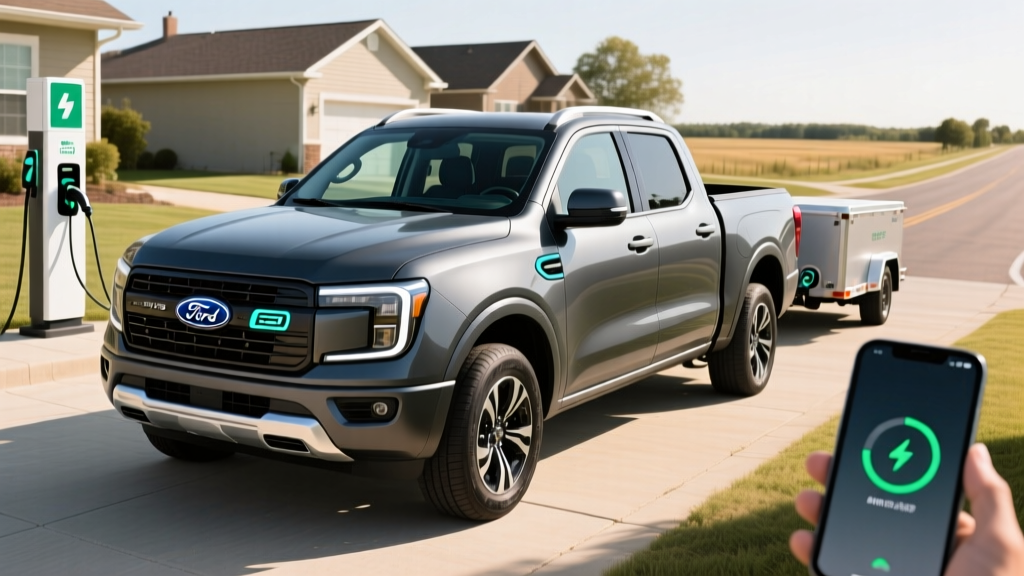
The compact truck segment has exploded, but the Ford Maverick Hybrid remains the only one offering a standard hybrid powertrain at a sub-$28,000 starting price. For 2026, Ford has expanded all-wheel-drive availability across the hybrid lineup and refined the 2.5-liter Atkinson-cycle powertrain that made this truck a runaway hit. If you need a truck bed but refuse to pay the fuel penalty of a body-on-frame pickup, the Maverick Hybrid is the most compelling answer on the market.
This guide covers everything a buyer needs: exact EPA fuel economy, real-world MPG data, powertrain specs, pricing by trim, tax-credit eligibility, battery warranty details, and a clear framework for deciding whether the Maverick Hybrid, a full EV truck, or a conventional gas pickup is right for your situation.
2026 Ford Maverick Hybrid Powertrain and Specs
The Maverick Hybrid pairs a 2.5-liter four-cylinder Atkinson-cycle engine with an electric motor integrated into Ford's eCVT (electronically controlled continuously variable transmission). This is a conventional hybrid (HEV) — not a plug-in. The battery recharges through regenerative braking and the gasoline engine. You never plug it in.
| Specification | Value |
|---|---|
| Engine | 2.5L 4-cyl Atkinson-cycle |
| Combined Horsepower | 194 hp |
| Transmission | eCVT (power-split hybrid) |
| Drivetrain (FWD) | Front-wheel drive (standard) |
| Drivetrain (AWD) | All-wheel drive (available) |
| Hybrid Battery | ~1.1 kWh lithium-ion (self-charging) |
| Towing Capacity (max) | 2,000 lbs |
| Payload Capacity (max) | 1,500 lbs |
| Bed Length | 4.5 ft (54.4 cu ft volume) |
| 0–60 mph | ~7.7 sec (FWD) |
The 194 combined horsepower figure represents peak system output when the engine and electric motor work together. The electric motor alone produces roughly 131 hp and 155 lb-ft of torque, which is why the Maverick Hybrid pulls away from stoplights on electric power in most city driving. The gasoline engine kicks in seamlessly for highway merging and sustained speeds.
For 2026, the AWD hybrid variant uses a rear-mounted electric motor to drive the rear wheels, rather than a mechanical driveshaft. This is a key distinction from conventional AWD systems — it's lighter, has fewer moving parts, and enables the rear motor to contribute to regenerative braking.
Fuel Economy: EPA Ratings and Real-World MPG
| Configuration | City MPG | Highway MPG | Combined MPG |
|---|---|---|---|
| FWD | 42 | 33 | 37 |
| AWD | 38 | 31 | 34 |
These figures come directly from fueleconomy.gov, the EPA's official database. The Maverick Hybrid FWD's 42 MPG city rating is exceptional for any vehicle, let alone a pickup truck with a usable bed.
Real-World MPG: What Owners Actually See
Hybrid powertrains behave differently from conventional gas cars. The Maverick Hybrid frequently exceeds its EPA city rating in stop-and-go traffic because regenerative braking recaptures energy that would otherwise be wasted. Many owners report 44–46 MPG in urban commuting during moderate temperatures.
However, highway fuel economy tends to fall below the EPA estimate. At sustained 75–80 mph speeds, expect 29–31 MPG in the FWD model. The boxy truck shape creates more aerodynamic drag than a sedan, and the hybrid system offers less benefit at constant highway speeds where regenerative braking is minimal.
Cold weather reduces fuel economy by roughly 8–12% in the Maverick Hybrid. The engine runs more frequently to provide cabin heat (there's no electric resistance heater large enough for a truck cabin in extreme cold), and the battery's charge/discharge efficiency drops in freezing temperatures. Expect 36–38 MPG combined in winter conditions for the FWD model.
HEV vs. PHEV vs. Full EV: Which Truck Fits You?
The Maverick Hybrid is a conventional hybrid (HEV). Ford does not currently offer a plug-in hybrid (PHEV) Maverick, and the fully electric Ford F-150 Lightning occupies a different size and price class. Here's how to decide which electrified truck approach matches your lifestyle:
| Factor | Maverick Hybrid (HEV) | PHEV Truck (e.g., upcoming options) | Full EV Truck (e.g., F-150 Lightning) |
|---|---|---|---|
| Plug-in Required? | No — self-charging | Yes — for EV range benefit | Yes — mandatory |
| Electric-Only Range | ~1–2 mi at low speed | 25–40 mi typical | 230–320 mi (full battery) |
| Home Charging Needed? | No | Recommended (Level 2) | Essential (Level 2 minimum) |
| Fuel Cost per Mile | ~$0.09 (at $3.30/gal) | ~$0.04–0.09 mixed | ~$0.04–0.06 (home charging) |
| Base Price Range | $27,995–$35,000 | $45,000–$60,000 | $52,000–$90,000+ |
| Federal Tax Credit | None | Up to $7,500 (if eligible) | Up to $7,500 (if eligible) |
| Best For | No home charging, budget-first, city commuting | Short commutes + occasional long trips | Home charging access, max savings, heavy towing |
Choose a full EV truck if: You can install a Level 2 home charger, your daily commute is under 200 miles round-trip, you want the lowest per-mile operating cost, and you're willing to pay more upfront.
Pricing by Trim and Tax Credit Eligibility
The 2026 Ford Maverick Hybrid is available across multiple trim levels. Pricing reflects MSRP before destination charges:
| Trim | MSRP (FWD) | MSRP (AWD) |
|---|---|---|
| XL Hybrid | $27,995 | $29,495 |
| XLT Hybrid | $29,995 | $31,495 |
| Lariat Hybrid | $34,095 | $35,595 |
| Tremor Hybrid | — | $38,995 |
| Lobo Hybrid | $35,495 | — |
Federal Tax Credit: Does the Maverick Hybrid Qualify?
No. The Maverick Hybrid is a conventional hybrid (HEV), and the IRS §30D Clean Vehicle Credit applies only to plug-in electric vehicles (BEVs and PHEVs) with battery capacities of at least 7 kWh. The Maverick's ~1.1 kWh hybrid battery does not meet this threshold.
According to IRS guidelines, the §30D credit requires a vehicle to be propelled to a significant extent by an electric motor drawing from a rechargeable battery. Conventional hybrids like the Maverick, which use small batteries primarily for assist and regenerative braking, are excluded.
Some states and municipalities offer separate incentives for hybrid vehicles, but these vary widely and are typically modest ($500–$1,500). Check your state's energy office or department of environmental quality for current programs. Always verify eligibility with a tax professional before making purchase decisions based on incentives.
Battery Warranty, Reliability, and Replacement Costs
Hybrid battery longevity is the single most common concern among first-time hybrid buyers. Here's what the data shows for the Maverick Hybrid's battery system:
How Long Do Hybrid Batteries Actually Last?
Ford's hybrid system has been in production in various forms since the early 2000s (the Escape Hybrid debuted in 2004). Real-world data from high-mileage Ford hybrid fleet vehicles shows the battery packs routinely lasting 150,000–200,000+ miles before significant degradation occurs. The Maverick's relatively small ~1.1 kWh battery undergoes shallow charge/discharge cycles — it rarely goes below 40% or above 80% state of charge — which dramatically extends cell life compared to a full EV battery that cycles through a wider range.
The Maverick Hybrid does not use a single monolithic battery pack. It uses a module-based design, meaning a failed module can sometimes be replaced individually rather than swapping the entire pack, reducing out-of-warranty repair costs.
Battery Replacement Cost
If the hybrid battery does require full replacement outside warranty, expect a dealer-installed replacement to cost between $2,500 and $4,500 including labor. Independent hybrid specialists may offer refurbished packs for $1,800–$3,000. Given the shallow-cycle usage pattern and robust warranty coverage, most Maverick Hybrid owners will never face this expense.
Beyond the battery, the hybrid powertrain carries Ford's standard 5-year / 60,000-mile powertrain warranty. The eCVT transmission has no conventional clutches, belts, or torque converter — it's a planetary gearset with fewer wear components than a traditional automatic.
Ownership Costs: Maverick Hybrid vs. Gas Maverick vs. F-150 Lightning
To put the Maverick Hybrid's value in context, here's a 5-year cost comparison assuming 15,000 miles per year, $3.30/gallon regular fuel, and $0.13/kWh home electricity:
| Cost Category | Maverick Hybrid FWD | Maverick 2.0L EcoBoost AWD | F-150 Lightning (Lariat) |
|---|---|---|---|
| Purchase Price (base) | $27,995 | $29,495 | $58,995 |
| Fuel / Energy (75k mi) | $5,940 | $8,910 | $2,760 |
| Maintenance (est.) | $2,800 | $3,200 | $1,600 |
| Federal Tax Credit | $0 | $0 | Up to $7,500* |
| Est. Depreciation (5 yr) | $11,200 | $12,400 | $22,000 |
| 5-Year Total (approx.) | $25,535 | $31,205 | $57,855 |
*F-150 Lightning tax credit eligibility depends on MSRP caps, buyer income limits, and battery-sourcing requirements under current IRS §30D rules. Verify at fueleconomy.gov before purchasing.
The Maverick Hybrid's total cost advantage comes from the combination of low purchase price, excellent fuel economy, and strong resale value. The F-150 Lightning saves dramatically on fuel and maintenance, but its higher purchase price and steeper depreciation offset much of that savings over five years — unless you drive significantly more than 15,000 miles annually.
Pros, Cons, and Final Verdict
Pros
- 42 MPG city (FWD) — best-in-class for any pickup
- Under $28,000 starting price
- No plug-in charging required
- Usable 4.5-ft bed with 1,500-lb payload
- AWD available across hybrid trims
- Strong 8-yr/100k-mi hybrid battery warranty
- Proven powertrain lineage (Ford hybrid system)
Cons
- Only 2,000-lb max towing capacity
- No PHEV option (no electric-only commuting)
- Highway MPG drops to ~29–31 real-world
- Small rear seat compared to midsize trucks
- No federal tax credit eligibility
- eCVT can drone under hard acceleration
- AWD hybrid adds $1,500 and reduces MPG
The Verdict: The 2026 Ford Maverick Hybrid occupies a unique position: it's the most fuel-efficient new pickup truck you can buy, at the lowest price point in the segment. If your truck needs are modest — hauling mulch, carrying a motorcycle, towing a small trailer — and your daily driving is primarily urban or suburban, the Maverick Hybrid delivers genuine truck utility at sedan-like fuel costs. If you regularly tow over 2,000 pounds or need a full-size bed, you'll need to look at larger trucks (and accept the fuel penalty). If you want electric-only commuting and have home charging access, a PHEV or full BEV truck will serve you better — at a significantly higher price.
Frequently Asked Questions
How many MPG does the Ford Maverick Hybrid get?
The 2026 Maverick Hybrid FWD achieves an EPA-rated 42 city / 33 highway / 37 combined MPG. The AWD version rates 38 city / 31 highway / 34 combined. In real-world city driving, many owners exceed the EPA city figure, seeing 44–46 MPG in moderate weather.
Is the Ford Maverick Hybrid a plug-in?
No. The Maverick Hybrid is a conventional hybrid (HEV). It charges its own small battery through regenerative braking and the gasoline engine. You never plug it in. There is no electric-only driving range beyond very low-speed maneuvering (~1 mile at parking-lot speeds).
Does the Maverick Hybrid qualify for a federal tax credit?
No. The IRS §30D Clean Vehicle Credit requires a plug-in vehicle with at least 7 kWh of battery capacity. The Maverick Hybrid's ~1.1 kWh battery does not qualify. Some state or local incentives may apply — check your jurisdiction's energy office.
How long will the Maverick Hybrid battery last?
Ford covers the hybrid battery for 8 years / 100,000 miles (10 years / 150,000 miles in CARB states). Based on Ford's hybrid fleet data, the battery modules typically last 150,000–200,000+ miles before significant degradation. The shallow charge/discharge cycles used in the Maverick's hybrid system are far less stressful on cells than full EV cycling.
What does it cost to replace the Maverick Hybrid battery?
Out-of-warranty dealer replacement runs approximately $2,500–$4,500 including labor. Independent hybrid shops may offer refurbished packs for $1,800–$3,000. Given the battery's robust warranty and longevity track record, most original owners will never need a replacement.
Can the Maverick Hybrid tow?
Yes, but modestly. The maximum towing capacity is 2,000 pounds across all hybrid trims. This covers a small utility trailer, a pair of dirt bikes, or a lightweight pop-up camper. If you need to tow a boat or travel trailer exceeding 2,000 pounds, you'll need the 2.0L EcoBoost Maverick (rated up to 4,000 lbs with the tow package) or a larger truck.
Hybrid vs. PHEV vs. EV — which truck is right for me?
Choose the Maverick Hybrid if you lack home charging access and want the lowest purchase price with excellent city MPG. Choose a PHEV truck if you have home charging and a short commute (under 30 miles) but still need gas-engine range for road trips. Choose a full EV truck like the F-150 Lightning if you have Level 2 home charging, want the lowest per-mile fuel cost, and don't mind a higher upfront investment. For a detailed breakdown, see the decision framework table above.