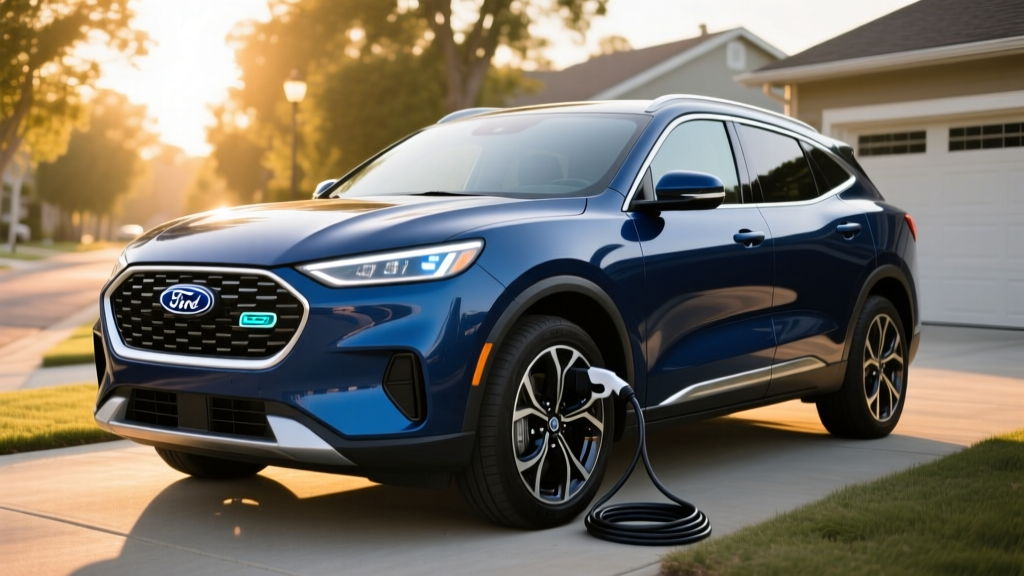
The Ford Maverick Hybrid carved out a unique niche as one of the only hybrid compact pickups on the market, and the 2026 model continues that tradition with a powertrain tuned for city efficiency and everyday utility. If you've been searching for ford maverick hybrid mpg numbers to decide whether this truck fits your commute, budget, and lifestyle, this guide gives you the exact EPA figures, real-world expectations, powertrain details, and long-term ownership data you need — no marketing fluff.
Unlike a plug-in hybrid (PHEV) or a full battery-electric vehicle (BEV), the Maverick Hybrid is a conventional hybrid electric vehicle (HEV). That means it charges its own battery through regenerative braking and the gasoline engine — you never plug it in. This distinction matters because it shapes everything from your daily routine to your tax-credit eligibility.
Ford Maverick Hybrid MPG: The EPA Numbers and Real-World Reality
The headline number is strong. According to fueleconomy.gov, the 2026 Ford Maverick Hybrid with front-wheel drive carries the following EPA estimates:
| Metric | EPA Estimate |
|---|---|
| City MPG | 42 MPG |
| Highway MPG | 33 MPG |
| Combined MPG | 37 MPG |
| Fuel Tank Capacity | 16.5 gallons |
| Total EPA Range | ~610 miles |
Hybrid (HEV) vs. Plug-In Hybrid (PHEV): What the Maverick Actually Is
This is a common source of confusion among truck shoppers, so let's be precise:
| Feature | Conventional Hybrid (HEV) | Plug-In Hybrid (PHEV) |
|---|---|---|
| Plug-in charging? | No — self-charging via engine + regen | Yes — plug into Level 1 or Level 2 |
| Battery size | ~1.1 kWh (small buffer) | 10–20+ kWh (larger pack) |
| Electric-only driving | Low-speed, short bursts only | 20–50 miles on electric alone |
| Fuel economy | Measured in MPG | Measured in MPGe (electric) + MPG (gas) |
| Federal tax credit (§30D) | Not eligible | May qualify ($3,750–$7,500) |
| Daily routine | Fill up at gas station only | Plug in at home for max savings |
The 2026 Ford Maverick Hybrid is a conventional HEV. It pairs a 2.5-liter Atkinson-cycle four-cylinder engine with an electric motor integrated into the transaxle. The small lithium-ion battery pack (approximately 1.1 kWh usable) stores energy captured from regenerative braking and excess engine output. You cannot plug it in, and it does not have a meaningful electric-only driving range. The system manages the gas/electric blend automatically — your only "fueling" stop is a gas station.
If you want plug-in capability in a Ford truck, you'd need to look at the F-150 PowerBoost (a different hybrid architecture) or wait for Ford's upcoming PHEV truck offerings. The Maverick Hybrid does not offer a PHEV variant for 2026.
Powertrain Specs: Horsepower, Torque, and Drivetrain
| Specification | Detail |
|---|---|
| Engine | 2.5L Atkinson-cycle inline-4 |
| Electric Motor | Permanent-magnet synchronous, integrated in eCVT |
| Combined System Horsepower | 191 HP |
| Engine Horsepower | 162 HP @ 5,600 RPM |
| Engine Torque | 155 lb-ft @ 4,000 RPM |
| Transmission | Electronic CVT (eCVT — planetary gearset, not a belt CVT) |
| Drivetrain | Front-wheel drive (FWD) standard; AWD available (2025+) |
| 0–60 MPH (est.) | ~8.5 seconds (FWD) |
| Towing Capacity | 2,000 lbs (standard); up to 2,000 lbs with hybrid AWD |
| Payload Capacity | ~1,500 lbs |
The eCVT in the Maverick Hybrid is Toyota-derived planetary gearset technology — not the rubber-belt continuously variable transmissions found in some competitors. This design is proven, smooth, and avoids the "drone" sensation associated with traditional CVTs under hard acceleration. The 191 combined horsepower is adequate for daily driving and light hauling, though it won't win any drag races against the turbocharged 2.0L EcoBoost Maverick (250 HP).
AWD note: Ford introduced all-wheel drive for the Maverick Hybrid beginning with the 2025 model year, and it continues for 2026. AWD models use a rear-axle electric motor rather than a mechanical driveshaft, which preserves the hybrid efficiency advantage. Expect AWD models to see a 1–2 MPG reduction compared to FWD across the EPA cycle.
Pricing, Trims, and Tax Credit Eligibility
| Trim | Approximate Starting MSRP |
|---|---|
| XL Hybrid (FWD) | ~$28,000 |
| XLT Hybrid (FWD) | ~$30,500 |
| Lariat Hybrid (FWD) | ~$34,000 |
| Lobo / Tremor Hybrid (if avail.) | ~$36,000–$38,000 |
Note: Pricing reflects estimated 2026 model-year MSRP before destination charges. Confirm exact figures with your local dealer or Ford's official configurator.
Real-World Ownership Costs: Fuel Savings vs. EcoBoost and Full EV
To understand the Maverick Hybrid's value, let's compare annual fuel costs across three scenarios — the Maverick Hybrid, the Maverick EcoBoost (gas-only), and a comparable electric pickup like the Ford F-150 Lightning or Rivian R1T. All calculations assume 15,000 miles/year, $3.50/gallon regular unleaded, and $0.16/kWh electricity (national averages as of early 2026).
| Vehicle | Economy | Annual Fuel/Energy Cost |
|---|---|---|
| Maverick Hybrid (FWD) | 37 MPG combined | ~$1,419 |
| Maverick EcoBoost (FWD) | 26 MPG combined | ~$2,019 |
| F-150 Lightning (BEV) | ~2.0 kWh/mi (70 MPGe) | ~$480 |
The Maverick Hybrid saves roughly $600/year in fuel compared to the EcoBoost — about $50/month. Over a 5-year ownership period, that's approximately $3,000 in fuel savings, which largely offsets the hybrid powertrain's typical $1,000–$1,500 premium over the base EcoBoost engine at purchase. The full EV saves dramatically more on energy, but comes with a significantly higher purchase price and the need for home charging infrastructure.
Battery Longevity, Warranty, and Reliability
• Hybrid Battery: 8 years / 100,000 miles (whichever comes first)
• Hybrid Components: 8 years / 100,000 miles
• Powertrain (engine, transaxle): 5 years / 60,000 miles
• Bumper-to-Bumper: 3 years / 36,000 miles
Ford's hybrid battery warranty is aligned with the industry standard for HEVs. The battery pack is a small, low-stress unit (~1.1 kWh) that rarely sees deep discharge cycles, contributing to long service life. Based on data from similar Ford and Toyota hybrid systems, hybrid battery replacements are uncommon before 150,000–200,000 miles. When replacement is needed out of warranty, expect a cost of $2,000–$4,000 depending on parts sourcing (new OEM vs. refurbished).
The Maverick Hybrid's powertrain — particularly the 2.5L Atkinson-cycle engine and eCVT — shares architecture with millions of proven hybrid vehicles on the road. The Atkinson cycle sacrifices peak power for thermal efficiency, resulting in lower cylinder pressures and reduced mechanical stress. The eCVT has no belts, chains, or friction clutches to wear out. This combination is among the most reliable powertrain configurations Ford offers.
For reliability ratings, the Maverick has received mixed but generally favorable scores. IIHS has tested the Maverick for crashworthiness, and the platform benefits from Ford's unibody construction. Long-term reliability data from Consumer Reports and J.D. Power typically places the hybrid variant at or above the model-line average, owing to the proven eCVT and naturally aspirated engine.
Who Should Choose the Maverick Hybrid vs. an EV or Gas Truck?
The Maverick Hybrid occupies a specific sweet spot. Here's a practical decision framework:
- Your commute is primarily city or suburban (where the 42 MPG city rating shines)
- You need a truck bed for weekend projects but don't tow more than 2,000 lbs
- You cannot install a home Level 2 charger (apartment, street parking, no garage)
- You want lower fuel costs without changing your fueling habits
- Your budget is under $35,000 and you want the lowest total cost of ownership in a compact truck
- You need the 4,000-lb towing capacity (available with EcoBoost + 4K Tow package)
- Your driving is overwhelmingly highway (the hybrid's advantage diminishes above 70 MPH)
- You want AWD with maximum towing — the EcoBoost offers a more robust AWD system
- Upfront cost is the primary concern and you drive fewer than 10,000 miles/year
- You have home charging access (Level 2, 240V) and want the lowest per-mile energy cost
- You qualify for the §30D federal tax credit ($7,500 point-of-sale on eligible models)
- Your daily driving is under 250 miles and you rarely tow
- You want zero tailpipe emissions and minimal drivetrain maintenance
Maverick Hybrid vs. the Competition
The compact hybrid truck segment remains small, which is the Maverick's biggest advantage. The closest competitors include:
| Vehicle | Type | EPA Combined | Starting MSRP | Towing |
|---|---|---|---|---|
| Ford Maverick Hybrid | HEV | 37 MPG | ~$28,000 | 2,000 lbs |
| Hyundai Santa Cruz (gas) | Gas only | 23–24 MPG | ~$28,500 | 5,000 lbs |
| Toyota Tacoma i-FORCE MAX | HEV | ~24 MPG | ~$42,000 | 6,000 lbs |
| Ford F-150 PowerBoost | HEV | ~24 MPG | ~$58,000 | 11,200 lbs |
The Maverick Hybrid is the only compact truck offering hybrid fuel economy in the 35+ MPG range at a sub-$30,000 starting price. The Tacoma i-FORCE MAX is a hybrid but prioritizes torque and towing over fuel economy. The Santa Cruz offers no hybrid option. The F-150 PowerBoost is a full-size truck at nearly double the price. For buyers whose priority is fuel efficiency in a truck form factor, the Maverick Hybrid has no direct rival.
Frequently Asked Questions
How many MPG does the Ford Maverick Hybrid actually get?
The EPA rates the 2026 Maverick Hybrid FWD at 42 city / 33 highway / 37 combined. In real-world city driving, many owners report 40–45 MPG thanks to aggressive regenerative braking. Highway-only trips at 75+ MPH typically yield 30–33 MPG. Expect a combined real-world average of 35–38 MPG across mixed driving conditions.
Does the Maverick Hybrid need to be plugged in?
No. The Maverick Hybrid is a conventional HEV (hybrid electric vehicle), not a PHEV. Its small battery charges automatically through regenerative braking and the gasoline engine. You never plug it in — you only refuel at a gas station.
Does the Ford Maverick Hybrid qualify for any tax credit?
No. The federal §30D Clean Vehicle Credit applies only to plug-in vehicles (BEVs and PHEVs) with qualifying battery sourcing. The Maverick Hybrid, as a self-charging HEV, is not eligible for the federal credit or most state EV incentives. Check IRS.gov for current eligibility rules.
Is the Maverick Hybrid reliable? What does a battery replacement cost?
The 2.5L Atkinson-cycle engine and eCVT are among the most proven and low-stress powertrain components Ford offers. The hybrid battery is covered for 8 years / 100,000 miles. Based on similar Ford and Toyota hybrid platforms, battery failures before 150,000 miles are rare. Out-of-warranty replacement costs range from $2,000 to $4,000, and refurbished options can reduce that further.
Can the Maverick Hybrid tow?
Yes, but modestly. The Maverick Hybrid is rated for 2,000 lbs of towing capacity — sufficient for a small utility trailer, a pair of dirt bikes, or a light pop-up camper. If you need to tow a boat or larger trailer (4,000+ lbs), you'll need the EcoBoost engine with the 4K Tow package.
Is AWD available on the Maverick Hybrid?
Yes. Ford introduced hybrid AWD for the 2025 model year using a rear-axle electric motor, and it continues for 2026. AWD models see a slight MPG reduction (typically 1–2 MPG combined) compared to FWD. Availability may vary by trim level.