The Ford Maverick Hybrid has carved out a unique niche since its debut: a compact pickup that sips fuel like a sedan while offering a functional 4.5-foot bed. For 2026, the Maverick Hybrid continues to attract buyers who want truck utility without the fuel penalty of a traditional midsize pickup. But beyond the powertrain, the cabin is where owners spend every minute behind the wheel. This guide breaks down the Ford Maverick Hybrid interior in detail — materials, tech, cargo flexibility, and comfort — alongside the hard efficiency numbers, battery warranty terms, and ownership economics that matter to hybrid shoppers.
HEV vs. PHEV: Where the Maverick Hybrid Fits
Before diving into specs, it's essential to clarify what the Maverick Hybrid is — and isn't. The Maverick Hybrid is a conventional hybrid electric vehicle (HEV). It pairs a gasoline engine with an electric motor and a small battery that recharges through regenerative braking and engine operation. You never plug it in. There is no electric-only driving range to manage and no charging cable to deal with.
This distinguishes it from a plug-in hybrid (PHEV) like the Toyota RAV4 Prime or Jeep Wrangler 4xe, which carries a larger battery (typically 15–25 kWh), offers 25–50 miles of electric-only range, and must be plugged in to realize its full efficiency benefit. The Maverick Hybrid does not have a PHEV variant as of the 2026 model year, and Ford has not announced one.
- Maverick Hybrid (HEV): No plug. ~1.1 kWh battery. 42 MPG city EPA. Refuels at any gas station.
- Typical PHEV: Plugs in. 15–25 kWh battery. 25–50 mi electric-only range. Needs Level 2 home charging for best economics.
- Full EV (BEV): No gas engine. 60–100+ kWh battery. 250–400 mi range. Requires regular charging access.
Ford Maverick Hybrid Interior: Materials, Layout, and Tech
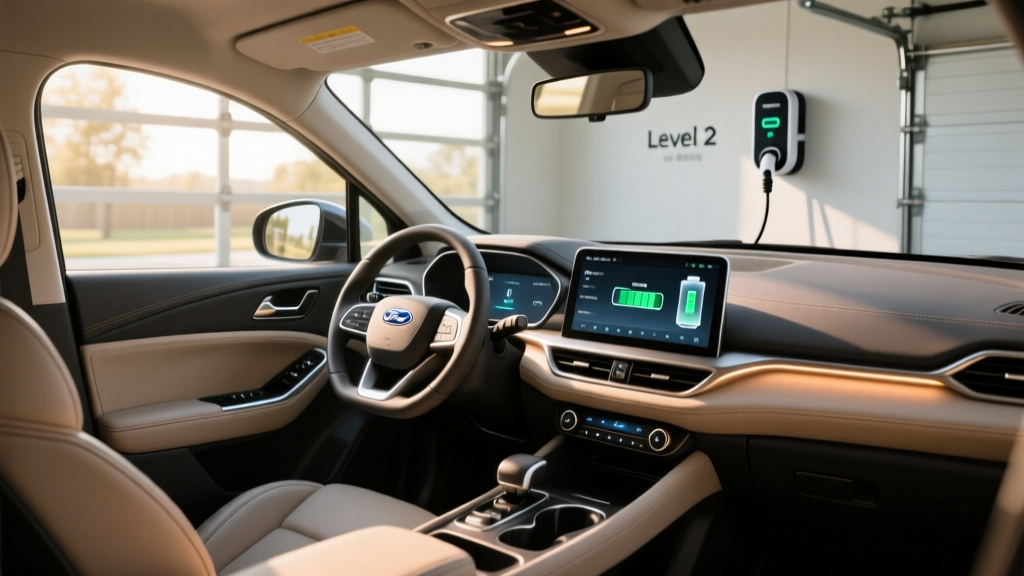
The 2026 Maverick Hybrid interior reflects its compact-truck positioning: functional and durable rather than luxurious, but with meaningful tech upgrades over earlier model years. Ford has standardized an 8-inch touchscreen running SYNC 4 across all trims, with wireless Apple CarPlay and Android Auto. The instrument cluster is a configurable digital display on Lariat and higher trims, while XL and XLT models use a simpler analog-digital combination.
Cabin Materials and Build
Base XL trims use hard-wearing cloth upholstery with vinyl accents on high-contact surfaces. The XLT adds premium cloth with available ActiveX (synthetic leather) bucket seats. The Lariat trim — the most popular for buyers prioritizing interior refinement — features ActiveX trimmed seats, a leather-wrapped steering wheel, and soft-touch materials on the door panels and dash top. Fit and finish have improved for 2026, with tighter panel gaps and fewer squeak-prone hard plastics than the 2022–2023 launch models, though the door uppers and lower dash remain hard plastic throughout the lineup.
Seating and Space
The Maverick is a strict four-door, five-seat crew cab. Front headroom measures 40.3 inches and rear headroom 39.6 inches — competitive with the Hyundai Santa Cruz. Rear legroom at 36.9 inches accommodates adults on shorter trips but will feel snug for taller passengers on long hauls. The rear seat cushion is relatively flat and thin compared to midsize trucks, a trade-off for the compact exterior footprint. A 60/40 split-folding rear seatback is standard, opening up interior cargo length for longer items.
Technology and Connectivity
SYNC 4 on the 8-inch touchscreen supports over-the-air updates, cloud-connected navigation (on equipped trims), and Ford Power-Up software delivery. Two USB-C ports are standard in front, with two additional USB-C ports available for rear passengers. A wireless charging pad is standard on Lariat and available on XLT. The available 4G LTE Wi-Fi hotspot supports up to 10 devices — useful for job-site connectivity or family road trips.
Driver Assistance
Ford Co-Pilot360 is standard on all 2026 Maverick Hybrid trims and includes automatic emergency braking with pedestrian detection, lane-keeping assist, auto high-beam headlamps, and a rearview camera. Blind-spot monitoring with rear cross-traffic alert is standard on XLT and above, optional on XL. Adaptive cruise control with stop-and-go and lane centering is available on Lariat and higher trims via the Ford Co-Pilot360 Assist package. This is an SAE Level 2 driver-assistance system — the driver must remain fully engaged and keep hands on the wheel at all times.
Fuel Economy: EPA Ratings and Real-World MPG
The Maverick Hybrid's headline number is its city efficiency. The front-wheel-drive (FWD) hybrid powertrain delivers an EPA-estimated 42 MPG city / 33 MPG highway / 37 MPG combined, according to fueleconomy.gov. The available all-wheel-drive (AWD) hybrid drops slightly to approximately 38 MPG city / 34 MPG highway / 36 MPG combined.
| Configuration | City MPG | Highway MPG | Combined MPG |
|---|---|---|---|
| FWD Hybrid | 42 | 33 | 37 |
| AWD Hybrid | 38 | 34 | 36 |
Real-World MPG: What Owners Actually See
Conventional hybrids like the Maverick tend to exceed their EPA city rating in stop-and-go driving because regenerative braking recovers energy that a gas-only vehicle wastes as heat. In mixed suburban driving with moderate traffic, owners frequently report 40–45 MPG in the FWD configuration. Highway driving is where the Maverick Hybrid's efficiency drops — at sustained 70–80 MPH speeds, expect 30–33 MPG, roughly matching or slightly below the EPA highway figure. Cold weather (below 35°F) reduces fuel economy by roughly 10–15% as the engine runs more frequently to provide cabin heat and maintain battery temperature.
For comparison, the non-hybrid 2.0L EcoBoost Maverick with AWD rates at approximately 23 MPG city / 30 MPG highway / 26 MPG combined. The hybrid's city advantage is dramatic — nearly double the EcoBoost's city figure — while highway efficiency is closer between the two powertrains.
Powertrain Specs: Engine, Motor, and Battery
| Engine | 2.5L Atkinson-cycle 4-cylinder |
| Engine Output | 162 hp / 155 lb-ft torque |
| Electric Motor | Permanent-magnet synchronous (integrated in transaxle) |
| Combined System Output | 191 hp |
| Transmission | eCVT (planetary gearset, not belt-driven) |
| Hybrid Battery | ~1.1 kWh lithium-ion (sealed, self-charging) |
| Drivetrain | FWD standard; AWD available |
| 0–60 MPH | ~7.5 seconds (FWD) |
| Max Towing | 2,000 lbs (hybrid); 4,000 lbs with EcoBoost + 4K Tow package |
| Max Payload | 1,500 lbs |
The 191-hp combined output provides adequate acceleration for daily driving and highway merging. The eCVT is Toyota-derived in architecture — Ford licensed the planetary gearset hybrid system — and it's proven durable in millions of vehicles. Unlike belt-driven CVTs found in some non-hybrid vehicles, this eCVT uses a fixed gearset with no belts or cones to wear, which contributes to long-term reliability.
One limitation worth noting: the hybrid powertrain is not available with the 4,000-lb 4K Tow package. If heavy towing is a priority, the 2.0L EcoBoost with AWD and the 4K Tow package is the correct configuration, though you'll sacrifice roughly 11 MPG combined to get it.
Pricing, Trims, and Tax Credit Eligibility
The 2026 Ford Maverick Hybrid is offered across three main trims, with the hybrid powertrain available on each:
- XL Hybrid (FWD): Starting MSRP approximately $28,500 (including destination). Basic interior, 8-inch SYNC 4 screen, cloth seats, steel wheels with wheel covers.
- XLT Hybrid (FWD/AWD): Starting MSRP approximately $30,500–$32,500. Adds premium cloth, available AWD, available blind-spot monitoring, alloy wheels, and the FX-4 off-road package on AWD models.
- Lariat Hybrid (FWD/AWD): Starting MSRP approximately $34,000–$36,000. ActiveX seats, leather-wrapped steering wheel, dual-zone automatic climate control, ambient lighting, available adaptive cruise with lane centering.
Fully optioned Lariat AWD Hybrid models with the Luxury package, bed liner, tonneau cover, and spray-in bedliner can approach $40,000.
Federal and State Tax Credits
Because the Maverick Hybrid is a conventional HEV — not a plug-in hybrid or battery electric vehicle — it does not qualify for the federal §30D Clean Vehicle Credit (up to $7,500 for new EVs and PHEVs meeting battery-sourcing and MSRP requirements). The IRS restricts this credit to vehicles with at least 7 kWh of battery capacity and plug-in charging capability, per irs.gov.
Some states offer modest incentives for conventional hybrids — typically $250–$500 rebates or reduced registration fees — but these vary widely by jurisdiction and change frequently. Check your state's energy or environmental agency website for current programs. The Maverick Hybrid's value proposition rests on fuel savings, not incentive eligibility.
Battery Warranty, Reliability, and Replacement Cost
Ford covers the Maverick Hybrid's high-voltage battery and hybrid-specific components for 8 years or 100,000 miles (whichever comes first). In states that follow California Air Resources Board (CARB) emissions warranty rules — including California, New York, Massachusetts, Oregon, Washington, and several others — hybrid battery coverage extends to 10 years or 150,000 miles.
Long-Term Reliability
The Maverick Hybrid uses a proven hybrid architecture derived from Ford's Escape Hybrid lineage, which itself shares fundamental design principles with Toyota's Hybrid Synergy Drive. These planetary-gearset eCVT systems have demonstrated exceptional longevity — Toyota Prius and Ford Escape Hybrid taxis routinely exceed 300,000 miles on original hybrid components.
The ~1.1 kWh battery pack in the Maverick Hybrid operates in a narrow state-of-charge window (roughly 40–60% SoC) managed by the vehicle's computer. This shallow cycling dramatically reduces degradation compared to full EVs that regularly cycle between 10% and 90% SoC. Battery capacity loss in Ford's hybrid systems has historically been minimal — typically under 10% over 150,000 miles.
Battery Replacement Cost
If the hybrid battery does require replacement outside of warranty, expect a cost of approximately $2,500–$4,000 for a new OEM battery pack, plus $500–$1,000 in labor. This is significantly less than a full EV battery replacement ($5,000–$20,000+) because the pack is small. Third-party refurbished hybrid batteries are available for $1,500–$2,500 installed. Given the proven durability of these systems, out-of-pocket battery replacement is uncommon within the vehicle's normal service life.
Who Should Buy the Maverick Hybrid — and Who Shouldn't
- 42 MPG city (FWD) — class-leading for any pickup
- No plug-in charging required — refuel at any gas station
- Competent 4.5-foot bed with available Flexbed dividers
- Low starting MSRP under $29,000
- Proven hybrid powertrain architecture
- 8-year/100,000-mile hybrid battery warranty
- 2,000-lb max towing (hybrid); EcoBoost needed for 4,000 lbs
- Rear seat space tight for tall adults on long trips
- Highway MPG (33) less impressive than city (42)
- No PHEV or EV variant available
- Interior hard plastics on lower door and dash surfaces
- No federal tax credit eligibility (HEV, not PHEV/EV)
Decision Framework
Choose the Maverick Hybrid if: Your driving is predominantly city and suburban, you want a small bed for DIY runs and gear, you don't want to manage plug-in charging, and fuel cost savings matter more than towing capacity.
Choose the Maverick EcoBoost if: You need AWD with the 4K Tow package (4,000 lbs), frequently drive highway miles where the hybrid's advantage shrinks, or regularly carry heavy payloads near the 1,500-lb limit.
Choose a full EV (e.g., Ford F-150 Lightning, Rivian R1T) if: You have reliable home Level 2 charging, your daily driving fits within 250–300 miles, you want zero tailpipe emissions, and you qualify for the §30D federal tax credit (up to $7,500) to offset the higher purchase price.
Choose a PHEV (e.g., RAV4 Prime, Tucson PHEV) if: You want electric-only commuting (25–42 miles) with a gas engine for longer trips, you can install a Level 2 home charger, and you want to qualify for partial federal tax credits ($3,750–$7,500 depending on the model and battery sourcing).
Ownership Economics: Fuel Cost vs. EcoBoost
The Maverick Hybrid's primary financial advantage is fuel savings. Here's a 5-year comparison assuming 15,000 miles/year, $3.50/gallon regular unleaded, and a 55% city / 45% highway driving mix:
| Metric | Hybrid FWD | EcoBoost AWD |
|---|---|---|
| EPA Combined MPG | 37 | 26 |
| Gallons per year (15,000 mi) | 405 | 577 |
| Annual fuel cost | $1,418 | $2,020 |
| 5-year fuel cost | $7,090 | $10,100 |
| 5-year savings (Hybrid) | ~$3,010 | |
At current fuel prices, the hybrid powertrain saves roughly $3,000 over five years — enough to offset the hybrid's modest price premium over the EcoBoost in most trim configurations. If your driving skews heavily toward city and stop-and-go conditions, savings will be even larger, as the hybrid's real-world city MPG often exceeds 40.
Frequently Asked Questions
How many MPG does the Ford Maverick Hybrid get?
The 2026 Maverick Hybrid FWD is EPA-rated at 42 MPG city, 33 MPG highway, and 37 MPG combined. The AWD hybrid rates at approximately 38/34/36 MPG. Real-world city driving frequently yields 40–45 MPG in the FWD model, while highway cruising at 75+ MPH typically returns 30–33 MPG.
Does the Maverick Hybrid need to be plugged in?
No. The Maverick Hybrid is a conventional HEV. Its ~1.1 kWh battery recharges automatically through regenerative braking and the gasoline engine. You simply refuel at any gas station — there is no plug, no charging cable, and no electric-only driving mode.
Is there a plug-in hybrid (PHEV) Maverick?
Not as of the 2026 model year. Ford has not announced a Maverick PHEV. If you need plug-in electric commuting range in a compact vehicle, consider crossover PHEVs like the Toyota RAV4 Prime (42 mi electric range) or Hyundai Tucson PHEV (33 mi electric range), though neither offers a truck bed.
Does the Maverick Hybrid qualify for any federal tax credit?
No. The federal §30D Clean Vehicle Credit requires plug-in capability and a minimum 7 kWh battery. The Maverick Hybrid's ~1.1 kWh self-charging battery does not meet these thresholds. Only the full-electric Ford F-150 Lightning (when eligible under current sourcing rules) qualifies among Ford trucks. Check IRS.gov for the latest eligibility rules.
How reliable is the Maverick Hybrid, and what does a battery replacement cost?
The hybrid system is based on Ford's proven eCVT architecture shared with the Escape Hybrid, which has demonstrated 200,000–300,000+ mile durability in fleet use. The hybrid battery is warranted for 8 years/100,000 miles (10 years/150,000 miles in CARB states). Out-of-warranty replacement costs approximately $2,500–$4,000 for a new OEM pack — far less than a full EV battery.
Can the Maverick Hybrid tow, and how much?
The Maverick Hybrid is rated for up to 2,000 lbs of towing capacity. This covers light-duty use — small utility trailers, a pair of dirt bikes, or a lightweight boat. If you need 4,000 lbs of towing, you'll need the 2.0L EcoBoost engine with the available 4K Tow package, which is not offered on the hybrid.
How does the Maverick Hybrid interior compare to the Hyundai Santa Cruz?
The Santa Cruz offers a slightly more car-like interior with softer materials and a more refined ride, but it's only available with turbocharged gas engines (no hybrid option, achieving roughly 23 MPG combined). The Maverick Hybrid's 37 MPG combined and lower starting price make it the efficiency and value play, while the Santa Cruz appeals to buyers prioritizing interior refinement and independent rear suspension ride quality.