Ford's Hybrid Lineup in 2026: HEV, PHEV, and What Actually Fits Your Driveway
Ford has doubled down on electrification without abandoning the practicality that truck and crossover buyers demand. For 2026, the automaker offers two core hybrid nameplates that dominate search interest around "Ford and hybrid": the Ford Maverick Hybrid (a compact pickup available as a conventional HEV) and the Ford Escape Hybrid (available as both an HEV and a plug-in hybrid PHEV). Neither requires you to commit to a full battery-electric vehicle, but they solve very different problems.
This guide breaks down exactly what each powertrain delivers — EPA MPG, real-world fuel economy, electric-only range for the PHEV, battery warranty terms, and federal tax credit eligibility under current IRS §30D rules — so you can match the right Ford hybrid to your actual driving pattern.
HEV vs PHEV: How Ford's Two Hybrid Systems Actually Work
Before comparing models, the distinction between Ford's hybrid types matters because it dictates whether you'll ever plug in, how far you can drive on electricity, and whether you qualify for federal incentives.
| Attribute | Conventional Hybrid (HEV) | Plug-In Hybrid (PHEV) |
|---|---|---|
| Plug in to charge? | No — regenerates via braking and engine | Yes — charges via plug + regeneration |
| Electric-only driving | Brief low-speed EV mode (<1 mi) | Full electric range (25–40 mi typical) |
| Battery size | ~1.1–1.5 kWh | ~14.4 kWh usable |
| Federal tax credit (§30D) | Not eligible | Up to $3,750 (sourcing-dependent) |
| Best for | No home charging access; long highway miles | Home charging + short daily commute |
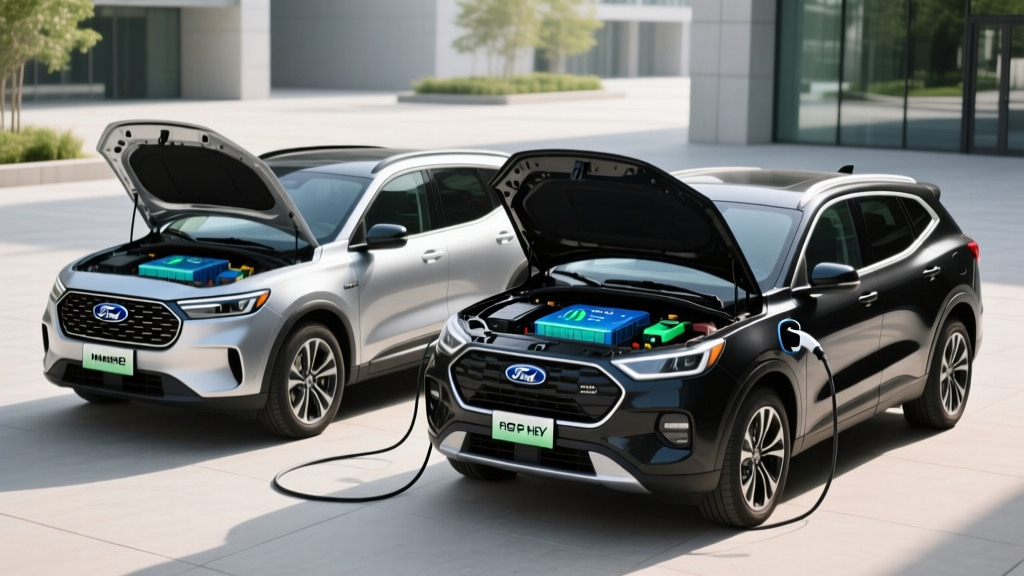
The Maverick Hybrid is HEV-only: it uses a small battery to assist its 2.5-liter Atkinson-cycle four-cylinder, capturing regenerative braking energy and enabling brief electric-only movement at low speeds. You never plug it in. The Escape PHEV, by contrast, carries a substantially larger lithium-ion pack that delivers genuine electric-only commuting range before the gasoline engine engages as a range extender.
2026 Ford Maverick Hybrid: MPG, Powertrain, and Real-World Efficiency
The Maverick Hybrid remains one of the most fuel-efficient pickups on the market and the entry point for buyers searching for a Ford and hybrid combination that doesn't sacrifice a truck bed.
| Spec | 2026 Maverick Hybrid (FWD) | 2026 Maverick Hybrid (AWD) |
|---|---|---|
| Powertrain | 2.5L I4 Atkinson + electric motor | 2.5L I4 Atkinson + electric motor |
| Combined HP | 191 hp | 191 hp |
| EPA City MPG | 42 | 38 |
| EPA Highway MPG | 33 | 31 |
| EPA Combined MPG | 37 | 34 |
| Battery | ~1.1 kWh (NiMH/Li-ion assist) | ~1.1 kWh (NiMH/Li-ion assist) |
| Towing Capacity | 2,000 lbs | 2,000 lbs |
| 0–60 mph | ~8.5 sec (est.) | ~8.8 sec (est.) |
| Starting MSRP | ~$27,995 | ~$29,495 |
| Federal Tax Credit | None (HEV) | None (HEV) |
Real-World MPG vs EPA: Hybrid trucks like the Maverick tend to exceed their EPA city estimate in stop-and-go driving because regenerative braking recovers more energy at lower speeds. Owners frequently report 44–46 MPG in urban commuting. Highway driving is the opposite story — at 75+ mph, the gasoline engine does most of the work, and real-world figures often settle around 30–32 MPG, slightly below the EPA sticker. Source: fueleconomy.gov.
The Maverick Hybrid is not a performance truck. Its 191 combined horsepower and CVT-style power-split device prioritize efficiency over acceleration. But for buyers who need a bed for weekend projects, occasional light towing, and daily commuting under 40 MPG, it occupies a segment with almost no direct competition.
2026 Ford Escape Hybrid and Escape PHEV: MPG, Electric Range, and Charging
The Escape lineup gives buyers a choice the Maverick does not: conventional HEV or plug-in PHEV. This decision hinges almost entirely on whether you can charge at home and how far your daily commute extends.
| Spec | 2026 Escape Hybrid (HEV, FWD) | 2026 Escape PHEV (FWD) |
|---|---|---|
| Powertrain | 2.5L I4 + electric motor | 2.5L I4 + electric motor (larger) |
| Combined HP | 191 hp (est.) | 210 hp (est.) |
| EPA City MPG | 44 | 42 (hybrid mode after EV range) |
| EPA Highway MPG | 37 | 37 (hybrid mode after EV range) |
| EPA Combined MPG | 40 | 40 (hybrid mode) |
| MPGe (EV mode) | N/A | ~105 MPGe |
| Electric-Only Range | N/A | ~37 miles |
| Total Combined Range | ~550 miles | ~520 miles (EV + gas) |
| Battery (usable) | ~1.1 kWh | ~14.4 kWh |
| Level 2 Charge Time (0–100%) | N/A | ~3.5 hours at 240V / 32A |
| DC Fast Charging | N/A | Not supported |
| Starting MSRP | ~$34,995 | ~$40,995 |
| Federal Tax Credit (§30D) | None (HEV) | Up to $3,750* |
*PHEV credit depends on battery component and critical-mineral sourcing requirements under IRS §30D rules. The maximum for PHEVs meeting partial sourcing thresholds is typically $3,750. Buyer income caps ($150K single / $300K joint) and MSRP caps ($80K for SUVs/PHEVs) apply. Confirm eligibility at point of sale or via your tax professional.
How Far Can the Escape PHEV Go on Electric Only?
The 2026 Escape PHEV delivers approximately 37 miles of electric-only range on a full charge, per EPA estimates. This covers the average American one-way commute (roughly 16 miles, per Census data) with margin to spare for errands — meaning many PHEV owners use zero gasoline on typical weekdays. When the battery depletes, the vehicle seamlessly transitions to hybrid mode, delivering the same ~40 MPG combined as the conventional Escape HEV.
Total combined range (electric + full gas tank) reaches approximately 520 miles, eliminating any range anxiety on road trips. The PHEV charges on a standard Level 2 home charger (240V, 32A) in roughly 3.5 hours. It does not support DC fast charging — a deliberate engineering choice, as the 14.4 kWh battery is small enough that Level 2 replenishment is practical and adding DC hardware would increase cost and weight for minimal gain.
Battery Warranty, Reliability, and Replacement Cost
Hybrid battery longevity is the single most cited concern among first-time hybrid buyers. Ford's warranty structure is designed to address this directly.
| Component | Warranty Coverage |
|---|---|
| Hybrid/EV Battery (Maverick HEV) | 8 years / 100,000 miles |
| Hybrid/EV Battery (Escape HEV) | 8 years / 100,000 miles |
| Hybrid/EV Battery (Escape PHEV) | 8 years / 100,000 miles |
| Hybrid Components (inverter, motor) | 8 years / 100,000 miles |
| Powertrain (engine, transmission) | 5 years / 60,000 miles |
Capacity retention threshold: Ford's hybrid battery warranty typically covers defects and capacity loss below ~70% of original capacity during the warranty period. Check your specific owner's manual for exact terms.
Is the Ford Hybrid Powertrain Reliable?
Ford's 2.5L Atkinson-cycle hybrid powertrain has been in production since the 2020 model year across multiple nameplates. It shares architecture with Toyota's well-proven hybrid system (Ford licensed certain hybrid patents from Toyota in the early 2000s), and real-world failure data from fleets and high-mileage owners has been favorable. The battery packs in modern Ford hybrids are significantly smaller and less stressed than full EV packs, which contributes to longevity.
Replacement cost if out of warranty: A hybrid battery replacement for a Maverick or Escape HEV typically ranges from $2,000 to $4,000 (parts and labor) at a dealership. The Escape PHEV's larger 14.4 kWh pack would cost more — estimated $5,000 to $8,000 — though these larger packs rarely require full replacement within the vehicle's normal lifespan. Independent hybrid specialists often offer refurbished packs at 30–50% lower cost.
Who Should Buy a Ford Hybrid vs a Full EV or Gas Car?
The decision between Ford's hybrids, a full battery-electric vehicle (like the Mustang Mach-E or F-150 Lightning), and a conventional gas-only model depends on three concrete factors: charging access, daily mileage, and budget.
Choose a Ford Hybrid (HEV) If:
- You cannot install a home charger (apartment, street parking, landlord restrictions)
- You drive 30+ highway miles daily where hybrid efficiency gains are smaller
- You want maximum simplicity — no plug, no charging apps, no new habits
- Your budget is under $35,000 and you need a truck bed (Maverick)
Choose the Escape PHEV If:
- You have Level 2 home charging (or a standard 120V outlet for overnight trickle charge)
- Your daily round-trip commute is under 40 miles — you'll rarely use gasoline
- You want EV-mode silence and instant torque for city driving but gas flexibility for road trips
- You qualify for the partial §30D tax credit (up to $3,750)
Choose a Full EV (Mach-E, Lightning) If:
- You have reliable home Level 2 charging and access to DC fast chargers for road trips
- You want to eliminate gasoline entirely and qualify for the full $7,500 §30D credit (if eligible)
- Your daily driving is predictable and within the vehicle's EPA range
- You prioritize lowest per-mile fuel cost (~$0.04–0.06/mi on home electricity vs ~$0.12–0.15/mi for hybrid gas)
Ford Hybrid (HEV) Pros
- No charging infrastructure needed
- 40+ MPG city in real-world driving
- Lower upfront cost than PHEV or EV
- Proven powertrain with 8yr/100k warranty
- Maverick offers truck utility at car-like fuel cost
Ford Hybrid (HEV) Cons
- No federal tax credit eligibility
- Cannot drive on electricity alone for meaningful distance
- AWD availability limited on some trims
- Less instant torque than EV or PHEV in EV mode
- Highway MPG drops noticeably above 70 mph
Ford Hybrid Tax Credit and Ownership Economics
Under current IRS §30D rules, conventional hybrids like the Maverick HEV and Escape HEV do not qualify for the federal clean vehicle credit. The credit applies only to plug-in vehicles (PHEVs and BEVs) meeting battery sourcing, MSRP, and buyer income requirements.
The Escape PHEV may qualify for up to $3,750 in federal credit, depending on whether its battery components and critical minerals meet the phased sourcing thresholds for the current tax year. This credit can be transferred to the dealer at point of sale, reducing your out-of-pocket cost immediately. Income caps apply: modified adjusted gross income must not exceed $150,000 (single) or $300,000 (married filing jointly).
| 5-Year Cost Factor | Maverick Hybrid (HEV) | Escape PHEV | Comparable Gas-Only SUV |
|---|---|---|---|
| Purchase Price (base MSRP) | ~$27,995 | ~$40,995 | ~$32,000 |
| Federal Tax Credit | $0 | Up to $3,750 | $0 |
| Effective Purchase Price | $27,995 | ~$37,245 | $32,000 |
| Fuel Cost (60K mi, $3.50/gal avg) | ~$5,675 (37 MPG avg) | ~$2,800 (half EV, half hybrid) | ~$8,400 (25 MPG avg) |
| Home Charging Cost (PHEV) | $0 | ~$1,200 (at $0.14/kWh) | $0 |
| Total Fuel/Energy (5 yr) | ~$5,675 | ~$4,000 | ~$8,400 |
| Estimated Maintenance | ~$2,500 | ~$2,200 | ~$3,200 |
Over five years and 60,000 miles, the fuel savings of either hybrid over a gas-only equivalent are substantial — $2,700+ for the Maverick HEV and $4,400+ for the Escape PHEV (accounting for electricity cost). The PHEV's higher upfront cost is partially offset by the tax credit and dramatically lower energy spend if most driving falls within its 37-mile electric range.
Frequently Asked Questions
How many MPG does the Ford Maverick Hybrid get?
The 2026 Maverick Hybrid FWD is EPA-rated at 42 city / 33 highway / 37 combined MPG. The AWD variant drops to 38/31/34. In real-world city driving, owners commonly report exceeding the EPA city estimate by 2–4 MPG thanks to aggressive regenerative braking. Highway driving at 75+ mph tends to yield 30–32 MPG, slightly below the sticker. (fueleconomy.gov)
How far can the Ford Escape PHEV go on electric only?
The 2026 Escape PHEV delivers approximately 37 miles of EPA-rated electric-only range. This covers most daily commutes without engaging the gasoline engine. Once the battery depletes, the vehicle operates as a conventional hybrid at roughly 40 MPG combined.
Does the Ford Maverick Hybrid qualify for a tax credit?
No. The Maverick Hybrid is a conventional HEV — it has no plug and no meaningful battery capacity under IRS §30D definitions. Only plug-in vehicles (PHEVs and BEVs) qualify for the federal clean vehicle credit. The Escape PHEV may qualify for up to $3,750, subject to income, MSRP, and battery-sourcing requirements.
Is the Ford hybrid battery reliable and what does replacement cost?
Ford covers hybrid batteries with an 8-year/100,000-mile warranty. The 2.5L hybrid powertrain has been in service since 2020 with favorable reliability data. Out-of-warranty replacement for the Maverick/Escape HEV battery runs $2,000–$4,000; the Escape PHEV's larger pack is estimated at $5,000–$8,000. Most hybrid batteries outlast the vehicle's useful life under normal use.
Hybrid vs PHEV vs EV — which Ford fits me?
Choose the HEV (Maverick or Escape Hybrid) if you lack home charging and want zero behavior change. Choose the PHEV (Escape PHEV) if you can charge at home and commute under 40 miles daily — you'll drive mostly on electricity while retaining gas flexibility. Choose a full EV (Mach-E, F-150 Lightning) if you have reliable charging access, want to eliminate gasoline, and qualify for the full $7,500 federal credit. See the decision framework above for a detailed breakdown.
Can I DC fast charge the Ford Escape PHEV?
No. The Escape PHEV does not support DC fast charging. Its 14.4 kWh battery charges fully in approximately 3.5 hours on a 240V Level 2 home charger. Given the battery size, DC fast charging would add cost and weight for minimal practical benefit — most PHEV owners charge overnight at home.