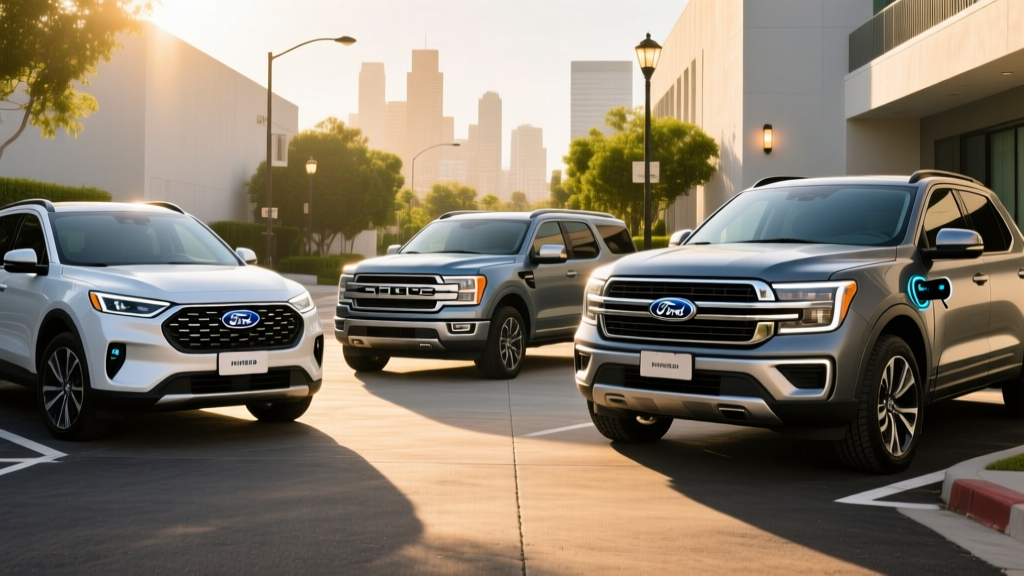
Ford has quietly built one of the broadest hybrid lineups in the U.S. market — spanning a compact pickup, a compact SUV, a full-size truck, and a three-row family hauler. But "hybrid" means very different things across these models. Some generate their own electricity and never need a plug. Others offer 30+ miles of electric-only driving before the gas engine kicks in. Choosing the right one depends on your commute, your charging access, and whether you need a truck bed or three rows.
This guide breaks down every 2026 Ford hybrid and plug-in hybrid currently on sale, with exact EPA fuel economy, powertrain output, pricing, tax-credit eligibility, and real-world ownership data.
The 2026 Ford Hybrid Lineup at a Glance
Ford sells four core hybrid models for the 2026 model year. Two are conventional hybrids (HEVs) that never need plugging in, one is a plug-in hybrid (PHEV) with meaningful electric-only range, and one — the F-150 PowerBoost — is a full hybrid designed for both fuel savings and jobsite power.
| Model | Type | EPA Combined MPG | Combined HP | Starting MSRP | Battery Warranty |
|---|---|---|---|---|---|
| Maverick Hybrid | HEV | 42 MPG (city) | 191 hp | $29,495 | 8 yr / 100,000 mi |
| Escape Hybrid | HEV | 39 MPG | 210 hp | $34,995 | 8 yr / 100,000 mi |
| Escape PHEV | PHEV | 37 mi electric + 40 MPG gas | 210 hp | $40,495 | 8 yr / 100,000 mi |
| F-150 PowerBoost | HEV | 23 MPG | 430 hp | $58,495 | 8 yr / 100,000 mi |
| Explorer Hybrid | HEV | 23 MPG | 318 hp | $53,400 | 8 yr / 100,000 mi |
HEV vs. PHEV: What's the Difference and Why It Matters
Conventional Hybrid (HEV) — The gas engine and electric motor work together, but you never plug it in. A small battery (typically 1–2 kWh) recharges through regenerative braking and the engine. Benefit: simpler ownership, no charging infrastructure needed. Trade-off: no electric-only highway driving; savings come from better MPG, especially in city traffic.
Plug-In Hybrid (PHEV) — A larger battery (typically 14–20 kWh) gives you 25–40 miles of electric-only driving. You plug in at home (Level 2) or at public chargers to recharge. Once the battery depletes, the gas engine takes over like a regular hybrid. Benefit: daily commutes can be fully electric with zero gas use. Trade-off: higher purchase price, requires home or workplace charging to realize full value.
For 2026, Ford offers only one PHEV — the Escape PHEV. The Maverick, F-150 PowerBoost, and Explorer are conventional HEVs. This matters practically: if you're shopping a PHEV expecting plug-in capability, only the Escape qualifies.
Ford Maverick Hybrid: The MPG Champion
The Maverick Hybrid remains Ford's most fuel-efficient vehicle and one of the most efficient non-plug-in vehicles sold in America. Its 2.5-liter four-cylinder Atkinson-cycle engine pairs with an electric motor for a combined 191 horsepower, routed through an electronically controlled CVT to the front wheels (AWD is available on hybrid trims for 2026, though it reduces fuel economy slightly).
| Configuration | City | Highway | Combined |
|---|---|---|---|
| FWD Hybrid | 42 MPG | 33 MPG | 38 MPG |
| AWD Hybrid | 38 MPG | 31 MPG | 35 MPG |
Real-world note: Hybrid city MPG often exceeds EPA estimates in stop-and-go driving because regenerative braking recovers energy that gas cars waste as heat. On the highway, where regenerative braking contributes less, expect numbers closer to or slightly below the EPA highway figure. Owners frequently report 40–45 MPG in mixed city driving and 30–33 MPG on sustained highway trips at 70+ mph, per fueleconomy.gov data.
The Maverick Hybrid starts at $29,495 for the XL trim. That pricing makes it not just the cheapest hybrid truck available but one of the cheapest hybrids overall. The 1.5-kWh lithium-ion battery is covered by Ford's 8-year/100,000-mile hybrid component warranty.
Ford Escape Hybrid and Escape PHEV: Two Paths to Efficiency
The Escape is where Ford's HEV and PHEV offerings sit side by side — and the distinction significantly changes the ownership experience.
Escape Hybrid (HEV)
The 2.5-liter hybrid powertrain produces 210 combined horsepower with standard AWD. EPA ratings land at 42 city / 36 highway / 39 combined MPG. Like the Maverick, real-world city driving can push past 40 MPG thanks to aggressive regenerative braking. Base price: $34,995.
Escape PHEV (Plug-In Hybrid)
The Escape PHEV uses a 14.4-kWh lithium-ion battery pack to deliver an EPA-rated 37 miles of electric-only range. Once that battery depletes, the gas engine engages and the vehicle operates as a conventional hybrid rated at 40 MPG combined. Total range — electric plus gas — exceeds 430 miles.
Charging the PHEV battery takes approximately 3.5 hours on a Level 2 (240V) home charger at its 3.3 kW onboard charge rate. The Escape PHEV does not support DC fast charging — this is common for PHEVs, whose smaller batteries don't justify the added cost and weight of DC hardware.
The PHEV commands a premium: base MSRP is $40,495, roughly $5,500 more than the HEV version. The question is whether your commute justifies it.
Battery Warranty: Both the Escape Hybrid and PHEV carry Ford's hybrid battery warranty of 8 years or 100,000 miles (whichever comes first), with a capacity retention threshold of approximately 70%. If the battery degrades below that threshold within the warranty period, Ford will repair or replace it. Out-of-warranty replacement for the PHEV's 14.4 kWh pack is estimated at $4,000–$6,500 including labor, based on current dealer parts pricing. The HEV's smaller 1.5 kWh battery is significantly cheaper to replace, typically under $2,500.
F-150 PowerBoost: Hybrid Muscle for Work and Tow
The F-150 PowerBoost pairs Ford's 3.5-liter twin-turbo V6 with a 47-hp electric motor integrated into the 10-speed automatic transmission. Combined output: 430 horsepower and 570 lb-ft of torque — more torque than the 5.0L V8. Towing capacity reaches 11,200 pounds when properly equipped.
Fuel economy is modest by hybrid standards but strong for a full-size truck:
| Configuration | City | Highway | Combined |
|---|---|---|---|
| 4x2 | 25 MPG | 24 MPG | 25 MPG |
| 4x4 | 23 MPG | 22 MPG | 23 MPG |
Real-world note: Towing a heavy trailer will drop fuel economy significantly — expect 10–14 MPG under load, which is comparable to or slightly better than the non-hybrid 3.5L EcoBoost under the same conditions. The hybrid system's primary advantage in truck use is idle fuel savings (the engine shuts off at stops) and low-speed electric assist, plus the available Pro Power Onboard system, which can output up to 7.2 kW of 120V/240V power from the bed — enough to run jobsite tools, a camper, or serve as home backup power during an outage.
The PowerBoost hybrid is available on XLT and above trims. Entry pricing for an XLT PowerBoost 4x4 starts at approximately $58,495. The 1.5-kWh hybrid battery carries the same 8-year/100,000-mile warranty.
Explorer Hybrid: Three-Row Efficiency
The Explorer Hybrid uses a 3.3-liter V6 paired with an electric motor for 318 combined horsepower. It's the only three-row hybrid SUV in Ford's lineup. EPA ratings come in at 23 MPG combined (21 city / 26 highway for RWD; AWD drops slightly). Real-world highway driving in a fully loaded Explorer with passengers tends to land between 22–25 MPG.
Starting price is $53,400. For families who need three rows but aren't ready for a full EV, the Explorer Hybrid bridges the gap — offering modest fuel savings over the gas-only Explorer (which rates around 20 MPG combined) without any charging considerations.
Tax Credits and Incentives for Ford Hybrids
This is where HEV and PHEV buyers face very different realities under current IRS §30D rules:
- Conventional Hybrids (Maverick, Escape HEV, F-150 PowerBoost, Explorer HEV): These do not qualify for the federal §30D clean vehicle tax credit. The credit requires a minimum battery capacity of 7 kWh and plug-in capability — neither of which applies to conventional hybrids.
- Escape PHEV: The Escape PHEV's 14.4-kWh battery meets the capacity threshold, but eligibility for the full $7,500 credit depends on battery component sourcing and critical minerals requirements that shift annually. As of 2026, many PHEVs face partial or no credit due to Foreign Entity of Concern (FEOC) sourcing restrictions. Verify current eligibility with your tax professional before purchasing.
§30D Credit Requirements (2026):
- Vehicle must be a PHEV or BEV with ≥7 kWh battery
- MSRP cap: $55,000 for sedans; $80,000 for SUVs, trucks, vans
- Buyer income cap: $150K single / $225K head of household / $300K joint
- Battery components and critical minerals must meet FEOC-free sourcing thresholds
- Credit can be transferred to the dealer at point of sale as a purchase discount
Some states offer additional incentives for PHEVs (California's CVRP, for example), but these vary widely by jurisdiction. Check your state energy office or the AFDC state incentive database for local programs.
Reliability and Long-Term Battery Costs
Ford's hybrid system — particularly the planetary-gear power-split device used in the Maverick and Escape — is mechanically simpler than a conventional automatic transmission. There's no torque converter, no multi-speed gear shifting in the hybrid transaxle, and regenerative braking reduces wear on friction brake pads (owners commonly report 80,000+ miles on original brake pads).
The hybrid battery itself uses proven lithium-ion chemistry. Ford's 8-year/100,000-mile warranty (extended to 10 years/150,000 miles in California and states that follow CARB emissions rules) covers battery capacity loss below the retention threshold. Out-of-warranty replacement costs vary:
- HEV batteries (1.5 kWh): $1,500–$2,500 — relatively affordable because the pack is small
- PHEV batteries (14.4 kWh): $4,000–$6,500 — larger pack, higher cost
For context, Toyota's hybrid taxis have logged 300,000+ miles on original batteries, and Ford's power-split architecture is similarly robust. Degradation in the first 100,000 miles is typically minimal — most owners will never need a battery replacement during typical ownership.
Hybrid vs. PHEV vs. EV: Which Ford Is Right for You?
Choose a Ford HEV (Maverick, Escape, F-150 PowerBoost, Explorer) if:
- You don't have access to home or workplace charging
- You want fuel savings with zero behavior change — just drive and fill up
- You frequently take long road trips and don't want to plan charging stops
- You need a truck bed (Maverick or F-150) or three rows (Explorer)
Choose the Ford Escape PHEV if:
- Your daily commute is under 37 miles round-trip
- You can install a Level 2 home charger or charge at work
- You want electric-only daily driving but gas flexibility for longer trips
- You want to reduce (but not eliminate) your gas spending
Consider a full EV (like the Mustang Mach-E or F-150 Lightning) if:
- You have reliable home Level 2 charging
- Your daily driving is under 200 miles
- You want the lowest per-mile fuel cost and zero tailpipe emissions
- You're eligible for the full $7,500 federal tax credit, which narrows the price gap
Ford Hybrids — Pros
- No charging infrastructure required (HEVs)
- Best-in-class city MPG for Maverick (42 city)
- F-150 PowerBoost offers 7.2 kW onboard power
- Proven power-split hybrid reliability
- 8-yr/100K-mi battery warranty (10/150K in CARB states)
- Lowest entry price in hybrid segment (Maverick at ~$29.5K)
Ford Hybrids — Cons
- Only one PHEV option (Escape) — no plug-in truck or three-row PHEV
- Escape PHEV limited to 3.3 kW charging (no DC fast charge)
- F-150 PowerBoost fuel savings modest vs. gas V6 under highway/tow use
- No federal tax credit for HEV models
- Explorer Hybrid MPG improvement over gas model is incremental
Frequently Asked Questions
How many MPG do Ford hybrids get?
It varies by model. The Maverick Hybrid leads at 42 city / 33 highway / 38 combined (FWD). The Escape Hybrid achieves 42/36/39 MPG. The F-150 PowerBoost rates 23–25 combined depending on 4x2 or 4x4. The Explorer Hybrid comes in at 23 combined. Real-world city MPG often exceeds EPA estimates in hybrids due to regenerative braking; highway MPG tends to match or fall slightly short.
How far can the Ford Escape PHEV go on electric only?
The EPA rates the Escape PHEV at 37 miles of electric-only range. In mild weather with moderate speeds, some owners report 38–40 miles. In cold weather (below 30°F), expect that to drop to roughly 28–32 miles as cabin heating draws from the battery. Once the electric range is depleted, the gas engine engages and the vehicle operates as a conventional hybrid rated at 40 MPG.
Do Ford hybrids need to be plugged in?
No — the Maverick Hybrid, Escape Hybrid, F-150 PowerBoost, and Explorer Hybrid are conventional HEVs that generate all their own electricity through the engine and regenerative braking. Only the Escape PHEV requires (and benefits from) plug-in charging. You can drive the PHEV without ever plugging it in, but you'll lose the electric-only range benefit and essentially operate it as a standard hybrid.
Are Ford hybrids reliable? What about battery replacement?
Ford's hybrid powertrains use a power-split device that is mechanically simpler than a conventional automatic transmission. The hybrid battery is warranted for 8 years/100,000 miles (10 years/150,000 miles in CARB states). Out-of-warranty HEV battery replacement runs $1,500–$2,500; PHEV replacement is $4,000–$6,500. Based on industry data, most hybrid batteries last well beyond the warranty period with minimal degradation.
Does any Ford hybrid qualify for a federal tax credit?
Only the Escape PHEV has the potential to qualify for the §30D federal clean vehicle credit, and eligibility depends on current-year battery sourcing rules, buyer income, and MSRP caps. Conventional hybrids (Maverick, Escape HEV, F-150 PowerBoost, Explorer HEV) do not qualify for any federal purchase credit. Always verify with a tax professional and check IRS.gov for the latest rules before purchasing.
Can the F-150 PowerBoost power my house or tools?
Yes. The available Pro Power Onboard system provides up to 7.2 kW of 120V/240V output through bed-mounted outlets. That's enough to run a welder, circular saw, and job-site lights simultaneously, or to back up essential home circuits during a power outage (with a proper transfer switch installed by an electrician). This is unique to the PowerBoost hybrid — the gas-only F-150 offers Pro Power Onboard at only 2.0 kW.