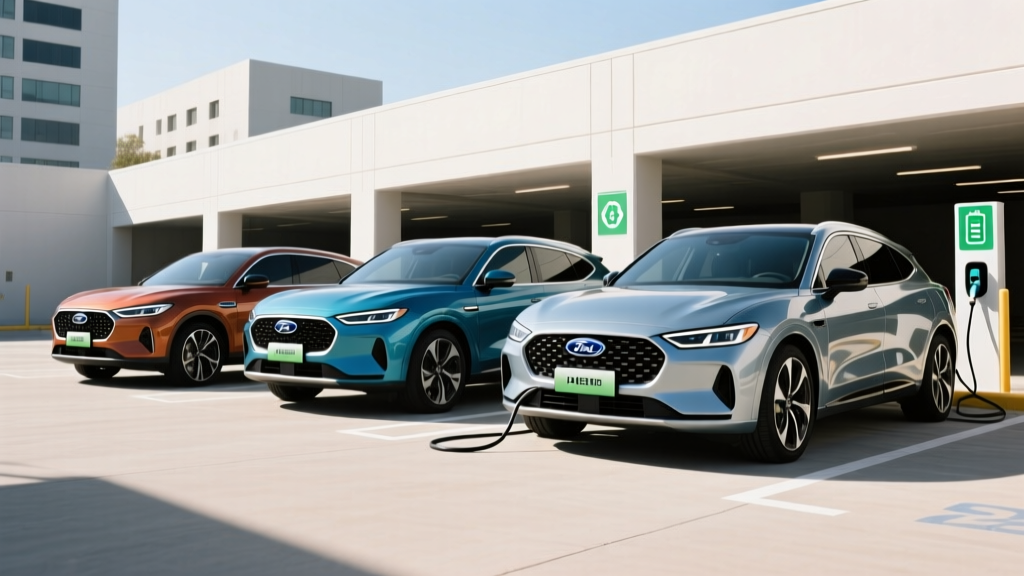
Ford's hybrid lineup has expanded considerably as the automaker pivots from its all-electric push toward a more pragmatic electrification strategy. For buyers searching for Ford hybrid specials, the 2026 model year presents a compelling mix: the segment-defining Maverick hybrid pickup, the refreshed Escape Hybrid compact SUV, and the Escape Plug-In Hybrid (PHEV) for drivers with shorter commutes and access to charging. Each occupies a distinct niche in terms of fuel economy, pricing, and ownership experience.
This guide breaks down every current Ford hybrid and PHEV with exact EPA figures, real-world efficiency expectations, powertrain specs, battery warranty coverage, and federal tax credit eligibility — so you can determine which model actually delivers the best value.
HEV vs. PHEV: Understanding Ford's Two Hybrid Approaches
Before evaluating deals, it's critical to understand the fundamental difference between Ford's conventional hybrids and its plug-in hybrid, because they serve different drivers and have different ownership requirements.
| Feature | Conventional Hybrid (HEV) | Plug-In Hybrid (PHEV) |
|---|---|---|
| Plug-in charging required? | No — charges via regenerative braking and engine | Yes — plug in for electric-only range |
| Electric-only driving | Very limited (low-speed, short distance) | 30-40+ miles on battery alone |
| Battery size | ~1.1-1.8 kWh (small buffer) | 14.4-18.5 kWh usable |
| Fueling | Gas station only | Gas station + Level 1/Level 2 charging |
| Federal tax credit | None (§30D requires plug-in) | Up to $3,750 (varies by battery sourcing) |
| Best for | Drivers without home charging access | Short commuters with home/work charging |
Conventional hybrids like the Maverick Hybrid and Escape Hybrid never need to be plugged in. Their small batteries charge through regenerative braking and the gasoline engine. PHEVs like the Escape PHEV have a substantially larger battery that enables meaningful electric-only driving — but only if you charge them regularly. A PHEV you never plug in is simply a heavier, less efficient conventional hybrid.
2026 Ford Hybrid Lineup: Specs, MPG, and Pricing
Here's how Ford's three primary hybrid offerings stack up on paper for the 2026 model year.
| Specification | Maverick Hybrid (FWD) | Escape Hybrid (AWD) | Escape PHEV (FWD) |
|---|---|---|---|
| Powertrain | 2.5L I4 + electric motor | 2.5L I4 + electric motors | 2.5L I4 + electric motor |
| Combined HP | 191 hp | 210 hp | 210 hp |
| Drivetrain | FWD (AWD available) | AWD standard | FWD only |
| Battery (usable) | ~1.1 kWh (NiMH) | ~1.1 kWh (NiMH) | 14.4 kWh (NMC lithium-ion) |
| EPA City MPG | 42 mpg | 42 mpg | 42 mpg (hybrid mode) / 105 MPGe (electric) |
| EPA Highway MPG | 33 mpg | 36 mpg | 37 mpg (hybrid mode) |
| EPA Combined MPG | 37 mpg | 39 mpg | 40 mpg (hybrid mode) |
| Electric-Only Range | N/A | N/A | 37 miles |
| Total Range | ~500 miles | ~520 miles | ~520 miles (37 mi EV + 483 mi gas) |
| Level 2 Charge Time | N/A | N/A | ~3.5 hours (240V, 32A) |
| DC Fast Charging | N/A | N/A | No |
| 0-60 mph | ~7.8 sec | ~7.5 sec | ~7.9 sec |
| Base MSRP | $27,995 | $34,495 | $39,995 |
| Federal Tax Credit (§30D) | Not eligible | Not eligible | Up to $3,750* |
*Tax credit eligibility depends on battery component sourcing, buyer income caps, and MSRP limits under current IRS §30D rules. The Escape PHEV's credit has fluctuated between $3,750 and $0 depending on critical-mineral sourcing compliance. Always verify current eligibility before purchase.
Real-World MPG: What Owners Actually Report
EPA sticker numbers tell part of the story, but hybrids behave differently than gas cars in real-world driving — often exceeding their city ratings while falling short on the highway.
Maverick Hybrid
The EPA rates the front-wheel-drive Maverick Hybrid at 42 city / 33 highway / 37 combined. In practice, city-heavy commuters regularly report 40-45 mpg thanks to the hybrid system's regenerative braking and frequent electric-motor assist at low speeds. Highway cruising at 75+ mph, however, typically yields 30-33 mpg — the boxy pickup aerodynamics and CVT tuning work against it at sustained high speeds. Fueleconomy.gov owner reports average around 36 mpg combined, close to the EPA estimate.
Escape Hybrid
Rated at 42 city / 36 highway / 39 combined (AWD), the Escape Hybrid tends to deliver 38-42 mpg in mixed suburban driving. Cold-weather operation drops this to roughly 34-36 mpg as the engine runs more frequently to provide cabin heat. Real-world combined averages on fueleconomy.gov hover around 37-38 mpg.
Escape PHEV
The PHEV's efficiency depends entirely on your charging habits. With regular Level 2 charging, owners with sub-30-mile commutes may use gasoline only on weekend road trips, achieving effective MPGe figures well above the EPA's 105 MPGe rating. Without plugging in, expect hybrid-mode efficiency of 38-41 mpg — slightly better than the standard Escape Hybrid because the larger battery enables more regenerative energy capture. The EPA listing confirms 40 mpg combined in charge-sustaining (hybrid) mode.
Battery Warranty, Lifespan, and Replacement Costs
Battery longevity remains the top concern for hybrid buyers. Here's what Ford covers and what replacement actually costs.
Ford Hybrid Battery Warranty Coverage
| Warranty Period | 8 years / 100,000 miles (whichever comes first) |
| Extended in CARB States | 10 years / 150,000 miles (California, New York, Massachusetts, and other states adopting CARB standards) |
| Coverage Threshold | Battery capacity loss below 60% of original capacity (PHEV); failure or malfunction (HEV) |
| What's Covered | High-voltage battery pack, battery control module, associated wiring |
Replacement Cost Reality
For conventional hybrids (Maverick, Escape Hybrid), the NiMH battery packs are relatively small (~1.1 kWh) and replacement costs typically range from $2,000 to $3,500 including labor. These packs have proven extremely durable — Toyota's similar hybrid architecture has demonstrated 200,000+ mile lifespans, and Ford's hybrid system follows the same planetary-gear eCVT design philosophy.
The Escape PHEV's larger 14.4 kWh lithium-ion (NMC chemistry) pack is more expensive to replace: expect $6,000 to $9,000 out of warranty. However, PHEV batteries are engineered with a larger buffer (roughly 20% of total capacity is reserved and inaccessible to the driver) to minimize degradation. Most owners will never need a replacement within typical ownership periods.
NiMH batteries in conventional hybrids degrade very slowly — expect 10-15% capacity loss over 10 years. This has minimal impact on fuel economy because the hybrid control system compensates by running the engine slightly more frequently. You likely won't notice the difference.
Ford Hybrid Pricing and Where to Find Specials
Ford hybrid specials typically come in three forms: manufacturer incentives (cash-back or below-market financing), dealer discounts on existing inventory, and federal or state tax credits for the PHEV.
Current Incentive Landscape (2026)
- Maverick Hybrid: High demand and limited production have kept dealer discounts thin. Expect MSRP or slight markups on XLT and Lariat trims. Ford Credit occasionally offers 2.9-4.9% APR financing for qualified buyers — check Ford's website for current offers.
- Escape Hybrid: More available inventory means dealer discounts of $500-$2,000 off MSRP are common, especially on higher trims (Platinum, ST-Line). End-of-month and end-of-quarter timing improves leverage.
- Escape PHEV: The highest-priced option, but also the most likely to carry dealer incentives. Look for $1,000-$2,500 in combined manufacturer and dealer discounts. Stack with any applicable §30D federal credit (verify current sourcing compliance on irs.gov).
Point-of-Sale Tax Credit Transfer
If the Escape PHEV qualifies for the §30D credit at the time of your purchase, you can transfer the credit to the dealer for an immediate price reduction at the point of sale — rather than waiting to claim it on your tax return. This effectively lowers your out-of-pocket cost or down payment. The dealer handles the IRS registration. Your modified adjusted gross income must not exceed $150,000 (single), $225,000 (head of household), or $300,000 (joint filers).
Who Should Buy a Ford Hybrid — and Who Shouldn't
Choose a Ford Hybrid (HEV) If:
- You lack access to home or workplace charging
- You want 37-40 mpg without changing any habits
- You drive a mix of city and highway miles
- You want a lower purchase price than a full EV
- You live in an area with limited public charging infrastructure
- You want a pickup (Maverick) with genuinely low fuel costs
Choose the Escape PHEV If:
- Your daily commute is under 35 miles round-trip
- You can install a Level 2 charger at home (240V outlet or hardwired)
- You want electric-only commuting but need gas for road trips
- You want to reduce fuel spending without range anxiety
- You qualify for the §30D federal tax credit
Consider a Full EV Instead If:
- Your commute is under 50 miles and you have reliable home charging
- You want zero tailpipe emissions and minimal maintenance (no oil changes, no engine)
- You're eligible for the full $7,500 federal EV tax credit on a qualifying BEV
- You want the lowest per-mile energy cost (electricity at $0.13/kWh ≈ $0.04/mile vs. hybrid at ~$0.09/mile)
Hybrid vs. PHEV vs. EV: The Decision Framework
Buy the Maverick Hybrid if you need a pickup truck, drive 12,000-18,000 miles/year in mixed conditions, and want fuel costs roughly 40% lower than a comparable gas truck — all without plugging in.
Buy the Escape Hybrid if you need a compact SUV with AWD, have no charging access, and prioritize proven reliability with low maintenance costs over maximum efficiency.
Buy the Escape PHEV if your commute is under 35 miles, you can charge at home on a 240V circuit, and you want near-EV daily driving costs with the safety net of a 483-mile gas range for longer trips.
Buy a full EV (e.g., Ford Mustang Mach-E) if you have home charging, drive under 250 miles daily, want the lowest long-term operating costs, and qualify for the full $7,500 federal credit.
Frequently Asked Questions
How many MPG does the Ford Maverick Hybrid get?
The EPA rates the 2026 Maverick Hybrid FWD at 42 city / 33 highway / 37 combined. Real-world owners typically report 35-38 mpg combined, with city-heavy drivers seeing 40+ mpg and highway-heavy drivers seeing 30-33 mpg. The AWD hybrid variant drops to approximately 38 city / 31 highway / 34 combined.
How far can the Escape PHEV go on electric only?
The EPA rates the 2026 Escape PHEV at 37 miles of electric-only range. In mild weather (60-75°F) with moderate speeds, some owners report 38-42 miles. In cold weather (below 35°F), expect 28-33 miles as the battery's usable capacity decreases and cabin heating draws additional power.
Do Ford conventional hybrids need to be plugged in?
No. The Maverick Hybrid and Escape Hybrid are self-charging conventional hybrids. Their small batteries charge through regenerative braking (capturing energy during deceleration) and the gasoline engine. You simply fill up at the gas station as normal.
Is the Ford hybrid battery reliable and what does replacement cost?
Ford's hybrid system — based on the planetary-gear eCVT architecture — has proven highly reliable. The NiMH battery packs in the Maverick and Escape Hybrid are covered for 8 years/100,000 miles (10 years/150,000 miles in CARB states). Replacement costs $2,000-$3,500 for conventional hybrids and $6,000-$9,000 for the Escape PHEV's larger lithium-ion pack. Most hybrid batteries outlast 150,000+ miles without significant issues.
Does any Ford hybrid qualify for a federal tax credit?
Only the Escape PHEV is potentially eligible for the federal §30D clean vehicle credit, which can provide up to $3,750 depending on current battery sourcing requirements. The Maverick Hybrid and Escape Hybrid are conventional hybrids and do not qualify for §30D credits because they cannot be plugged in. Always verify current eligibility on irs.gov before purchasing, as sourcing rules change periodically.
How long does it take to charge the Escape PHEV?
On a standard 120V household outlet (Level 1), the Escape PHEV takes approximately 10-11 hours for a full charge — adequate for overnight charging. On a 240V Level 2 charger (32 amps), a full charge takes about 3.5 hours. The Escape PHEV does not support DC fast charging, which is typical for PHEVs in this price range.
What's the real cost difference between the Maverick Hybrid and a gas Maverick?
The Maverick Hybrid carries roughly a $1,500-$2,000 premium over the equivalent gas turbo trim. At 15,000 miles/year and $3.40/gallon gas, the hybrid's 37 mpg combined versus the gas model's 26 mpg combined saves approximately $600-$700 annually in fuel. The hybrid premium pays for itself in roughly 2.5-3 years for average drivers, and immediately if you factor in higher resale values.