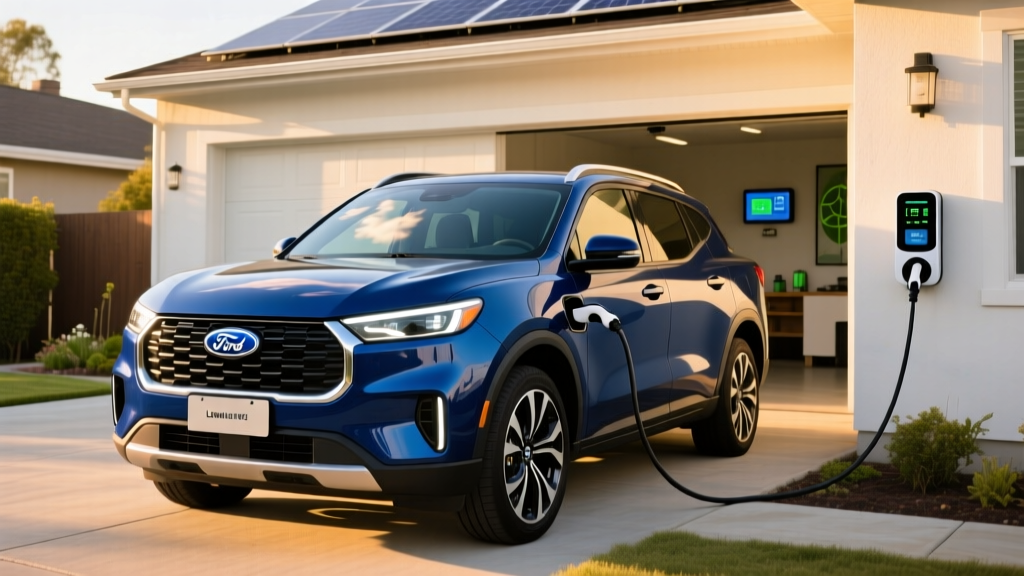
The compact pickup segment has one undisputed fuel-economy champion: the Ford Hybrid Maverick. While rivals chase turbocharged horsepower, Ford's 2.5-liter hybrid powertrain delivers EPA-estimated 42 MPG city in a truck that starts under $29,000 and still tows up to 2,000 pounds. For 2026, the Maverick Hybrid retains the formula that made it a runaway sales success — front-wheel-drive hybrid efficiency with an optional all-wheel-drive system — while adding incremental tech and trim updates.
This guide covers everything a buyer needs: real-world MPG versus EPA estimates, the hybrid powertrain in detail, battery longevity and warranty, pricing across trims, tax credit eligibility, and a clear framework for deciding whether the Maverick Hybrid, a plug-in alternative, or a full EV is the right call.
Ford Hybrid Maverick Fuel Economy: EPA Numbers vs. Real World
The headline number is what draws buyers in, but understanding where those MPG figures come from — and where they hold up or fall short — is what separates a smart purchase from a disappointed one.
| Drivetrain | City MPG | Highway MPG | Combined MPG |
|---|---|---|---|
| FWD Hybrid (2.5L I4) | 42 | 33 | 38 |
| AWD Hybrid (2.5L I4) | 40 | 34 | 37 |
Source: fueleconomy.gov
The Maverick Hybrid's EPA city figure of 42 MPG is one of the rare cases where real-world driving can exceed the sticker. In stop-and-go urban traffic, regenerative braking recaptures energy constantly, and many owners report 44–48 MPG on city-heavy commutes. Highway driving is a different story: at sustained 75–80 MPH speeds, expect 30–33 MPG as the gasoline engine does more of the work. Cold weather (below 30°F) reduces city MPG by roughly 10–15% as the engine runs more frequently for cabin heat and battery warm-up. A realistic blended expectation for mixed driving year-round is 36–40 MPG for FWD models.
This split personality — exceptional city efficiency, merely adequate highway economy — is inherent to the series-parallel hybrid architecture. The electric motor handles low-speed propulsion where gasoline engines are least efficient, while the Atkinson-cycle 2.5L engine takes over at highway speeds. Buyers whose commutes are 70%+ highway should still expect meaningful savings over a conventional truck, but the gap narrows considerably.
Powertrain Breakdown: Engine, Motor, and Combined Output
The 2026 Maverick Hybrid uses Ford's fourth-generation 2.5-liter Atkinson-cycle inline-four paired with a permanent-magnet electric motor and an electronically controlled continuously variable transmission (eCVT). This is a conventional hybrid (HEV) — it charges its battery through regenerative braking and engine-driven generation. There is no plug, no electric-only driving mode of meaningful distance, and no need to install home charging equipment.
| Engine | 2.5L Atkinson-cycle I4 |
| Engine Power | 162 hp / 155 lb-ft torque |
| Electric Motor | Permanent-magnet synchronous |
| Motor Power | 131 hp / 173 lb-ft torque |
| Combined System Output | 194 hp |
| Transmission | eCVT (planetary gearset) |
| Battery | ~1.1 kWh lithium-ion (self-charging) |
| Drivetrain | FWD standard; AWD optional |
| 0–60 MPH | ~7.8 seconds (FWD) |
| Max Towing | 2,000 lbs |
| Max Payload | 1,500 lbs |
The 194 combined horsepower is adequate for daily driving and highway merging but not quick by modern standards. The eCVT is smooth and avoids the rubber-band feel of some belt-driven CVTs, as it uses a planetary gearset to blend engine and motor power. The AWD system adds a rear-mounted electric motor for traction rather than a mechanical driveshaft, which preserves interior space and adds minimal weight.
HEV vs. PHEV vs. EV: Which Powertrain Fits You?
The Maverick is available only as a conventional hybrid (HEV) — Ford does not offer a plug-in hybrid (PHEV) variant. Understanding the distinction matters because each electrified powertrain serves a different use case.
| Attribute | HEV (Maverick Hybrid) | PHEV (e.g., Toyota RAV4 Prime) | Full BEV (e.g., Ford F-150 Lightning) |
|---|---|---|---|
| Plug-in charging? | No — self-charging | Yes — plug in for EV range | Yes — plug-in only |
| Electric-only range | ~1 mile at low speed | 25–42 miles typical | 230–350+ miles |
| Home charger needed? | No | Recommended (Level 2) | Essential (Level 2) |
| Gas engine? | Yes — primary power | Yes — backup after battery | No |
| Tailpipe emissions | Reduced vs. gas-only | Zero on EV mode | Zero |
| Federal tax credit (§30D) | Not eligible | Up to $7,500 if qualified | Up to $7,500 if qualified |
| Best for | No home charging access; mixed driving | Short EV commutes; road-trip flexibility | Home charging; daily + moderate trips |
- Choose the Maverick Hybrid if: You don't have access to home or workplace Level 2 charging, your commute is city-heavy, you want truck utility without a $55,000+ price tag, and you want zero behavior change from a gas vehicle.
- Choose a PHEV (like a RAV4 Prime or Tucson PHEV) if: You have Level 2 charging access, your daily commute is under 35 miles, and you want EV-mode commuting with gas-engine flexibility for longer trips. You sacrifice the pickup bed.
- Choose a full BEV (like an F-150 Lightning or Rivian R1T) if: You have reliable home Level 2 charging, you want zero tailpipe emissions, and your budget accommodates a $55,000–$80,000 truck. You gain a frunk, V2L capability, and instant torque.
Pricing, Trims, and Tax Credit Eligibility
The 2026 Ford Maverick Hybrid is available across multiple trims. Pricing below reflects MSRP before destination charges.
| Trim | MSRP (FWD) | MSRP (AWD add-on) |
|---|---|---|
| XL Hybrid | $28,145 | +$2,220 |
| XLT Hybrid | $30,640 | +$2,220 |
| Lobo Hybrid | $34,495 | N/A (FWD only) |
| Lariat Hybrid | $35,340 | +$2,220 |
| Tremor Hybrid | $38,340 | Standard AWD |
Federal Tax Credit: Does the Maverick Hybrid Qualify?
The conventional Maverick Hybrid does not qualify for the federal §30D Clean Vehicle Credit. That credit — up to $7,500 — is reserved for plug-in electric vehicles (BEVs and PHEVs) that meet battery capacity, critical-mineral sourcing, MSRP caps, and buyer income limits as defined by the IRS. Because the Maverick Hybrid cannot be plugged in and its battery is far below the 7 kWh minimum threshold, it is ineligible.
- §30D credit for Maverick Hybrid: Not eligible (conventional HEV)
- State/local incentives: Some states (e.g., California, Colorado, New York) offer rebates for hybrids — check your state energy office or DMV
- Insurance discounts: Some carriers offer hybrid/electrified-vehicle discounts of 5–10%
- Employer benefits: A growing number of employers offer commuter benefits that include hybrid parking incentives
While the lack of a federal credit is a disadvantage versus PHEV competitors, the Maverick Hybrid's sub-$29,000 starting price largely negates the need for one. A $28,145 truck with 38 MPG combined costs less to buy and fuel than most PHEV SUVs after their credits are applied.
Battery Longevity, Warranty, and Replacement Cost
Hybrid battery anxiety is the single most common concern among first-time hybrid buyers. Here's what the data shows for the Maverick's lithium-ion hybrid battery pack.
- Hybrid Battery: 8 years / 100,000 miles (whichever comes first)
- Hybrid Battery (CARB states): 10 years / 150,000 miles
- Hybrid System Components: 8 years / 100,000 miles (inverter, eCVT, motor)
- Powertrain (engine): 5 years / 60,000 miles
- Bumper-to-Bumper: 3 years / 36,000 miles
The Maverick's hybrid battery is small (~1.1 kWh) and operates within a narrow state-of-charge window — typically between 40% and 80% SoC. This shallow cycling dramatically extends cell life compared to a full EV battery that regularly cycles from 10% to 90%. Ford's hybrid battery systems in the Escape Hybrid and Fusion Hybrid (which share this architecture) have demonstrated 150,000–200,000+ miles of service with minimal degradation in fleet and taxi use.
What Does Hybrid Battery Replacement Cost?
If the battery fails outside warranty, replacement costs for the Maverick Hybrid are estimated at $2,500–$4,000 for the battery pack plus labor, based on comparable Ford hybrid models. This is a fraction of full EV battery replacement costs ($8,000–$20,000+) because the pack is small and modular. Independent hybrid specialists can often refurbish or replace individual modules for $1,200–$2,000. Given the warranty coverage and the battery's conservative cycling profile, out-of-pocket replacement is uncommon within the vehicle's typical ownership life.
Reliability and Long-Term Ownership
Ford's 2.5L hybrid powertrain has been in production since the 2020 Escape Hybrid and is now in its second generation within the Maverick. Early-model-year Mavericks (2022–2023) experienced some build-quality issues — primarily related to body panels, infotainment glitches, and 12V battery drain — rather than hybrid powertrain failures. The hybrid system itself has proven robust.
Key reliability considerations:
- eCVT durability: The planetary-gear eCVT has no belts, bands, or clutches to wear. It is among the most reliable transmission designs in production, with Toyota and Ford both demonstrating 200,000+ mile service life.
- Brake longevity: Regenerative braking significantly reduces friction brake wear. Maverick Hybrid owners commonly report 60,000–80,000+ miles on original brake pads.
- Maintenance costs: No timing belt (chain-driven), no traditional transmission fluid service intervals, and reduced brake wear make the Maverick Hybrid cheaper to maintain than its EcoBoost gasoline sibling.
- AWD system: The rear electric motor AWD has fewer mechanical components than a traditional driveshaft-based system. Long-term data is more limited (introduced for 2025), but the design is inherently simpler.
Total Cost of Ownership: Maverick Hybrid vs. Gas Maverick
The hybrid powertrain carries an approximate $1,500 premium over the 2.0L EcoBoost gasoline engine on comparable trims. Here's how that payback calculates over five years and 75,000 miles.
| Cost Factor | Hybrid (38 MPG) | EcoBoost (26 MPG) |
|---|---|---|
| Purchase price (XLT base) | $30,640 | $29,140 |
| Fuel cost ($3.40/gal avg) | $6,711 | $9,808 |
| Estimated maintenance | $2,100 | $2,800 |
| Insurance (avg) | $7,500 | $7,200 |
| 5-year depreciation (est.) | $12,200 | $13,100 |
| Total 5-yr cost | $59,151 | $62,048 |
The hybrid saves approximately $2,900 over five years despite the higher purchase price, driven primarily by $3,097 in fuel savings and slightly lower maintenance. The hybrid also tends to hold resale value better due to strong demand. For buyers who keep vehicles 8–10 years, the savings compound significantly. At 15,000 miles/year and $3.40/gallon, the hybrid's fuel savings alone pay back the $1,500 powertrain premium in roughly 2.5 years.
Pros and Cons at a Glance
- 42 MPG city EPA — best-in-class for any pickup
- Sub-$29,000 starting MSRP (XL Hybrid)
- No plug-in charging required — zero behavior change
- AWD available with rear electric motor
- Proven, reliable eCVT and hybrid architecture
- 8-year/100,000-mile hybrid battery warranty
- Strong resale value due to high demand
- 4.5-foot bed with practical utility for most tasks
- Highway MPG (33) is merely average
- 2,000-lb towing limit (EcoBoost: 4,000 lbs)
- No federal tax credit eligibility
- 194 hp feels modest when loaded or merging uphill
- Long dealer wait times / limited inventory in some markets
- Rear seat space is tight for tall adults
- AWD hybrid not available on all trims
Frequently Asked Questions
How many MPG does the Ford Hybrid Maverick get?
The 2026 Maverick Hybrid with FWD is EPA-rated at 42 city / 33 highway / 38 combined MPG. The AWD version rates at 40/34/37 MPG. In real-world city driving, many owners report exceeding the EPA city figure, while sustained highway speeds above 75 MPH reduce fuel economy to 30–33 MPG.
Does the Maverick Hybrid need to be plugged in?
No. The Maverick Hybrid is a conventional (self-charging) hybrid. Its small lithium-ion battery charges through regenerative braking and the gasoline engine. There is no plug, no charging cable, and no home charging equipment needed.
How far can the Maverick Hybrid drive on electric power alone?
Only about 1 mile at very low speeds (under 25 MPH) in stop-and-go conditions. This is not a plug-in hybrid — the electric motor supplements the gasoline engine rather than replacing it for meaningful distances. If you want 25–40 miles of electric-only driving, you need a PHEV, which the Maverick does not offer.
Is the Ford Maverick Hybrid reliable?
The 2.5L hybrid powertrain has proven reliable since its introduction in the Escape Hybrid. The eCVT is one of the most durable transmission designs available. Early Maverick model years had some non-powertrain build-quality issues (body, infotainment), but hybrid system failures have been rare. The 8-year/100,000-mile hybrid battery warranty provides strong coverage.
What does a Maverick Hybrid battery replacement cost?
Out-of-warranty replacement is estimated at $2,500–$4,000 for the pack plus labor. Independent hybrid shops can often refurbish modules for $1,200–$2,000. Given the conservative charge cycling and strong warranty, most owners will never need a replacement.
Does the Maverick Hybrid qualify for a tax credit?
No. The federal §30D Clean Vehicle Credit requires plug-in capability and a minimum 7 kWh battery. The Maverick Hybrid meets neither criterion. Some states offer separate hybrid incentives — check your state energy office. The IRS Clean Vehicle Credit page details full eligibility rules.
Can the Maverick Hybrid tow?
Yes, but with a 2,000-pound maximum towing capacity — half of the EcoBoost model's 4,000-pound limit (with the 4K Tow Package). For light utility trailers, small boats, or a pair of dirt bikes, the hybrid is adequate. For heavier loads, the EcoBoost or a larger truck is necessary.
Is AWD worth it on the Maverick Hybrid?
If you live in a region with snow, ice, or unpaved roads, the AWD system (a rear-mounted electric motor, not a mechanical driveshaft) adds meaningful traction for a $2,220 premium and only a 1 MPG combined penalty. For dry-climate commuters, FWD with quality all-season tires is sufficient and maximizes fuel economy.