Why a Ford Hybrid Lease Makes Sense in 2026
If you want to cut fuel costs without committing to a full battery-electric vehicle or worrying about long-term depreciation, a Ford hybrid lease is one of the most pragmatic moves in the current market. Ford's hybrid lineup has expanded to cover compact trucks, compact SUVs, and a plug-in hybrid variant — each targeting a different buyer profile. Leasing lets you lock in today's incentives, drive the latest powertrain tech, and hand the keys back before the battery warranty clock runs out.
This guide breaks down every current Ford hybrid and PHEV available for lease, with exact EPA fuel economy figures, real-world MPG expectations, powertrain specs, pricing, and federal tax credit eligibility under current IRS §30D rules.
HEV vs PHEV: Which Ford Hybrid Is Right for You?
Before diving into models, it's critical to understand the difference between Ford's conventional hybrids and its plug-in hybrid. They serve fundamentally different use cases.
Conventional Hybrid (HEV)
How it works: A small battery (typically 1–2 kWh) is charged by regenerative braking and the gasoline engine. You never plug it in. The electric motor assists the engine during acceleration and enables electric-only driving at very low speeds.
Best for: Drivers without home charging access, apartment dwellers, high-mileage commuters who want set-it-and-forget-it efficiency.
Plug-in Hybrid (PHEV)
How it works: A larger battery (14–18 kWh usable) provides meaningful electric-only range (typically 30–40 miles) for daily commuting. You plug it in at home or at public Level 2 chargers. Once the battery depletes, it operates as a conventional hybrid.
Best for: Drivers with home charging who commute under 40 miles round-trip and want EV-like daily driving with gas-engine flexibility for road trips.
2026 Ford Hybrid Lineup: Specs at a Glance
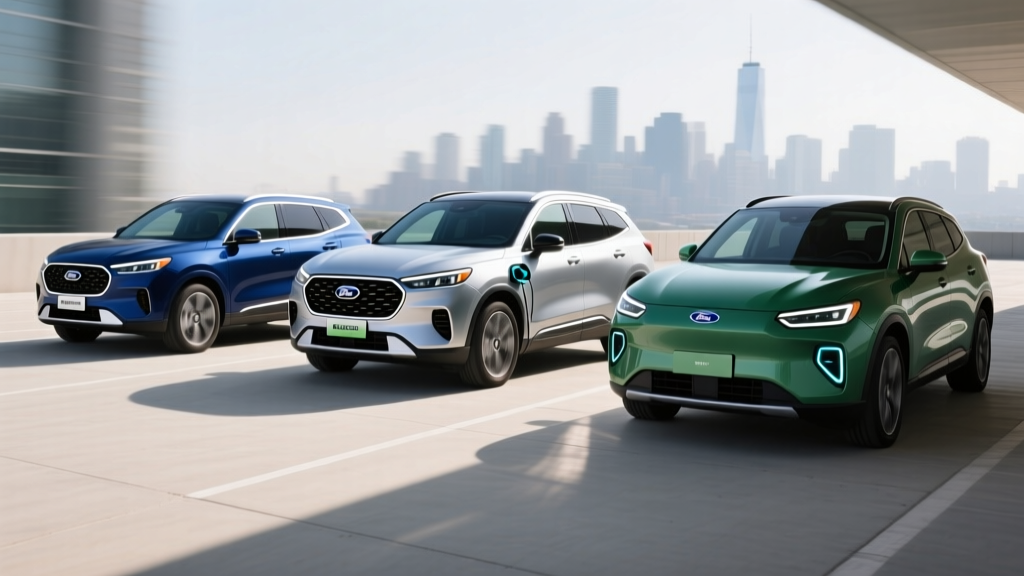
Ford currently offers three core hybrid models in the U.S. market. Here's how they stack up on the numbers that matter.
| Spec | Maverick Hybrid | Escape Hybrid (HEV) | Escape PHEV |
|---|---|---|---|
| Powertrain | 2.5L I4 + electric motor | 2.5L I4 + electric motor | 2.5L I4 + electric motor |
| Combined HP | 194 hp | 200 hp (FWD) / 210 hp (AWD) | 210 hp |
| Battery (usable) | ~1.1 kWh (HEV) | ~1.1 kWh (HEV) | ~14.4 kWh (NMC) |
| EPA City / Hwy / Combined MPG | 42 / 33 / 38 | 42 / 36 / 39 | 39 combined (gas) / 105 MPGe (elec) |
| Electric-Only Range | N/A (HEV) | N/A (HEV) | 37 miles |
| Total Range | ~500+ miles | ~490+ miles | ~430+ miles (gas) + 37 elec |
| Charging (PHEV) | N/A | N/A | Level 2: ~3.5 hrs; No DCFC |
| Drivetrain | FWD only | FWD or AWD | FWD only |
| 0–60 mph | ~7.5 sec | ~7.7 sec (FWD) | ~8.0 sec |
| Base MSRP | ~$27,995 | ~$33,995 | ~$39,995 |
| Est. Monthly Lease (36 mo) | ~$299–$379 | ~$389–$469 | ~$449–$549 |
Lease estimates based on typical 36-month/36,000-mile terms with $2,500–$3,500 due at signing. Actual offers vary by region, dealer, and credit tier. Source: fueleconomy.gov and Ford Motor Company.
Ford Maverick Hybrid: The Efficiency Truck
The Maverick Hybrid remains the standout in Ford's lineup for buyers who need truck utility without truck fuel bills. Its 2.5-liter Atkinson-cycle four-cylinder paired with an electric motor delivers 194 combined horsepower and an EPA-rated 42 city / 33 highway / 38 combined MPG.
Real-World MPG: What to Actually Expect
Conventional hybrids like the Maverick tend to beat their EPA city estimates in stop-and-go traffic, where regenerative braking and electric assist do the most work. In real-world mixed driving, owners consistently report 37–44 MPG in city conditions. Highway driving at sustained 70+ mph drops efficiency to roughly 30–33 MPG, since the electric motor contributes less at constant high speed.
If your commute is mostly urban or suburban, expect to average 38–42 MPG. If it's predominantly interstate, plan for 32–35 MPG. Cold weather (below 30°F) typically reduces hybrid efficiency by 5–10% due to increased engine runtime for cabin heat and reduced battery performance.
Lease Positioning
The Maverick Hybrid leases aggressively because Ford uses it as a volume play in the compact truck segment. Typical lease offers range from $299–$379/month with moderate drive-off costs. The low MSRP keeps capitalized cost down, and residual values have held well as demand for fuel-efficient trucks remains strong.
Ford Escape Hybrid and Escape PHEV: The SUV Options
The Escape gives hybrid buyers an SUV form factor with two distinct paths: the conventional Escape Hybrid for plug-free simplicity, or the Escape PHEV for daily electric commuting with gas-engine backup.
Escape Hybrid (HEV)
With 200 hp (FWD) or 210 hp (AWD) and an EPA-rated 42 city / 36 highway / 39 combined MPG, the Escape Hybrid delivers crossover practicality with near-Maverick efficiency. The AWD variant sacrifices roughly 1–2 MPG combined for all-weather traction. Real-world city MPG of 38–44 is common; highway drops to 33–36.
Escape PHEV
The Escape PHEV pairs its 2.5L engine with a ~14.4 kWh usable NMC lithium-ion battery, delivering an EPA-rated 37 miles of electric-only range and 105 MPGe when operating on electricity. Total combined range exceeds 430 miles once the battery depletes and the hybrid system takes over at 39 MPG.
| Driving Scenario | Escape Hybrid (EPA) | Escape Hybrid (Real-World) | Escape PHEV (Electric) | Escape PHEV (Gas Hybrid) |
|---|---|---|---|---|
| City | 42 MPG | 38–44 MPG | 105 MPGe | 39 MPG |
| Highway | 36 MPG | 33–36 MPG | N/A (37-mi range) | 35 MPG |
| Combined | 39 MPG | 36–41 MPG | 105 MPGe | 39 MPG |
Charging the Escape PHEV: The Escape PHEV charges via a standard J1772 connector. On a Level 2 home charger (240V, 32A), a full charge takes approximately 3.5 hours. On a standard 120V Level 1 outlet, expect roughly 8–10 hours — sufficient for overnight charging. Notably, the Escape PHEV does not support DC fast charging, which is typical for PHEVs in this class.
Tax Credits, Incentives, and Lease Economics
Hybrid lease economics depend heavily on available incentives. Here's what applies under current 2026 rules:
Federal §30D Tax Credit
Under current IRS §30D guidelines, the federal clean vehicle credit of up to $7,500 applies only to new plug-in electric vehicles and fuel cell vehicles. Conventional hybrids (Maverick Hybrid, Escape Hybrid) do not qualify — they have no plug and insufficient battery capacity.
The Escape PHEV may qualify for a partial or full credit, but eligibility hinges on several requirements:
- MSRP cap: SUVs must not exceed $80,000 MSRP (Escape PHEV clears this easily)
- Buyer income cap: AGI must not exceed $150,000 (single) / $300,000 (joint)
- Battery sourcing: Critical minerals and battery components must meet phased-in percentage thresholds from U.S. or FTA-partner countries
- North American assembly: Vehicle must undergo final assembly in North America (Escape qualifies)
- Point-of-sale transfer: Buyers can elect to transfer the credit to the dealer at purchase, reducing the upfront price
Important leasing nuance: When you lease a vehicle, the lessor (the leasing company) technically claims any tax credit — not you. Some manufacturers pass this savings through as a "lease cash" incentive that reduces the capitalized cost, while others absorb it. Always ask the dealer whether Ford's current lease offers reflect any passed-through federal incentives.
State and Local Incentives
Several states offer additional rebates or HOV lane access for PHEVs. California's CVRP, Colorado's state credit, and various utility company rebates can stack on top of federal incentives. Check your state's energy office and local utility for current programs — these vary significantly by jurisdiction and change frequently.
Battery Reliability, Warranty, and Replacement Costs
Battery longevity is the top concern for hybrid buyers, and it's where Ford's track record provides genuine reassurance.
Ford Hybrid Battery Warranty
All Ford hybrid and PHEV models carry a hybrid battery warranty of 8 years / 100,000 miles (whichever comes first). In states that follow California Air Resources Board (CARB) standards — including California, New York, Massachusetts, and several others — the warranty extends to 10 years / 150,000 miles.
The warranty covers battery capacity loss below a defined threshold (typically 60–70% of original capacity) and any manufacturing defects in hybrid system components including the electric motor, inverter, and DC-DC converter.
Real-World Hybrid Battery Longevity
Ford's hybrid batteries are notably smaller than full EV batteries (~1.1 kWh for HEVs, ~14.4 kWh for the PHEV), and they operate within a conservative state-of-charge window — typically between 20% and 80% — which dramatically reduces degradation stress. Real-world data from Ford's earlier hybrid models (Fusion Hybrid, C-Max) shows hybrid batteries routinely lasting 150,000–200,000+ miles with minimal capacity loss.
Replacement Cost If Out of Warranty
If a hybrid battery does fail outside the warranty period:
- Maverick/Escape HEV battery replacement: ~$2,500–$4,000 (small battery, lower parts cost)
- Escape PHEV battery replacement: ~$6,000–$9,000 (larger NMC pack)
These figures include parts and labor at a Ford dealer. Independent hybrid specialists often offer replacements at 20–30% lower cost. Refurbished or remanufactured packs are also becoming available as the hybrid fleet ages.
Who Should Lease a Ford Hybrid — and Who Shouldn't?
Lease a Ford Hybrid If…
- You drive 12,000–15,000 miles/year and want to minimize fuel cost without plugging in (HEV)
- You need a compact truck bed but refuse to pay truck fuel prices (Maverick)
- You have home charging and a sub-40-mile daily commute (Escape PHEV)
- You want to avoid EV depreciation risk by returning the car at lease end
- You live in an area with limited public charging infrastructure
- You want lower monthly payments than a comparable full EV lease
Skip the Hybrid Lease If…
- You have reliable home charging and a commute under 250 miles — a full EV like the Mustang Mach-E or Tesla Model Y may save more over 3 years
- You drive fewer than 8,000 miles/year — the fuel savings won't offset even a modest lease premium
- You plan to keep the vehicle 8+ years — buying (not leasing) and running out the warranty is more economical
- You need AWD with the PHEV — the Escape PHEV is FWD only; choose the Escape Hybrid AWD instead
- You tow heavy loads — the Maverick Hybrid is rated for only 2,000 lbs towing (vs. 4,000 lbs for the EcoBoost AWD)
Hybrid vs PHEV vs Full EV: The Decision Framework
Choose the Maverick or Escape Hybrid (HEV) if: You have no home charging, you want zero behavior change, or you frequently drive long highway routes where hybrid efficiency is already optimal.
Choose the Escape PHEV if: You have Level 2 home charging, your daily round-trip is under 37 miles, and you take 3–5 road trips per year where you don't want to plan around charging stops.
Choose a full EV (Mustang Mach-E, F-150 Lightning) if: You have reliable home charging, your daily driving is under 250 miles, you want the lowest per-mile energy cost, and you're comfortable with the higher lease payment and charging logistics on road trips.
Frequently Asked Questions
How many MPG does the Ford Maverick Hybrid actually get?
The EPA rates the 2026 Maverick Hybrid at 42 city / 33 highway / 38 combined MPG. In real-world driving, city-heavy commuters regularly see 38–44 MPG. Highway-only driving at 70+ mph typically yields 30–33 MPG. Cold weather reduces these figures by roughly 5–10%.
How far can the Escape PHEV go on electric only?
The EPA rates the Escape PHEV at 37 miles of electric-only range. In mild weather (50–80°F) with moderate speeds, some drivers report 35–40 miles. In cold weather or at highway speeds, expect 28–33 miles before the gas engine engages. Once depleted, it operates as a standard hybrid at 39 MPG combined.
Does a Ford hybrid qualify for any tax credit?
Conventional Ford hybrids (Maverick Hybrid, Escape Hybrid) do not qualify for the federal §30D clean vehicle credit — they lack a plug and sufficient battery capacity. The Escape PHEV may qualify for up to $7,500, subject to buyer income caps, battery sourcing requirements, and MSRP limits. When leasing, the lessor claims the credit; ask your dealer whether savings are passed through as lease cash. Check IRS.gov for current eligibility details.
Are Ford hybrid batteries reliable, and what does replacement cost?
Ford's hybrid batteries are among the most reliable in the industry, with real-world evidence showing 150,000–200,000+ mile lifespans. All models carry an 8-year/100,000-mile hybrid battery warranty (10 years/150,000 miles in CARB states). Out-of-pocket replacement costs range from ~$2,500–$4,000 for HEV packs to ~$6,000–$9,000 for the PHEV pack.
Is it better to lease or buy a Ford hybrid?
Leasing makes sense if you want lower monthly payments, plan to drive 10,000–15,000 miles per year, and prefer to upgrade every 3 years. Buying makes sense if you drive the vehicle 8+ years (running out the full battery warranty), exceed typical lease mileage limits, or want to capture the full value of any tax credits directly. For the Escape PHEV specifically, buying allows you to claim the §30D credit at point of sale, which a lease may not pass through.
Can I charge the Escape PHEV at a DC fast charger?
No. The Escape PHEV supports Level 1 (120V) and Level 2 (240V) AC charging only, using a standard J1772 connector. DC fast charging is not available on any current Ford PHEV. A full Level 2 charge takes approximately 3.5 hours; Level 1 takes 8–10 hours overnight.