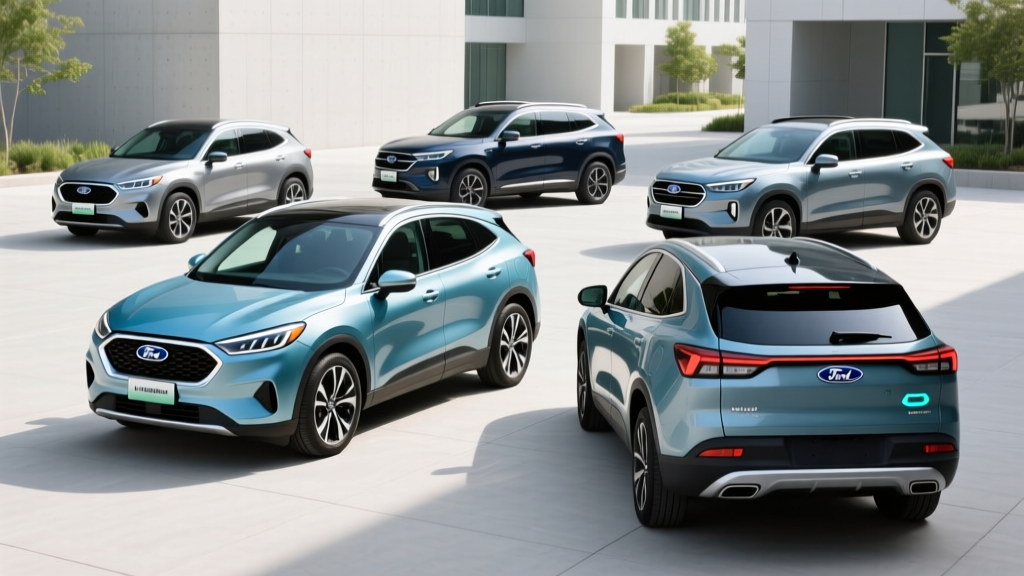
Ford's hybrid lineup in 2026 spans compact trucks, compact SUVs, and full-size pickups — but the differences between Ford's conventional hybrids (HEVs) and its plug-in hybrid (PHEV) are significant enough to change your total cost of ownership by thousands of dollars. This guide breaks down every current Ford hybrid with exact EPA figures, real-world fuel economy expectations, powertrain specs, and tax-credit eligibility so you can pick the right one.
Ford's 2026 Hybrid Lineup at a Glance
Ford offers three core hybrid models for the 2026 model year. Two are conventional hybrids (HEVs) that never need plugging in, and one is a plug-in hybrid (PHEV) that delivers short electric-only trips before the gas engine kicks in. The distinction matters: HEVs are simpler and cheaper upfront; PHEVs can eliminate daily gasoline use if your commute fits their electric range.
| Model | Type | EPA Combined MPG | Electric-Only Range | Combined HP | Battery (kWh) | Starting MSRP |
|---|---|---|---|---|---|---|
| Ford Maverick Hybrid | HEV | 42 MPG | N/A | 191 hp | 1.1 kWh | $28,490 |
| Ford Escape Hybrid | HEV | 39 MPG | N/A | 210 hp | 1.1 kWh | $34,490 |
| Ford Escape PHEV | PHEV | 37 MPG (gas) / 105 MPGe | 37 miles | 210 hp | 14.4 kWh | $39,490 |
| Ford F-150 PowerBoost | HEV | 25 MPG | N/A | 430 hp | 1.5 kWh | $62,090 |
HEV vs PHEV: Which Ford Hybrid Is Right for You?
A conventional hybrid (HEV) like the Maverick Hybrid or Escape Hybrid uses a small battery charged entirely by regenerative braking and the gas engine. You never plug it in. It improves fuel economy 30–50% over a gas-only equivalent.
A plug-in hybrid (PHEV) like the Escape PHEV has a much larger battery you charge from a wall outlet or charger. It drives on electricity alone for 37 miles before seamlessly switching to hybrid mode. If your daily driving stays under that range and you charge nightly, you may use almost no gasoline for commuting.
The choice comes down to three questions: Do you have access to overnight charging (home or workplace)? Is your daily round-trip commute under 37 miles? Are you willing to pay ~$5,000 more upfront for the PHEV's electric capability? If yes to all three, the Escape PHEV can dramatically cut your fuel spend. If not, the HEV models deliver excellent efficiency with zero behavior change.
Ford Maverick Hybrid: The MPG King of Compact Trucks
The 2026 Ford Maverick Hybrid remains one of the most fuel-efficient vehicles Ford sells, and it's the cheapest entry point into a Ford hybrid. Its 2.5-liter Atkinson-cycle four-cylinder paired with an electric motor produces 191 combined horsepower through an eCVT transmission.
| Trim/Config | City MPG | Highway MPG | Combined MPG |
|---|---|---|---|
| FWD (XL, XLT, Lariat) | 42 | 36 | 42 |
| AWD (XLT, Lariat) | 38 | 34 | 36 |
Hybrids consistently beat their EPA city estimates in stop-and-go traffic because regenerative braking recovers energy that gas cars waste as heat. Maverick Hybrid owners regularly report 44–48 MPG in urban driving. Highway MPG tends to run 2–4 MPG below the sticker because aerodynamic drag dominates at 70+ mph and the electric motor contributes less at sustained speed. Expect ~33–35 MPG on the highway in real-world FWD driving, per aggregated owner data on fueleconomy.gov.
The Maverick Hybrid's 1.1 kWh lithium-ion battery is small by design — it buffers energy for acceleration assist and regen capture, not for electric-only driving. Because it's never deeply cycled (the system keeps it between roughly 40–60% state of charge), degradation is minimal over the vehicle's life.
Who it's for: Buyers who want a practical, affordable truck with sedan-like fuel economy. The Maverick Hybrid is ideal for urban and suburban drivers who haul gear occasionally but prioritize daily efficiency. It does not offer DC fast charging because it's an HEV — there's nothing to plug in.
Ford Escape Hybrid and Escape PHEV: Two Paths to Efficiency
The 2026 Escape is where Ford's HEV and PHEV strategies sit side by side, and the differences are worth understanding before you choose a trim.
Escape Hybrid (HEV)
The Escape Hybrid pairs the same 2.5L Atkinson-cycle engine with a more powerful electric motor for 210 combined horsepower. EPA ratings land at 42 city / 36 highway / 39 combined for FWD, and 38 / 34 / 36 for AWD. Like the Maverick, it uses a 1.1 kWh battery and requires no plug.
Escape PHEV — The Electric Commuter
The Escape PHEV is the most electrified Ford short of a full BEV. Its 14.4 kWh lithium-ion battery (usable capacity approximately 12.9 kWh) delivers an EPA-rated 37 miles of electric-only range. Once that's depleted, the 2.5L engine and motor operate as a conventional hybrid at 37 MPG combined.
| Specification | Value |
|---|---|
| Electric-Only Range (EPA) | 37 miles |
| Total Range (Electric + Gas) | ~430 miles |
| MPGe (Electric Mode) | 105 MPGe combined |
| MPG (Hybrid/Gas Mode) | 37 combined (40 city / 34 hwy) |
| Battery Capacity | 14.4 kWh gross (~12.9 kWh usable) |
| Level 1 Charging (120V) | ~10–12 hours (full) |
| Level 2 Charging (240V) | ~3.5 hours (full) |
| DC Fast Charging | Not available |
| Combined System Power | 210 hp |
| 0–60 mph | ~7.5 seconds |
A critical detail many buyers miss: the Escape PHEV does not support DC fast charging. Ford limited it to Level 2 (240V, ~6.6 kW onboard charger). That's fine for overnight home charging but means you can't quickly top up on a road trip. For a PHEV with 37 miles of range, this is rarely a practical problem — most PHEV owners charge at home and only use gas on longer trips.
The 37-mile EPA electric range assumes moderate temperatures and mixed driving. In summer with A/C, expect 32–35 miles. In freezing weather with cabin heat, the battery's usable capacity drops and heating loads increase — plan for 24–28 electric miles. Highway-speed electric driving (70+ mph) also reduces range to roughly 28–30 miles. If your commute is 30 miles round-trip, the Escape PHEV can realistically cover it on electricity year-round in most US climates.
Ford F-150 PowerBoost: Full-Size Truck, Hybrid Efficiency
The F-150 PowerBoost is Ford's most powerful hybrid, combining a 3.5L twin-turbo V6 with a 35 kW electric motor integrated into the 10-speed automatic transmission. Combined output is 430 horsepower and 570 lb-ft of torque — more than the non-hybrid 3.5L EcoBoost.
EPA ratings for the 4x2 PowerBoost are 25 city / 26 highway / 25 combined. The 4x4 drops to 23 / 24 / 24. For a 5,000+ lb truck with a 13,000-lb max towing capacity, these figures represent meaningful fuel savings — especially for fleet operators and tradespeople who idle frequently (the hybrid system allows engine-off idle for power tools via the available Pro Power Onboard generator).
The PowerBoost's 1.5 kWh battery is larger than the Maverick/Escape HEV batteries because it supports the higher power demands of a full-size truck, including launch assist and sustained low-speed electric operation in stop-and-go conditions. Like all Ford HEVs, it charges through regen and the engine — no plug required.
Who it's for: Truck buyers who tow, haul, or idle on job sites and want to reduce fuel costs without sacrificing capability. The PowerBoost is not about maximizing MPG — it's about delivering full-size truck utility with ~20% better fuel economy than a comparable non-hybrid V6 F-150.
Tax Credits and Incentives for Ford Hybrids
Federal tax credit eligibility under IRS §30D is one of the most consequential — and confusing — factors in hybrid purchasing. Here's where each Ford hybrid stands in 2026:
- Ford Escape PHEV: Eligible for up to $3,750 in federal tax credit (partial credit based on battery capacity and critical-mineral sourcing requirements). The full $7,500 credit requires meeting both critical-mineral and battery-component sourcing thresholds that shift annually. Income caps apply: $150,000 single / $225,000 head of household / $300,000 joint. MSRP must not exceed $80,000 for SUVs. Check current eligibility at IRS.gov.
- Ford Maverick Hybrid (HEV): Not eligible for the §30D clean vehicle credit. Conventional hybrids do not qualify — only BEVs and PHEVs with sufficient battery capacity do.
- Ford Escape Hybrid (HEV): Not eligible for §30D.
- Ford F-150 PowerBoost (HEV): Not eligible for §30D.
The §30D credit is non-refundable for purchases (you can only use it up to your tax liability), but the point-of-sale transfer option allows you to apply it as an immediate price reduction at the dealer if you meet income requirements. Always verify current sourcing and eligibility rules before purchasing — the IRS updates critical-mineral and battery-component requirements periodically. Consult a tax professional for your specific situation.
State and local incentives vary widely. Some states (California, Colorado, New York, among others) offer additional rebates for PHEVs. Check your state energy office or the Alternative Fuels Data Center for current programs.
Battery Warranty, Reliability, and Replacement Costs
Hybrid battery longevity is the top concern for buyers considering their first hybrid. Ford's track record here is solid, and the warranties reflect manufacturer confidence.
All 2026 Ford hybrids (HEV and PHEV) carry a hybrid battery warranty of 8 years / 100,000 miles (whichever comes first). In California Air Resources Board (CARB) states, the warranty extends to 10 years / 150,000 miles. This covers battery capacity loss below a defined threshold and any manufacturing defects.
| Model | Battery Type | Warranty | CARB State Warranty | Est. Replacement Cost |
|---|---|---|---|---|
| Maverick Hybrid | 1.1 kWh Li-ion (HEV) | 8 yr / 100k mi | 10 yr / 150k mi | $2,500–$3,500 |
| Escape Hybrid | 1.1 kWh Li-ion (HEV) | 8 yr / 100k mi | 10 yr / 150k mi | $2,500–$3,500 |
| Escape PHEV | 14.4 kWh Li-ion (PHEV) | 8 yr / 100k mi | 10 yr / 150k mi | $6,000–$8,500 |
| F-150 PowerBoost | 1.5 kWh Li-ion (HEV) | 8 yr / 100k mi | 10 yr / 150k mi | $3,000–$4,500 |
For context, HEV batteries (1.1–1.5 kWh) are small and relatively inexpensive to replace. They also experience minimal degradation because the system never fully charges or fully depletes them — the battery operates in a narrow state-of-charge window that maximizes cycle life. Many Ford hybrid owners from the 2010s are still on their original batteries at 150,000+ miles.
The Escape PHEV's 14.4 kWh pack is more expensive to replace but is warrantied identically. Ford's PHEV battery management includes active thermal conditioning (liquid cooling) to reduce heat-related degradation during Level 2 charging and sustained electric driving.
Overall hybrid reliability for Ford has been competitive. The Maverick Hybrid and Escape Hybrid use the well-proven 2.5L Atkinson-cycle powertrain that Ford has refined since the 2020 model year. IIHS and NHTSA safety ratings for the current Escape and F-150 are strong, with Top Safety Pick designations where applicable.
Ford Hybrid vs Full EV vs Gas: Which Should You Buy?
Choose a Ford HEV (Maverick Hybrid, Escape Hybrid, F-150 PowerBoost) if:
- You cannot charge at home (no garage, apartment living, no workplace charging)
- You want zero behavior change — just drive and refuel like a normal car
- Your budget is tighter and you want lower upfront cost
- You regularly drive long highway distances where PHEV electric range adds little benefit
Choose the Escape PHEV if:
- You have reliable overnight charging (a standard 120V outlet is sufficient for PHEVs)
- Your daily commute is under 35 miles round-trip
- You want to drive mostly on electricity but need gas flexibility for road trips
- The ~$5,000 price premium over the Escape Hybrid pays back in fuel savings within your ownership timeline
Choose a full EV (Ford Mustang Mach-E, F-150 Lightning) if:
- You have Level 2 home charging and want to eliminate gasoline entirely
- Your daily driving is under 250 miles and you're comfortable with DC fast charging on road trips
- You want the lowest per-mile fuel cost and lowest maintenance cost
- You qualify for the full $7,500 federal tax credit, narrowing the price gap
Frequently Asked Questions
How many MPG does the Ford Maverick Hybrid get?
The 2026 Ford Maverick Hybrid FWD achieves 42 city / 36 highway / 42 combined MPG per the EPA. AWD models drop to 38 / 34 / 36. In real-world city driving, many owners report 44–48 MPG thanks to aggressive regenerative braking in stop-and-go traffic.
How far can the Escape PHEV go on electric only?
The EPA rates the 2026 Escape PHEV at 37 miles of electric-only range. In real-world conditions, expect 32–35 miles in warm weather and 24–28 miles in freezing temperatures due to battery capacity reduction and cabin heating load.
Do Ford conventional hybrids need to be plugged in?
No. The Maverick Hybrid, Escape Hybrid, and F-150 PowerBoost are conventional hybrids (HEVs). Their small batteries charge entirely through regenerative braking and the gasoline engine. You never plug them in. Only the Escape PHEV requires (and benefits from) plug-in charging.
Is the Ford hybrid battery reliable and expensive to replace?
Ford hybrid batteries are warrantied for 8 years / 100,000 miles (10 years / 150,000 miles in CARB states). HEV battery replacement costs range from $2,500–$4,500 depending on model. The Escape PHEV battery runs $6,000–$8,500. In practice, HEV batteries rarely fail before 150,000 miles due to conservative state-of-charge management.
Does any Ford hybrid qualify for a federal tax credit?
Only the Ford Escape PHEV qualifies for a federal tax credit under IRS §30D, currently up to $3,750 depending on battery sourcing requirements and your income level. Conventional Ford hybrids (Maverick, Escape HEV, F-150 PowerBoost) do not qualify for §30D credits. Verify current rules at IRS.gov before purchasing.
Can the Escape PHEV DC fast charge?
No. The Escape PHEV supports Level 1 (120V, ~10–12 hours for a full charge) and Level 2 (240V, ~3.5 hours) only. There is no DC fast charging capability. For a PHEV with 37 miles of range, overnight Level 1 or Level 2 home charging is sufficient for daily use.
Which Ford hybrid gets the best fuel economy?
The Ford Maverick Hybrid FWD at 42 MPG combined is the most fuel-efficient vehicle Ford currently sells. Among PHEVs, the Escape PHEV achieves 105 MPGe in electric mode, making it the most energy-efficient option if you can charge regularly.