Ford Fusion Hybrid MPG: What the Numbers Actually Mean in 2026
The Ford Fusion Hybrid was discontinued after the 2020 model year, but it remains one of the most searched midsize hybrids on the used market. Buyers want to know one thing above all: what kind of Ford Fusion Hybrid MPG can you actually expect? The short answer is that the 2020 Fusion Hybrid delivers an EPA-estimated 43 mpg city, 41 mpg highway, and 42 mpg combined — figures that still hold up against newer competitors. But real-world results vary, and understanding the powertrain, battery longevity, and ownership costs matters just as much as the sticker number.
This guide covers every Fusion Hybrid generation (2013–2020), the Energi plug-in variant, and how these models stack up against buying a full EV or a conventional gas sedan in 2026.
EPA Ratings and Real-World Ford Fusion Hybrid MPG
The EPA fuel economy figures changed slightly across the Fusion Hybrid's production run. Here's the breakdown by generation, sourced from fueleconomy.gov:
| Model Years | City MPG | Highway MPG | Combined MPG | Annual Fuel Cost* |
|---|---|---|---|---|
| 2020 | 43 | 41 | 42 | ~$1,150 |
| 2017–2019 | 43 | 41 | 42 | ~$1,150 |
| 2013–2016 | 44 | 41 | 42 | ~$1,150 |
*Based on 15,000 miles/year at $3.25/gallon regular unleaded. Adjust for local fuel prices.
The Fusion Hybrid's regenerative braking system recovers energy during deceleration, which is why city MPG actually exceeds highway MPG — the opposite of a conventional gas car. Drivers who adopt a smooth, anticipatory driving style (coasting to stops, gentle acceleration) routinely see 45+ mpg in warm-weather city conditions.
HEV vs. PHEV: Ford Fusion Hybrid vs. Fusion Energi
Ford offered two electrified Fusion variants, and confusing them is a common buyer mistake. Here's the critical distinction:
| Attribute | Fusion Hybrid (HEV) | Fusion Energi (PHEV) |
|---|---|---|
| Plug-in required? | No — self-charging | Yes — plug in to use electric range |
| Electric-only range | ~0.5–1 mile at low speed | 26 miles (2020 EPA) |
| Battery capacity | 1.4 kWh (usable ~1.0 kWh) | 7.6 kWh (usable ~5.8 kWh) |
| Combined MPG / MPGe | 42 mpg combined | 103 MPGe (electric) / 42 mpg (gas-only) |
| Total range | ~600 miles | ~610 miles (26 electric + ~584 gas) |
| DC fast charging | No | No — Level 2 AC only |
| Level 2 charge time | N/A | ~2.5 hours at 240V |
| Federal tax credit (new) | None | Was ~$4,007 (expired with model) |
| Trunk space | 12.0 cu ft | 8.2 cu ft (battery intrusion) |
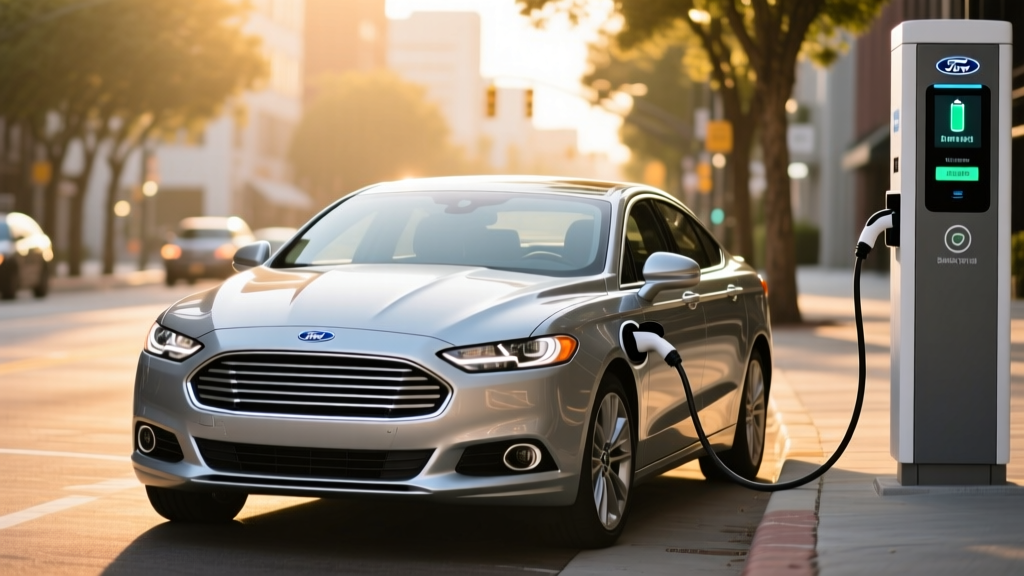
The Fusion Hybrid is a conventional HEV — it generates all electricity from the gasoline engine and regenerative braking. You never plug it in. The Fusion Energi is a plug-in hybrid (PHEV) with a larger battery that provides 26 miles of electric-only driving before the gas engine kicks in. If you can charge at home and your commute is under 26 miles, the Energi effectively becomes an EV for daily driving.
The trade-off: the Energi's larger battery cuts trunk space from 12.0 to 8.2 cubic feet and adds roughly 300 lbs of weight. If you rarely plug in, the Energi operates as a slightly heavier, slightly less efficient version of the standard Hybrid.
Powertrain and Performance Specs
| Engine | 2.0L Atkinson-cycle 4-cylinder |
| Engine power | 141 hp @ 6,000 rpm |
| Electric motor | 88 kW (118 hp) permanent-magnet AC |
| Combined net output | 195 hp |
| Transmission | eCVT (planetary gearset, not belt-driven) |
| 0–60 mph | ~8.1 seconds |
| Drivetrain | Front-wheel drive |
| Curb weight | ~3,472 lbs (Hybrid) / ~3,774 lbs (Energi) |
| Fuel tank | 13.5 gallons |
| Fuel type | Regular unleaded (87 octane) |
The Fusion Hybrid uses Ford's fourth-generation hybrid powertrain, pairing a 2.0-liter Atkinson-cycle engine with an electric motor through an electronically controlled continuously variable transmission (eCVT). Unlike the rubber-belt CVTs found in some competitors, Ford's eCVT uses a planetary gearset — a more durable design with fewer wear components. Total system output of 195 hp provides adequate acceleration for merging and passing, though it won't feel quick by modern standards.
Battery Warranty, Reliability, and Replacement Cost
The Fusion Hybrid's 1.4 kWh battery pack is small and conservatively managed — Ford engineers built in a substantial buffer, using only a fraction of total cell capacity to reduce stress. Real-world data from high-mileage owners and fleet use (notably taxi and rideservice applications) shows these packs commonly reach 150,000–200,000 miles with minimal capacity loss. The most common failure mode is individual cell imbalance rather than full pack death.
If replacement is needed, expect these costs in 2026:
- Remanufactured pack: $1,800–$2,800 (parts + labor at an independent hybrid specialist)
- New OEM pack: $3,500–$5,000 (dealer-installed)
- Used/salvage pack: $800–$1,500 (from a wrecked Fusion; condition-dependent)
The Fusion Energi's larger 7.6 kWh pack is more expensive to replace: roughly $4,000–$6,500 for a new OEM unit. However, PHEV packs in the Fusion Energi have shown strong longevity when regularly charged and not habitually deep-cycled to zero.
Overall vehicle reliability is solid. The NHTSA gave the 2020 Fusion a 5-star overall safety rating. Common non-powertrain complaints include the Sync 3 infotainment system being slow by 2026 standards, some early-model (2013–2014) reports of 12V battery drain issues, and worn brake actuators at higher mileages (the regen system means friction brakes are used less, but the hydraulic components can still age).
Used Pricing and Tax Credit Eligibility in 2026
Since the Fusion Hybrid is no longer produced, all purchases are on the used market. Here's what pricing looks like as of early 2026:
| Model Year | Trim | Mileage Range | Typical Price |
|---|---|---|---|
| 2020 | SE / Titanium | 30K–60K mi | $17,500–$22,000 |
| 2019 | SE / Titanium | 50K–80K mi | $15,000–$19,500 |
| 2017–2018 | SE / Platinum | 60K–100K mi | $12,500–$16,500 |
| 2013–2016 | SE / Titanium | 80K–140K mi | $8,000–$12,500 |
| 2020 | Energi (PHEV) | 30K–60K mi | $19,000–$24,000 |
Federal tax credit: Under current IRS §30D rules, the Fusion Hybrid (HEV) does not qualify for any federal clean vehicle credit — it has no plug and no sufficient battery. The Fusion Energi (PHEV) could theoretically qualify for the Used Clean Vehicle Credit (§25E), which provides up to $4,000 or 30% of the sale price (whichever is less) for eligible used plug-in vehicles. Requirements include:
- Sale price must be $25,000 or less
- Buyer income caps: $75,000 single / $112,500 head of household / $150,000 joint (modified AGI)
- Vehicle must be at least 2 model years old (all Fusion Energi examples qualify)
- Must purchase from a licensed dealer (private-party sales excluded)
- Credit is non-refundable — you must have tax liability to claim it
- Can only be claimed once per vehicle (check VIN history)
At typical 2026 pricing, a Fusion Energi selling for $20,000 from a dealer could yield a $4,000 credit for income-eligible buyers, effectively reducing cost to $16,000. Confirm eligibility with a tax professional before purchase — rules are subject to legislative change.
Who Should Buy the Fusion Hybrid vs. an EV or Gas Car?
Choose the Ford Fusion Hybrid if:
- You want 40+ mpg without changing your driving or fueling habits
- You lack access to home or workplace charging (no plug needed)
- Your budget is $10,000–$22,000 for a reliable midsize sedan
- You drive 12,000–20,000 miles/year and want to minimize fuel costs
- You want a proven, conservative powertrain with wide service availability
Choose the Fusion Energi (PHEV) if:
- You can charge at home (Level 1 or 2) and commute under 26 miles round-trip
- You want EV-like daily driving with gas-engine flexibility for road trips
- You qualify for the used PHEV tax credit and find one under $25,000
Choose a full EV (e.g., used Tesla Model 3, Chevy Bolt) if:
- You have reliable home Level 2 charging
- Your daily driving is under 200 miles and you rarely take long road trips
- You want near-zero maintenance (no oil changes, no exhaust system, minimal brake wear)
- You're eligible for the full $7,500 new EV credit or $4,000 used EV credit
Stick with a conventional gas car if:
- You drive very few miles per year (under 8,000) — the hybrid premium won't pay back
- You do almost entirely highway driving at high speeds — the hybrid MPG advantage shrinks
For a driver covering 15,000 miles/year at the EPA combined 42 mpg, the Fusion Hybrid uses about 357 gallons annually, costing roughly $1,160 at $3.25/gallon. A comparable gas-only midsize sedan at 28 mpg combined burns 536 gallons — about $1,742 per year. That's a $582 annual fuel savings, or roughly $2,900 over five years. Against a full EV charging at $0.14/kWh and averaging 3.5 miles/kWh, the EV's annual "fuel" cost is around $600 — saving $560/year over the Fusion Hybrid. The EV wins on operating cost, but the Hybrid wins on flexibility and zero charging infrastructure requirements.
- 42 mpg combined is real and achievable in daily driving
- No plugging in — zero lifestyle change required
- Proven eCVT powertrain with strong longevity record
- Comfortable midsize sedan with good ride quality
- Used prices are attractive; $4,000 PHEV credit available on Energi
- Regular 87-octane fuel; no premium required
- Discontinued after 2020 — no new examples available
- Original battery warranty expired or expiring on most examples
- Sync 3 infotainment feels dated vs. 2026 systems
- Energi trunk space (8.2 cu ft) is impractical for some buyers
- No DC fast charging on Energi — Level 2 only
- Not eligible for new-vehicle federal tax credits
Frequently Asked Questions
How many MPG does the Ford Fusion Hybrid get in real-world driving?
The EPA rates the 2017–2020 Fusion Hybrid at 43 city / 41 highway / 42 combined. In real-world suburban commuting with stop-and-go traffic, owners commonly report 40–45 mpg combined. Highway-only driving at speeds above 70 mph typically yields 36–39 mpg. Cold weather (below 30°F) reduces city fuel economy by roughly 10–15%. The hybrid system excels in city driving where regenerative braking recovers the most energy.
How far can the Fusion Energi go on electric only?
The 2019–2020 Fusion Energi is EPA-rated for 26 miles of electric-only range on a full charge. Earlier Energi models (2013–2016) with the smaller 6.5 kWh pack deliver approximately 19–21 miles electric-only. Real-world electric range varies with temperature and driving style — expect 20–24 miles in warm conditions and 15–18 miles in cold weather with cabin heat running. Once the battery is depleted, the Energi operates as a conventional hybrid at roughly 42 mpg combined.
Is the Ford Fusion Hybrid reliable?
Yes. The Fusion Hybrid's powertrain — particularly the eCVT planetary gearset and the 2.0L Atkinson-cycle engine — has demonstrated strong long-term reliability. The hybrid battery is conservatively managed and commonly reaches 150,000+ miles. The main ownership considerations are the age of the hybrid battery on earlier model years and standard wear items (suspension, brakes, 12V battery). Ford's hybrid system has fewer failure points than conventional automatic transmissions.
What does a Ford Fusion Hybrid battery replacement cost?
In 2026, a remanufactured hybrid battery pack for the Fusion Hybrid costs $1,800–$2,800 installed at an independent hybrid specialist. A new OEM pack from a Ford dealer runs $3,500–$5,000. Used/salvage packs are available for $800–$1,500 but carry unknown remaining life. The Fusion Energi's larger PHEV battery is more expensive: $4,000–$6,500 for a new OEM replacement.
Does the Ford Fusion Hybrid qualify for any tax credit?
The conventional Fusion Hybrid (HEV) does not qualify for any federal tax credit — it has no plug and doesn't meet clean vehicle credit requirements. The Fusion Energi (PHEV) may qualify for the IRS §25E Used Clean Vehicle Credit of up to $4,000, provided the sale price is under $25,000, the buyer meets income limits, and the vehicle is purchased from a licensed dealer. This credit is non-refundable. Consult a tax professional and verify current IRS §25E guidelines before purchasing.
Should I buy a used Fusion Hybrid or a new hybrid in 2026?
A new Toyota Camry Hybrid (52 mpg combined, starting ~$30,000) or Hyundai Sonata Hybrid (47 mpg combined, starting ~$31,000) delivers better fuel economy and a full factory warranty. However, a used Fusion Hybrid at $12,000–$18,000 represents strong value if you want a proven midsize hybrid without a new-car payment. The fuel economy gap is modest (42 vs. 47–52 mpg), and the used Fusion's lower purchase price often offsets the slightly higher fuel cost over a typical ownership period. If budget allows, a new hybrid provides warranty peace of mind; if value is the priority, the Fusion Hybrid remains a smart used buy.