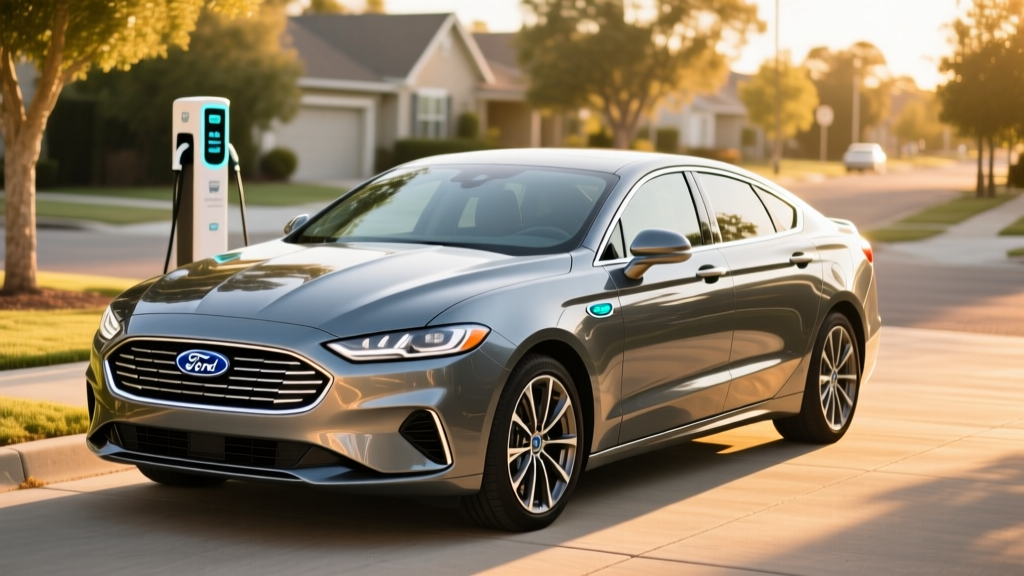
Important note for 2026 buyers: Ford discontinued the Fusion sedan after the 2020 model year, including both the Fusion Hybrid and Fusion Energi plug-in hybrid. However, the Fusion Hybrid remains one of the most popular used hybrid sedans on the market, and its fuel-economy benchmarks still influence how buyers evaluate today's midsize hybrid options. This guide covers the Fusion Hybrid's EPA MPG data, real-world efficiency, battery longevity, and how it compares to current alternatives you can buy new today.
Ford Fusion Hybrid MPG: The EPA Numbers
The final-generation Ford Fusion Hybrid (2019–2020 model years) carries EPA ratings that remain competitive with today's midsize hybrid sedans. The Fusion Energi plug-in hybrid variant offers a different value proposition with electric-only driving capability.
| Model | City MPG | Highway MPG | Combined MPG | MPGe (PHEV) |
|---|---|---|---|---|
| Fusion Hybrid (HEV) | 43 | 41 | 42 | — |
| Fusion Energi (PHEV) | 43 (charge-sustaining) | 41 (charge-sustaining) | 42 (charge-sustaining) | 103 MPGe |
Source: EPA Fuel Economy
For the conventional hybrid, the 42 MPG combined figure was among the best in its class at launch, trailing only the Toyota Camry Hybrid LE (52 MPG combined for the 2025 model year). The Fusion Hybrid's city-dominant driving profile — 43 city vs. 41 highway — is typical of series-parallel hybrid systems that lean heavily on electric motor assist in stop-and-go traffic.
Real-World MPG: What Owners Actually Report
EPA stickers are a starting point, not a guarantee. The Fusion Hybrid's real-world fuel economy varies meaningfully based on driving style, climate, and trip length.
- City / suburban commuting: 40–45 MPG (many owners exceed the EPA city rating)
- Highway cruising (70–75 mph): 36–40 MPG (aerodynamic drag reduces hybrid advantage)
- Mixed driving (annual average): 38–43 MPG
- Cold weather (below 32°F): 33–38 MPG (engine runs more for cabin heat, battery efficiency drops)
Hybrids like the Fusion tend to beat their EPA city rating in warm-weather stop-and-go driving because regenerative braking recovers energy that gas-only vehicles waste as heat. On sustained highway trips, however, the advantage narrows — the electric motor provides less assist at constant speed, and the 2.0L Atkinson-cycle engine operates without the efficiency gains of frequent deceleration events.
According to Fuelly.com owner-reported data spanning 2013–2020 models, the lifetime average across tracked Fusion Hybrids sits around 39.5 MPG, consistent with our real-world expectations for mixed driving.
Fusion Hybrid (HEV) vs. Fusion Energi (PHEV): Key Differences
Ford offered two electrified Fusion variants, and confusing them is a common buyer mistake. Here's how they differ fundamentally:
| Attribute | Fusion Hybrid (HEV) | Fusion Energi (PHEV) |
|---|---|---|
| Powertrain Type | Conventional Hybrid | Plug-in Hybrid |
| Battery Capacity | 1.4 kWh (usable) | 7.6 kWh (usable, 2019–2020) |
| Needs to Plug In? | No — self-charging via regen + engine | Yes — plugs in for EV range |
| Electric-Only Range | ~1 mile at low speed | 26 miles (EPA) |
| Total Range | ~580 miles | ~410 miles (EV + gas combined) |
| DC Fast Charging | No | No — Level 2 only (AC) |
| Level 2 Charge Time (0–100%) | N/A | ~2.7 hours (at 3.3 kW) |
| Combined Horsepower | 195 hp | 195 hp |
| Engine | 2.0L Atkinson I4 + electric motor | 2.0L Atkinson I4 + electric motor |
| Trunk Space | 12.0 cu ft | 8.2 cu ft (battery intrusion) |
The Fusion Energi's 26-mile electric-only range was adequate for short commutes in 2020 but falls well short of current PHEV leaders. For context, the 2025 Toyota RAV4 Prime delivers 42 miles of EV range, and the 2026 Hyundai Tucson PHEV offers approximately 33 miles. The Energi's smaller trunk (8.2 cu ft vs. 12.0 cu ft) is a meaningful trade-off caused by the larger battery pack occupying cargo space.
Powertrain and Performance Specifications
| Specification | Detail |
|---|---|
| Engine | 2.0L Atkinson-cycle inline-4 |
| Engine Power | 141 hp @ 6,000 rpm |
| Electric Motor Power | 120 hp (88 kW) |
| Combined System Output | 195 hp |
| Transmission | eCVT (planetary gearset, not belt-driven) |
| 0–60 mph | ~8.1 seconds |
| Drivetrain | Front-wheel drive |
| Curb Weight | ~3,600 lbs (HEV), ~3,900 lbs (Energi) |
Ford's eCVT is a power-split device — not the rubber-belt CVT found in some competitors. It uses a planetary gearset to blend engine and motor power seamlessly, which is mechanically robust and avoids the "rubber-band" acceleration feel of traditional CVTs. This same architecture is used in Toyota's Hybrid Synergy Drive and is among the most proven hybrid drivetrain designs in production.
Battery Longevity, Warranty, and Replacement Cost
- Federal mandate (all states): 8 years / 100,000 miles — hybrid battery and hybrid-specific components
- CARB states (CA, NY, MA, and others): 10 years / 150,000 miles
- Capacity threshold: Warranty covers defects and premature degradation; Ford does not publish a specific capacity-retention percentage trigger as some EV makers do
The Fusion Hybrid uses a lithium-ion battery pack (in 2013+ models; earlier models used NiMH). Real-world data suggests these packs hold up well — it's common to see Fusion Hybrids with 150,000+ miles on original batteries with minimal capacity loss. The hybrid system's relatively small battery undergoes shallow charge-discharge cycles (typically operating between 40–60% state of charge), which dramatically reduces degradation compared to a full EV battery that cycles from 10–90%.
Battery replacement cost: If the hybrid battery does fail out of warranty, expect to pay $2,500–$4,500 for a replacement pack including labor at a dealership. Third-party refurbished batteries are available for $1,500–$2,500. This is a fraction of EV battery replacement costs, which can exceed $10,000–$20,000, because the Fusion Hybrid's pack is small (1.4 kWh usable for the HEV).
According to NHTSA recall data, the Fusion Hybrid battery has not been subject to widespread fire-risk recalls, unlike some early-generation PHEVs from other manufacturers.
Pricing and Tax Credit Eligibility (2026 Used Market)
Because the Fusion Hybrid is discontinued, all purchases in 2026 are on the used market. Pricing varies by model year, mileage, and condition:
| Model Year | Mileage Range | Typical Price Range |
|---|---|---|
| 2020 | 30,000–60,000 mi | $19,000–$24,000 |
| 2019 | 50,000–80,000 mi | $16,000–$21,000 |
| 2017–2018 | 70,000–110,000 mi | $12,000–$17,000 |
| 2013–2016 | 90,000–140,000 mi | $8,000–$13,000 |
Federal tax credit — used EV credit (§25E): The Fusion Hybrid (HEV) does not qualify for the federal used clean vehicle credit. That credit applies only to used battery-electric vehicles and plug-in hybrids meeting specific battery-capacity thresholds. The conventional Fusion Hybrid is not eligible.
Fusion Energi (PHEV) used credit: The Fusion Energi may qualify for the §25E used clean vehicle credit of up to $4,000 (30% of sale price, capped at $4,000), subject to these IRS requirements:
- Sale price must be $25,000 or less
- Buyer income cap: $75,000 single / $112,500 head of household / $150,000 joint
- Vehicle must be at least 2 model years old
- Must purchase from a licensed dealer
- Vehicle must have a battery capacity of at least 7 kWh (the Energi's 7.6 kWh qualifies)
Source: IRS §25E Used Clean Vehicle Credit
Fusion Hybrid vs. Current Alternatives: What to Buy in 2026
If you're cross-shopping a used Fusion Hybrid against new hybrid sedans available today, here's how the landscape looks:
| Vehicle | Combined MPG | Combined HP | Starting Price | Status |
|---|---|---|---|---|
| Ford Fusion Hybrid (2020) | 42 | 195 | ~$19K–$24K (used) | Discontinued |
| Toyota Camry Hybrid (2025) | 52 (LE) | 225 | $30,495 | Current |
| Honda Accord Hybrid (2025) | 48 (Sport) | 204 | $33,655 | Current |
| Hyundai Sonata Hybrid (2025) | 47 (Blue) | 192 | $31,250 | Current |
| Kia K5 Hybrid (2025) | 44 | 192 | $31,090 | Current |
The 2025 Camry Hybrid's 52 MPG combined (LE trim) represents a significant efficiency leap over the Fusion, thanks to Toyota's fifth-generation hybrid system. However, a used Fusion Hybrid at $19,000–$24,000 still represents strong value for buyers who want proven hybrid fuel economy without a $30,000+ new-car commitment.
- Choose the used Fusion Hybrid if: Budget is under $25,000, you want proven hybrid reliability with strong city MPG, and you prefer a sedan over a crossover.
- Choose a new Camry/Accord Hybrid if: You want a full warranty, the latest safety tech (standard AEB, lane-keeping), and maximum MPG — and your budget supports $30K+.
- Choose a PHEV (RAV4 Prime, Tucson PHEV) if: You have home charging, a commute under 30–40 miles, and want electric-only daily driving with gas-engine backup for road trips.
- Choose a full EV (Tesla Model 3, Hyundai Ioniq 6) if: You have reliable home charging, want zero tailpipe emissions, and your daily driving is under 250 miles with access to DC fast charging for road trips.
Pros and Cons of the Ford Fusion Hybrid
Pros
- Strong 42 MPG combined; often exceeds EPA in city driving
- Proven eCVT powertrain with excellent reliability record
- Comfortable ride quality and composed handling for a hybrid
- Spacious rear seat and decent trunk (12 cu ft for HEV)
- Available used at attractive price points ($12K–$24K)
- Hybrid battery warranty may still apply on low-mileage 2019–2020 examples
Cons
- Discontinued — no new models, no latest safety/tech features
- Highway MPG (41) trails newer hybrids like Camry (50+)
- Fusion Energi PHEV has only 26 miles EV range and small trunk
- No all-wheel-drive option (unlike Camry Hybrid AWD)
- Infotainment (SYNC 3) feels dated vs. 2025 systems
- No DC fast charging on Energi (Level 2 only at 3.3 kW)
Frequently Asked Questions
How many MPG does the Ford Fusion Hybrid get?
The 2019–2020 Ford Fusion Hybrid is EPA-rated at 43 city / 41 highway / 42 combined MPG. Real-world mixed driving typically yields 38–43 MPG, with city commuters often exceeding 43 MPG in warm weather and highway-heavy drivers seeing 36–40 MPG.
How far can the Fusion Energi go on electric only?
The 2019–2020 Fusion Energi provides 26 miles of EPA-rated electric-only range on a full charge. After the battery depletes, it operates as a conventional hybrid at 42 MPG combined. Total range (EV + gas) is approximately 410 miles. This is modest by 2026 PHEV standards — the RAV4 Prime offers 42 miles EV, and several new PHEVs exceed 35 miles.
Hybrid vs. PHEV vs. EV — which fits my lifestyle?
Hybrid (HEV): Best if you can't charge at home, drive varied routes, and want fuel savings with zero behavior change. The Fusion Hybrid is a strong example.
PHEV: Best if you have home Level 2 charging, a commute under your vehicle's EV range, and want electric daily driving with gas flexibility for longer trips.
Full EV (BEV): Best if you have home charging, want lowest per-mile fuel cost, and your typical trips fit within 250+ miles of range (with DC fast charging available for road trips).
Is the Fusion Hybrid reliable, and what does battery replacement cost?
The Fusion Hybrid has a strong reliability record. Ford's power-split eCVT is mechanically simple and proven. The hybrid battery typically lasts well beyond 150,000 miles with minimal degradation. Out-of-warranty replacement costs $2,500–$4,500 at a dealer, or $1,500–$2,500 for a refurbished pack. Federal warranty mandates cover the battery for at least 8 years / 100,000 miles (10 years / 150,000 miles in CARB states).
Does the Ford Fusion Hybrid qualify for any tax credit?
The conventional Fusion Hybrid (HEV) does not qualify for any federal tax credit — new or used. The Fusion Energi (PHEV) may qualify for the §25E used clean vehicle credit of up to $4,000 if purchased from a dealer for $25,000 or less and the buyer meets income caps. The original §30D new-vehicle credit for the Energi expired when the model was discontinued. Always verify current eligibility on IRS.gov before purchasing.
Does the Fusion Hybrid need to be plugged in?
No. The conventional Fusion Hybrid (HEV) charges its battery entirely through regenerative braking and the gasoline engine. You never plug it in. Only the Fusion Energi (PHEV) requires plugging in to access its 26-mile electric-only range — if you don't plug the Energi in, it simply operates as a heavier conventional hybrid at 42 MPG combined.