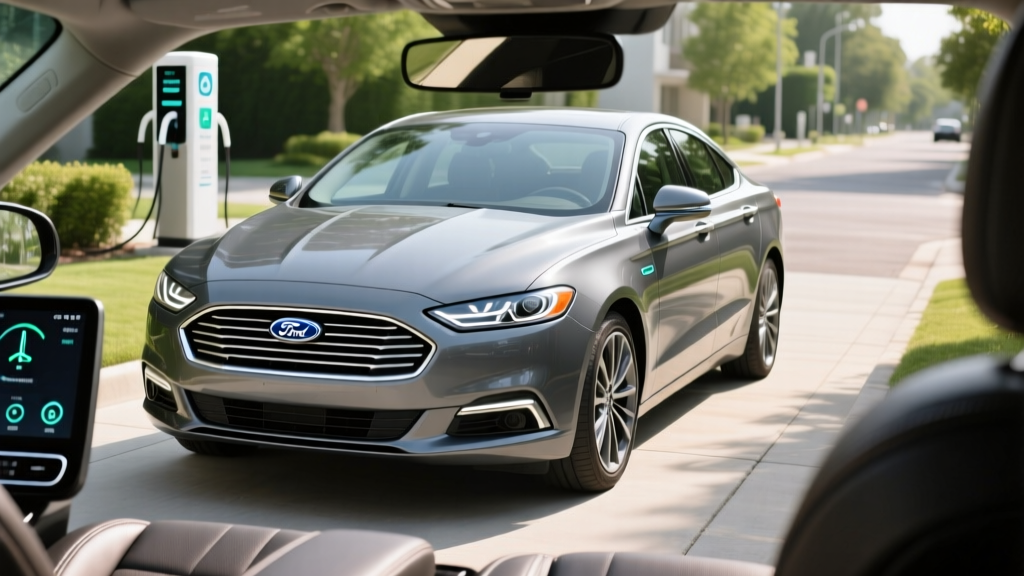
The Ford Fusion Hybrid was discontinued after the 2020 model year, but it remains one of the most popular midsize hybrid sedans on the used market. If you're shopping for a Ford Fusion Hybrid 2020 in 2026, you're likely weighing its proven fuel economy against newer hybrids and full EVs. This guide covers everything a data-driven buyer needs: exact EPA MPG figures, real-world fuel economy, powertrain specs, battery longevity, replacement costs, and how it stacks up against the PHEV variant and modern alternatives.
Ford Fusion Hybrid vs. Fusion Energi: HEV or PHEV?
Before diving into specs, it's critical to distinguish between the two electrified Fusion variants Ford offered in 2020. Confusing them is one of the most common buyer mistakes in the used market.
| Feature | Fusion Hybrid (HEV) | Fusion Energi (PHEV) |
|---|---|---|
| Powertrain type | Conventional Hybrid (HEV) | Plug-in Hybrid (PHEV) |
| Plug-in charging required? | No — self-charging via regenerative braking | Yes — J1772 Level 2 (120V Level 1 included) |
| Battery capacity (usable) | 1.4 kWh (lithium-ion) | 7.6 kWh (lithium-ion) |
| Electric-only range | N/A (brief EV assist only) | 26 miles (EPA) |
| Combined horsepower | 188 HP | 188 HP (195 HP with full charge) |
| EPA combined MPG / MPGe | 42 MPG combined | 42 MPG (gas) / 103 MPGe (EV mode) |
| DC fast charging | Not applicable | No — Level 2 AC only |
| Cargo space (trunk) | 12.0 cu ft | 8.2 cu ft (battery intrusion) |
Bottom line: The Fusion Hybrid is a conventional HEV — it charges itself through regenerative braking and the gas engine. You never plug it in. The Fusion Energi is a PHEV that offers 26 miles of electric-only driving when plugged in, but sacrifices trunk space to the larger battery. Both share the same 2.0L Atkinson-cycle 4-cylinder engine and electric motor architecture.
EPA Fuel Economy and Real-World MPG
Fuel economy is the primary reason buyers choose the Fusion Hybrid. Here are the official EPA estimates from fueleconomy.gov for the 2020 Ford Fusion Hybrid:
| Driving Condition | EPA Estimate | Real-World Expectation |
|---|---|---|
| City | 43 MPG | 44–48 MPG (hybrids excel in stop-and-go) |
| Highway | 41 MPG | 36–39 MPG (sustained high speed reduces regen benefit) |
| Combined | 42 MPG | 39–45 MPG (varies by driving mix) |
Why real-world city MPG often beats the EPA sticker: Hybrid powertrains recapture energy through regenerative braking every time you slow down. In heavy traffic with frequent stops, the Fusion Hybrid runs on its electric motor more often and the gas engine shuts off at idle. Owners on Fuelly and hybrid forums consistently report 44–48 MPG in urban driving.
Highway caveat: At sustained speeds above 65 mph, the electric motor provides minimal assist and aerodynamic drag dominates. Expect highway fuel economy to dip to 36–39 MPG, especially in winter when cold air density increases drag and the engine runs more frequently for cabin heat. If your commute is 90% highway, a conventional hybrid's advantage over an efficient gas car narrows considerably.
Powertrain Specs: Engine, Motor, and Performance
| Specification | Value |
|---|---|
| Engine | 2.0L Atkinson-cycle inline-4 |
| Engine horsepower | 141 HP @ 6,000 RPM |
| Electric motor output | 118 HP (88 kW) |
| Combined system output | 188 HP |
| Transmission | eCVT (planetary gearset, not a belt CVT) |
| 0–60 mph | ~8.0 seconds |
| Drivetrain | Front-wheel drive (FWD only, no AWD option) |
| Fuel tank capacity | 13.5 gallons |
| Total driving range | ~567 miles (13.5 gal × 42 MPG) |
The Fusion Hybrid's eCVT is a key reliability advantage. Unlike belt-driven continuously variable transmissions found in some competitors, Ford uses a planetary gearset that seamlessly blends engine and motor power. There are no belts, cones, or friction surfaces to wear out — this is the same proven architecture Toyota uses in its Prius and Camry Hybrid lineups. The result is smooth, quiet acceleration with minimal maintenance concerns.
At 188 combined horsepower, the Fusion Hybrid is adequate for daily driving and highway merging but won't feel sporty. The electric motor delivers instant torque from a stop, making it feel peppier than the 0–60 time suggests in city driving. For comparison, the gas-only 2020 Fusion with the 1.5L EcoBoost makes 181 HP — the hybrid actually has a slight edge while delivering nearly double the fuel economy.
Battery Longevity, Warranty, and Replacement Cost
How long will the battery actually last? The Fusion Hybrid's 1.4 kWh lithium-ion battery is relatively small and is never fully charged or fully discharged — Ford's battery management system maintains a buffer at both ends to minimize degradation. This "shallow cycling" strategy is why hybrid batteries routinely outlast their warranty periods. Based on fleet data and owner reports from similar Ford hybrid powertrains, expect the battery to retain 80–90% of its original capacity at 150,000 miles under normal use.
Battery replacement cost: If the battery does fail outside warranty, replacement costs for the 2020 Fusion Hybrid typically range from $2,000 to $3,500 for a refurbished or aftermarket unit, or $3,500 to $5,000 for a new OEM battery pack installed at a Ford dealer. However, individual battery modules can often be replaced for $500–$1,200 if only specific cells have degraded — a hybrid specialist shop can diagnose this. Given the battery's track record, most used buyers will never face this cost.
Signs of battery degradation to watch for (used buyers):
- Noticeable drop in city MPG (e.g., consistently below 38 MPG in stop-and-go driving)
- The gas engine running more frequently at low speeds or at stoplights
- A dashboard warning light indicating hybrid system or battery fault
- Reduced regenerative braking feel (less deceleration when lifting off the accelerator)
Pricing and Tax Credit Eligibility in 2026
The 2020 Ford Fusion Hybrid was originally offered in three trims with the following MSRP:
- S Hybrid: ~$23,270 (base)
- SE Hybrid: ~$25,720
- Titanium Hybrid: ~$31,215
As of 2026, used 2020 Fusion Hybrid pricing typically ranges from $14,000 to $22,000 depending on mileage, trim, and condition, based on Kelley Blue Book and Edmunds market data.
Federal tax credit status: The 2020 Fusion Hybrid (conventional HEV) does not qualify for the federal §30D clean vehicle tax credit. The §30D credit applies only to new plug-in electric vehicles (BEVs and PHEVs meeting battery-sourcing and MSRP requirements). Conventional hybrids are not eligible under current IRS rules.
Used EV credit (IRC §25E): The Fusion Hybrid also does not qualify for the up-to-$4,000 used clean vehicle credit, which requires the vehicle to be a plug-in EV or fuel cell vehicle. As a self-charging hybrid, it falls outside both credit programs.
State incentives: Some states offer rebates or HOV lane access for hybrid vehicles, but these programs vary widely and change frequently. Check your state's energy or environmental agency website for current offerings. California's Clean Vehicle Rebate Project (CVRP), for example, has historically excluded conventional hybrids in favor of PHEVs and BEVs.
2020 Ford Fusion Energi (PHEV): Electric-Only Range and Charging
If you're considering the plug-in variant instead, here are the key numbers for the 2020 Fusion Energi:
| Specification | Value |
|---|---|
| Electric-only range (EPA) | 26 miles |
| Total range (EV + gas) | ~500+ miles |
| Battery capacity (usable) | 7.6 kWh lithium-ion |
| MPGe (electric mode) | 103 MPGe combined |
| MPG (gas-only, battery depleted) | 42 MPG combined |
| Level 1 charging (120V) | ~7 hours (full charge) |
| Level 2 charging (240V) | ~2.5 hours (full charge) |
| DC fast charging | Not supported |
| Charging connector | J1772 (standard AC) |
| Original MSRP (SE) | ~$33,300 |
The Energi's 26-mile electric-only range is enough to cover most daily commutes without using gas — but only if you charge it nightly. Without regular plug-in charging, the Energi functions as a conventional hybrid with a heavier battery penalty (expect 38–40 MPG in charge-depleted mode vs. 42 MPG for the lighter HEV). The Energi also lost 3.8 cubic feet of trunk space to the larger battery, dropping from 12.0 to 8.2 cu ft — a meaningful compromise for a family sedan.
Charging the Energi at home: A standard 120V outlet (Level 1) will fully recharge the 7.6 kWh battery overnight in about 7 hours. A 240V Level 2 home charger cuts that to roughly 2.5 hours. The Energi does not support DC fast charging — there is no CCS or CHAdeMO port. For PHEV owners, Level 2 home charging is the practical sweet spot.
Reliability and What to Inspect on a Used 2020 Fusion Hybrid
The 2020 Fusion Hybrid benefits from being the final model year of a nameplate that had been refined over two generations (2013–2020). The hybrid powertrain, shared in concept with the Ford C-Max and Escape Hybrid, has a strong reliability track record. The IIHS named the 2020 Fusion a Top Safety Pick+ when equipped with specific headlights, and it earned a 5-star overall rating from NHTSA.
Key areas to inspect on a used example:
- Hybrid battery health: Ask for a state-of-health (SoH) readout from a Ford dealer or hybrid specialist. Any SoH below 80% at under 100,000 miles may indicate a warranty-covered issue.
- Brake wear: Regenerative braking significantly extends pad life. Original brake pads at 60,000+ miles are common. If they've been replaced early, ask why.
- 12V auxiliary battery: Like all hybrids, the Fusion has a conventional 12V battery that powers electronics. These typically last 3–5 years. A weak 12V battery can cause hybrid system errors even if the high-voltage battery is healthy.
- Transmission fluid: Ford recommends eCVT fluid inspection at 150,000 miles, but many owners opt for a drain-and-fill at 60,000–100,000 miles as preventive maintenance.
- Infotainment/software: The SYNC 3 system in the 2020 model is generally reliable, but confirm that Apple CarPlay/Android Auto connectivity works and that all software updates have been applied.
Hybrid vs. PHEV vs. Full EV: Which Is Right for You?
- Choose the Fusion Hybrid (HEV) if: You want maximum fuel economy with zero lifestyle change — no charging, no range planning, no home electrical work. Ideal for apartment dwellers, street parkers, or anyone without reliable access to a plug. Best for drivers covering 10,000–15,000 miles/year with a mix of city and highway.
- Choose the Fusion Energi (PHEV) if: You have home charging access (garage or driveway with an outlet) and a commute under 25 miles round-trip. You'll drive most days on electricity alone and take gas-powered road trips without range anxiety. The trunk sacrifice matters less if you don't regularly haul cargo.
- Choose a full EV (BEV) instead if: You have reliable Level 2 home charging, your daily driving is under 250 miles, you want to eliminate gas entirely, and you're buying new to capture the §30D federal tax credit (up to $7,500 for eligible new EVs). Consider models like the Hyundai Ioniq 6, Tesla Model 3, or Chevrolet Equinox EV — all offer 300+ miles of range and lower per-mile fuel costs than any hybrid.
Pros, Cons, and the Bottom Line for 2026 Buyers
- 42 MPG combined EPA; often exceeds in city driving
- No plug-in charging required — zero infrastructure cost
- Proven eCVT planetary gearset (no belt wear)
- Top Safety Pick+ (IIHS) with proper headlights
- Spacious 12.0 cu ft trunk (vs. 8.2 in Energi)
- Smooth, quiet electric-motor assist in city traffic
- Strong used-market availability at $14K–$22K
- Discontinued — no new units, limited future parts support
- No AWD option (FWD only)
- No federal or state tax credits (HEV ineligible)
- Highway MPG drops to 36–39 at sustained speeds
- Modest 188 HP — adequate but not quick
- SYNC 3 infotainment dated vs. 2026 standards
- Used battery health varies — inspection essential
The 2020 Ford Fusion Hybrid remains a smart used-car buy in 2026 for drivers who prioritize fuel savings without the complexity of plug-in charging. Its combination of proven hybrid reliability, strong city MPG, and comfortable midsize-sedan packaging makes it competitive even against newer hybrids like the Toyota Camry Hybrid (52 MPG combined) and Honda Accord Hybrid (48 MPG combined) — though those models command higher used prices. If you can verify battery health and find one within your budget, the Fusion Hybrid delivers predictable, low-cost motoring for years to come.
Frequently Asked Questions
How many MPG does the 2020 Ford Fusion Hybrid get?
The EPA rates the 2020 Fusion Hybrid at 43 MPG city, 41 MPG highway, and 42 MPG combined. In real-world city driving, many owners report 44–48 MPG thanks to frequent regenerative braking. Highway driving at sustained speeds typically yields 36–39 MPG.
How far can the Fusion Energi go on electric only?
The 2020 Fusion Energi (PHEV) has an EPA-rated electric-only range of 26 miles on a full charge. Once the battery is depleted, it operates as a conventional hybrid with 42 MPG combined. Total combined range (electric + gas) exceeds 500 miles.
Does the 2020 Ford Fusion Hybrid qualify for any tax credit?
No. Conventional hybrids (HEVs) do not qualify for the federal §30D clean vehicle credit or the §25E used EV credit. These credits apply only to plug-in vehicles (BEVs and qualifying PHEVs). The Fusion Energi PHEV originally qualified for a federal credit when new, but that credit is no longer available for used purchases under current IRS rules.
Is the 2020 Fusion Hybrid reliable, and what does battery replacement cost?
Yes — the Fusion Hybrid's powertrain is well-proven, with a planetary eCVT that avoids belt-wear issues. The 1.4 kWh battery is covered by an 8-year/100,000-mile warranty (10 years/150,000 miles in CARB states). Full battery replacement costs $2,000–$5,000 depending on OEM vs. refurbished, but most batteries outlast the warranty with 80–90% capacity retained at 150,000 miles.
Should I buy a used Fusion Hybrid or a newer Camry/Accord Hybrid?
The Fusion Hybrid offers strong value at $14,000–$22,000 used, undercutting comparable Camry and Accord Hybrids by $5,000–$10,000. However, the Toyota and Honda hybrids deliver 48–52 MPG combined, have stronger long-term parts support, and may carry remaining factory warranty. If budget is the priority, the Fusion Hybrid is excellent. If you plan to keep the car 10+ years, the Camry Hybrid's parts ecosystem and slightly higher MPG may justify the premium.