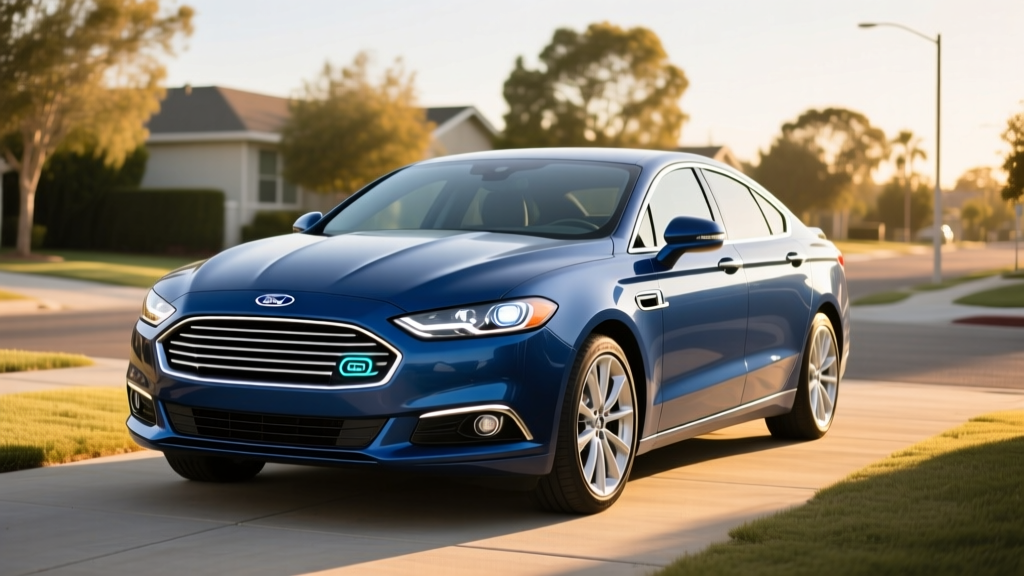
The Ford Fusion Hybrid was discontinued after the 2020 model year, but the 2019 version remains one of the most popular used midsize hybrids on the market. With an EPA-rated 42 MPG combined, a proven Atkinson-cycle powertrain, and a battery warranty that still covers many examples on dealer lots today, the 2019 Fusion Hybrid is a practical entry point for buyers who want hybrid efficiency without plug-in complexity or full-EV range concerns.
This guide breaks down the exact fuel economy figures, powertrain specs, battery longevity data, used-market pricing, and ownership economics you need to evaluate a 2019 Ford Fusion Hybrid in 2026.
HEV vs. PHEV: Which 2019 Fusion Are You Looking At?
Ford sold two electrified Fusion variants in 2019, and confusing them is the most common buyer mistake. Here's the critical distinction:
| Attribute | 2019 Fusion Hybrid (HEV) | 2019 Fusion Energi (PHEV) |
|---|---|---|
| Powertrain Type | Conventional hybrid — no plug | Plug-in hybrid — charges via outlet/station |
| EPA Combined MPG | 42 MPG (gas only) | 42 MPG (gas) + 103 MPGe (electric) |
| Electric-Only Range | N/A (EV assist only, ~1 mi) | 25 miles (EPA) |
| Battery Capacity | 1.4 kWh (usable ~1.0 kWh) | 7.6 kWh (usable ~5.8 kWh) |
| Plug Required? | No — regenerates via braking & engine | Yes — Level 1 (120V) or Level 2 (240V) |
| DC Fast Charging | No | No |
| Trunk Space | 12.0 cu ft | 8.2 cu ft (battery intrusion) |
| Federal Tax Credit (New) | None | Expired — was ~$4,007 when new |
This article focuses primarily on the 2019 Ford Fusion Hybrid (HEV), the conventional self-charging model. If you're considering the Energi plug-in variant, we address its specifics throughout and in the FAQ section.
Fuel Economy: EPA Ratings vs. Real-World MPG
The 2019 Fusion Hybrid carries an EPA rating of 43 city / 41 highway / 42 combined MPG, according to fueleconomy.gov. These numbers remain competitive against newer midsize hybrids in 2026.
| Driving Scenario | EPA Rating | Real-World Expectation |
|---|---|---|
| City | 43 MPG | 44–50 MPG (hybrids excel in stop-and-go regen) |
| Highway (70 mph) | 41 MPG | 36–40 MPG (aero drag, less regen benefit) |
| Combined | 42 MPG | 38–45 MPG (depends on route mix) |
| Cold Weather (below 32°F) | — | 33–38 MPG (engine runs more for cabin heat) |
Key insight: Unlike gas cars, hybrids typically exceed their EPA city rating in real-world urban driving because regenerative braking recaptures energy at every stop. Highway efficiency drops because the electric motor provides less assist at sustained high speeds and the engine bears the full load. In winter, expect a 10–15% MPG penalty as the engine cycles on more frequently to provide cabin heat — the Fusion Hybrid lacks a heat pump.
With a 13.5-gallon fuel tank, the real-world driving range sits between 510 and 600 miles depending on conditions — enough for most commutes to require just one fill-up per week.
Powertrain and Performance Specs
| Specification | 2019 Ford Fusion Hybrid |
|---|---|
| Engine | 2.0L Atkinson-cycle I4 |
| Engine Output | 141 hp / 129 lb-ft torque |
| Electric Motor | Permanent-magnet AC synchronous, 118 hp |
| Combined System Output | 188 hp |
| Transmission | eCVT (planetary gearset, not belt-driven) |
| 0–60 mph | ~7.8 seconds |
| Drivetrain | Front-wheel drive |
| Curb Weight | ~3,630 lbs |
| Towing Capacity | Not rated for towing |
The 2.0L Atkinson-cycle engine prioritizes thermal efficiency over peak power, while the electric motor fills in low-end torque. The eCVT isn't a traditional continuously variable transmission with a steel belt — it uses a planetary gearset to blend engine and motor power, which is mechanically simpler and more durable than belt-type CVTs. This is the same architecture Toyota pioneered, and Ford's implementation has proven reliable over hundreds of thousands of fleet miles.
Battery Health, Warranty, and Replacement Cost
The 2019 Fusion Hybrid uses a 1.4 kWh lithium-ion traction battery (supplied by LG Chem) mounted behind the rear seats. This is a small battery by design — it buffers energy from regenerative braking and assists during acceleration, then recharges continuously from the engine.
Battery Warranty Coverage
- Hybrid Battery: 8 years / 100,000 miles (10 years / 150,000 miles in CARB states including CA, NY, MA, and others)
- Hybrid Components: 8 years / 100,000 miles
- Capacity Threshold: Ford warrants the battery will retain sufficient capacity to meet emissions and fuel-economy standards — typically interpreted as ~70% state of health
For a 2019 model, the standard 8-year warranty expires in 2027. CARB-state vehicles retain coverage through 2029 or 150,000 miles.
Degradation reality: Because the Fusion Hybrid's battery is small and the system avoids deep discharge cycles (it typically operates between 40–60% state of charge), degradation is minimal in practice. Fleet data and owner reports indicate most Fusion Hybrid batteries retain 85–90% capacity after 100,000 miles. Catastrophic failure is rare.
Replacement cost if out of warranty:
- New OEM battery pack: $2,500–$3,800 (parts + labor at a Ford dealer)
- Refurbished/remanufactured pack: $1,500–$2,200 (independent hybrid shops)
- Individual module replacement: $300–$600 (some shops replace only failed modules)
Given the modest battery size and conservative charge management, battery replacement is unlikely to be needed during typical ownership of a 2019 model. It remains a lower-risk proposition than the larger batteries in PHEVs or full EVs.
Used Pricing and Tax Credit Eligibility
As of early 2026, the 2019 Ford Fusion Hybrid trades on the used market between $13,000 and $20,000, depending on mileage, condition, trim level (SE or Titanium), and region. Low-mileage Titanium examples with under 40,000 miles command the upper end.
Federal tax credit status:
- The new-vehicle §30D credit does not apply — the Fusion Hybrid was never eligible (conventional HEVs have not qualified since the credit was restructured).
- The used-vehicle clean vehicle credit (up to $4,000 or 30% of sale price, whichever is lower, under IRS §25E) may apply if you purchase from a licensed dealer, the sale price is $25,000 or less, your income falls below IRS thresholds ($75,000 single / $150,000 joint), and the vehicle is at least two model years old. However, the Fusion Hybrid is a conventional HEV, not a PHEV or BEV, so it does not qualify for the §25E used-vehicle credit. That credit requires the vehicle to have a battery capacity of at least 7 kWh and be a PHEV or BEV.
The 2019 Fusion Energi (PHEV) with its 7.6 kWh battery can qualify for the used-vehicle credit if purchased from a dealer under the income and price caps. Check current IRS rules at irs.gov before purchasing.
Driving Experience, Tech, and Practicality
The 2019 Fusion Hybrid drives like a conventional midsize sedan with seamless electric assist. The transition between electric and gas power is nearly imperceptible — a mark of Ford's mature hybrid calibration. Steering is light and predictable, ride quality is comfortable, and cabin noise is well-managed.
Standard and available features (by trim):
- SE: 8-inch SYNC 3 touchscreen, Apple CarPlay/Android Auto, dual-zone climate, Ford Co-Pilot360 (automatic emergency braking, lane-keeping, blind-spot monitoring), adaptive cruise control
- Titanium: Leather seats, 12-speaker Sony audio, navigation, heated front seats, ambient lighting, rear parking sensors
Cargo: 12.0 cubic feet of trunk space — competitive for the class and unaffected by the small hybrid battery. The rear seats do not fold flat due to the battery partition, which limits longer cargo.
Pros
- 42 MPG combined; often exceeds EPA in city driving
- Proven, low-risk hybrid system with minimal degradation
- Comfortable ride with solid build quality
- Strong safety suite (Co-Pilot360 standard on all trims)
- No plug required — zero lifestyle change vs. gas car
- Battery warranty may still apply through 2027–2029
Cons
- Discontinued — no new examples available
- Rear seats don't fold flat
- No DC fast charging (not applicable for HEV)
- Highway MPG drops noticeably above 70 mph
- Cold-weather MPG penalty of 10–15%
- No federal tax credit eligibility for the HEV variant
Who Should Buy This Hybrid vs. a PHEV or Full EV?
Choose the 2019 Fusion Hybrid (HEV) if:
- You lack access to home or workplace charging (apartment, street parking)
- Your budget is $13,000–$18,000 for a reliable used sedan
- You drive 15,000+ miles/year and want consistent MPG without behavior changes
- You want zero learning curve — fuel it like a gas car, get 42 MPG
Choose a used PHEV (like the Fusion Energi) if:
- You can charge at home (even a 120V outlet works overnight for 25 miles)
- Your daily commute is under 30 miles — you'll rarely burn gas
- You want the used-vehicle tax credit (up to $4,000 on dealer purchases under $25K)
Choose a full EV (like a used Bolt EV or Model 3) if:
- You have reliable Level 2 home charging
- You want zero oil changes, zero emissions from the tailpipe
- Your daily driving is under 200 miles and you can plan road-trip charging
At current 2026 gas prices (~$3.10/gal national average), the Fusion Hybrid saves roughly $700–$900 per year in fuel compared to a comparable 25-MPG gas sedan for a driver covering 15,000 miles annually. Over five years, that's $3,500–$4,500 in fuel savings — often enough to offset the hybrid's used-market premium over a gas-only Fusion.
Frequently Asked Questions
How many MPG does the 2019 Ford Fusion Hybrid actually get?
The EPA rates it at 43 city / 41 highway / 42 combined. In real-world city driving with frequent stops, many owners report 45–50 MPG thanks to regenerative braking. Highway-only trips at 75+ mph typically return 36–39 MPG. Cold weather reduces efficiency by 10–15%.
How far can the 2019 Fusion Energi go on electric only?
The Fusion Energi PHEV is EPA-rated for 25 miles of electric-only range on a full charge. Real-world results vary from 20–28 miles depending on temperature, speed, and terrain. After the battery depletes, it operates as a conventional hybrid at 42 MPG combined.
Does the 2019 Fusion Hybrid need to be plugged in?
No. The conventional Fusion Hybrid (HEV) charges its battery entirely through regenerative braking and the gasoline engine. There is no plug and no charging cable. The Fusion Energi (PHEV) does require plugging in to access its 25-mile electric range.
Is the 2019 Fusion Hybrid reliable?
Yes. Ford's 2.0L Atkinson-cycle hybrid powertrain has been in production since 2013 with incremental updates, and the eCVT planetary gearset has no belts or clutches to wear. The hybrid battery's conservative charge window (40–60% SoC) minimizes degradation. Major reliability databases rate it above average for the midsize sedan class.
What does a Fusion Hybrid battery replacement cost?
Out of warranty, expect $2,500–$3,800 at a Ford dealer for a new OEM pack, or $1,500–$2,200 for a refurbished unit at an independent hybrid specialist. However, the battery is designed to last the life of the vehicle under normal use, and many examples exceed 150,000 miles without replacement.
Does the 2019 Fusion Hybrid qualify for any tax credit in 2026?
The conventional Fusion Hybrid (HEV) does not qualify for any federal tax credit — neither the new-vehicle §30D credit nor the used-vehicle §25E credit (which requires a PHEV or BEV with ≥7 kWh battery). The Fusion Energi PHEV may qualify for the up-to-$4,000 used-vehicle credit if purchased from a dealer under the income and price caps. Verify current eligibility at irs.gov.
How does the Fusion Hybrid compare to a Toyota Camry Hybrid?
The 2019 Camry Hybrid LE is EPA-rated at 52 MPG combined — 10 MPG better than the Fusion Hybrid. However, the Fusion offers a more refined ride, standard Co-Pilot360 safety suite (which was optional on base Camry trims), and often trades for $1,000–$2,000 less on the used market. If maximum MPG is the priority, the Camry wins. If you value driving dynamics and tech, the Fusion remains compelling.