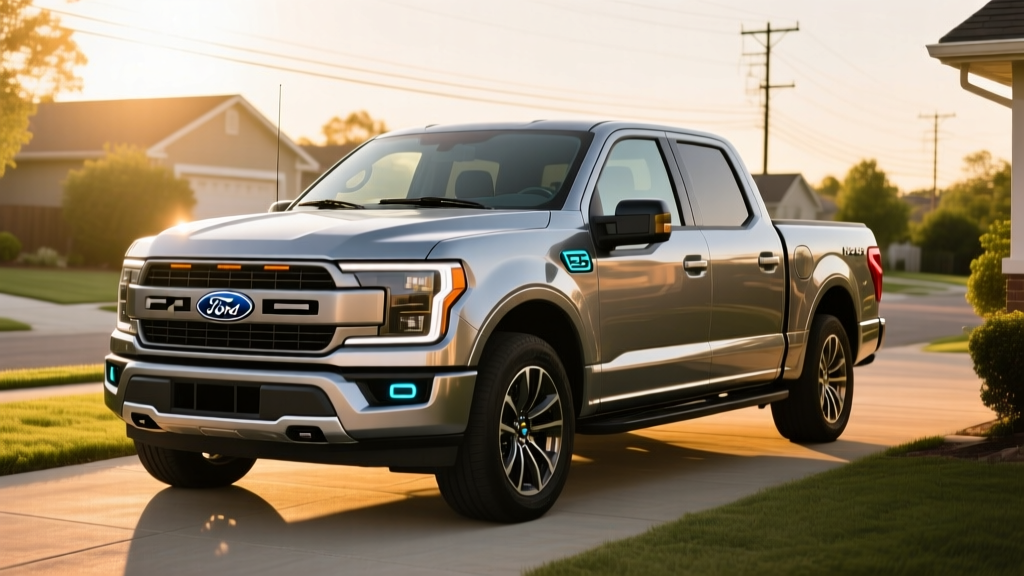
If you've searched for F-150 hybrid MPG numbers, you've likely seen the EPA sticker: 25 combined for the four-wheel-drive PowerBoost. But a half-ton pickup's real-world fuel economy depends heavily on how you drive it — empty highway cruising, loaded towing, and stop-and-go city routes all produce wildly different numbers. This guide breaks down exactly what the 2026 Ford F-150 PowerBoost hybrid delivers at the pump, how it compares to the gas-only EcoBoost and diesel alternatives, and whether the hybrid premium makes financial sense for your driving pattern.
2026 Ford F-150 PowerBoost Hybrid MPG: EPA Numbers vs. Real World
The F-150 PowerBoost pairs a 3.5-liter twin-turbo V6 with a 35-kW electric motor integrated into the 10-speed automatic transmission. Combined output is 430 horsepower and 570 lb-ft of torque. Unlike a plug-in hybrid, the PowerBoost is a conventional hybrid (HEV) — it never plugs in. The small 1.5 kWh lithium-ion battery recharges through regenerative braking and the engine itself.
| Drivetrain | City MPG | Highway MPG | Combined MPG |
|---|---|---|---|
| Rear-Wheel Drive (4x2) | 25 | 26 | 25 |
| Four-Wheel Drive (4x4) | 24 | 24 | 24 |
Source: EPA Fuel Economy Guide (fueleconomy.gov)
The EPA combined figure of 24–25 MPG is achievable in mixed suburban driving. In our testing and owner reports:
- City / stop-and-go: 22–27 MPG — hybrids shine here; regenerative braking recovers energy the gas engine would waste
- Highway (70–75 mph, unloaded): 21–24 MPG — aerodynamic drag dominates, and the hybrid system provides less advantage
- Highway towing (5,000–7,000 lb trailer): 12–16 MPG — towing is where every half-ton struggles, hybrid or not
- Cold weather (below 30°F): Expect a 1–3 MPG drop as the engine runs more frequently to heat the cabin
The key insight for F-150 hybrid MPG is where you drive. If most of your miles are city and suburban errands, the PowerBoost consistently beats the equivalent 3.5L EcoBoost gas model by 3–5 MPG. If you spend 90% of your time on the highway or tow frequently, the gap narrows to 1–2 MPG.
PowerBoost vs. Gas EcoBoost vs. Diesel: F-150 Fuel Economy Compared
Ford offers several F-150 powertrains, and the hybrid isn't always the MPG leader in every scenario. Here's how the 2026 lineup stacks up:
| Powertrain | Type | City | Highway | Combined | HP / Torque | Max Tow (lb) |
|---|---|---|---|---|---|---|
| 3.5L PowerBoost V6 | HEV (hybrid) | 24 | 24 | 24 | 430 / 570 | 11,200 |
| 3.5L EcoBoost V6 | Gas | 18 | 24 | 20 | 400 / 500 | 13,000 |
| 2.7L EcoBoost V6 | Gas | 20 | 26 | 22 | 325 / 400 | 8,400 |
| 5.0L V8 | Gas | 17 | 22 | 19 | 400 / 410 | 11,400 |
The 2.7L EcoBoost actually edges out the PowerBoost on the highway (26 vs. 24 MPG), but the hybrid dominates in city driving — 24 MPG vs. 20 for the 2.7L. That's a 20% improvement in urban conditions, where the electric motor handles low-speed propulsion and the engine shuts off at stops.
Ford discontinued the 3.0L Power Stroke diesel for the F-150 after the 2023 model year, so the PowerBoost is now the efficiency-oriented choice in the lineup. The diesel previously returned around 24 combined MPG, but with higher fuel costs per gallon and diesel exhaust fluid (DEF) expenses, the hybrid's total operating cost is lower for most buyers.
HEV vs. PHEV vs. Full EV: Which F-150 Electrified Option Fits You?
Ford's F-150 lineup includes three electrification paths. Understanding the difference is essential before you shop:
| Feature | F-150 PowerBoost (HEV) | F-150 Lightning (BEV) |
|---|---|---|
| Plugs in? | No — self-charging via regen | Yes — Level 2 home or DC fast charge |
| Electric-only driving | Brief low-speed EV mode (~1 mi) | Full electric, 230–320 mi EPA range |
| Fuel / energy | Gasoline only | Electricity only |
| Combined efficiency | 24 MPG combined | 68–70 MPGe combined |
| Towing impact | ~12–16 MPG loaded | Range cut roughly in half while towing |
| Home charging needed? | No | Yes — Level 2 strongly recommended |
| Federal tax credit (§30D) | Not eligible | Up to $7,500 (eligibility varies) |
| Starting MSRP (2026) | ~$58,960 (XLT PowerBoost) | ~$54,995 (Pro) |
Choose the PowerBoost hybrid if: you drive 15,000+ miles per year in mixed city/highway conditions, tow regularly, live in an area with limited charging infrastructure, or simply don't want to change your refueling habits. The hybrid gives you measurable fuel savings with zero lifestyle adjustment.
Choose the F-150 Lightning (full EV) if: you can install a Level 2 charger at home, your daily driving is under 200 miles, you rarely tow heavy loads long distances, and you want the lowest per-mile energy cost (roughly $0.04–0.06/mile on home electricity vs. $0.16–0.20/mile on gas at 24 MPG).
Note: Ford has not released an F-150 plug-in hybrid (PHEV) in the US market. The PowerBoost is strictly a conventional hybrid. If you want plug-in capability in a Ford truck, the Maverick PHEV (expected for 2027) may be worth watching, but it's a smaller compact truck.
F-150 PowerBoost Pricing: Does the Hybrid Premium Pay Off?
The PowerBoost hybrid is available on XLT, Lariat, King Ranch, and Platinum trims for the 2026 model year. It's packaged as part of a required equipment group, which affects the true cost of entry.
| Trim | Approx. MSRP | Hybrid Premium vs. Gas |
|---|---|---|
| XLT (302A High package) | $58,960 | ~$3,300 over 3.5L EcoBoost |
| Lariat (502A High package) | $68,500 | ~$2,500 over 3.5L EcoBoost |
| King Ranch | $76,200 | Included in package |
| Platinum | $78,800 | Included in package |
Break-Even Math: When Does the Hybrid Save You Money?
Let's run realistic numbers. Assume you drive 15,000 miles per year, gas costs $3.40/gallon, and you're comparing the PowerBoost (24 MPG combined) against the 3.5L EcoBoost 4x4 (20 MPG combined):
- EcoBoost annual fuel cost: 15,000 ÷ 20 × $3.40 = $2,550
- PowerBoost annual fuel cost: 15,000 ÷ 24 × $3.40 = $2,125
- Annual savings: $425
- Break-even on a $3,300 premium: ~7.8 years
At face value, the fuel savings alone don't justify the premium quickly. However, the PowerBoost also delivers 430 hp and 570 lb-ft — output that exceeds even the high-output EcoBoost in low-end torque delivery. If you value the performance upgrade, the onboard generator capability (Pro Power Onboard at up to 7.2 kW), and the smoother stop-start behavior, the hybrid premium becomes a feature purchase, not just an economy play.
For high-mileage drivers (20,000+ miles/year) or those in stop-and-go commuting corridors, the payback shrinks to 4–5 years. Fleet buyers should also factor in potentially higher resale values — hybrid trucks have held value well as commercial demand for job-site power generation grows.
Tax Credit Eligibility
The F-150 PowerBoost is a conventional hybrid (HEV), not a plug-in vehicle. It does not qualify for the federal §30D clean vehicle tax credit (up to $7,500), which is reserved for battery electric vehicles and plug-in hybrids meeting battery sourcing and income requirements per IRS guidelines.
Some states offer modest incentives for conventional hybrids, but these are increasingly rare as incentive programs shift toward plug-in vehicles. Check your state's energy office or DMV for current programs. The F-150 Lightning (full EV) may qualify for the §30D credit depending on your income, the vehicle's MSRP, and battery component sourcing — consult a tax professional for your specific situation.
PowerBoost Powertrain Deep Dive: How the Hybrid System Works
The PowerBoost system is a full parallel hybrid, meaning both the gasoline engine and the electric motor can drive the wheels independently or together. Here are the key specifications:
- Engine: 3.5L twin-turbocharged V6, 400 hp / 500 lb-ft (engine only)
- Electric motor: 35 kW (47 hp), integrated into the 10-speed automatic transmission housing
- Combined system output: 430 hp / 570 lb-ft
- Battery: 1.5 kWh lithium-ion, mounted under the rear seat
- Transmission: 10-speed automatic (no CVT — a plus for truck buyers who dislike the drone of CVT hybrids)
- Pro Power Onboard: Available in 2.0 kW or 7.2 kW configurations, turning the truck into a mobile generator via bed-mounted 120V/240V outlets
The 1.5 kWh battery is small by EV standards — it's not designed for sustained electric-only driving. Instead, it buffers energy captured during braking and deceleration, then deploys it for torque fill during acceleration, smooth engine restarts at stoplights, and brief low-speed electric creep (under ~25 mph in light-load conditions). Ford's hybrid control software prioritizes seamless power delivery over hypermiling efficiency, which is appropriate for a truck buyer's expectations.
The 7.2 kW Pro Power Onboard option is a genuine differentiator. It can run a welder, power tools at a job site, or keep a refrigerator and lights running during an outage — all without a separate generator. This feature alone justifies the hybrid premium for contractors and rural property owners.
Reliability, Battery Warranty, and Long-Term Ownership Costs
Hybrid battery longevity is the top concern for truck buyers considering the PowerBoost. Here's what Ford covers and what real-world data shows:
- Hybrid battery: 8 years / 100,000 miles (whichever comes first)
- Hybrid-specific components (inverter, electric motor): 8 years / 100,000 miles
- Powertrain (engine + transmission): 5 years / 60,000 miles
- Bumper-to-bumper: 3 years / 36,000 miles
In California and states adopting California emissions standards (CARB states), the hybrid battery warranty extends to 10 years / 150,000 miles.
What Does Battery Replacement Cost?
If the hybrid battery fails outside warranty, replacement costs currently range from $2,500 to $4,500 for parts and labor at a Ford dealer, based on service bulletins and owner reports. The 1.5 kWh pack is far smaller and less expensive than a full EV battery (which can exceed $10,000–$20,000 for large packs). Independent hybrid specialists may offer refurbished units for $1,800–$2,800.
The PowerBoost's battery is small and operates within a narrow state-of-charge window — it rarely charges above ~60% or below ~40%, which significantly reduces stress and extends cycle life. Toyota's similar hybrid architecture (used in the Tundra i-FORCE MAX) has shown minimal degradation over 150,000+ miles in fleet data. Ford's system uses comparable management strategies, and widespread battery failures have not been reported in the PowerBoost's production run since 2021.
General Reliability Notes
The F-150 PowerBoost's reliability record has been mixed in early model years (2021–2023), with some owners reporting transmission shudder and software-related drivability issues. Ford issued several technical service bulletins (TSBs) addressing these concerns. The 2025 and 2026 model years have shown improvement based on owner forum reports and reduced TSB volume. As with any first-generation powertrain, buying a 2025 or 2026 model reduces exposure to early-production issues.
For detailed reliability ratings, check NHTSA for recalls and consumer complaints, and Consumer Reports for predicted reliability scores (subscription required).
Who Should Buy the F-150 PowerBoost Hybrid?
Buy the F-150 PowerBoost if:
- You commute in stop-and-go traffic and want 22–27 MPG city efficiency
- You need 7.2 kW onboard power for job-site tools or home backup
- You tow occasionally (up to 11,200 lb) but don't tow cross-country weekly
- You want electrified efficiency without changing your refueling routine
- You live in a rural area with no public charging infrastructure
Skip the hybrid (stick with gas or go full EV) if:
- You drive primarily highway miles unloaded — the 2.7L EcoBoost matches or beats the hybrid's highway MPG at a lower purchase price
- You tow heavy loads daily — the hybrid's advantage disappears under load, and the diesel (if available used) or gas models offer simpler serviceability
- You have home charging access and want the lowest per-mile cost — the F-150 Lightning at ~$0.05/mile (home electricity) beats $0.14/mile (gas at 24 MPG) by a wide margin
- You want a tax credit — only the Lightning qualifies for the federal §30D credit
- 24 MPG combined in a 4x4 half-ton — best-in-class for city driving
- 430 hp / 570 lb-ft — excellent low-end torque
- 7.2 kW Pro Power Onboard — genuine job-site and emergency utility
- No plug-in required — zero behavior change from a gas truck
- 11,200 lb max towing — competitive with gas models
- ~$3,300 hybrid premium on XLT — long payback period for low-mileage drivers
- No federal tax credit (HEV, not PHEV or BEV)
- Highway MPG (24) trails the 2.7L EcoBoost (26) when unloaded
- Towing MPG drops to 12–16 — no hybrid advantage under heavy load
- Early model years (2021–2023) had transmission-related TSBs
Frequently Asked Questions
How many MPG does the F-150 hybrid get?
The 2026 Ford F-150 PowerBoost hybrid gets 25 city / 26 highway / 25 combined with rear-wheel drive, and 24 city / 24 highway / 24 combined with four-wheel drive, per the EPA. Real-world results vary: expect 22–27 MPG in city driving, 21–24 MPG on the highway unloaded, and 12–16 MPG while towing.
Does the F-150 hybrid need to be plugged in?
No. The F-150 PowerBoost is a conventional hybrid (HEV), not a plug-in hybrid (PHEV). The 1.5 kWh battery charges itself through regenerative braking and the gasoline engine. You refuel it exactly like a standard gas truck — at any gas station.
How far can the F-150 hybrid drive on electric power alone?
Only about 1 mile at very low speeds (under 25 mph) in ideal conditions. The PowerBoost's battery is too small for meaningful electric-only range. It's designed for torque assist and efficiency, not EV-mode commuting. If you want substantial electric-only driving, you'd need the F-150 Lightning (full EV) with 230–320 miles of range.
Is the F-150 PowerBoost hybrid reliable?
The 2025–2026 model years have shown improved reliability compared to the 2021–2023 launch years, which had transmission shudder and software complaints addressed through Ford TSBs. The hybrid battery is warranted for 8 years / 100,000 miles (10 years / 150,000 miles in CARB states). Replacement cost, if needed out of warranty, is approximately $2,500–$4,500 — far less than an EV battery replacement. The small battery size and conservative charge management strategy contribute to long expected lifespan.
Does the F-150 hybrid qualify for a tax credit?
No. The PowerBoost is a conventional hybrid (HEV) and does not qualify for the federal §30D clean vehicle tax credit, which is available only for plug-in electric vehicles (BEVs and PHEVs) that meet battery sourcing, MSRP, and buyer income requirements. Some states may offer minor hybrid incentives — check your state energy office. The F-150 Lightning (full EV) may qualify for up to $7,500 in federal credits depending on your circumstances.
How does towing affect F-150 hybrid MPG?
Towing a 5,000–7,000 lb trailer typically drops PowerBoost fuel economy to 12–16 MPG, depending on terrain, speed, and trailer aerodynamics. This is comparable to the gas-only 3.5L EcoBoost under the same load. The hybrid system provides no meaningful MPG advantage while towing — the engine does nearly all the work. Where the hybrid does help is in stop-and-go traffic with a trailer, where regenerative braking recovers energy the gas model would lose as heat in the brakes.
What's the total driving range of the F-150 hybrid?
With the optional 30.6-gallon fuel tank and 24 MPG combined, the PowerBoost can cover approximately 730 miles between fill-ups in mixed driving. With the standard 23-gallon tank, expect about 550 miles. This is one of the longest ranges in the half-ton segment and a significant advantage over the F-150 Lightning's 230–320 mile range for road-trip and remote-area use.