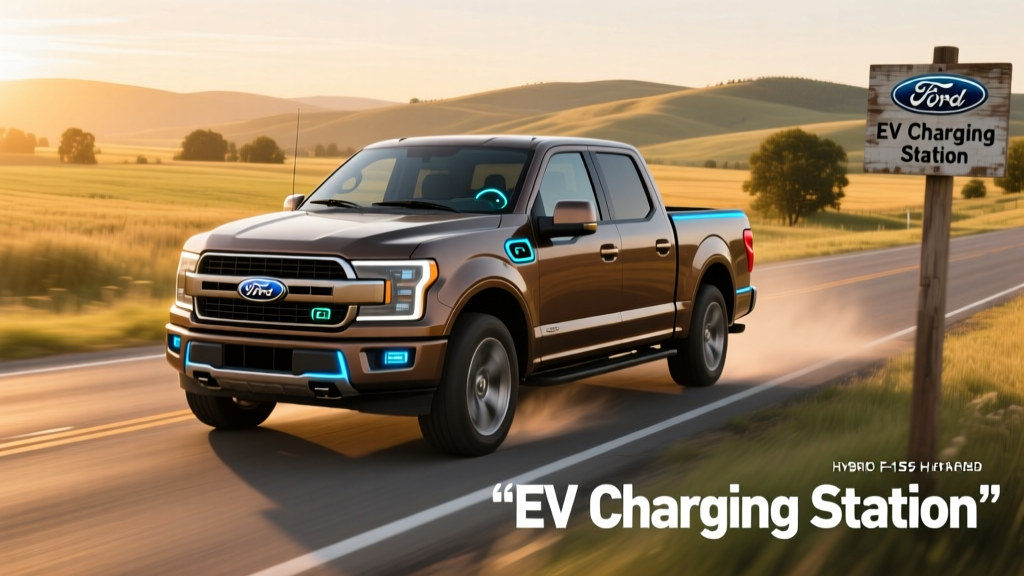
The Ford F-150 PowerBoost Hybrid occupies a specific niche in the full-size truck market: it delivers V8-rivaling torque with fuel economy that undercuts most six-cylinder gas trucks. But the EPA sticker only tells part of the story. Here's the complete breakdown of what Ford F-150 hybrid MPG looks like in the real world, what the PowerBoost powertrain actually does, and whether this conventional hybrid (HEV) makes more sense for your workflow than a gas-only F-150 or a fully electric alternative like the F-150 Lightning.
Quick Clarification: HEV vs. PHEV
The F-150 PowerBoost is a conventional hybrid (HEV) — it generates all its electricity internally via regenerative braking and the gasoline engine. You never plug it in. This is fundamentally different from a plug-in hybrid (PHEV) like the Toyota RAV4 Prime or Jeep Wrangler 4xe, which has a larger battery you charge externally for 20–40 miles of electric-only driving. Ford does not currently offer a plug-in hybrid F-150.
Ford F-150 Hybrid MPG: EPA Ratings vs. Real-World Results
The 2025–2026 F-150 PowerBoost Hybrid pairs a 3.5-liter twin-turbo V6 with a 35-kW electric motor integrated into the 10-speed automatic transmission. Ford tunes the system to prioritize low-end torque delivery and regenerative efficiency in stop-and-go driving. Here's what the EPA reports:
| Configuration | City MPG | Highway MPG | Combined MPG |
|---|---|---|---|
| 4×2 (Rear-Wheel Drive) | 25 | 26 | 25 |
| 4×4 (Four-Wheel Drive) | 23 | 24 | 24 |
Source: EPA Fuel Economy Guide
Real-World MPG: What Owners Actually Report
EPA combined figures assume a 55% city / 45% highway mix. In practice, F-150 PowerBoost owners see meaningful variation based on driving patterns:
- City-heavy commuting (70%+ stop-and-go): 24–27 MPG. The hybrid system shines here — regenerative braking recovers energy at every light, and the electric motor handles low-speed launches without engaging the gas engine.
- Highway-dominant driving (70%+ interstate at 70–80 mph): 20–23 MPG. Aerodynamic drag dominates at speed, and the hybrid system offers less advantage. Towing or hauling drops this further to 14–18 MPG depending on load.
- Mixed suburban/rural driving: 22–25 MPG, closely tracking the EPA combined figure.
- Cold-weather penalty (below 30°F): Expect a 10–15% drop in city MPG as the engine runs more frequently for cabin heat and battery conditioning.
PowerBoost Powertrain: Specs and How It Works
| Specification | Detail |
|---|---|
| Engine | 3.5L twin-turbo V6 (ICE: 400 hp / 500 lb-ft) |
| Electric Motor | 35 kW (47 hp) integrated into transmission |
| Combined System Output | 430 hp / 570 lb-ft torque |
| Transmission | 10-speed automatic (modular hybrid) |
| Hybrid Battery | 1.5 kWh lithium-ion (not plug-in) |
| 0–60 mph | ~5.8 seconds (4×4) |
| Max Towing Capacity | 11,200 lbs (properly equipped, 4×2) |
| Max Payload | 2,120 lbs (varies by trim/config) |
| Drivetrain | RWD or 4WD |
The PowerBoost's 1.5 kWh battery is small by EV standards — it's not designed for electric-only driving. Instead, it acts as a buffer: capturing energy during braking and deceleration, then deploying it during acceleration to reduce the load on the gasoline engine. The electric motor fills in the torque gap while the turbochargers spool up, eliminating the turbo lag that the standard 3.5L EcoBoost exhibits from a stop.
The 570 lb-ft of combined torque is the real headline. That figure exceeds the 5.0L V8 (410 lb-ft) and matches the high-output 3.5L EcoBoost — but the PowerBoost delivers it at lower RPM thanks to the electric motor's instant response. This matters for towing from a standstill and merging onto highways under load.
Pro Power Onboard: The Hidden Hybrid Advantage
Every PowerBoost F-150 comes standard with Pro Power Onboard, a built-in generator system that provides 2.4 kW or 7.2 kW (depending on trim) of 120V/240V AC power from the truck's bed outlets. This is a direct benefit of the hybrid architecture — the high-voltage battery and electric motor can run power tools, job-site equipment, or tailgate appliances without idling the gas engine continuously. The system can run for up to 32 hours on a full tank at 2.4 kW load, or approximately 8 hours at 7.2 kW.
Pricing, Trims, and Tax Credit Eligibility
The PowerBoost hybrid is available across multiple F-150 trims for the 2025–2026 model year. Pricing reflects the hybrid powertrain as a standalone option or bundled package:
| Trim Level | Approx. Starting MSRP (4×4) | PowerBoost Availability |
|---|---|---|
| XLT | ~$56,000 | Optional (PowerBoost package) |
| Lariat | ~$64,000 | Optional / standard on some configs |
| King Ranch | ~$72,000 | Standard |
| Platinum | ~$74,000 | Standard |
| Limited | ~$87,000 | Standard |
The PowerBoost upgrade typically adds $2,500–$3,500 over the standard 3.5L EcoBoost on trims where it's optional.
Federal Tax Credit Status
Because the F-150 PowerBoost is a conventional hybrid (HEV) — not a plug-in hybrid or battery electric vehicle — it does not qualify for the IRS §30D Clean Vehicle Credit. That credit requires a minimum battery capacity of 7 kWh and the ability to charge from an external power source, per current IRS guidelines. The PowerBoost's 1.5 kWh battery falls well below this threshold.
Some states offer modest incentives for conventional hybrids (typically $250–$1,000 rebates), but these vary by jurisdiction and change frequently. Check your state energy office or department of environmental quality for current programs. Federal and state incentives strongly favor PHEVs and BEVs with larger batteries.
Battery Warranty, Reliability, and Replacement Cost
The PowerBoost's 1.5 kWh battery is far less stressed than a full EV battery pack. It operates in a narrow state-of-charge window (roughly 40–60% SoC) and never experiences the deep discharge cycles that accelerate degradation in BEVs. Ford's hybrid battery chemistry and thermal management are derived from over two decades of hybrid engineering dating back to the 2005 Escape Hybrid.
Long-Term Reliability Data
Ford's 3.5L PowerBoost has been in production since the 2021 model year. Early reliability data from owner surveys and warranty claim rates show:
- Hybrid system components: Low failure rates. The electric motor and inverter have proven durable, consistent with Ford's earlier hybrid platforms.
- 10-speed transmission: Some owners report occasional rough shifts in early model years (2021–2022), addressed largely through software updates in 2023+ models.
- Battery degradation: Minimal at current mileage levels. Most PowerBoost trucks on the road have not yet reached 100,000 miles. Based on Ford's Escape and Fusion Hybrid track records, expect less than 10% capacity loss over 150,000 miles — which is negligible for a 1.5 kWh buffer battery.
Battery Replacement Cost
If the hybrid battery fails outside warranty, replacement costs are estimated at $3,000–$5,000 including labor (based on Ford dealer parts pricing and independent hybrid shop data). This is significantly less than an EV battery replacement ($10,000–$20,000+) because the PowerBoost pack is small and accessible. Third-party hybrid battery refurbishers also offer reconditioned units at lower cost, though availability for the PowerBoost is still limited given the platform's age.
PowerBoost Hybrid vs. Gas F-150 vs. F-150 Lightning EV
The F-150 lineup offers three distinct powertrain philosophies. Here's how they compare on the metrics that matter:
| Metric | PowerBoost Hybrid | 3.5L EcoBoost (Gas) | F-150 Lightning (EV) |
|---|---|---|---|
| Combined MPG / MPGe | 24 MPG (4×4) | 20–22 MPG (4×4) | 70–77 MPGe |
| Horsepower / Torque | 430 hp / 570 lb-ft | 400 hp / 500 lb-ft | 580 hp / 775 lb-ft |
| 0–60 mph | ~5.8 sec | ~5.5 sec | ~3.8 sec (ER) |
| Max Towing | 11,200 lbs | 13,500 lbs | 10,000 lbs |
| Fuel/Energy Cost per Mile | ~$0.14 (gas @ $3.50/gal) | ~$0.17 | ~$0.05 (home L2) |
| Starting MSRP (4×4) | ~$56,000 | ~$50,000 | ~$55,000 |
| §30D Tax Credit | $0 | $0 | Up to $7,500* |
| Pro Power Onboard | 2.4–7.2 kW | 2.0 kW (optional) | 9.6 kW |
| Plug In Required? | No | No | Yes (L2 recommended) |
* F-150 Lightning tax credit eligibility depends on buyer income, MSRP caps, and battery sourcing requirements under IRS §30D rules. Confirm eligibility before purchase.
PowerBoost Hybrid Pros
- Best-in-class MPG for gas-powered full-size trucks in city driving
- 570 lb-ft torque with zero turbo lag from a stop
- No charging infrastructure needed — works with existing gas stations
- Pro Power Onboard up to 7.2 kW standard
- 11,200-lb towing (competitive with gas V8s)
- Lower per-mile fuel cost vs. gas-only F-150
PowerBoost Hybrid Cons
- No federal tax credit (HEV, not PHEV/BEV)
- Highway MPG advantage over EcoBoost is modest (2–4 MPG)
- Hybrid premium adds $2,500–$3,500 to vehicle cost
- Towing MPG drops to 14–18 — less advantage under heavy load
- Cannot drive on electric power alone
- Higher complexity than a standard gas powertrain (two systems)
Who Should Choose the F-150 PowerBoost Hybrid?
Choose the PowerBoost Hybrid If:
- Your driving is 50%+ city or suburban stop-and-go — this is where the hybrid system delivers its biggest MPG gains
- You need strong towing capability (10,000+ lbs) but also want better daily-driver fuel economy
- You use job-site power regularly — Pro Power Onboard at 7.2 kW is a genuine worksite tool
- You don't have access to home Level 2 charging, making a full EV impractical
- You want to reduce fuel spend without changing your refueling habits
Choose the Gas 3.5L EcoBoost Instead If:
- You drive primarily highway miles at steady speed — the MPG gap narrows to 2–3 MPG
- You need maximum towing capacity (13,500 lbs with Max Tow package)
- You want the lowest possible purchase price and don't care about fuel savings
Choose the F-150 Lightning EV If:
- You have reliable home Level 2 charging and your daily driving is under 230–320 miles
- You want the lowest per-mile energy cost (~$0.05 vs. $0.14 for hybrid)
- You want maximum acceleration (3.8 sec 0–60) and 9.6 kW Pro Power Onboard
- You qualify for the §30D tax credit, bringing the effective price below the PowerBoost
5-Year Fuel Cost Comparison: Hybrid vs. Gas vs. EV
The hybrid premium only makes financial sense if the fuel savings offset the higher purchase price. Here's a 5-year / 75,000-mile projection:
| PowerBoost Hybrid | 3.5L EcoBoost Gas | F-150 Lightning | |
|---|---|---|---|
| Average MPG / MPGe | 23 MPG (mixed real-world) | 19 MPG (mixed real-world) | 73 MPGe |
| Fuel/Energy Cost | $3.50/gal gas | $3.50/gal gas | $0.14/kWh (home L2 avg) |
| 5-Year Fuel Cost | ~$11,413 | ~$13,816 | ~$3,850 |
| 5-Year Fuel Savings vs. Gas | $2,403 | Baseline | $9,966 |
At current gas prices, the PowerBoost saves approximately $2,400 over the gas EcoBoost across 75,000 miles — roughly offsetting the hybrid powertrain premium. If gas prices rise above $4.00/gallon, the payback period shortens. The Lightning, meanwhile, saves nearly $10,000 in energy costs but requires home charging infrastructure and may not suit high-mileage or heavy-towing use cases.
Frequently Asked Questions
How many MPG does the Ford F-150 hybrid get in real-world driving?
The EPA rates the F-150 PowerBoost 4×4 at 23 city / 24 highway / 24 combined MPG. In real-world mixed driving, most owners report 22–25 MPG. City-heavy commutes can push this to 26–27 MPG thanks to regenerative braking, while sustained highway driving at 75+ mph drops it to 20–22 MPG. Towing a trailer typically yields 14–18 MPG depending on weight and terrain.
Does the F-150 hybrid need to be plugged in?
No. The F-150 PowerBoost is a conventional hybrid (HEV), not a plug-in hybrid. Its 1.5 kWh battery charges entirely through regenerative braking and the gasoline engine. You refuel it exactly like a standard gas truck — at any gas station, with regular or premium unleaded.
How far can the F-150 hybrid drive on electric power alone?
It can't. The PowerBoost system uses its electric motor to assist the gas engine, not to drive the truck independently. At very low speeds (parking lots, creeping in traffic), the motor can move the truck briefly without the engine running, but this is measured in feet, not miles. If electric-only driving is a priority, look at a PHEV or the fully electric F-150 Lightning.
Is the F-150 PowerBoost hybrid reliable?
Early data (2021–2025 model years) indicates good reliability for the hybrid-specific components. The 3.5L V6 and 10-speed transmission are proven, high-volume Ford powertrain components. The electric motor and inverter have shown low failure rates. Ford covers hybrid components for 8 years/100,000 miles (10 years/150,000 miles in CARB states). Long-term data beyond 100,000 miles is still limited given the platform's age.
What does it cost to replace the F-150 hybrid battery?
Out-of-warranty replacement for the 1.5 kWh hybrid battery is estimated at $3,000–$5,000 including labor at a Ford dealer. This is far less than an EV battery replacement because the pack is small and the chemistry operates under minimal stress. Given the narrow state-of-charge window and robust thermal management, most hybrid batteries should last the life of the truck.
Does the F-150 hybrid qualify for a federal tax credit?
No. The IRS §30D Clean Vehicle Credit requires a plug-in vehicle with at least 7 kWh of battery capacity. The PowerBoost's 1.5 kWh battery and conventional hybrid architecture do not meet this threshold. Only the F-150 Lightning (full EV) qualifies, subject to income limits, MSRP caps, and battery-sourcing requirements. Check IRS.gov for current eligibility rules.
How does F-150 hybrid MPG compare to other full-size trucks?
The PowerBoost's 24 MPG combined (4×4) leads the full-size truck segment for conventional powertrains. The Ram 1500 with the 3.6L V6 eTorque mild hybrid achieves 22 MPG combined (4×4). The Chevy Silverado 1500 with the 2.7L turbo four-cylinder achieves 22–23 MPG combined. The Toyota Tundra i-FORCE MAX hybrid (a twin-turbo V6 hybrid like the PowerBoost) achieves 20–22 MPG combined. Ford's advantage comes from the more aggressive electric assist strategy and a lighter overall curb weight relative to competitors with similar output.
The F-150 PowerBoost Hybrid isn't a bridge to an electric future — it's a practical fuel-economy upgrade for truck buyers who need towing capacity, job-site power, and gas-station convenience today. If your driving profile is city-heavy and you value the 2–4 MPG improvement over a standard EcoBoost (plus the turbo-lag-free torque delivery), the hybrid premium pays for itself within a typical ownership cycle. If your miles are mostly highway or you tow heavy every week, the advantage shrinks, and the standard 3.5L EcoBoost or a diesel alternative may serve you equally well.