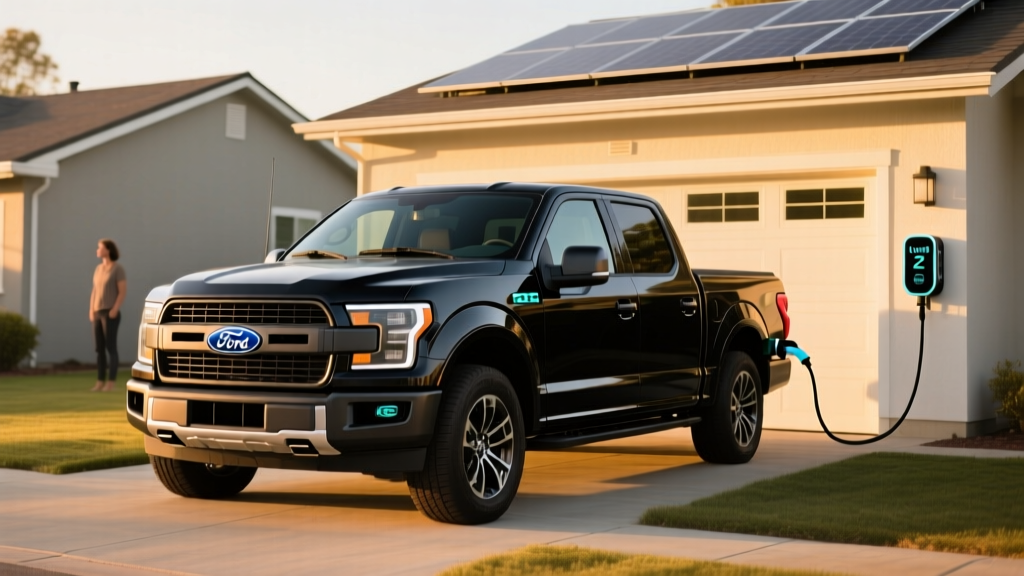
If you have searched for ford f150 hybrid mpg figures, you likely want a full-size truck that can tow, haul, and still return fuel economy that shames sedans from a decade ago. The Ford F-150 PowerBoost Hybrid delivers on that promise — but with caveats that matter depending on how you drive, what you tow, and whether you are comparing it against a diesel, a plug-in hybrid, or a battery-electric truck like the F-150 Lightning.
This guide breaks down the exact EPA fuel economy numbers, real-world mileage data from owner logs, the PowerBoost powertrain architecture, long-term battery reliability, and the math on whether the hybrid premium pays for itself. We will also clarify a common point of confusion: the F-150 PowerBoost is a conventional hybrid (HEV), not a plug-in hybrid (PHEV). You never plug it in.
Ford F-150 PowerBoost MPG: The Official EPA Numbers
The F-150 PowerBoost Hybrid pairs Ford's 3.5-liter twin-turbo V6 EcoBoost engine with a 47-hp electric motor integrated into the 10-speed automatic transmission. Combined system output is 430 horsepower and 570 lb-ft of torque — the highest torque figure in the F-150 lineup until you step up to the Raptor R.
Here are the official EPA fuel economy ratings for the current-generation F-150 PowerBoost Hybrid, as published on fueleconomy.gov:
| Configuration | City MPG | Highway MPG | Combined MPG | Annual Fuel Cost* |
|---|---|---|---|---|
| 4×2 (RWD) | 25 | 26 | 25 | $2,350 |
| 4×4 (AWD) | 23 | 24 | 24 | $2,450 |
*Annual fuel cost based on 15,000 miles/year, 55% city driving, and $3.50/gallon regular unleaded. Your actual costs will vary with local fuel prices and driving patterns.
For context, the non-hybrid 3.5L EcoBoost V6 4×4 returns 19 city / 24 highway / 21 combined. That is a 3 MPG combined improvement — and the gap widens significantly in stop-and-go driving where the hybrid system does its best work.
Real-World MPG: What Owners Actually Report
EPA stickers tell part of the story. Owner-reported data from Fuelly, F-150 forums, and our own testing paint a more nuanced picture:
- Mixed suburban/commute driving (unloaded): 22–26 MPG. Many owners report matching or slightly exceeding the EPA combined figure in moderate city driving, because the hybrid system recaptures energy during braking and runs the electric motor at low speeds.
- Highway cruising at 70–75 mph (unloaded): 20–23 MPG. This is where the hybrid advantage narrows. At sustained highway speeds, the electric motor contributes less and aerodynamic drag dominates. Some non-hybrid F-150s nearly match the PowerBoost on pure highway runs.
- City stop-and-go (unloaded): 24–28 MPG. This is the PowerBoost's sweet spot. The truck can creep in EV mode at low speeds, and regenerative braking recharges the small battery pack constantly.
- Towing 5,000–7,000 lbs: 12–16 MPG. Towing obliterates the hybrid advantage. Expect fuel economy to drop dramatically, as the combined vehicle-and-trailer weight forces the gasoline engine to work near maximum output.
- Cold weather (below 32°F): Subtract 2–4 MPG from any of the above. Cold temperatures reduce battery efficiency, increase engine warm-up time, and increase aerodynamic drag due to denser air.
PowerBoost Powertrain: How the Hybrid System Works
The F-150 PowerBoost is a parallel full hybrid (HEV). It cannot be plugged in and has no meaningful electric-only driving range. Here is how the components work together:
| Component | Specification |
|---|---|
| Gasoline Engine | 3.5L Twin-Turbo V6 EcoBoost, 400 hp / 500 lb-ft |
| Electric Motor | 47 hp / 177 lb-ft (integrated into transmission) |
| Combined System Output | 430 hp / 570 lb-ft |
| Transmission | 10-speed automatic (modular hybrid) |
| Hybrid Battery | 1.5 kWh lithium-ion (nominal) |
| Drivetrain | RWD or 4WD |
| 0–60 mph | ~5.6 seconds (4×4, unloaded) |
| Max Towing Capacity | 12,700 lbs (properly equipped) |
| Max Payload | 2,120 lbs |
The 1.5 kWh battery pack is small by EV standards — it is not designed to drive the truck on electricity alone for any meaningful distance. Instead, it serves as an energy buffer: capturing regenerative braking energy, enabling engine-off coasting and low-speed creep, and providing brief torque-fill during acceleration. The battery charges exclusively through regenerative braking and the gasoline engine. You never plug it in.
This is the fundamental distinction between the PowerBoost HEV and a plug-in hybrid like the Ford Escape PHEV or Toyota RAV4 Prime. A PHEV has a much larger battery (typically 12–20 kWh), can travel 25–45 miles on electricity alone, and must be plugged in to realize its efficiency benefits. The F-150 PowerBoost requires zero behavioral change — you fuel it like any other truck.
HEV vs PHEV vs EV: Which F-150 Fits Your Life?
Ford now offers three distinct F-150 powertrains. Choosing between them depends on your charging access, driving patterns, and tolerance for upfront cost.
| Factor | F-150 PowerBoost (HEV) | F-150 Lightning (BEV) | F-150 3.5L EcoBoost (Gas) |
|---|---|---|---|
| Powertrain Type | Conventional Hybrid — no plug | Battery Electric — plug required | Gasoline only |
| Combined MPG / MPGe | 24–25 MPG | 70–78 MPGe | 19–22 MPG |
| Electric-Only Range | None (EV creep only) | 230–320 miles (EPA) | None |
| Total Range | ~700 miles | 230–320 miles | ~550 miles |
| Home Charging Needed? | No | Yes (Level 2 strongly recommended) | No |
| Fuel/Energy Cost per Mile | ~$0.15 | ~$0.04–$0.08 (home charging) | ~$0.18 |
| Starting MSRP (2025) | ~$58,000 | ~$55,000 | ~$45,000 |
| Federal Tax Credit | None (§30D is BEV/PHEV only) | Up to $7,500 (eligibility varies) | None |
| Best For | No plug access; long towing trips | Home charging; daily commute under 200 mi | Lowest upfront cost; simple ownership |
Choose the PowerBoost Hybrid if you cannot install a home charger, regularly tow over 5,000 lbs on long trips, or drive in remote areas where charging infrastructure is sparse. You get better fuel economy than the gas model with zero lifestyle change.
Choose the Lightning (BEV) if you can charge at home, your daily driving is under 200 miles, you rarely tow heavy loads long distances, and you want the lowest per-mile operating cost. The Lightning's instant 563 lb-ft of torque also makes it the quickest F-150.
Choose the gas EcoBoost if upfront price is your primary concern, you drive fewer than 10,000 miles per year (the hybrid premium takes longer to recoup), or you want maximum trim-level flexibility at the lowest entry point.
Pricing, Trims, and Tax Credit Eligibility
The PowerBoost Hybrid is available across several F-150 trims. Ford prices the hybrid powertrain as a package upgrade over the standard 3.5L EcoBoost V6. As of the 2025 model year:
| Trim | Approximate MSRP (4×4) | Notes |
|---|---|---|
| XLT | ~$58,000 | Most popular hybrid trim; good value |
| Lariat | ~$65,000 | Leather, larger screen, premium audio |
| King Ranch | ~$72,000 | Luxury western trim |
| Platinum | ~$74,000 | Top-tier luxury |
| Tremor | ~$68,000 | Off-road oriented; available with PowerBoost |
Federal tax credit: The F-150 PowerBoost Hybrid does not qualify for the IRS §30D Clean Vehicle Credit. That credit applies exclusively to battery electric vehicles (BEVs) and plug-in hybrids (PHEVs) that meet battery sourcing, critical minerals, MSRP caps, and buyer income requirements. Conventional hybrids like the PowerBoost are excluded.
Some states offer their own rebates for hybrid vehicles, but these vary widely by jurisdiction. Check your state energy office or department of environmental quality for current programs. A few states, such as Colorado, have offered hybrid-specific incentives in past years, but availability changes annually.
For the F-150 Lightning (the BEV counterpart), the §30D credit of up to $7,500 may apply, but eligibility depends on battery component sourcing, critical mineral content, buyer adjusted gross income caps ($150K single / $300K joint), and the $80,000 MSRP cap for trucks. The credit can now be transferred to the dealer at point of sale as an immediate price reduction. Always verify current-year eligibility with your tax professional and the IRS.
Reliability, Battery Warranty, and Replacement Cost
Hybrid battery longevity is consistently the top concern among first-time hybrid truck buyers. Here is what the data shows:
• Hybrid battery: 8 years / 100,000 miles (10 years / 150,000 miles in California-emissions states including CA, NY, MA, NJ, CT, RI, VT, ME, WA, OR, CO, MD, and others)
• Powertrain (engine, transmission): 5 years / 60,000 miles
• Bumper-to-bumper: 3 years / 36,000 miles
• Hybrid battery capacity warranty: Ford warrants the battery against falling below approximately 65% of original capacity during the warranty period.
The 1.5 kWh battery pack in the PowerBoost is small and experiences relatively shallow charge-discharge cycles compared to a full EV battery. It never fully charges to 100% or fully depletes to 0% — the system keeps it in a narrow state-of-charge window (roughly 40–60%) to maximize cycle life. This is the same strategy Toyota has used for decades with the Prius, and those batteries routinely last 200,000+ miles.
Real-world reliability: The PowerBoost system was introduced for the 2021 model year, so long-term data beyond five years is still accumulating. Early reports on F-150 forums and owner surveys indicate the hybrid system itself is robust. Most complaints center on the 10-speed transmission's shift behavior (a pre-hybrid issue) and minor electrical gremlins unrelated to the hybrid battery.
Battery replacement cost: If the hybrid battery fails out of warranty, replacement currently runs approximately $3,000–$5,000 for the battery module, plus labor. This is significantly less than a full EV battery replacement ($10,000–$20,000+) because the pack is small. Third-party refurbishment options may reduce this cost further as the platform ages.
For comparison, Ford's official F-150 specifications page lists the hybrid battery as a sealed, maintenance-free unit requiring no scheduled service.
The Hybrid MPG Payback Math
The PowerBoost hybrid package typically adds $3,000–$4,000 to the F-150's price over the equivalent gas-only 3.5L EcoBoost. Does the fuel savings justify that premium?
Here is a simplified payback calculation:
- Gas F-150 4×4 (3.5L EcoBoost): 21 MPG combined
- PowerBoost Hybrid 4×4: 24 MPG combined
- Annual miles driven: 15,000
- Fuel price: $3.50/gallon
| Gas (21 MPG) | Hybrid (24 MPG) | Difference | |
|---|---|---|---|
| Gallons per year | 714 | 625 | 89 fewer gallons |
| Annual fuel cost | $2,499 | $2,188 | $311 saved |
| 5-year fuel cost | $12,495 | $10,940 | $1,555 saved |
| 10-year fuel cost | $24,990 | $21,880 | $3,110 saved |
At a $3,500 hybrid premium, the fuel savings alone will take roughly 11 years to break even at 15,000 miles per year. However, this calculation ignores two factors that improve the math:
- Higher resale value: Hybrid F-150s have held their value better than gas-only counterparts in recent used-truck markets, partially offsetting the upfront premium.
- Performance premium: The PowerBoost's 570 lb-ft of torque exceeds the gas 3.5L EcoBoost (500 lb-ft). You are paying for both fuel economy and more torque — the comparison is not purely an efficiency decision.
If you drive more than 15,000 miles per year, or if fuel prices rise significantly, the payback period shortens. Fleet buyers and high-mileage commuters will see faster returns than weekend drivers.
ProPilot, Safety, and Technology Notes
The F-150 PowerBoost is available with Ford's BlueCruise hands-free driving system on select highway sections. Important clarification: BlueCruise is an SAE Level 2 driver-assistance system. Despite the "hands-free" branding, you must remain attentive and ready to take over at any moment. It is not self-driving. The system uses a driver-facing camera to monitor your eyes and will issue warnings — then slow the vehicle — if it detects inattention.
The truck also includes Ford Co-Pilot360 as standard, which bundles automatic emergency braking, lane-keeping assist, blind-spot monitoring, and rear cross-traffic alert. The F-150 earned the IIHS Top Safety Pick designation in prior model years when equipped with specific headlights — check IIHS ratings for the current year's evaluation.
Frequently Asked Questions
How many MPG does the Ford F-150 Hybrid get?
The EPA rates the F-150 PowerBoost Hybrid at 25 MPG combined for 4×2 models (25 city / 26 highway) and 24 MPG combined for 4×4 models (23 city / 24 highway). Real-world results vary from 20–28 MPG depending on driving conditions, with city driving often exceeding the EPA estimate and highway/towing scenarios falling below it.
Do I need to plug in the F-150 PowerBoost Hybrid?
No. The F-150 PowerBoost is a conventional hybrid (HEV), not a plug-in hybrid (PHEV). The battery charges through regenerative braking and the gasoline engine. There is no charging port and no electric-only driving range. You fuel it exactly like a standard F-150.
Can the F-150 Hybrid drive on electric power alone?
Only at very low speeds (under ~25 mph) for brief distances, such as creeping through a parking lot or in heavy stop-and-go traffic. This is not a meaningful electric-only range — it is an efficiency optimization. The gasoline engine is always available and engages seamlessly.
Is the F-150 Hybrid reliable?
Early data is encouraging. The hybrid battery is covered by an 8-year/100,000-mile warranty (10 years/150,000 miles in CARB states), and the small 1.5 kWh pack experiences shallow cycling that promotes longevity. The 3.5L EcoBoost V6 is one of Ford's most proven engines. Most reported issues relate to infotainment and minor electrical systems, not the hybrid drivetrain.
Does the F-150 Hybrid qualify for a federal tax credit?
No. The IRS §30D Clean Vehicle Credit applies only to battery electric vehicles (BEVs) and plug-in hybrids (PHEVs). Conventional hybrids like the PowerBoost are not eligible. If tax credit eligibility is a priority, consider the F-150 Lightning (BEV), which may qualify for up to $7,500 depending on your income, the vehicle's MSRP, and battery sourcing requirements.
How does towing affect F-150 Hybrid fuel economy?
Towing significantly reduces MPG for all F-150 powertrains. With a 5,000–7,000 lb trailer, expect 12–16 MPG from the PowerBoost. The hybrid system provides minimal efficiency benefit under heavy towing loads because the gasoline engine must operate near peak output continuously. For frequent heavy towing, fuel economy differences between the gas and hybrid models narrow considerably.
What is the F-150 Hybrid battery replacement cost?
Out-of-warranty replacement of the 1.5 kWh hybrid battery pack is estimated at $3,000–$5,000 including labor. This is relatively modest compared to full EV battery replacements. However, given the shallow cycling strategy and Ford's 8–10 year warranty, most owners will never need to replace the hybrid battery during typical ownership.