Ford F-150 3.5 PowerBoost Full Hybrid: The Truck That Pays for Itself at the Pump
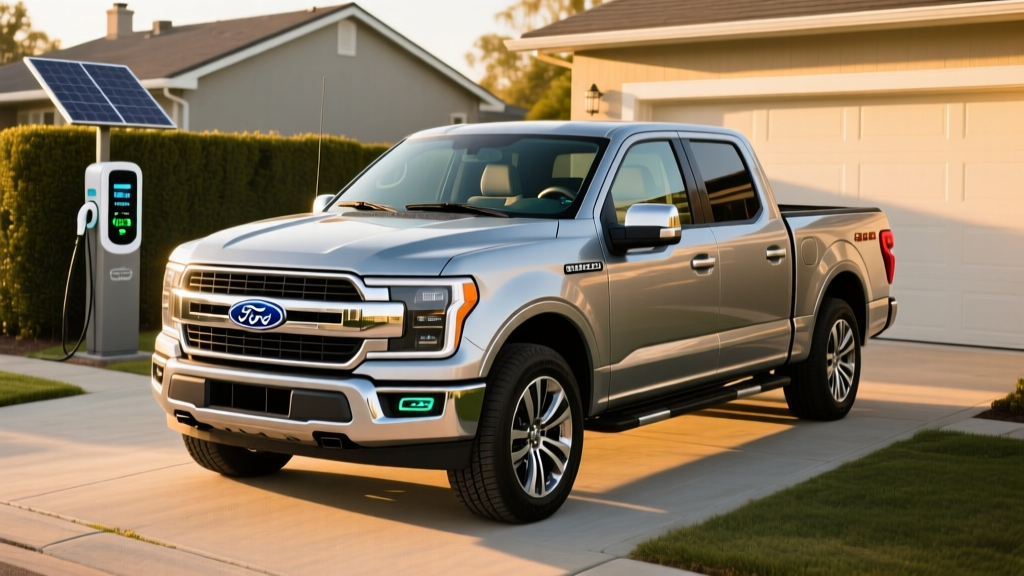
If you need a full-size pickup but flinch every time you pass a gas station, the Ford F-150 3.5L PowerBoost Full Hybrid is the most compelling middle ground on the market. This is a conventional hybrid (HEV) — not a plug-in — meaning you never hunt for a charger. You just fuel up and drive, while a 1.5 kWh lithium-ion battery and a 47-hp electric motor tucked between the engine and transmission silently recover energy during braking and assist during acceleration.
For the 2026 model year, Ford continues to offer the PowerBoost exclusively on the F-150 with the 3.5-liter twin-turbo V6. The result: 430 combined horsepower, 570 lb-ft of torque, best-in-class hybrid towing, and EPA-estimated fuel economy that embarrasses the non-hybrid 3.5L EcoBoost — especially around town.
| Spec | Value |
|---|---|
| Powertrain | 3.5L twin-turbo V6 + 47-hp electric motor |
| Combined Output | 430 hp / 570 lb-ft |
| Transmission | 10-speed modular hybrid automatic |
| Battery | 1.5 kWh lithium-ion (HEV, self-charging) |
| Drivetrain | RWD or 4WD |
| EPA Fuel Economy (4WD) | 23 city / 24 highway / 23 combined MPG |
| EPA Fuel Economy (RWD) | 25 city / 26 highway / 25 combined MPG |
| Max Towing (properly equipped) | 7,000 lbs (4WD); up to 12,700 lbs with Max Trailer Tow |
| Payload | Up to 2,120 lbs |
| Pro Power Onboard | 2.0 kW, 2.4 kW, or 7.2 kW (bed outlets) |
| 0–60 mph | ~5.9 seconds (4WD, tested) |
| Starting MSRP | ~$59,045 (Lariat PowerBoost 4×2, 2026 est.) |
| Federal Tax Credit | Not eligible (§30D requires plug-in capability) |
| Hybrid Battery Warranty | 8 years / 100,000 miles |
HEV vs. PHEV vs. EV: Where Does the PowerBoost Fit?
Before we dig into MPG, let's be precise about what the PowerBoost is — and what it isn't. This matters because the terminology gets mangled constantly in truck marketing.
| Feature | HEV (PowerBoost) | PHEV (e.g., F-150 Lightning successor / Rivian R2T future) | BEV (F-150 Lightning) |
|---|---|---|---|
| Plug-in Required? | No — self-charging via regen | Yes — plug in for electric range | Yes — plug in for all driving |
| Electric-Only Range | ~1 mile at low speed | 20–50 mi (typical PHEV) | 230–320+ mi (EPA) |
| Total Range | ~700+ mi (1 tank) | ~450–600 mi combined | 230–320 mi per charge |
| Fuel / Energy | Gasoline only | Gasoline + electricity | Electricity only |
| Federal Tax Credit (§30D) | Not eligible | Up to $7,500 (if eligible) | Up to $7,500 (if eligible) |
| Home Charging Needed? | No | Recommended (Level 2) | Essential (Level 2) |
| Best For | No garage charger, heavy towing, rural | Short commute + garage charger | Home charger, no towing needs |
The PowerBoost is a conventional full hybrid. Its 1.5 kWh battery is small by EV standards (the F-150 Lightning uses a ~98–131 kWh pack), but that's by design. The battery is never meant to be depleted — it buffers energy captured during regenerative braking and feeds the electric motor during acceleration, smoothing out the turbo V6's thirst. You will never see a charge port on a PowerBoost F-150.
Real-World MPG: What Owners Actually Report
| Driving Scenario | EPA Estimate (4WD) | Real-World Owner Reports |
|---|---|---|
| City | 23 MPG | 22–26 MPG |
| Highway (70 mph) | 24 MPG | 19–23 MPG |
| Combined | 23 MPG | 20–24 MPG |
| Towing (5,000-lb trailer) | N/A (not EPA-rated) | 10–14 MPG |
| Cold Weather (<30°F) | N/A | 18–21 MPG |
Here's the counterintuitive truth about hybrids: they shine in the city. The PowerBoost's electric motor handles low-speed crawling, stop-and-go traffic, and neighborhood driving almost entirely on electric assist, with the V6 shutting off frequently. Many owners report exceeding the EPA city estimate of 23 MPG — some hitting 26 MPG on suburban routes with moderate traffic.
Highway driving is a different story. At sustained 70–80 mph, the aerodynamic drag of a full-size truck dominates, and the hybrid system's advantage shrinks. Expect 19–23 MPG on the interstate depending on speed, wind, and bed load. If your driving is 80% highway, the PowerBoost's MPG edge over the standard 3.5L EcoBoost (20 city / 24 highway / 22 combined for 4WD, per fueleconomy.gov) narrows to roughly 1–2 MPG combined.
Towing is where reality bites hardest. Hook up a 5,000-lb camper or boat trailer and watch the trip computer drop to 10–14 MPG. The hybrid system still helps — the electric motor's instant torque smooths launch from stops — but physics demands fuel. For context, the F-150 Lightning (BEV) can tow up to 10,000 lbs, but its range drops by 40–60% under load, making the PowerBoost the more practical heavy-towing choice for long hauls.
Powertrain Deep Dive: 430 HP and How the Hybrid System Works
The PowerBoost pairs Ford's 3.5-liter twin-turbocharged V6 with a 47-horsepower (35 kW) electric motor integrated directly into the 10-speed automatic transmission housing. Combined output is 430 hp and 570 lb-ft of torque — figures that put it in the territory of the high-output EcoBoost, but with far better low-end responsiveness.
The electric motor fills the torque gap before the turbos spool up, virtually eliminating turbo lag off the line. The result is a 0–60 mph time of approximately 5.9 seconds in 4WD — genuinely quick for a 5,500-lb truck. The transition between electric assist and gasoline power is seamless; most drivers won't notice the handoff.
The 1.5 kWh lithium-ion battery pack sits under the rear seat, preserving the full cab interior and bed space. Because it's a small HEV battery, it charges entirely through regenerative braking and engine-driven generation — no plug, no cable, no range anxiety. Ford engineers designed the system to keep the battery's state of charge (SoC) between roughly 40–60% during normal driving, which maximizes longevity by avoiding deep cycles.
Pro Power Onboard: The Feature That Sells the PowerBoost
One feature unique to the PowerBoost (and the Lightning) is Pro Power Onboard — electrical outlets in the truck bed that can run tools, appliances, and even a small job site. This is where the hybrid's battery and inverter system pays dividends beyond fuel economy.
Three tiers are available depending on trim:
- 2.0 kW: Standard on PowerBoost trims. Two 120V/20A bed outlets. Runs power tools, a small fridge, or a TV.
- 2.4 kW: Adds a 240V/30A outlet. Can run a welder or air compressor.
- 7.2 kW: Available on Lariat and above with the Max Trailer Tow package. Includes four 120V/20A outlets, one 240V/30A outlet, and one 240V/50A outlet. Can power a circular saw, compressor, and flood lights simultaneously — or serve as emergency home backup during an outage (via a transfer switch, installed by a licensed electrician).
The 7.2 kW system is a legitimate differentiator. Contractors regularly cite it as the reason they chose the PowerBoost over a diesel or standard gas truck. At a job site with no grid power, the truck becomes a mobile generator — and because the hybrid system can run the engine only as needed to recharge the battery, it's quieter and more fuel-efficient than a standalone generator.
Pricing, Trim Availability, and Tax Credit Reality
The PowerBoost is not a budget option. For the 2026 model year, it's available starting on the Lariat trim and up (Lariat, King Ranch, Platinum, Limited), with 4×2 and 4×4 configurations.
| Trim | PowerBoost 4×2 | PowerBoost 4×4 |
|---|---|---|
| Lariat | ~$59,045 | ~$62,545 |
| King Ranch | — | ~$72,000 |
| Platinum | — | ~$76,000 |
| Limited | — | ~$86,000+ |
Federal tax credit: The PowerBoost does not qualify for the IRS §30D Clean Vehicle Credit. That credit is reserved for plug-in electric vehicles (BEVs and PHEVs) with battery packs of at least 7 kWh and external charging capability. The PowerBoost's 1.5 kWh self-charging battery doesn't meet that threshold. If a federal tax credit is a dealbreaker, you'd need to look at the F-150 Lightning (BEV) or a qualifying PHEV.
That said, some states and local utilities offer rebates for hybrid vehicles, and the fuel savings over a gas-only F-150 can add up. At $3.50/gallon and 15,000 miles/year, a PowerBoost getting 23 MPG combined vs. a standard 3.5L EcoBoost at 22 MPG saves roughly $100/year in fuel — modest. The real savings come vs. the 5.0L V8 (19 MPG combined), where the PowerBoost saves approximately $550/year. Over five years, that's ~$2,750 in fuel savings against the V8.
Reliability, Battery Lifespan, and Replacement Cost
PowerBoost Hybrid Battery Warranty
Ford covers the hybrid battery and all hybrid-specific components (electric motor, inverter, control modules) under its 8-year / 100,000-mile hybrid/electric component warranty — whichever comes first. This is a federal-mandated minimum for hybrid components. The standard powertrain warranty covers the 3.5L V6 and transmission for 5 years / 60,000 miles.
Hybrid battery longevity is a top concern, and the data is reassuring. The 1.5 kWh pack in the PowerBoost is small, lightly cycled (it never fully charges or fully depletes), and thermally managed. Toyota's hybrid batteries — which operate on similar principles — routinely last 150,000–200,000+ miles before any capacity loss is noticeable. Ford's hybrid system in the Escape Hybrid and Fusion Hybrid (predecessors to this architecture) have shown similar durability in fleet use.
If the battery does need replacement out of warranty, expect a cost in the range of $2,500–$4,500 including labor at a Ford dealer. That's significantly less than a full EV battery replacement ($10,000–$20,000+) because the pack is small and modular. Independent hybrid specialists can often refurbish or replace individual cells for less.
The broader powertrain — the 3.5L EcoBoost V6 and 10-speed transmission — has been in production since 2017 and is one of Ford's most widely deployed engines. Common issues reported on earlier model years (2017–2020) included cam phaser rattle and turbo wastegate concerns, most of which were addressed in subsequent revisions. The PowerBoost variant, introduced for the 2021 model year, has a relatively clean reliability record as of 2026, with no widespread systemic failures reported by major reliability trackers.
Who Should Buy the PowerBoost — And Who Shouldn't
Pros
- Best-in-class hybrid towing (up to 12,700 lbs with Max Trailer Tow)
- City MPG that exceeds EPA estimates for many drivers
- Pro Power Onboard (up to 7.2 kW) — a genuine job-site tool
- No charging infrastructure needed — just fill up with gas
- 430 hp / 570 lb-ft with smooth, lag-free acceleration
- Full-size truck capability: payload, bed space, cab room unchanged
- Hybrid battery warranty: 8 years / 100,000 miles
Cons
- Highway MPG advantage is small (1–2 MPG over EcoBoost)
- Starting MSRP ~$59K — the hybrid premium is ~$3,000–$5,000 over equivalent EcoBoost
- No federal tax credit (not a plug-in vehicle)
- Towing MPG drops to 10–14 MPG (same as gas trucks)
- Only available on Lariat trim and above (no XL/XLT PowerBoost)
- Cold-weather MPG loss of ~10–15%
Choose the F-150 PowerBoost If:
- You tow frequently and need long range without charging stops
- You work on job sites and want Pro Power Onboard
- You can't install a home Level 2 charger (apartment, no garage)
- Your driving is a mix of city and highway, and you want 22–25 MPG combined
- You need full-size truck payload and towing, and a BEV's range loss under load is unacceptable
Look at a BEV (F-150 Lightning) Instead If:
- You have a home Level 2 charger and drive under 250 miles/day
- You want the lowest per-mile "fuel" cost (~$0.04–$0.06/mi on home electricity vs. ~$0.15–$0.18/mi on gas)
- You want to qualify for the federal §30D tax credit (up to $7,500, subject to income and sourcing rules)
- You rarely tow heavy loads over long distances
Frequently Asked Questions
How many MPG does the F-150 3.5 PowerBoost Full Hybrid get?
The EPA rates the 2026 F-150 PowerBoost 4WD at 23 city / 24 highway / 23 combined MPG. The RWD version is rated at 25 city / 26 highway / 25 combined. In real-world driving, many owners exceed the city estimate (24–26 MPG in stop-and-go traffic) but fall slightly short on the highway (19–23 MPG at 70+ mph). Towing drops fuel economy to 10–14 MPG depending on trailer weight.
Does the PowerBoost need to be plugged in?
No. The PowerBoost is a conventional hybrid (HEV), not a plug-in hybrid (PHEV). Its 1.5 kWh battery charges entirely through regenerative braking and engine-driven generation. There is no charge port, no plug, and no electric-only driving range beyond very low-speed maneuvering (~1 mile). You fuel it like any other gas truck.
How far can the PowerBoost drive on electric power alone?
Effectively zero miles at normal driving speeds. The electric motor assists the gasoline engine and can propel the truck at very low speeds (under ~25 mph) for short distances, such as in a parking lot or heavy traffic. But sustained electric-only driving is not possible — this is by design for a conventional hybrid.
Is the PowerBoost hybrid system reliable?
As of the 2026 model year, the PowerBoost has a solid reliability record. The 3.5L EcoBoost V6 is a mature, widely deployed engine, and the hybrid components (electric motor, inverter, battery) are lightly stressed due to the small battery size and partial-cycling strategy. Ford covers hybrid-specific components for 8 years / 100,000 miles. Hybrid battery replacement, if needed out of warranty, typically costs $2,500–$4,500.
Does the F-150 PowerBoost qualify for a federal tax credit?
No. The IRS §30D Clean Vehicle Credit requires a vehicle to have a battery capacity of at least 7 kWh and the ability to be recharged from an external power source (i.e., it must be a plug-in vehicle). The PowerBoost's 1.5 kWh self-charging battery does not qualify. If a tax credit is important, consider the F-150 Lightning (BEV) or a qualifying PHEV. Always verify current eligibility at irs.gov, as rules change.
How does the PowerBoost compare to the F-150 Lightning for towing?
The Lightning has a higher max tow rating (10,000 lbs vs. the PowerBoost's 12,700 lbs with Max Trailer Tow), but the critical difference is range under load. The Lightning's EPA range of 230–320 miles can drop by 40–60% when towing a heavy trailer, leaving you with 100–180 miles between charges — and DC fast chargers are sparse on rural towing routes. The PowerBoost's 30.6-gallon tank gives you ~700 miles of range regardless of trailer weight, with refueling in 5 minutes. For long-distance heavy towing, the PowerBoost remains the more practical choice in 2026.
What does Pro Power Onboard cost, and is it worth it?
The 2.0 kW system is included standard on PowerBoost trims. The 7.2 kW system is bundled in the Max Trailer Tow Package (approximately $1,500–$2,000 depending on trim). For contractors, the 7.2 kW system eliminates the need for a portable generator ($800–$2,000) and runs quieter, with no separate fuel to manage. For homeowners, it can serve as emergency backup power during outages when paired with a professionally installed transfer switch.
The F-150 3.5 PowerBoost Full Hybrid isn't revolutionary — it's pragmatic. It doesn't ask you to change your habits, install a charger, or plan routes around charging stations. It just delivers 430 hp, class-leading hybrid towing, and 23+ MPG in a full-size truck that works exactly like the truck you already know. For buyers who need capability first and efficiency second, it's the smartest F-150 powertrain Ford currently offers.