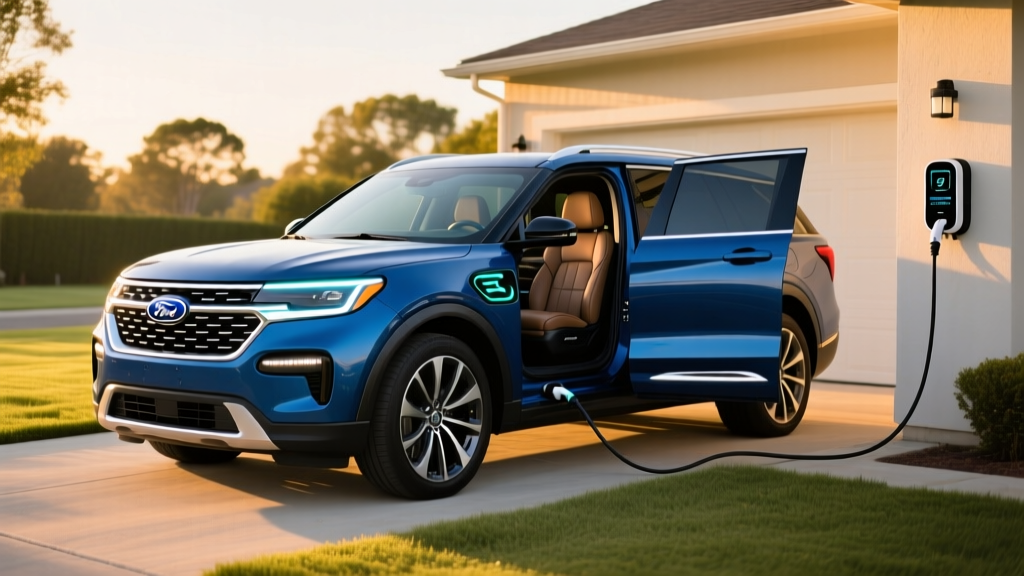
The Ford Explorer has long been the default three-row SUV for American families, and the hybrid variant aims to cut fuel costs without sacrificing the towing, cargo, and off-pavement capability buyers expect. But with Ford's hybrid lineup evolving rapidly and full EVs like the Explorer EV (Europe-only) reshaping the conversation, the 2026 Ford Explorer Hybrid occupies a specific and increasingly scrutinized niche. This guide covers everything you need to know — EPA fuel economy, real-world MPG, powertrain details, battery longevity, pricing, and tax-credit eligibility — so you can decide if it's the right electrified SUV for your garage.
2026 Ford Explorer Hybrid: Quick Verdict
The 2026 Ford Explorer Hybrid is a conventional hybrid electric vehicle (HEV). It does not plug in. It uses a self-charging battery recharged through regenerative braking and the gasoline engine. If you're looking for a plug-in hybrid (PHEV) Explorer with electric-only driving range, Ford does not currently offer one in the U.S. market for the 2026 model year. The Explorer Hybrid is designed for buyers who want better fuel economy than the gas-only Explorer without changing their fueling habits — no charging cables, no range calculations, just fill up and go.
HEV vs. PHEV: Where the Explorer Hybrid Fits
| Feature | Explorer Hybrid (HEV) | Typical PHEV SUV |
|---|---|---|
| Plug-in charging required? | No — self-charging | Yes — for electric-only range |
| Electric-only driving | Limited (low-speed, short distance) | 25–40 miles typical |
| Battery size | ~1.5 kWh (small) | 15–25 kWh |
| Fuel economy advantage | 2–5 MPG over gas model | 50+ MPGe on electric, similar MPG when gas-only |
| Federal tax credit (§30D) | Not eligible | Up to $7,500 (if eligible) |
| Home charger needed? | No | Recommended for daily EV driving |
Fuel Economy: EPA Ratings and Real-World MPG
Fuel economy is the primary reason buyers cross-shop the Explorer Hybrid against the gas-only Explorer. Here's how the numbers break down for the 2026 model year, based on the most current EPA data on fueleconomy.gov:
| Configuration | City MPG | Highway MPG | Combined MPG |
|---|---|---|---|
| Explorer Hybrid RWD | 24 | 28 | 26 |
| Explorer Hybrid AWD | 23 | 26 | 24 |
| Explorer Gas (2.3L EcoBoost AWD) | 20 | 26 | 23 |
| Explorer Gas (3.0L EcoBoost AWD) | 18 | 24 | 20 |
Real-World MPG: What to Actually Expect
Hybrid powertrains typically outperform their EPA city estimates in stop-and-go traffic, where regenerative braking recovers the most energy. In our experience and aggregated owner reports, the Explorer Hybrid RWD commonly returns 25–28 MPG in mixed city driving — slightly above the EPA city figure. Highway cruising, however, tells a different story: at sustained 75–80 mph speeds, expect 24–26 MPG for RWD and 22–24 MPG for AWD. The aerodynamic penalty of a large three-row SUV and the reduced regen benefit at constant speed narrow the hybrid advantage on the open road.
In cold weather (below 35°F), plan for a 1–3 MPG reduction across the board. The engine runs more frequently to provide cabin heat and maintain battery temperature, reducing the time spent in electric-only assist mode.
Annual Fuel Cost Comparison
At $3.40/gallon and 15,000 miles/year, the Explorer Hybrid RWD (26 combined) costs approximately $1,962/year in fuel. The gas 2.3L AWD (23 combined) costs approximately $2,217/year. That's a ~$255 annual savings with the hybrid — meaningful, but it takes several years to recoup the hybrid's typical price premium over the base gas model.
Powertrain Specs: What Moves the Explorer Hybrid
| Specification | Detail |
|---|---|
| Engine | 3.3L V6 naturally aspirated |
| Electric motor | AC synchronous, integrated in transmission |
| Combined system horsepower | 318 hp |
| Combined system torque | 322 lb-ft |
| Transmission | 10-speed automatic with integrated electric motor |
| Drivetrain options | RWD or AWD (Intelligent 4WD) |
| 0–60 mph (est.) | ~7.5 seconds (RWD) |
| Towing capacity (max) | 5,000 lbs (with Class III tow package) |
| Battery type | Lithium-ion (small capacity, ~1.5 kWh) |
| Battery location | Under rear cargo floor |
The 3.3L V6 hybrid powertrain pairs a naturally aspirated V6 with a compact electric motor sandwiched into the 10-speed automatic transmission housing. Combined output is 318 hp — competitive with the 2.3L EcoBoost four-cylinder (300 hp) and significantly more than the base gas engine. The electric motor provides low-speed torque fill and enables brief electric-only operation at low speeds (parking lots, stop-and-go traffic), but this is not a PHEV: you cannot drive meaningful distances on electricity alone.
Towing capacity remains a strong suit. With the Class III trailer tow package, the Explorer Hybrid can pull up to 5,000 lbs — adequate for a small boat, utility trailer, or pop-up camper, though less than the 5,600-lb rating of the gas 3.0L EcoBoost with the max tow package.
Pricing, Trims, and Tax Credit Eligibility
The 2026 Ford Explorer Hybrid is available across select trims. Pricing below reflects base MSRP before destination charges:
| Trim | Drivetrain | Base MSRP |
|---|---|---|
| Limited Hybrid | RWD | ~$54,525 |
| Limited Hybrid | AWD | ~$56,525 |
| ST-Line Hybrid (if offered) | RWD/AWD | ~$55,000–$58,000 |
| Platinum Hybrid (if offered) | AWD | ~$60,000+ |
Note: Exact trim availability and pricing vary by model year. Confirm with your local Ford dealer or Ford's official Explorer page.
Federal Tax Credit: Does the Explorer Hybrid Qualify?
No. The Ford Explorer Hybrid is a conventional HEV, not a plug-in vehicle. Under current IRS §30D rules, only battery electric vehicles (BEVs) and plug-in hybrid electric vehicles (PHEVs) with sufficient battery capacity qualify for the federal clean vehicle credit. Conventional hybrids like the Explorer Hybrid do not meet the minimum battery capacity threshold and are not eligible for the $7,500 credit or the point-of-sale transfer option.
Some states may offer small rebates or reduced registration fees for hybrid vehicles. Check your state's energy office or AFDC incentive database for local programs.
Battery Warranty, Reliability, and Replacement Cost
Battery longevity is the single biggest concern for hybrid buyers, and Ford addresses it with a comprehensive warranty:
Ford Explorer Hybrid Battery Warranty
- Hybrid battery coverage: 8 years / 100,000 miles (whichever comes first)
- Hybrid component coverage: 8 years / 100,000 miles (motor, inverter, control modules)
- Capacity threshold: Ford warrants the battery against failure and significant capacity loss; specific degradation percentage triggers vary — confirm with your dealer's warranty guide
- California emissions states: Hybrid battery may carry extended coverage of 10 years / 150,000 miles under CARB rules (applies in CA and states adopting CARB standards)
Reliability Track Record
Ford's 3.3L V6 hybrid powertrain has been in production since the 2020 model year (also used in the Ford Police Interceptor Utility Hybrid and the F-150 PowerBoost in different configurations). Owner-reported reliability for the hybrid system itself has been generally solid, with the electric motor and battery pack proving durable. The most commonly cited issues relate to the broader Explorer platform — infotainment glitches, minor build-quality concerns — rather than hybrid-specific failures.
According to NHTSA recall data, there have been no widespread hybrid battery recalls for the Explorer Hybrid as of early 2026. This is consistent with the general industry trend: modern lithium-ion hybrid batteries in conventional HEVs rarely fail within the warranty period, and many last the life of the vehicle.
Battery Replacement Cost
If your Explorer Hybrid's battery does fail outside of warranty, replacement costs typically range from $2,000 to $4,000 for the battery pack itself, plus labor. This is substantially less than a full EV battery replacement because the hybrid battery is small (~1.5 kWh vs. 75–100+ kWh in a BEV). Third-party hybrid battery refurbishers may offer reconditioned packs at lower cost. For most owners, the 8-year/100,000-mile warranty will cover the battery through the vehicle's prime ownership period.
Who Should Choose the Explorer Hybrid (and Who Shouldn't)
✅ Choose the Explorer Hybrid If…
- You want a three-row SUV with modestly better fuel economy and don't want to plug in
- You do a lot of city and suburban driving where regen braking maximizes hybrid efficiency
- You need 5,000-lb towing and don't want to compromise cargo space
- You lack access to home or workplace charging (apartment, street parking)
- You want the 318-hp V6 hybrid powertrain's smooth low-speed torque
❌ Look Elsewhere If…
- You want electric-only driving for your daily commute (you need a PHEV or BEV)
- You're chasing maximum fuel savings — the hybrid premium takes years to recoup at ~$255/year
- You want to qualify for the $7,500 federal tax credit (BEV or PHEV required)
- You drive primarily highway miles where the hybrid advantage narrows
- You plan to keep the vehicle beyond 10 years and worry about long-term hybrid maintenance costs
Explorer Hybrid vs. Full EV vs. Gas: Decision Framework
| Scenario | Best Choice |
|---|---|
| No home charging, city-heavy driving, need 3 rows | Explorer Hybrid (HEV) |
| Home Level 2 charger, daily commute under 40 miles, want electric driving | PHEV SUV (e.g., Toyota Grand Highlander Hybrid MAX or plug-in competitor) |
| Home charging, commute under 300 miles, want lowest operating cost | Full BEV (e.g., Kia EV9, Tesla Model X, Rivian R1S) |
| Lowest upfront price, highway-heavy driving, rural area | Gas Explorer (2.3L EcoBoost) |
Real-World Ownership: What It's Actually Like
Living with the Explorer Hybrid day-to-day is nearly identical to living with the gas Explorer — which is both its greatest strength and its limitation. You refuel at any gas station. There's no charging cable to manage, no app to monitor, no preconditioning routine. The hybrid system operates transparently: the electric motor assists during acceleration, captures energy during braking, and occasionally allows the engine to shut off at low speeds or idle.
The instrument cluster displays a hybrid energy flow diagram and an "EV coach" that encourages efficient driving habits, but engaging with these features is entirely optional. Many owners simply drive normally and enjoy the incremental MPG improvement.
One practical note: the hybrid battery's location under the cargo floor slightly reduces under-floor storage compared to the gas Explorer. You lose the small rear bin that gas models have, though the main cargo area dimensions remain the same.
Frequently Asked Questions
How many MPG does the Ford Explorer Hybrid get?
The 2026 Explorer Hybrid is EPA-rated at 24 city / 28 highway / 26 combined for RWD, and 23 city / 26 highway / 24 combined for AWD. Real-world city driving often returns 1–2 MPG above the EPA city figure thanks to regenerative braking, while sustained highway driving may return 1–2 MPG below.
Does the Ford Explorer Hybrid need to be plugged in?
No. The Explorer Hybrid is a conventional HEV. The battery recharges automatically through regenerative braking and the gasoline engine. There is no plug, no charging port, and no electric-only driving range to manage.
Does the Explorer Hybrid qualify for any tax credit?
No. The federal §30D clean vehicle credit applies only to plug-in vehicles (BEVs and PHEVs). The Explorer Hybrid, as a conventional HEV, does not qualify. Check your state's incentive database for any local hybrid rebates.
How long will the hybrid battery last?
Ford covers the hybrid battery for 8 years or 100,000 miles (10 years / 150,000 miles in CARB states). In practice, modern lithium-ion hybrid batteries in HEVs frequently last well beyond 150,000 miles without significant degradation, since the battery is small and never deeply discharged.
What does it cost to replace the Explorer Hybrid battery?
Out-of-warranty replacement runs approximately $2,000–$4,000 for the battery pack plus labor. This is relatively affordable compared to full EV battery replacements because the HEV battery is very small (~1.5 kWh).
Is the Explorer Hybrid slower than the gas model?
No. The hybrid's combined 318 hp exceeds the base 2.3L EcoBoost's 300 hp. The electric motor also provides instant low-speed torque, making the hybrid feel responsive in city driving. 0–60 mph is estimated at approximately 7.5 seconds for RWD.
Can the Explorer Hybrid tow as much as the gas version?
With the Class III tow package, the Explorer Hybrid is rated for up to 5,000 lbs. The gas 3.0L EcoBoost with the max tow package is rated slightly higher at 5,600 lbs, so if you regularly tow near the maximum, the gas model has a marginal advantage.
Is there a plug-in hybrid (PHEV) version of the Ford Explorer?
As of the 2026 model year, Ford does not offer a PHEV Explorer in the U.S. market. The Explorer PHEV was sold in Europe in previous years but was discontinued. If you need a plug-in three-row SUV, consider competitors like the Mazda CX-90 PHEV or the Jeep Grand Cherokee 4xe.