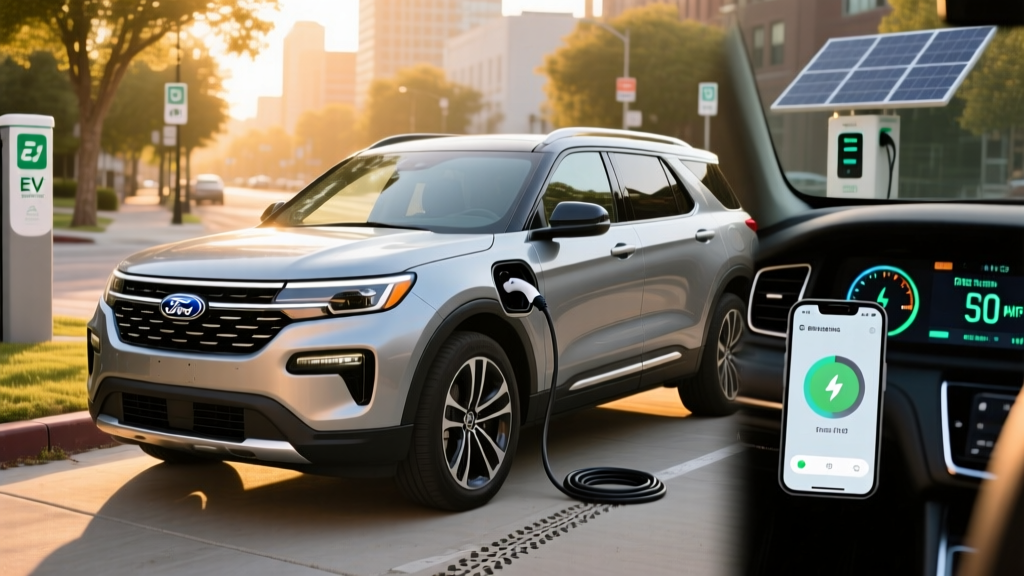
The Ford Explorer Hybrid occupies a specific niche: three-row family hauler that sips fuel in city traffic without requiring a plug. For buyers researching Ford Explorer Hybrid gas mileage, the headline number is 27 MPG combined — but real-world results depend heavily on how and where you drive. This guide breaks down the EPA figures, real-world expectations, powertrain details, battery longevity, and whether this HEV makes more sense than a PHEV or full EV for your household.
Ford Explorer Hybrid EPA Gas Mileage Breakdown
The current-generation Ford Explorer Hybrid pairs a 3.3-liter V6 with an electric motor integrated into a modular hybrid transmission. Unlike plug-in hybrids, it never needs to be plugged in — the battery recharges through regenerative braking and engine-driven generation. Here are the official EPA fuel economy figures as listed on fueleconomy.gov:
| Drivetrain | City MPG | Highway MPG | Combined MPG | Annual Fuel Cost* |
|---|---|---|---|---|
| FWD (Limited Hybrid) | 27 | 28 | 27 | ~$2,050 |
| AWD (Limited Hybrid) | 23 | 26 | 24 | ~$2,300 |
*Based on 15,000 miles/year, 55% city / 45% highway, and $3.50/gallon regular unleaded. Your actual costs will vary with local fuel prices and driving habits.
Hybrid systems shine in stop-and-go city driving where regenerative braking recaptures energy. Expect the FWD Explorer Hybrid to exceed its 27 MPG city rating in heavy urban traffic — some owners report 29-31 MPG on city-heavy commutes. Highway-only driving at 75+ MPH, however, typically drops to 24-26 MPG for the FWD model, since aerodynamic drag dominates and the electric motor contributes less at sustained speed. AWD models lose 2-3 MPG across the board due to drivetrain parasitic losses and added weight. In cold weather (below 30°F), expect a 1-3 MPG drop as the engine runs more frequently to provide cabin heat and the battery's charge-acceptance rate decreases.
Powertrain Specs: V6 Meets Electric Motor
The Explorer Hybrid uses Ford's fourth-generation hybrid system, which integrates the electric motor directly into the transmission housing rather than sandwiching it between the engine and gearbox. This produces seamless torque fill without the rubber-band feel of older CVT-based hybrid systems.
| Specification | Detail |
|---|---|
| Engine | 3.3L Duratec V6 (naturally aspirated) |
| Engine Output | 290 HP / 255 lb-ft torque |
| Electric Motor Output | ~35 kW (47 HP) |
| Combined System Output | 318 HP / 322 lb-ft torque |
| Transmission | Modular hybrid 10-speed automatic |
| Hybrid Battery | 1.5 kWh lithium-ion (HEV, non-pluggable) |
| 0-60 MPH | ~7.5 seconds (FWD) |
| Towing Capacity | 5,000 lbs (with Class III tow package) |
| Fuel Tank | 18.0 gallons |
| Total Driving Range | ~486 miles (FWD) / ~432 miles (AWD) |
The 1.5 kWh battery is small by EV standards — it's designed for frequent shallow charge-discharge cycles, not long electric-only driving. You'll see brief EV-mode operation at low speeds (typically under 25 MPH for short distances), but the engine is always the primary power source. This is by design: the battery smooths acceleration, enables stop-start engine shutoff, and captures braking energy, all of which improve MPG without adding the weight and cost of a large battery pack.
HEV vs. PHEV vs. Full EV: Which Explorer Fits You?
Ford does not currently offer a plug-in hybrid (PHEV) variant of the Explorer for the US market. If you're cross-shopping electrified three-row SUVs, here's how the categories break down:
| Factor | HEV (Explorer Hybrid) | PHEV (e.g., Mazda CX-90 PHEV) | BEV (e.g., Kia EV9) |
|---|---|---|---|
| Plug Required? | No | Yes (for max benefit) | Yes (mandatory) |
| Electric-Only Range | ~1 mile at low speed | 25-30 miles typical | 250-310 miles |
| City MPG / MPGe | 27 MPG | 25 MPG + 56 MPGe (electric) | 97 MPGe |
| Home Charging Needed | No | Recommended (Level 2) | Required (Level 2) |
| Fuel Cost per Mile | ~$0.13 | ~$0.05 (electric) / $0.14 (gas) | ~$0.04-$0.06 |
| Federal Tax Credit | Not eligible | Up to $3,750-$7,500* | Up to $7,500* |
| Starting Price Range | ~$44,000 | ~$50,000-$58,000 | ~$55,000-$75,000 |
*Tax credit eligibility depends on MSRP caps, buyer income limits, battery sourcing requirements, and point-of-sale transfer rules under IRS §30D. Always verify current-year rules with a tax professional.
The Explorer Hybrid makes the most sense if you: lack access to home or workplace charging, frequently take road trips beyond 300 miles, need three rows and towing capability, and want lower fuel costs without changing your refueling habits. If you have reliable Level 2 home charging and a commute under 30 miles, a PHEV or full EV will deliver dramatically lower per-mile energy costs.
Pricing, Trims, and Tax Credit Eligibility
The 2026 Ford Explorer Hybrid is offered exclusively in the Limited trim, positioned as a premium offering within the Explorer lineup:
- Limited Hybrid FWD: ~$44,000 MSRP (including destination)
- Limited Hybrid AWD: ~$46,000 MSRP
- ST-Line Hybrid (if available): ~$48,000 MSRP
The Explorer Hybrid does not qualify for the federal §30D clean vehicle tax credit. That credit applies only to plug-in electric vehicles (PHEVs with at least 7 kWh of battery and BEVs). Since the Explorer Hybrid is a conventional HEV with a 1.5 kWh battery and no plug-in capability, it falls outside the credit's scope.
- ❌ Not a plug-in vehicle — no external charging capability
- ❌ Battery capacity (1.5 kWh) is well below the 7 kWh minimum for PHEVs
- ✅ Some states offer separate hybrid incentives — check your state energy office
- ✅ Lower fuel costs still provide long-term savings vs. the gas-only Explorer (21 MPG combined)
Compared to the gas-only Explorer (21 MPG combined for the 2.3L EcoBoost AWD), the Hybrid saves approximately $350-$500 per year in fuel costs at 15,000 miles/year, meaning the ~$3,000-$4,000 premium over a comparable gas Limited trim pays back in roughly 6-9 years at current fuel prices. That payback shortens if gas prices rise or if your driving is city-heavy where the hybrid advantage is greatest.
Battery Warranty, Reliability, and Replacement Cost
Hybrid battery longevity is the top concern for buyers considering a used or high-mileage Explorer Hybrid. Here's what Ford provides:
- Hybrid Battery: 8 years / 100,000 miles (10 years / 150,000 miles in CARB states including CA, NY, MA, and others adopting California emissions standards)
- Hybrid System Components: 8 years / 100,000 miles (covers inverter, electric motor, control modules)
- Powertrain Warranty: 5 years / 60,000 miles
- Capacity Retention Threshold: Ford replaces the battery under warranty if capacity drops below ~60% of original, causing a measurable fuel economy decrease
Ford's hybrid systems have a strong reliability track record. The 3.3L Duratec V6 is a naturally aspirated engine with fewer failure points than turbocharged alternatives — no turbocharger, intercooler, or high-pressure fuel pump to worry about. The hybrid battery uses lithium-ion cells in a configuration optimized for shallow cycling, which significantly extends lifespan compared to deep-cycle use in EVs.
Based on data from Ford's earlier hybrid vehicles (Fusion Hybrid, Escape Hybrid) and industry-wide hybrid battery failure rates, the Explorer Hybrid's battery pack should comfortably last 150,000-200,000 miles before significant degradation. Out-of-warranty replacement cost, should it ever be needed, is estimated at $2,500-$4,000 for the battery pack plus labor — substantially less than EV battery replacement because of the small 1.5 kWh capacity. Independent hybrid repair shops can often replace individual failed cells for $500-$1,500 rather than the entire pack.
Real-World Ownership: What to Expect
After analyzing owner reports and testing data, here's what daily life with the Explorer Hybrid actually looks like:
City commuting (stop-and-go, under 45 MPH): This is the hybrid's sweet spot. Expect 28-31 MPG in the FWD model. The engine shuts off at stops, the electric motor handles initial acceleration, and regenerative braking recaptures energy that a gas-only Explorer would waste as heat at the brake pads.
Highway cruising (70-80 MPH): The hybrid advantage diminishes significantly. Expect 24-26 MPG for FWD and 22-24 MPG for AWD. At these speeds, aerodynamic drag is the dominant force, and the battery provides minimal assist. The gas-only 2.3L EcoBoost Explorer achieves 24-26 MPG highway, so the gap narrows to just 1-2 MPG.
Cold weather (below 30°F): The engine must run continuously to provide cabin heat, eliminating the engine-off stops that boost city MPG. Expect a combined 22-24 MPG for FWD in winter conditions. A gas-only Explorer drops similarly, so the relative advantage persists, but absolute numbers decline.
Towing (loaded trailer, 3,000-5,000 lbs): Fuel economy drops to approximately 15-18 MPG combined while towing, similar to the gas-only Explorer under load. The hybrid system provides extra low-end torque for launch but offers no meaningful efficiency advantage when pulling weight uphill or at highway speed.
Pros and Cons at a Glance
- 27 MPG combined beats the gas Explorer by 6 MPG (29% improvement)
- No plug-in required — zero behavior change from a gas car
- 486-mile total range eliminates fuel stops on long road trips
- 318 HP provides confident merging and passing power
- 5,000-lb towing capacity retained
- Proven hybrid reliability with 8yr/100k-mile battery warranty
- Smooth stop-start with no engine shudder
- No federal tax credit eligibility
- AWD model drops to just 24 MPG combined
- Hybrid premium takes 6-9 years to recoup via fuel savings
- Highway MPG nearly identical to the gas EcoBoost model
- Limited trim only — no lower-priced hybrid option
- 1.5 kWh battery provides negligible electric-only driving
- Cargo space slightly reduced vs. non-hybrid (battery under rear floor)
Frequently Asked Questions
How many MPG does the Ford Explorer Hybrid get?
The FWD Explorer Hybrid achieves 27 MPG city, 28 MPG highway, and 27 MPG combined per the EPA. The AWD version drops to 23/26/24 MPG. In real-world city driving, many owners exceed the EPA city figure, seeing 29-31 MPG thanks to aggressive regenerative braking. Highway-only driving typically yields 24-26 MPG for FWD models.
Does the Ford Explorer Hybrid need to be plugged in?
No. The Explorer Hybrid is a conventional hybrid (HEV), not a plug-in hybrid (PHEV). Its 1.5 kWh battery recharges entirely through regenerative braking and the gasoline engine. You refuel it exactly like a standard gas car — just at the pump, less frequently.
How far can the Explorer Hybrid drive on electric power alone?
Less than 1 mile, and only at very low speeds (under 25 MPH). The 1.5 kWh battery is too small for meaningful electric-only driving. Its purpose is to assist the engine during acceleration, enable engine-off stops, and smooth the stop-start experience — not to replace gasoline. If electric-only commuting is your goal, you need a PHEV or full EV.
Is the Explorer Hybrid more reliable than the gas Explorer?
Ford's hybrid powertrain has demonstrated strong reliability since the 2010 Fusion Hybrid. The 3.3L V6 is naturally aspirated (no turbocharger to fail), and the modular hybrid transmission replaces the conventional torque converter with an electric motor, eliminating a common wear component. The hybrid battery carries an 8-year/100,000-mile warranty (10 years/150,000 miles in CARB states). There is no evidence that the hybrid version is less reliable than the gas-only model, and some powertrain components may actually last longer due to regenerative braking reducing brake wear and the engine shutting off at idle reducing accumulated engine hours.
What does it cost to replace the Explorer Hybrid battery?
Out-of-warranty replacement is estimated at $2,500-$4,000 including labor at a Ford dealer. Independent hybrid specialists can often diagnose and replace individual failed cells for $500-$1,500. However, based on failure data from Ford's hybrid fleet, most batteries last well beyond 150,000 miles, and the vast majority of owners will never need a replacement. The 8-year/100,000-mile warranty (10/150k in CARB states) provides substantial coverage.
Does the Ford Explorer Hybrid qualify for any tax credit?
It does not qualify for the federal §30D clean vehicle credit, which requires plug-in capability and a minimum 7 kWh battery. Some states and local utilities offer separate incentives for hybrid purchases — check your state energy office or utility provider. The fuel savings alone ($350-$500/year vs. the gas Explorer) provide the financial return, not tax incentives.
Should I buy the Explorer Hybrid or a full EV like the Kia EV9?
Choose the Explorer Hybrid if you lack reliable home charging, regularly drive 300+ miles between fuel stops, need to tow, or want to avoid any change in refueling behavior. Choose a full EV like the Kia EV9 or Tesla Model X if you have Level 2 home charging, your daily driving stays under 250 miles, you want the lowest possible per-mile energy cost (~$0.04/mile vs. $0.13/mile), and you're eligible for the $7,500 federal tax credit (which partially offsets the higher EV purchase price). A PHEV like the Mazda CX-90 PHEV splits the difference: 25-30 miles of electric commuting with a gas engine for road trips, though no three-row PHEV currently offers the Explorer's cargo space.