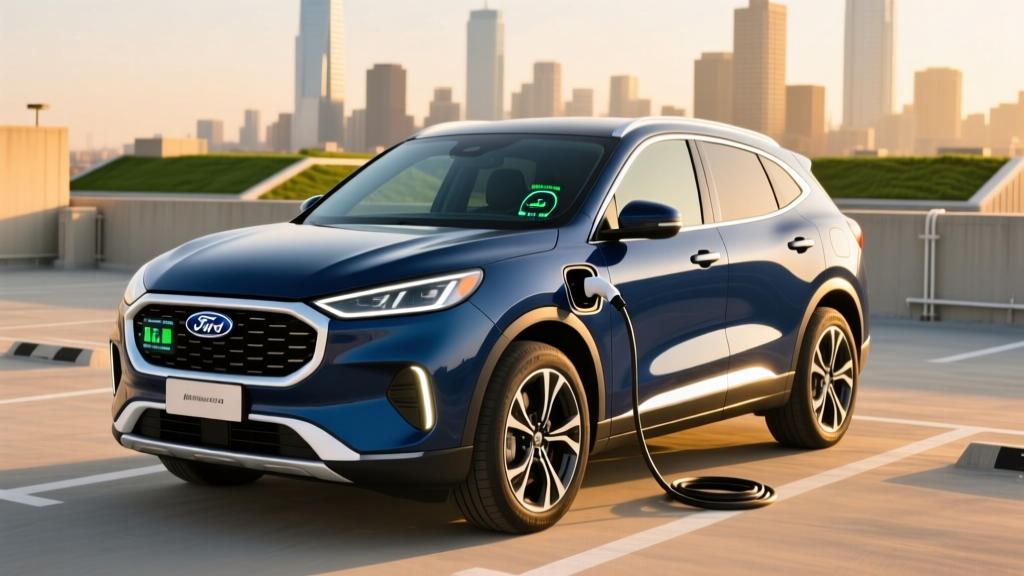
If you want electric commuting without giving up the flexibility of a gas tank for road trips, a Ford plug-in hybrid SUV is one of the most practical electrified vehicles on the market. For 2026, Ford continues to offer the Escape PHEV as its sole plug-in hybrid SUV — a compact crossover that pairs a 2.5-liter Atkinson-cycle engine with a robust electric motor and a usable battery pack that delivers genuine zero-emission daily driving.
This guide breaks down everything you need to know about the 2026 Ford Escape PHEV: real-world electric range, fuel economy, charging logistics, powertrain specs, pricing, tax credit eligibility, and whether a PHEV beats a full EV or conventional hybrid for your lifestyle.
HEV vs PHEV: What Ford Plug-In Hybrid SUV Buyers Must Know
Before diving into specs, it's critical to understand the difference between Ford's two hybrid flavors, because the ownership experience is fundamentally different.
| Feature | Conventional Hybrid (HEV) | Plug-In Hybrid (PHEV) |
|---|---|---|
| Battery Size | ~1.1 kWh (small buffer) | 14.4 kWh usable (Escape PHEV) |
| Plug In to Charge? | No — regenerative braking only | Yes — Level 1 or Level 2 |
| Electric-Only Driving | Brief low-speed assist only | Up to 37 miles at highway speeds |
| Fuel Economy (gas mode) | ~39 MPG combined | ~40 MPG combined (after battery depletes) |
| MPGe (electric mode) | N/A | 105 MPGe combined |
| Best For | No home charging access | Home charging + short commutes |
The Ford Escape is available in both configurations. If you can charge at home — even from a standard 120V outlet — the PHEV unlocks dramatically lower fuel costs for daily driving. If you live in an apartment without charging access, the conventional HEV still delivers strong MPG without any plug-in requirement.
2026 Ford Escape PHEV: Electric Range, MPG, and Efficiency
The headline number for any plug-in hybrid is how far it goes on electricity alone. The 2026 Ford Escape PHEV carries an EPA-rated 37 miles of electric-only range, which covers the average American one-way commute (roughly 16 miles each way) with room to spare for errands.
EPA Electric-Only Range: 37 miles
Real-World Expectation: 30–35 miles in mild weather; 24–28 miles in freezing temps (below 30°F) due to cabin heating demands and reduced battery efficiency.
Total Combined Range (Electric + Gas): ~520 miles with a full tank and full battery.
Once the battery depletes, the Escape PHEV operates as a conventional hybrid. The EPA rates it at 40 MPG combined in hybrid mode — competitive with the non-plug-in Escape HEV, which is rated at 39 MPG combined.
| Driving Mode | City | Highway | Combined |
|---|---|---|---|
| Electric-Only (MPGe) | 110 MPGe | 99 MPGe | 105 MPGe |
| Hybrid Mode (MPG) | 42 MPG | 37 MPG | 40 MPG |
Real-World MPG vs. EPA Sticker
In our experience and owner reports, the Escape PHEV tends to exceed its EPA city rating in stop-and-go traffic, where regenerative braking recaptures energy most effectively. Highway driving at 75+ MPH yields lower efficiency — expect 34–36 MPG in hybrid mode on the interstate. In cold weather, hybrid-mode MPG can dip to the mid-30s as the engine runs more frequently to provide cabin heat.
For maximum electric range, use the "EV Now" drive mode and precondition the cabin while plugged in. This draws heating or cooling energy from the grid rather than the battery, preserving those 37 miles for actual driving.
Powertrain, Performance, and Battery Specs
The 2026 Escape PHEV uses Ford's fourth-generation hybrid powertrain, pairing a 2.5-liter Atkinson-cycle four-cylinder engine with a permanent-magnet electric motor integrated into the eCVT transmission.
| Specification | 2026 Ford Escape PHEV |
|---|---|
| Combined System Horsepower | 210 hp |
| Engine | 2.5L Atkinson-cycle I4 (163 hp) |
| Electric Motor | 134 hp (integrated in eCVT) |
| Battery Chemistry | NMC (Nickel Manganese Cobalt) |
| Battery Capacity (Usable) | 14.4 kWh |
| Transmission | eCVT (planetary gearset, no fixed gears) |
| Drivetrain | Front-wheel drive only |
| 0–60 mph | ~8.0 seconds (estimated) |
| Towing Capacity | 1,500 lbs |
| Cargo Volume (behind 2nd row) | 34.4 cu ft |
The 210 combined horsepower provides confident highway merging and passing. The eCVT operates without traditional gear shifts — it's a planetary gearset that seamlessly blends engine and motor power. Acceleration is linear and quiet in EV mode, with the engine engaging almost imperceptibly when the battery depletes or you demand hard acceleration.
One notable limitation: the Escape PHEV is front-wheel drive only. If you need AWD, Ford offers it on the conventional Escape Hybrid (HEV) but not on the PHEV variant. This is a trade-off buyers in snow-belt states should weigh carefully.
Charging the Escape PHEV: Times, Levels, and Connector
Charging a PHEV is simpler and less demanding than a full EV because the battery is smaller. You won't need a DC fast charger — in fact, the Escape PHEV does not support DC fast charging. That's normal for PHEVs; the battery is small enough that Level 2 AC charging fills it quickly.
| Charging Level | Power (kW) | 0–100% Time | Notes |
|---|---|---|---|
| Level 1 (120V household outlet) | ~1.4 kW | ~10–11 hours | Overnight from any standard outlet |
| Level 2 (240V home/public) | ~3.3 kW (vehicle-limited) | ~3.5 hours | Recommended for daily use |
| DC Fast Charging | Not supported | N/A | CCS/NACS not applicable |
The onboard charger is limited to 3.3 kW, meaning even if you plug into a 7.2 kW or 11.5 kW Level 2 station, the Escape PHEV will only draw 3.3 kW. This is typical for PHEVs — the small battery doesn't need high-speed charging. A dedicated Level 2 home charger (240V, 16A or higher) will fully replenish the battery in about 3.5 hours, easily fitting into an evening routine.
Charging connector: The Escape PHEV uses the standard J1772 connector for AC charging. This is universal across all non-Tesla EVs and PHEVs in North America. Adapters are available if you need to use a NACS (Tesla) destination charger.
Cost to Charge
At the US average residential electricity rate of ~$0.16/kWh (per EIA data), a full 14.4 kWh charge costs roughly $2.30 — the equivalent of about 0.7 gallons of gas. That 37 miles of electric driving costs less than a gallon of regular unleaded, yielding an effective "fuel cost" of about $0.06 per mile on electricity versus $0.12–$0.14 per mile on gas at current prices.
Pricing, Trims, and Federal Tax Credit Eligibility
The 2026 Ford Escape PHEV is available in a single well-equipped trim, simplifying the purchase decision.
| Trim | MSRP (est.) | Key Features |
|---|---|---|
| Escape PHEV (base) | ~$40,500 | 14.4 kWh battery, 13.2" touchscreen, wireless CarPlay/Android Auto, Ford Co-Pilot360, heated front seats |
Does the Ford Escape PHEV Qualify for a Federal Tax Credit?
Under the IRS §30D Clean Vehicle Credit rules, the Escape PHEV's eligibility depends on several factors that shift frequently:
- MSRP Cap: SUVs must be under $80,000 — the Escape PHEV clears this easily.
- Battery Capacity: Must be ≥7 kWh — the 14.4 kWh battery qualifies.
- Buyer Income Limits: AGI must not exceed $150,000 (single), $225,000 (head of household), or $300,000 (joint). Check your modified AGI against IRS thresholds.
- Critical Minerals & Battery Sourcing: The credit is split into two halves ($3,750 each) based on critical-mineral sourcing and battery-component manufacturing requirements. These rules tighten annually. As of 2026, many PHEVs qualify for the partial $3,750 credit, but full $7,500 eligibility depends on supply-chain compliance that changes year to year.
- Point-of-Sale Transfer: You can transfer the credit to the dealer at purchase, reducing your out-of-pocket cost immediately rather than waiting for tax filing.
Bottom line: Verify current-year eligibility on fueleconomy.gov and consult a tax professional before relying on a specific credit amount. State incentives (California, Colorado, New York, and others) may stack on top — check your state's energy office for details.
Battery Warranty, Reliability, and Replacement Cost
Battery longevity is the top concern for hybrid and PHEV buyers, and Ford addresses it with strong warranty coverage.
Hybrid/PHEV Battery Warranty: 8 years / 100,000 miles (whichever comes first)
In California and CARB-adopting states: 10 years / 150,000 miles
Coverage Threshold: Ford warrants the battery to retain sufficient capacity to deliver rated electric range. If degradation drops capacity below the warranted threshold, Ford will repair or replace the battery at no cost.
Real-World Reliability
Ford's hybrid powertrain has been in production since the 2005 Escape Hybrid, giving it nearly two decades of field data. The eCVT design has no traditional transmission clutches or bands to wear out — it's a simple planetary gearset with far fewer failure points than a conventional automatic. Owner communities report high-mileage examples (150,000+ miles) with minimal battery degradation, typically in the 10–15% range after 8–10 years.
Battery Replacement Cost
If a replacement is needed outside warranty, expect a Ford Escape PHEV battery replacement to cost between $4,000 and $6,500 (parts and labor) at a dealership. However, out-of-warranty failures are rare based on historical data from Ford's hybrid lineup. Individual module replacement (rather than the full pack) may be possible at lower cost through independent hybrid specialists.
Who Should Buy the Ford Escape PHEV vs. a Full EV or Gas Car?
The Escape PHEV occupies a specific niche. Here's a decision framework to determine if it fits your life.
Choose the Ford Escape PHEV if:
- Your daily round-trip commute is under 35 miles and you can charge at home
- You take 3+ road trips per year exceeding 200 miles and don't want to plan around charging stops
- You want EV-like daily driving without range anxiety in cold weather or rural areas
- You don't have access to reliable DC fast charging infrastructure near your home
Choose a full EV (e.g., Ford Mustang Mach-E, Tesla Model Y) if:
- Your commute is longer but still under 250 miles round-trip
- You have home Level 2 charging and access to DC fast chargers for road trips
- You want zero tailpipe emissions and the lowest per-mile fuel cost
- You want to eliminate oil changes and engine maintenance entirely
Choose a conventional hybrid (Escape HEV) if:
- You cannot charge at home (apartment, street parking, no garage outlet)
- Your budget is tighter — the HEV starts several thousand dollars lower
- You need AWD, which the PHEV doesn't offer
Pros and Cons at a Glance
Pros
- 37 miles of electric-only range covers most commutes
- 105 MPGe in EV mode yields extremely low daily fuel costs
- No range anxiety — 520+ miles total range with gas engine
- Charges fully overnight on a standard 120V outlet
- Strong 8yr/100k-mile battery warranty
- Proven, reliable eCVT powertrain with two decades of lineage
Cons
- FWD only — no AWD option on the PHEV
- Single trim limits customization; MSRP ~$40,500
- 3.3 kW onboard charger limits Level 2 speed (irrelevant for most PHEV owners)
- Partial federal tax credit eligibility — verify yearly sourcing rules
- Less cargo space than the non-hybrid Escape due to battery placement (34.4 vs 37.5 cu ft)
Frequently Asked Questions
How many MPG does the Ford Escape PHEV get?
The 2026 Ford Escape PHEV achieves 40 MPG combined (42 city / 37 highway) in hybrid mode after the battery depletes. In electric-only mode, it earns 105 MPGe combined. In real-world driving, expect to exceed the EPA city rating in stop-and-go traffic and fall slightly below the highway rating at sustained 75+ MPH speeds.
How far can the Ford Escape PHEV go on electric only?
The EPA rates the Escape PHEV at 37 miles of electric-only range. In real-world conditions, expect 30–35 miles in mild weather and 24–28 miles in freezing temperatures. Using EV Now mode and preconditioning while plugged in maximizes your electric miles.
Does the Ford Escape PHEV qualify for a federal tax credit?
It may qualify for a partial or full §30D Clean Vehicle Credit (up to $7,500), depending on current-year critical-mineral sourcing and battery-component rules, your income, and the vehicle's MSRP. The Escape PHEV clears the $80,000 SUV MSRP cap and the 7 kWh minimum battery requirement. Verify current eligibility on fueleconomy.gov and consult a tax professional. Point-of-sale transfer is available if eligible.
Is the Ford Escape PHEV reliable, and what does battery replacement cost?
Ford's hybrid system has been in production since 2005 with a strong reliability track record. The eCVT has fewer moving parts than a conventional automatic. The battery is warranted for 8 years/100,000 miles (10 years/150,000 miles in CARB states). Out-of-warranty battery replacement costs $4,000–$6,500 but is rarely needed based on long-term owner data.
Can I charge the Escape PHEV at a Tesla Supercharger?
No. The Escape PHEV uses a J1772 AC connector and does not support DC fast charging, so Tesla Superchargers (which are DC) are incompatible. However, you can use a J1772 adapter to charge at Tesla Destination Chargers (Level 2 AC) at hotels and businesses. For home charging, any standard 120V outlet or 240V Level 2 station works.
Hybrid vs PHEV vs EV — which is right for me?
If you can charge at home and your daily driving is under 35 miles, the PHEV gives you EV-like daily costs with gas-engine road-trip freedom — the best of both worlds. If you can't charge at home, a conventional hybrid (HEV) delivers strong MPG with zero plug-in hassle. If you have home charging, road-trip charging access, and want the lowest operating cost with zero emissions, a full EV like the Mustang Mach-E or Tesla Model Y is the more transformative choice.