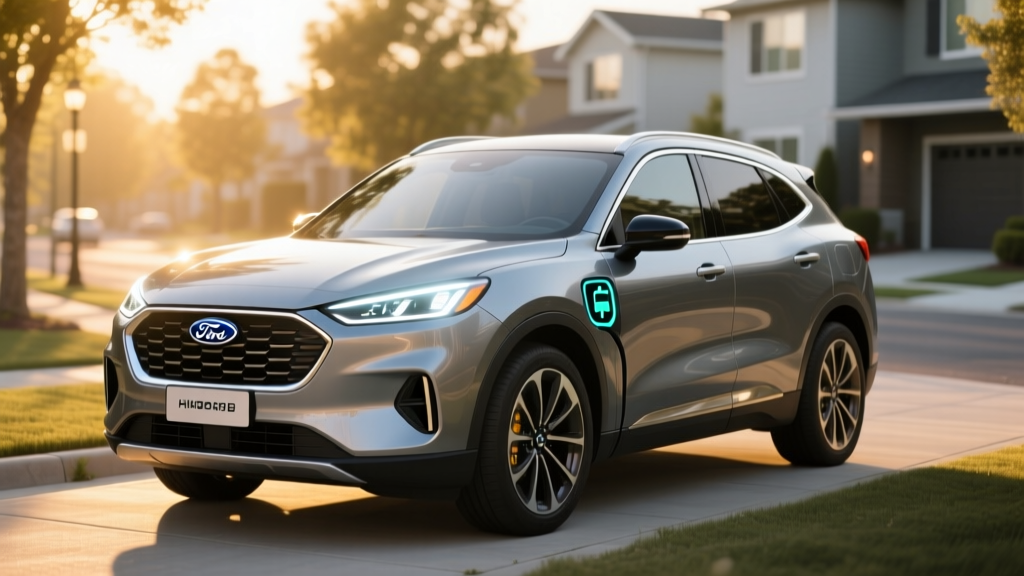
The Ford Escape Hybrid has been one of the best-selling electrified compact SUVs for years, and for the 2026 model year it continues to offer a practical bridge between conventional gas models and full battery-electric vehicles. Whether you are looking at the conventional hybrid (HEV) or the plug-in hybrid (PHEV) variant, the Escape lineup covers a wide spectrum of efficiency needs — from drivers who never want to think about plugging in to those who want electric-only commuting with a gas-engine safety net.
This guide breaks down the exact numbers that matter: EPA fuel economy, electric-only range, powertrain output, battery warranty, pricing, and whether you qualify for any federal tax credits. We will also separate the HEV from the PHEV clearly so you can decide which version fits your driving pattern.
HEV vs PHEV: Which Ford Escape Hybrid Is Which?
Ford offers two distinct electrified Escape models. They share a nameplate but operate very differently, and confusing them is the single most common mistake buyers make at the dealership.
| Feature | Escape Hybrid (HEV) | Escape Plug-In Hybrid (PHEV) |
|---|---|---|
| Needs to be plugged in? | No — self-charging via regenerative braking and engine | Yes — plug in to access electric-only range |
| Electric-only driving | Very limited (low-speed, short distances) | ~37 miles EPA on battery alone |
| Battery capacity | ~1.1 kWh (small buffer) | 14.4 kWh usable |
| Charging hardware | None required | Level 1 (120V) included; Level 2 (240V) optional |
| DC fast charging | Not available | Not available |
| Federal tax credit | Not eligible | Eligible (subject to §30D rules) |
| Drivetrain | AWD standard | FWD only |
The HEV is a "gas-and-go" vehicle — you fuel it normally and the hybrid system handles the rest. The PHEV rewards you with electric-only commuting but requires access to a plug (a standard 120V outlet works, though a 240V Level 2 charger is significantly faster).
Fuel Economy: EPA Numbers and Real-World MPG
Fuel economy is the primary reason buyers cross-shop the Escape Hybrid. Here is the official EPA data for the 2026 model year, via fueleconomy.gov:
| Model | City MPG | Highway MPG | Combined MPG | MPGe (PHEV elec. mode) |
|---|---|---|---|---|
| Escape Hybrid AWD | 42 | 36 | 39 | N/A |
| Escape Hybrid FWD | 44 | 37 | 41 | N/A |
| Escape PHEV (gas mode) | 40 | 37 | 39 | 105 MPGe |
Real-World MPG vs. EPA Sticker
Hybrids typically exceed their EPA city estimates in stop-and-go traffic because regenerative braking recovers energy that a gas car wastes as heat. In our experience and owner-reported data, the Escape Hybrid HEV regularly achieves 41–45 MPG in urban driving. Highway driving is the opposite story: at sustained 70–75 mph speeds, expect 32–35 MPG, since the electric motor contributes less at constant high velocity and aerodynamic drag dominates.
For the PHEV, real-world electric-only range depends heavily on temperature and driving style. The EPA rates it at 37 miles on battery alone. In mild weather (55–75°F) with moderate city driving, owners consistently report 35–40 miles. In cold weather (below 35°F), cabin heating and battery chemistry reduce that to roughly 28–32 miles. Highway driving at 70 mph will deplete the battery in approximately 25–28 miles.
Once the PHEV battery is depleted, it operates as a conventional hybrid and achieves approximately 39 MPG combined — essentially matching the HEV.
Powertrain and Performance Specs
| Specification | Escape Hybrid (HEV) | Escape PHEV |
|---|---|---|
| Engine | 2.5L Atkinson-cycle I4 | 2.5L Atkinson-cycle I4 |
| Combined system HP | 198 hp (AWD) | 210 hp |
| Electric motor | Permanent-magnet AC synchronous | Permanent-magnet AC synchronous (larger) |
| Transmission | eCVT (power-split) | eCVT (power-split) |
| Drivetrain | AWD (standard) | FWD only |
| 0–60 mph | ~7.5 seconds | ~7.1 seconds |
| Towing capacity | 1,500 lbs | 1,500 lbs |
| Total combined range | ~550 miles | ~520 miles (37 elec. + ~483 gas) |
The eCVT in both models is not a traditional belt-and-pulley CVT. It is a planetary gear set that blends engine and motor output seamlessly. There are no shift shocks, no rubber-band sensation, and durability is excellent — Toyota and Ford have used this power-split architecture for over two decades with very low failure rates.
The PHEV's larger electric motor gives it a slight acceleration advantage and makes electric-only highway merging feasible, though you will want the gas engine for sustained uphill grades or full-load passing.
PHEV Charging: How Long and What Equipment?
The Escape PHEV's 14.4 kWh battery charges as follows:
| Charging Level | Power | Time (0–100%) | Equipment Needed |
|---|---|---|---|
| Level 1 (120V household) | ~1.4 kW | ~10–11 hours | Included cordset; standard outlet |
| Level 2 (240V) | ~3.6 kW (onboard limit) | ~3.5–4 hours | Level 2 EVSE; 240V outlet or hardwired |
| DC Fast Charge | N/A | N/A | Not supported |
A critical detail: the Escape PHEV's onboard charger is limited to approximately 3.6 kW. Even if you plug into a 7.2 kW or 11.5 kW Level 2 station, the car will only accept 3.6 kW. This is typical for PHEVs — the smaller battery does not need high-speed charging — but it means investing in an expensive high-power home charger provides no benefit here. A basic 16-amp, 240V Level 2 unit (roughly $250–$400 for the hardware) is all you need.
DC fast charging is not available on the Escape PHEV. This is standard for nearly all PHEVs on the market; the battery is simply too small to justify the cost and weight of DC fast-charge hardware.
Pricing, Trims, and Tax Credit Eligibility
For the 2026 model year, Ford prices the Escape Hybrid lineup as follows (MSRP, before destination):
| Trim | Body Style | MSRP (approx.) |
|---|---|---|
| Escape Hybrid Base (AWD) | HEV | $34,500 |
| Escape Hybrid Premium (AWD) | HEV | $38,000 |
| Escape PHEV Base (FWD) | PHEV | $39,500 |
| Escape PHEV Premium (FWD) | PHEV | $43,000 |
Federal Tax Credit for the Escape PHEV
The Escape PHEV may qualify for the IRS §30D Clean Vehicle Credit, which offers up to $7,500 for eligible new plug-in hybrids and EVs. However, eligibility is not automatic. Current-year requirements include:
- MSRP cap: SUVs must be priced at or below $80,000 — the Escape PHEV clears this easily.
- Buyer income cap: Modified adjusted gross income must not exceed $150,000 (single), $225,000 (head of household), or $300,000 (joint).
- Battery sourcing: A percentage of critical minerals and battery components must be sourced from the U.S. or free-trade-agreement partners. These thresholds increase annually; check the IRS clean vehicle credit page for current-year compliance.
- Point-of-sale transfer: As of 2024, you can transfer the credit to the dealer at purchase and receive it as a price reduction, rather than waiting to claim it on your tax return.
The conventional Escape Hybrid (HEV) does not qualify for the §30D federal credit because it cannot be plugged in. Some states offer separate incentives for conventional hybrids, but these vary widely — check your state energy office for current programs.
Battery Warranty: What Is Covered?
Ford covers the hybrid battery in both the HEV and PHEV with an 8-year / 100,000-mile warranty (10 years / 150,000 miles in California and states that follow CARB emissions standards). This warranty covers defects and capacity loss below a defined threshold — typically 60–70% of original capacity, though the exact threshold is specified in your warranty booklet.
Replacement cost for an Escape hybrid battery, out of warranty, ranges from approximately $2,500 to $4,500 depending on the model (HEV batteries are smaller and less expensive; PHEV batteries cost more). However, real-world failure rates for Ford's hybrid batteries are very low. Many Escape Hybrids from the early 2020s are still running on their original packs with minimal degradation. Toyota's hybrid battery track record (which shares similar chemistry and architecture philosophy) shows most packs lasting 150,000–200,000+ miles before significant capacity loss.
Who Should Choose the Escape Hybrid vs. a Full EV or Gas Car?
Choose the Escape Hybrid HEV if:
- You do not have access to home or workplace charging
- You want maximum MPG without changing any habits
- You drive a mix of city and highway and want AWD
- You want a lower purchase price than a PHEV or EV
Choose the Escape PHEV if:
- You can charge at home (even a standard 120V outlet works overnight)
- Your daily commute is under 35 miles round-trip
- You want electric-only driving for most trips but need gas-engine range for road trips
- You want to reduce fuel spending significantly without range-anxiety concerns
Choose a full EV (like the Ford Mustang Mach-E or Hyundai Ioniq 5) if:
- You have reliable home Level 2 charging
- Your daily driving is under 250 miles and you can plan road-trip charging
- You want zero tailpipe emissions and the lowest per-mile fuel cost
- You want to eliminate oil changes and most powertrain maintenance
For the PHEV buyer, the economics are compelling: if you charge nightly and drive 30 miles per day, you might use gasoline only a handful of times per month. At $3.50/gallon and 39 MPG in gas mode, versus $0.14/kWh electricity, your "fuel" cost per mile drops from roughly $0.09 (gas) to $0.04 (electric) — a savings of over $500/year for a 12,000-mile driver who charges consistently.
Reliability and Long-Term Ownership
Ford's hybrid system, derived in part from Toyota-licensed power-split technology, has a strong reliability record. The eCVT transmission has no belts, no clutches, and no traditional wear items — it is one of the most durable transmissions in the industry. Brake wear is significantly reduced thanks to regenerative braking; many hybrid owners report original brake pads lasting 80,000–100,000 miles.
The primary long-term ownership concern is the hybrid battery. As noted above, the 8-year/100,000-mile warranty provides substantial coverage, and out-of-pocket replacement costs ($2,500–$4,500) are manageable compared to a full EV battery replacement ($8,000–$20,000+). Consumer Reports and J.D. Power data consistently rank Ford's hybrid powertrains as average to above-average in long-term reliability.
Insurance costs for the Escape Hybrid are generally comparable to the gas-only Escape, sometimes slightly higher due to the electrified powertrain. Get quotes from your insurer before purchasing — hybrid-specific surcharges vary by carrier.
Pros
- Excellent city MPG (42–44 EPA; often exceeded in real-world driving)
- PHEV offers 37 miles of electric-only commuting
- No range anxiety — gas engine provides 500+ total miles
- eCVT is extremely durable with minimal maintenance
- AWD available on HEV (standard, in fact)
- PHEV may qualify for up to $7,500 federal tax credit
- Strong 8-year/100,000-mile hybrid battery warranty
Cons
- PHEV is FWD only — no AWD option
- No DC fast charging on PHEV (3.6 kW onboard limit)
- Highway MPG drops to 32–35 real-world (typical for hybrids)
- PHEV cargo space slightly reduced vs. gas model
- HEV does not qualify for federal tax credit
- PHEV requires plug access to capture full value
Frequently Asked Questions
How many MPG does the Ford Escape Hybrid get?
The 2026 Escape Hybrid AWD is EPA-rated at 42 city / 36 highway / 39 combined. The FWD variant achieves 44 city / 37 highway / 41 combined. In real-world city driving, many owners report 41–45 MPG thanks to regenerative braking. Highway driving at 70+ mph typically yields 32–35 MPG.
How far can the Escape PHEV go on electric only?
The EPA rates the Escape PHEV at 37 miles of electric-only range. In mild weather with moderate city driving, expect 35–40 miles. Cold weather (below 35°F) reduces this to roughly 28–32 miles. Sustained highway driving at 70 mph depletes the battery in about 25–28 miles.
Does the Ford Escape Hybrid qualify for a tax credit?
The conventional Escape Hybrid (HEV) does not qualify for the federal §30D Clean Vehicle Credit because it cannot be plugged in. The Escape PHEV may qualify for up to $7,500, subject to buyer income caps ($150K single / $300K joint), MSRP limits ($80K for SUVs), and battery-sourcing requirements. Always verify current-year eligibility at IRS.gov and consult a tax professional.
Is the Ford Escape Hybrid reliable and what does battery replacement cost?
Ford's hybrid powertrain has a strong reliability record, with the eCVT being one of the most durable transmissions available. The hybrid battery is covered by an 8-year/100,000-mile warranty (10 years/150,000 miles in CARB states). Out-of-warranty battery replacement costs approximately $2,500–$4,500, but most packs last well beyond 150,000 miles based on historical data from Ford and similar Toyota hybrid systems.
Should I buy the Escape Hybrid, the PHEV, or a full EV?
If you lack home charging access, the HEV gives you excellent MPG with zero behavior change. If you can charge at home and commute under 35 miles daily, the PHEV lets you drive mostly on electricity while keeping a gas engine for road trips. If you have reliable Level 2 home charging and can plan around DC fast charging on road trips, a full EV like the Mustang Mach-E offers the lowest operating cost and zero tailpipe emissions — but requires more upfront infrastructure investment.
Does the Escape Hybrid need to be plugged in?
No. The conventional Escape Hybrid (HEV) charges its small battery through regenerative braking and the gas engine. You never plug it in. Only the Escape PHEV requires plugging in to access its 37 miles of electric-only range — though it will still operate as a regular hybrid if you never plug it in (you just lose the electric-commuting benefit).