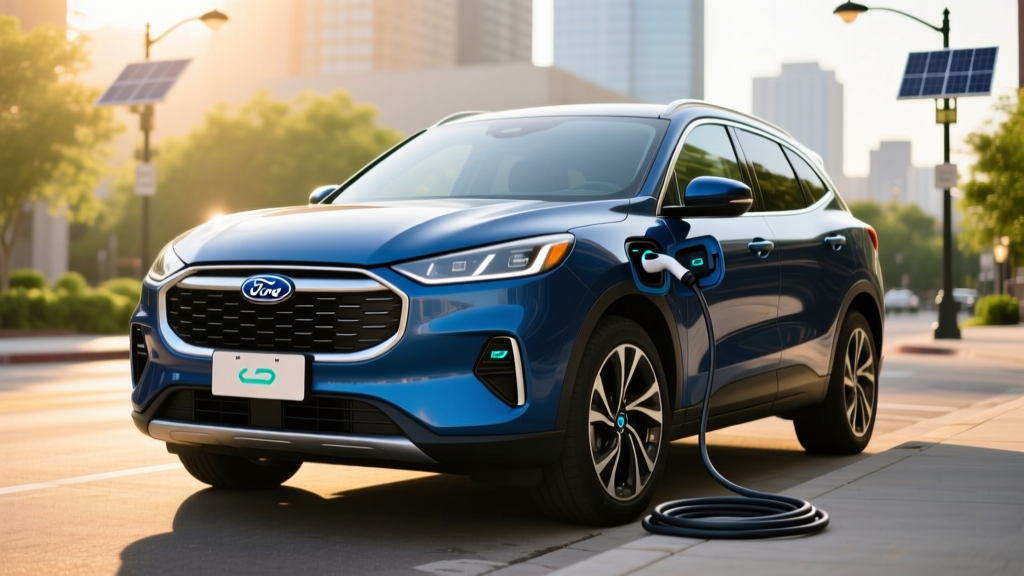
The Ford Escape Hybrid occupies a specific niche in the compact crossover segment: it delivers meaningful fuel savings over a gas-only Escape without requiring a plug, a lifestyle change, or a massive upfront premium. For 2026, Ford continues to offer the Escape in both conventional hybrid (HEV) and plug-in hybrid (PHEV) configurations, and the difference between them matters far more than most buyers realize at the dealership.
If you've been searching for Ford Escape Hybrid MPG data, you've likely noticed conflicting numbers depending on whether a source is discussing the HEV or the PHEV. This guide breaks down both powertrains with exact EPA figures, real-world observations, battery and warranty specifics, and a clear framework for deciding whether the standard hybrid, the plug-in hybrid, a full EV, or even a conventional gas model makes the most sense for your driving pattern.
Ford Escape Hybrid MPG: EPA Numbers and What They Actually Mean
The 2026 Ford Escape Hybrid (HEV) pairs a 2.5-liter Atkinson-cycle four-cylinder engine with an electric motor integrated into Ford's eCVT transmission. The front-wheel-drive (FWD) variant leads the lineup in efficiency, while the all-wheel-drive (AWD) model sacrifices a few MPG for added traction.
| Drivetrain | City MPG | Highway MPG | Combined MPG |
|---|---|---|---|
| FWD | 42 | 36 | 39 |
| AWD | 42 | 36 | 39 |
Source: fueleconomy.gov (U.S. EPA). Ford's hybrid system has historically performed very close to its EPA ratings in mixed driving, and the city-heavy nature of hybrid efficiency means stop-and-go commuters often see results at or slightly above the combined figure.
Escape PHEV: Electric-Only Range and Combined Efficiency
The 2026 Ford Escape Plug-In Hybrid (PHEV) is a fundamentally different vehicle underneath, despite wearing the same badge. It uses the same 2.5-liter engine but pairs it with a larger electric motor and a 14.4 kWh lithium-ion battery pack (usable capacity approximately 11.5 kWh). The PHEV is offered exclusively in FWD.
| Metric | Value |
|---|---|
| Electric-Only Range | 37 miles |
| Combined MPGe (electric + gas) | 105 MPGe |
| Gas-Only Combined MPG (after battery depleted) | 40 MPG |
| Total Combined Range (full tank + full charge) | ~490 miles |
| Battery Usable Capacity | ~11.5 kWh (14.4 kWh gross) |
The 37-mile electric-only range is enough to cover the average American's one-way commute, according to EPA PHEV data. Once the battery is depleted, the Escape PHEV operates as a conventional hybrid, delivering roughly 40 MPG combined — nearly identical to the standard HEV. This dual-mode operation is the PHEV's core value proposition: electric commuting with gas-powered road-trip capability.
PHEV Charging Time and Capabilities
The Escape PHEV charges via a standard J1772 AC port. It does not support DC fast charging — a common limitation among compact PHEVs, where battery sizes are too small to justify the hardware cost and thermal management requirements of DCFC.
| Charging Level | Power | 0–100% Time |
|---|---|---|
| Level 1 (120V household outlet) | ~1.4 kW | ~10–11 hours |
| Level 2 (240V home/public station) | ~3.7 kW (onboard charger limit) | ~3.5 hours |
| DC Fast Charging | Not supported | N/A |
For PHEV owners, Level 2 home charging is the sweet spot: plug in when you get home, and the battery is fully replenished by morning. The onboard charger caps at approximately 3.7 kW, so there's no benefit to installing a 48-amp (11.5 kW) Level 2 station specifically for this vehicle — a 16-amp or 20-amp Level 2 unit is sufficient.
HEV vs PHEV vs EV: Which Escape Is Right for You?
Ford sells the Escape in three powertrain flavors for 2026: a conventional gas model (1.5L EcoBoost), the Hybrid (HEV), and the Plug-In Hybrid (PHEV). Choosing between the hybrid options — or stepping up to a full battery-electric vehicle — depends on your daily mileage, charging access, and budget.
Choose the Escape HEV If:
- You drive 25–50 miles daily in mixed city/highway conditions
- You don't have access to home or workplace charging
- You want fuel savings with zero behavior change
- You tow occasionally (the HEV AWD has a slight edge in capability)
- Upfront cost matters — the HEV carries a smaller premium over the gas model
Choose the Escape PHEV If:
- Your daily round-trip commute is under 37 miles
- You can charge at home (even a standard 120V outlet works overnight)
- You want near-EV running costs for daily driving but need gas flexibility for road trips
- You qualify for the federal §30D tax credit (see details below)
- You're willing to pay a higher MSRP premium to capture long-term fuel savings
Choose a Full EV (e.g., Mustang Mach-E) If:
- Your daily driving is under 250 miles and you can charge at home
- You want zero tailpipe emissions and minimal maintenance
- You're ready for the full EV ownership experience
- Long-term fuel and maintenance savings are your top priority
Stick With Gas (EcoBoost) If:
- You drive fewer than 8,000 miles per year (hybrid premium won't pay back)
- Upfront purchase price is your primary constraint
- You plan to own the vehicle for fewer than 3 years
Powertrain Specs: What's Under the Hood
| Specification | Escape Hybrid (HEV) | Escape PHEV |
|---|---|---|
| Engine | 2.5L Atkinson-cycle I-4 | 2.5L Atkinson-cycle I-4 |
| Engine Horsepower | 163 hp | 163 hp |
| Electric Motor | Integrated in eCVT | Larger motor, integrated in eCVT |
| Combined System Horsepower | 198 hp (FWD) / 210 hp (AWD) | 210 hp |
| Transmission | eCVT | eCVT |
| Drivetrain Options | FWD or AWD | FWD only |
| 0–60 mph (est.) | ~7.5 sec (FWD) | ~7.8 sec |
| Battery Type | ~1.1 kWh NiMH/Li-ion (buffer) | 14.4 kWh Li-ion (11.5 usable) |
| Fuel Tank | 14.2 gal | 11.1 gal |
Neither powertrain is built for performance thrills — the eCVT delivers smooth, linear acceleration without the shift shock of a traditional automatic. The AWD hybrid uses a rear-mounted electric motor to drive the rear wheels when traction demands it, rather than a mechanical driveshaft, which preserves interior space and efficiency.
Pricing, Trims, and Federal Tax Credit Eligibility
| Model / Trim | Starting MSRP |
|---|---|
| Escape Hybrid FWD (ST-Line) | ~$34,500 |
| Escape Hybrid AWD (ST-Line) | ~$36,000 |
| Escape Hybrid AWD (ST-Line Select) | ~$38,500 |
| Escape PHEV (ST-Line) | ~$39,500 |
| Escape PHEV (ST-Line Select) | ~$42,000 |
| Escape PHEV (Premium) | ~$44,500 |
Prices are approximate based on Ford's published MSRP and may vary by dealer. Destination charges add approximately $1,495.
Federal §30D Tax Credit — PHEV Eligibility
The Ford Escape PHEV may qualify for up to $3,750 under the IRS §30D Clean Vehicle Credit for 2026. The full $7,500 credit requires meeting both critical-mineral and battery-component sourcing thresholds under the Inflation Reduction Act. As of the 2026 model year, the Escape PHEV typically qualifies for the $3,750 critical-minerals portion but may not meet the battery-component requirement, depending on supply-chain updates. Verify the latest eligibility on fueleconomy.gov's tax credit page.
- Vehicle MSRP cap: SUVs/vans/pickups must be under $80,000 — the Escape PHEV qualifies.
- Buyer income cap: Modified AGI must not exceed $150,000 (single), $225,000 (head of household), or $300,000 (joint).
- Battery sourcing: Credit phases in based on critical-mineral and component percentages from FTA countries — check current-year IRS guidance.
- Point-of-sale transfer: As of 2024+, the credit can be transferred to the dealer at purchase, reducing your out-of-pocket cost immediately rather than waiting for a tax refund.
- Conventional HEV: The standard Escape Hybrid does NOT qualify for §30D — only plug-in vehicles are eligible.
Battery Warranty, Reliability, and Replacement Cost
Hybrid battery longevity remains the top concern for first-time hybrid buyers. Ford backs both the Escape HEV and PHEV high-voltage batteries with a comprehensive warranty that meets or exceeds industry norms.
- Hybrid battery: 8 years / 100,000 miles (whichever comes first)
- Hybrid-specific components (eCVT, inverter, electric motor): 8 years / 100,000 miles
- Capacity retention threshold: Ford defines a "defect" as the battery dropping below approximately 70% of original capacity within the warranty period
- California-emissions states: Hybrid battery coverage extends to 10 years / 150,000 miles in CARB-adopting states
What Does a Replacement Cost?
If the high-voltage battery requires replacement out of warranty, expect to pay between $2,500 and $4,500 for the Escape HEV's smaller battery pack, and $5,000 to $8,000 for the PHEV's larger 14.4 kWh pack (parts and labor). However, modern hybrid batteries are engineered for 150,000–200,000+ miles of service life. Data from fleet operators and long-term owners of Ford's hybrid systems (shared across the Maverick Hybrid and Lincoln Corsair) shows degradation rates of approximately 1–2% per year under normal use, meaning most batteries retain 85–90% capacity at 100,000 miles.
According to NHTSA complaint databases, the Escape Hybrid has not shown systemic battery failure patterns in recent model years. Ford's eCVT design — which has no traditional belts, clutches, or torque converter — is mechanically simpler than a conventional automatic and generally more reliable over the long term.
Real-World Ownership: 5-Year Fuel Cost Comparison
To contextualize the Escape Hybrid's value, here's a five-year fuel-cost comparison assuming 15,000 miles driven annually, $3.50/gallon regular unleaded, and a 55% city / 45% highway driving mix.
| Powertrain | Avg MPG / MPGe | Annual Fuel Cost | 5-Year Fuel Cost |
|---|---|---|---|
| Escape Gas (1.5L EcoBoost AWD) | 28 MPG combined | ~$1,875 | ~$9,375 |
| Escape Hybrid AWD (HEV) | 39 MPG combined | ~$1,346 | ~$6,731 |
| Escape PHEV (70% electric / 30% gas)* | ~105 MPGe blended | ~$750 | ~$3,750 |
*PHEV cost assumes regular home charging and a commute within the 37-mile electric range. Electricity cost estimated at $0.14/kWh. Actual costs vary by local utility rates and driving habits. Source: calculations based on fueleconomy.gov data.
The HEV saves roughly $2,644 over five years compared to the gas-only Escape. The PHEV saves even more — but only if you charge regularly. A PHEV that's never plugged in is just a slightly heavier hybrid, and its fuel savings narrow considerably.
Pros and Cons: The Honest Summary
Pros
- Strong city MPG (42 EPA) that often exceeds the sticker in real driving
- No plug required for the HEV — zero behavior change
- PHEV's 37-mile EV range covers most daily commutes
- 8-year/100,000-mile hybrid battery warranty provides long-term peace of mind
- AWD available on the HEV (rare for hybrids in this class)
- Competitive MSRP with no range anxiety
- Smooth eCVT acceleration without shift lag
Cons
- Highway MPG (36) is less impressive than city — highway commuters see smaller gains
- PHEV is FWD only — no AWD option
- PHEV does not support DC fast charging
- PHEV cargo space slightly reduced due to larger battery
- §30D credit for the PHEV may be limited to $3,750, not the full $7,500
- HEV does not qualify for any federal tax credit
- eCVT engine drone under hard acceleration (common to all Toyota/Ford hybrid systems)
Frequently Asked Questions
How many MPG does the Ford Escape Hybrid get?
The 2026 Ford Escape Hybrid (HEV) is EPA-rated at 42 city / 36 highway / 39 combined MPG for both FWD and AWD models. Real-world city driving often yields 40–44 MPG, while sustained highway driving at 75 mph typically returns 34–37 MPG.
How far can the Escape PHEV go on electric only?
The 2026 Escape PHEV has an EPA-rated electric-only range of 37 miles. In moderate temperatures and at speeds under 50 mph, some drivers report 38–40 miles. Cold weather and highway speeds can reduce this to 28–32 miles.
Does the Ford Escape Hybrid need to be plugged in?
No. The conventional Escape Hybrid (HEV) charges its small battery entirely through regenerative braking and the gasoline engine. You never plug it in. Only the Escape PHEV requires (or benefits from) plug-in charging.
Is the Ford Escape Hybrid reliable?
Ford's 2.5L hybrid powertrain, shared with the Maverick Hybrid and Lincoln Corsair, has demonstrated strong reliability in fleet and consumer data. The eCVT has fewer moving parts than a traditional automatic. The hybrid battery is warranted for 8 years/100,000 miles (10 years/150,000 in CARB states).
What is the hybrid battery replacement cost?
Out-of-warranty replacement costs approximately $2,500–$4,500 for the HEV battery and $5,000–$8,000 for the PHEV battery, including labor. Most hybrid batteries are engineered to last 150,000–200,000+ miles with gradual degradation of 1–2% per year.
Does the Escape Hybrid or PHEV qualify for a tax credit?
The conventional Escape Hybrid (HEV) does not qualify for any federal tax credit. The Escape PHEV may qualify for up to $3,750 under the §30D Clean Vehicle Credit, subject to buyer income limits, MSRP caps, and battery-sourcing requirements. Check fueleconomy.gov and consult a tax professional for current eligibility.
Hybrid vs PHEV vs EV — which fits my lifestyle?
Choose the HEV if you can't charge at home and want simple fuel savings. Choose the PHEV if you can charge at home, commute under 37 miles, and want EV-like daily costs with gas road-trip flexibility. Choose a full EV (like the Mustang Mach-E) if you want zero tailpipe emissions, minimal maintenance, and have reliable home charging access.