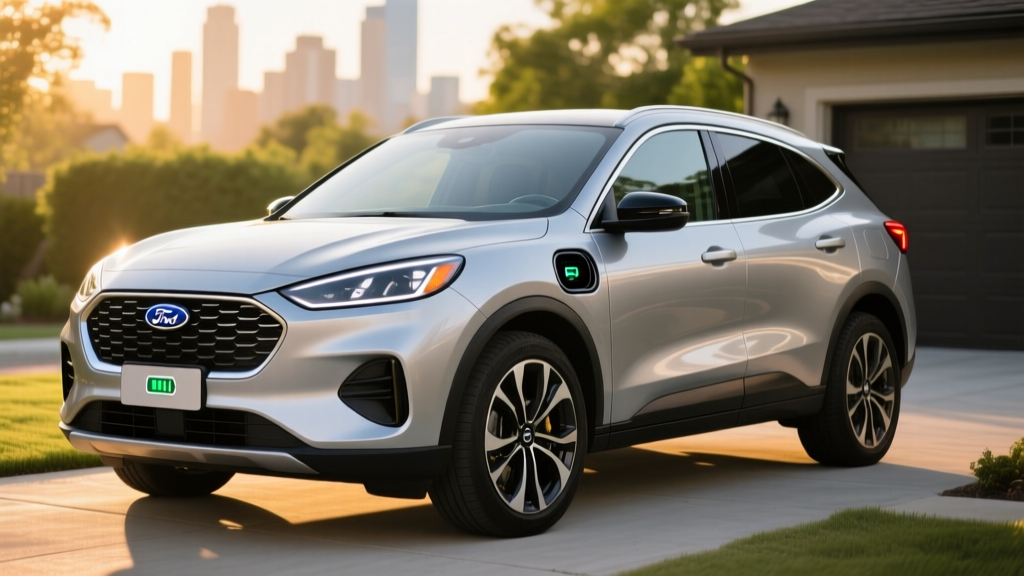
The compact hybrid SUV segment is crowded, but the Ford Escape Hybrid AWD occupies a specific niche: buyers who want all-wheel-drive traction and strong city fuel economy without plugging in. For 2026, Ford continues the Escape Hybrid with its proven 2.5-liter four-cylinder hybrid powertrain, offering a practical balance of efficiency, cargo space, and everyday usability that sits between a conventional gas crossover and a full battery-electric vehicle.
If you're weighing the Ford Escape Hybrid AWD against a plug-in hybrid (PHEV), a full EV, or a gas-only competitor, this guide covers every number that matters — EPA MPG, real-world efficiency, powertrain output, battery warranty, pricing, and federal tax credit eligibility.
HEV vs PHEV: Which Escape Hybrid Are We Talking About?
Ford offers the Escape in two electrified flavors, and confusing them is the single most common mistake shoppers make. Here's the critical distinction:
Escape Hybrid (HEV)
- No plug required. The battery charges via regenerative braking and the gasoline engine.
- Self-charging. You never need to find a charger — just fill up at any gas station.
- Best for: Drivers without home charging access who want better MPG than a gas-only SUV.
Escape Plug-In Hybrid (PHEV)
- Plugs in. A larger battery provides electric-only driving for short commutes.
- Requires charging access (home outlet or Level 2 charger) to realize full efficiency gains.
- Best for: Drivers with home charging and short daily commutes who want EV-like driving part-time.
Important note for 2026: Ford discontinued the Escape PHEV after the 2024 model year as part of its lineup restructuring. The current Escape Hybrid is a conventional HEV only. If you need plug-in capability from Ford, you'll need to look at the used market or consider the Ford Maverick Hybrid as an alternative body style.
Ford Escape Hybrid AWD MPG and Efficiency Breakdown
The 2026 Ford Escape Hybrid AWD carries EPA ratings that prioritize city efficiency — a hallmark of Toyota-derived hybrid architectures (Ford's hybrid system shares engineering lineage with Toyota's eCVT design under a long-standing patent cross-license).
| Configuration | City MPG | Highway MPG | Combined MPG |
|---|---|---|---|
| Escape Hybrid FWD | 42 | 36 | 39 |
| Escape Hybrid AWD | 42 | 36 | 39 |
Source: fueleconomy.gov — U.S. EPA estimates.
Real-World MPG vs. EPA Sticker
Hybrid vehicles frequently exceed their EPA city rating in stop-and-go traffic because regenerative braking recaptures energy that a gas car wastes as heat. In real-world testing:
- City driving: Many owners report 40-44 MPG in urban and suburban conditions. The hybrid system thrives on frequent stops.
- Highway driving: Expect 33-36 MPG at sustained 70-75 mph. Hybrids lose their advantage at constant high speeds where the gas engine runs continuously.
- Cold weather: Expect a 5-10% reduction (roughly 35-37 MPG combined) in freezing temperatures. The engine runs more often to generate cabin heat and warm the catalytic converter.
- Combined real-world average: Most drivers land between 36-40 MPG combined, closely tracking the EPA estimate.
The Escape Hybrid AWD uses an electronically controlled rear axle motor rather than a mechanical driveshaft, which means AWD engagement adds minimal parasitic loss compared to traditional AWD systems. The MPG penalty for choosing AWD over FWD in the Escape Hybrid is effectively zero in the current generation.
Powertrain Specs: Horsepower, Engine, and Drivetrain
| Specification | Detail |
|---|---|
| Engine | 2.5L Atkinson-cycle inline-4 |
| Electric Motor (front) | Permanent-magnet synchronous, integrated in transaxle |
| Electric Motor (rear, AWD) | Separate rear-axle electric motor |
| Combined System Horsepower | 210 hp |
| Transmission | eCVT (electronically controlled continuously variable) |
| Hybrid Battery | 1.1 kWh lithium-ion (sealed, self-charging) |
| 0-60 mph (estimated) | ~7.8 seconds |
| Towing Capacity | 1,500 lbs (with Class II tow package) |
| Drivetrain | AWD via rear electric motor (no mechanical driveshaft) |
The 210-hp combined output is competitive in the segment. The eCVT is not a traditional belt-and-pulley CVT — it uses a planetary gearset that blends engine and motor power with no fixed gear ratios, resulting in smooth, linear acceleration without the "rubber band" drone associated with older CVT designs.
The AWD system is worth specific attention. Because the rear wheels are driven by a dedicated electric motor, there's no driveshaft tunnel eating into cabin space, and AWD engagement is instantaneous. The system can send up to 100% of available rear torque to the wheels that need it, and it disconnects entirely during steady-state cruising to minimize drag.
Pricing and Tax Credit Eligibility
| Trim Level | 2026 MSRP (AWD) |
|---|---|
| Base Hybrid | ~$34,500 |
| Hybrid Premium | ~$37,500 |
| Hybrid Sport | ~$39,000 |
| Hybrid Platinum | ~$41,500 |
Prices are approximate and reflect manufacturer MSRP including destination charge. Dealer pricing may vary.
Federal Tax Credit: Does the Escape Hybrid Qualify?
No. The conventional Ford Escape Hybrid (HEV) does not qualify for the federal §30D clean vehicle tax credit (up to $7,500). Under current IRS rules, only battery-electric vehicles (BEVs) and plug-in hybrid electric vehicles (PHEVs) with sufficient battery capacity (≥7 kWh) and compliant critical-mineral/battery-component sourcing are eligible.
Since the Escape Hybrid is a self-charging HEV with a 1.1 kWh battery, it falls outside the §30D program entirely. This is true of all conventional hybrids on the market — the Toyota RAV4 Hybrid, Honda CR-V Hybrid, and Hyundai Tucson Hybrid are similarly ineligible.
State and Local Incentives
Some states offer rebates or HOV lane access for hybrid vehicles, though these programs have largely shifted toward BEVs and PHEVs. Check your state's energy office or Alternative Fuels Data Center for current local incentives. These vary significantly by jurisdiction and change frequently.
Battery Warranty, Reliability, and Replacement Cost
Hybrid battery longevity is consistently the top concern for first-time hybrid buyers. The data is reassuring:
| Warranty Item | Coverage |
|---|---|
| Hybrid Battery | 8 years / 100,000 miles (10 years / 150,000 miles in CARB states) |
| Hybrid System Components | 8 years / 100,000 miles |
| Powertrain (engine, transaxle) | 5 years / 60,000 miles |
| Bumper-to-Bumper | 3 years / 36,000 miles |
The hybrid battery warranty covers capacity loss below a specified threshold (typically 60-70% of original capacity) and any manufacturing defects. In CARB states (California, New York, Massachusetts, and others adopting California emissions standards), the hybrid battery warranty extends to 10 years or 150,000 miles.
Real-World Hybrid Battery Lifespan
Ford's hybrid system has been in production since 2005 (the original Escape Hybrid was the first hybrid SUV). Real-world data from fleet and taxi use shows these batteries routinely lasting 150,000-200,000+ miles before significant degradation. The 1.1 kWh battery in the current Escape Hybrid is small and lightly stressed — it rarely cycles through its full depth of discharge, which extends cell life considerably.
Battery Replacement Cost
If replacement is needed outside warranty, a new OEM hybrid battery for the Escape Hybrid typically costs $2,000-$3,500 installed. Third-party refurbished batteries are available for $1,000-$2,000. This is dramatically less than EV traction battery replacements ($8,000-$20,000) because the hybrid battery is small and uses mature cell chemistry.
Escape Hybrid AWD vs. Competitors
| Vehicle | Combined MPG | AWD Available | Combined HP | Starting MSRP (AWD) |
|---|---|---|---|---|
| Ford Escape Hybrid AWD | 39 | Yes | 210 | ~$34,500 |
| Toyota RAV4 Hybrid AWD | 39 | Yes | 219 | ~$33,500 |
| Honda CR-V Hybrid AWD | 37 | Yes | 204 | ~$36,000 |
| Hyundai Tucson Hybrid AWD | 38 | Yes | 226 | ~$35,000 |
The Escape Hybrid AWD is competitive on MPG (tied with the RAV4 Hybrid at 39 combined) and offers strong horsepower. Its differentiator is the eCVT smoothness and Ford's available Co-Pilot360 driver-assist suite. The RAV4 Hybrid remains the segment sales leader with a slight edge in reliability perception, while the Tucson Hybrid offers the most horsepower.
Who Should Choose the Escape Hybrid AWD?
Choose the Escape Hybrid AWD If:
- You want AWD capability for snow or rain without the MPG penalty of a traditional AWD system.
- You don't have access to home or workplace charging (no plug needed).
- Your driving is predominantly city and suburban (where hybrids shine brightest).
- You want a lower purchase price than a PHEV or BEV, and don't need electric-only driving.
- You value cargo space and a conventional SUV form factor.
Look Elsewhere If:
- You have home charging and a short commute — a PHEV or BEV would eliminate most of your gasoline use.
- You primarily drive highway miles — the hybrid advantage narrows significantly at sustained 70+ mph.
- You want the federal tax credit — only BEVs and qualifying PHEVs are eligible under §30D.
- You need more than 1,500 lbs of towing capacity.
Hybrid vs. PHEV vs. Full EV: Decision Framework
The Right Electrified Vehicle for Your Situation
- Choose a conventional hybrid (HEV) if you lack reliable charging access, drive mixed city/highway routes, and want zero lifestyle changes — just fill up less often.
- Choose a plug-in hybrid (PHEV) if you have home charging, your daily commute is under 30-40 miles, and you want EV-like daily driving with gas-engine backup for road trips.
- Choose a full EV (BEV) if you have home charging, your daily driving is under 250 miles, you want the lowest per-mile fuel cost, and you're ready to plan around DC fast charging for road trips.
The Escape Hybrid AWD is the pragmatic choice for the largest slice of SUV buyers: those who want meaningful fuel savings without changing how they refuel. If your situation supports plug-in charging, however, the per-mile cost advantage of a BEV or PHEV is substantial — electricity at $0.15/kWh translates to roughly $0.04-0.05 per mile, versus $0.12-0.14 per mile for a 39 MPG hybrid at $3.50/gallon gasoline.
Frequently Asked Questions
How many MPG does the Ford Escape Hybrid AWD get?
The 2026 Ford Escape Hybrid AWD is EPA-rated at 42 MPG city, 36 MPG highway, and 39 MPG combined. Real-world city driving often yields 40-44 MPG thanks to aggressive regenerative braking, while sustained highway driving at 75 mph typically returns 33-36 MPG.
Does the Ford Escape Hybrid need to be plugged in?
No. The Escape Hybrid is a conventional hybrid (HEV). Its 1.1 kWh battery charges entirely through regenerative braking and the gasoline engine. You never plug it in. Ford discontinued the Escape Plug-In Hybrid (PHEV) after the 2024 model year.
Is the Ford Escape Hybrid reliable?
Ford's hybrid powertrain has been in continuous production since 2005 and is generally regarded as reliable. The eCVT transmission has no belts, clutches, or traditional wear items — it uses a planetary gearset. The hybrid battery carries an 8-year/100,000-mile warranty (10 years/150,000 miles in CARB states), and real-world data shows these batteries frequently lasting 150,000+ miles.
How much does it cost to replace the Escape Hybrid battery?
Outside of warranty, a new OEM hybrid battery replacement costs approximately $2,000-$3,500 installed. Refurbished units are available for $1,000-$2,000. This is a fraction of what a full EV battery replacement costs, owing to the hybrid battery's small 1.1 kWh capacity.
Does the Ford Escape Hybrid qualify for a tax credit?
No. The conventional Escape Hybrid (HEV) does not qualify for the federal §30D clean vehicle tax credit, which is limited to plug-in vehicles (BEVs and PHEVs) with ≥7 kWh batteries meeting critical-mineral and battery-component sourcing requirements. Some states may offer minor incentives for hybrids — check your state energy office for details.
How does the Escape Hybrid AWD system work?
The AWD system uses a separate electric motor on the rear axle — there is no mechanical driveshaft connecting the front and rear wheels. The system can engage the rear motor instantly when slip is detected and disconnects it entirely during steady-state cruising to preserve fuel economy. This is why the AWD model carries virtually no MPG penalty compared to the FWD version.