Quick Verdict: A Pioneer That Still Delivers City MPG
The 2009 Ford Escape Hybrid was one of the first mainstream compact SUVs to pair a gasoline engine with an electric motor in a package that didn't demand a plug. Seventeen years later, it remains a curiosity in the used market — a vehicle that proved hybrid technology could work in an everyday crossover. If you're researching the Ford Escape Hybrid 2009 as a budget-friendly used purchase in 2026, this guide covers exactly what you need to know: real-world fuel economy, the aging NiMH battery, replacement costs, and how this first-generation HEV stacks up against modern hybrids, PHEVs, and full EVs.
Spoiler: The Escape Hybrid's 34 MPG city figure still holds up remarkably well in stop-and-go traffic. But highway efficiency, interior tech, and battery age are legitimate concerns you need to weigh before signing a bill of sale.
Ford Escape Hybrid 2009: Core Specifications
| Specification | Value |
|---|---|
| Powertrain Type | Conventional Hybrid (HEV) — no plug |
| Gas Engine | 2.5L Atkinson-cycle 4-cylinder, 153 HP |
| Electric Motor | Permanent-magnet synchronous AC motor |
| Combined System Output | 177 HP |
| Transmission | eCVT (planetary gearset, no fixed gears) |
| Hybrid Battery | ~1.8 kWh NiMH (nickel-metal hydride) |
| Drivetrain | FWD standard; e4WD AWD optional |
| EPA Fuel Economy (FWD) | 34 city / 31 highway / 32 combined MPG |
| EPA Fuel Economy (AWD) | 29 city / 27 highway / 28 combined MPG |
| Fuel Tank Capacity | 15.0 gallons |
| Total Driving Range (FWD est.) | ~480 miles |
| 0–60 MPH | ~10.5 seconds |
| Cargo Volume (behind rear seats) | 29.2 cu ft |
| Original MSRP (2009) | ~$32,260 (base Hybrid) |
| Typical 2026 Used Price | $3,500–$7,000 depending on mileage/condition |
EPA MPG vs. Real-World: What to Actually Expect
The EPA rates the front-wheel-drive 2009 Escape Hybrid at 34 MPG city, 31 MPG highway, and 32 MPG combined, per fueleconomy.gov. Those were impressive numbers in 2009, and they remain competitive for a compact SUV today — the 2026 Toyota RAV4 Hybrid, for reference, achieves 41/38/40 MPG.
- City driving: 30–36 MPG. Hybrids shine in stop-and-go traffic where regenerative braking recovers energy. Many owners report matching or slightly exceeding the 34 EPA city figure on low-speed commutes.
- Highway driving (70–80 MPH): 26–30 MPG. The Atkinson-cycle engine is optimized for efficiency, not high-speed cruising. Aerodynamic drag on this boxy SUV body hurts highway numbers.
- Mixed/combined real-world: 28–33 MPG for most drivers.
- Cold weather penalty: Expect a 10–15% drop in winter. The engine runs more frequently to generate cabin heat, and the NiMH battery is less efficient at low temperatures.
The AWD (e4WD) variant sacrifices roughly 4 MPG across the board due to the additional rear-axle electric motor and drivetrain weight. If fuel economy is your priority, the FWD model is the clear choice.
Hybrid Powertrain Deep Dive: How It Works
The 2009 Escape Hybrid uses Ford's second-generation hybrid system, which was co-developed with Aisin (the transmission supplier). Here's how the components work together:
The 2.5L Atkinson-cycle four-cylinder produces 153 HP on its own. Unlike a conventional Otto-cycle engine, the Atkinson cycle keeps the intake valve open longer during the compression stroke, sacrificing some peak power for greater thermal efficiency. This is the same principle used in nearly every modern hybrid engine, from the Toyota Prius to the Hyundai Tucson Hybrid.
The electric motor is integrated into the eCVT transaxle. It provides low-speed torque fill (the electric motor delivers maximum torque at 0 RPM), assists during acceleration, and acts as a generator during regenerative braking. The combined system output of 177 HP is respectable for a 2009 compact SUV, though the 10.5-second 0–60 time reflects the vehicle's 3,800+ lb curb weight and the eCVT's prioritization of smoothness over sportiness.
The eCVT transmission is not a belt-and-pulley CVT like those in Nissan or Subaru vehicles. It uses a planetary gearset to seamlessly blend power from the engine and motor. This design — essentially the same architecture Toyota uses in its Hybrid Synergy Drive — is extremely durable because it has no friction bands, clutches, or traditional gear shifts to wear out.
Regenerative braking captures kinetic energy during deceleration and feeds it back into the NiMH battery pack. The transition between regenerative and friction braking is one area where the 2009 Escape feels dated — the brake pedal feel is somewhat nonlinear compared to modern hybrids, with a noticeable "grab" when the friction brakes engage below ~8 MPH.
HEV vs. PHEV vs. Full EV: Where Does the Escape Hybrid Fit in 2026?
- HEV (Conventional Hybrid): Small battery (~1–2 kWh), charges via regenerative braking and the engine. Never plugs in. The 2009 Escape Hybrid is an HEV.
- PHEV (Plug-in Hybrid): Larger battery (~10–25 kWh), charges via a plug for 20–50 miles of electric-only range, then operates as a conventional hybrid. Examples: Toyota RAV4 Prime, Ford Escape PHEV (2020+).
- BEV (Battery Electric Vehicle): No gasoline engine. Runs entirely on a large battery (60–100+ kWh). Examples: Tesla Model Y, Hyundai Ioniq 5.
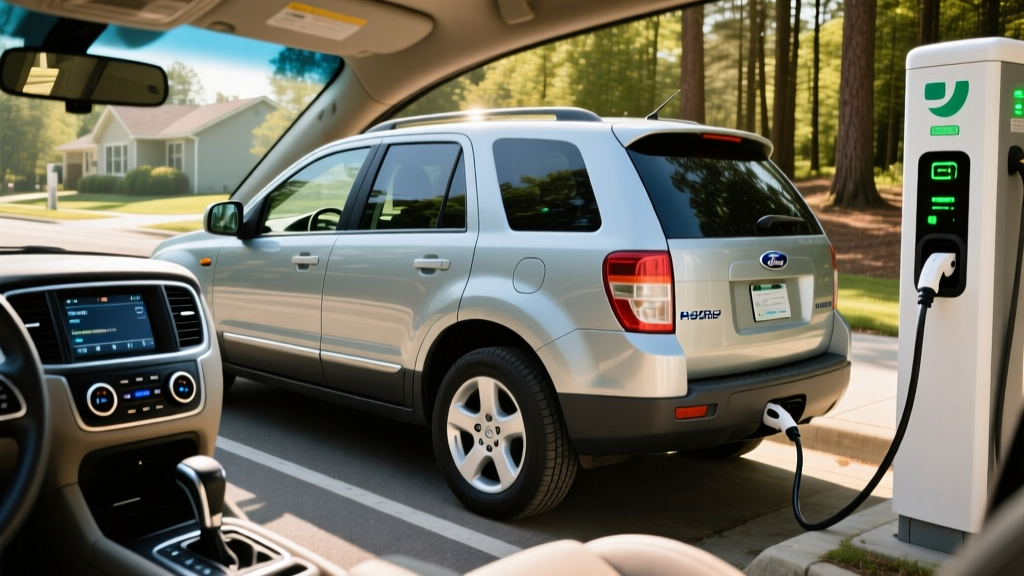
The 2009 Ford Escape Hybrid is a conventional hybrid (HEV). It has no plug, no electric-only driving mode beyond very low-speed maneuvers (roughly 1–2 miles at under 25 MPH on a full battery charge), and no external charging capability. The gasoline engine and regenerative braking keep the small NiMH battery charged automatically.
Choose the 2009 Escape Hybrid (HEV) if:
- You want better fuel economy without changing your refueling habits
- You lack access to home or workplace charging (no plug needed)
- Your budget is under $7,000 for a used vehicle
- You drive primarily in city/stop-and-go conditions where hybrid efficiency peaks
- You want a simple, proven powertrain with minimal learning curve
Consider a modern PHEV or BEV instead if:
- You have home Level 2 charging and a short commute (a PHEV like the RAV4 Prime delivers 42 miles electric-only, making most daily driving emissions-free)
- You want to qualify for federal tax credits (used HEVs from 2009 do not qualify for any current credits)
- You prioritize modern safety features, infotainment, and driver-assist technology
- You want to minimize fuel costs — a BEV's "fuel" cost is typically $0.04–$0.06 per mile vs. the Escape Hybrid's ~$0.10–$0.12 per mile at 2026 gas prices
Battery Health, Lifespan, and Replacement Cost
The nickel-metal hydride (NiMH) battery pack in the 2009 Escape Hybrid has a usable capacity of approximately 1.8 kWh. Unlike modern lithium-ion packs, NiMH chemistry is less energy-dense but has proven remarkably durable in real-world use. Toyota Prius and Ford Escape Hybrid batteries from this era routinely reach 150,000–200,000+ miles before requiring replacement.
However, age is now the primary degradation factor. A 2009 battery is 17 years old in 2026. Even with low mileage, NiMH cells lose capacity over time due to electrolyte breakdown and internal resistance increases. Here's what to expect:
- Original battery still in the vehicle: Likely showing 15–30% capacity loss. You'll notice reduced electric-only assist at low speeds, more frequent engine starts, and slightly lower MPG (perhaps 1–3 MPG below original EPA figures).
- Replaced/refurbished battery: Some used examples will have had the battery replaced. Ask for documentation. A refurbished NiMH pack from a reputable supplier restores near-original performance.
Battery replacement costs in 2026:
- Refurbished/reconditioned NiMH pack: $1,500–$2,500 (parts and labor at an independent hybrid specialist)
- New OEM Ford pack: $3,000–$4,500 (if still available through Ford parts; supply is dwindling for 2009 models)
- Individual cell/module replacement: $500–$1,200 (a hybrid specialist can test and replace only the weak modules rather than the entire pack — this is often the most cost-effective option for a vehicle worth $5,000)
Signs of a failing hybrid battery: reduced fuel economy, the battery charge indicator fluctuating rapidly, the engine running more frequently than expected, a dashboard warning light ("Check Hybrid System"), or reduced regenerative braking feel.
Reliability, Common Issues, and Ownership Costs
The 2009 Escape Hybrid's powertrain is widely regarded as one of Ford's most reliable offerings from this era. The eCVT transmission, in particular, has an excellent track record — the planetary gearset design has no wear items like clutch packs or torque converters. Many examples exceed 200,000 miles on the original transaxle with only fluid changes.
Known issues to watch for:
- Hybrid battery degradation (discussed above — budget $1,500–$3,000 for eventual replacement if the original pack is still installed)
- Brake actuator assembly: The electrohydraulic brake system can develop faults around 120,000–160,000 miles. Replacement runs $800–$1,500. Symptoms include a firm brake pedal, ABS warning light, or reduced regenerative braking.
- Electric power steering (EPS): Some owners report EPS motor failures, particularly in high-mileage examples. Ford issued a recall (14V-284) for certain 2008–2011 Escape Hybrids related to steering torque sensor issues.
- Conventional wear items: Suspension components (struts, bushings), A/C compressor, and water pump follow typical 15-year-old vehicle failure patterns.
Estimated annual ownership costs (2026):
- Fuel (12,000 miles/year at 30 MPG, $3.30/gal): ~$1,320
- Insurance: ~$800–$1,200 (varies by state and driver profile)
- Maintenance and repairs: ~$600–$1,200 (higher than a newer vehicle; budget for age-related repairs)
- Total annual operating cost: ~$2,700–$3,700
Tax Credits and Incentives: The 2009 Reality
When new, the 2009 Ford Escape Hybrid qualified for a federal tax credit of up to $3,000 under the Energy Policy Act of 2005. That credit has long since expired for this model — it was available only to the original purchaser during the 2009–2010 tax years.
In 2026, buying a used 2009 Escape Hybrid does not qualify for any federal tax credit. The current IRS §30D Clean Vehicle Credit applies to new EVs and PHEVs meeting battery sourcing, MSRP cap ($55,000 for SUVs, $80,000 for trucks/vans), and buyer income limits. The Used Clean Vehicle Credit (§25E) provides up to $4,000 for used EVs and PHEVs purchased from a dealer for $25,000 or less — but conventional hybrids (HEVs) are not eligible under either program. Only plug-in vehicles qualify.
Some states and local utilities offer rebates for used vehicle purchases or emissions-reduction programs, but these rarely apply to 17-year-old conventional hybrids. Check your state's energy office for current programs.
Pros and Cons: The Honest Assessment
- 34 MPG city still competitive for a compact SUV
- No plug required — refuel at any gas station
- eCVT planetary gearset is extremely durable
- Proven, well-understood hybrid system with wide mechanic familiarity
- Low purchase price ($3,500–$7,000 used)
- AWD (e4WD) option available
- Practical cargo space (29.2 cu ft)
- Highway MPG (26–30) trails modern hybrids significantly
- 17-year-old NiMH battery likely needs or will soon need replacement ($1,500–$3,000)
- No federal tax credit eligibility
- Dated safety features — no standard stability control on early builds, no modern ADAS
- Nonlinear brake pedal feel (regen-to-friction transition)
- Sluggish acceleration (10.5s 0–60)
- Outdated interior tech (no Apple CarPlay, basic infotainment)
- Parts availability declining for hybrid-specific components
Frequently Asked Questions
How many MPG does the 2009 Ford Escape Hybrid actually get?
The EPA rates the FWD model at 34 city / 31 highway / 32 combined MPG. In real-world driving, most owners see 28–33 MPG combined, with city driving potentially exceeding the EPA figure and highway driving falling 2–5 MPG below it. The AWD version drops to 29/27/28 EPA, with real-world combined closer to 25–28 MPG.
Does the 2009 Escape Hybrid need to be plugged in?
No. The 2009 Escape Hybrid is a conventional hybrid (HEV). It charges its own battery through regenerative braking and the gasoline engine. There is no plug, no charging port, and no electric-only driving mode beyond brief low-speed maneuvers. You refuel it exclusively at a gas station, just like a conventional car.
How much does it cost to replace the hybrid battery?
In 2026, expect to pay $1,500–$2,500 for a refurbished/reconditioned NiMH pack installed by a hybrid specialist, or $3,000–$4,500 for a new OEM pack (if available). Individual module replacement can reduce cost to $500–$1,200 if only a few cells have failed. Given the vehicle's used value of $3,500–$7,000, a full OEM replacement may not be economically justified — a refurbished pack or module-level repair is usually the smarter choice.
Is the 2009 Escape Hybrid reliable?
The hybrid powertrain itself — the engine, electric motor, and eCVT — is among the most reliable Ford has ever built. The planetary-gearset eCVT has virtually no wear items. The main reliability risk is the aging NiMH battery (now 17 years old) and the electrohydraulic brake actuator. With a healthy or recently replaced battery, these vehicles regularly reach 200,000+ miles. Check the NHTSA database at nhtsa.gov/recalls for any open recalls on a specific VIN.
Does the 2009 Ford Escape Hybrid qualify for any tax credit in 2026?
No. The original federal hybrid tax credit (up to $3,000) expired over a decade ago. Current federal credits under IRS §30D and §25E apply only to plug-in vehicles (PHEVs and BEVs), not conventional hybrids. See irs.gov for current credit eligibility rules. No state incentives specifically target 17-year-old conventional hybrids either.
Should I buy a 2009 Escape Hybrid or save for a newer hybrid?
If your budget is strictly under $7,000 and you need a compact SUV with strong city MPG and no plug requirement, the 2009 Escape Hybrid is a defensible choice — but budget $1,500–$2,500 for a battery replacement. If you can stretch to $15,000–$22,000, a 2017–2020 Toyota RAV4 Hybrid (41/38 MPG EPA) or a 2020+ Ford Escape Hybrid (44/37 MPG) offers dramatically better highway efficiency, modern safety features (automatic emergency braking, lane-keeping), and a battery with years of warranty remaining. The total cost of ownership over five years may actually favor the newer vehicle when you factor in repair costs, fuel savings, and safety.