Quick Verdict: A Practical Used Hybrid for City Drivers
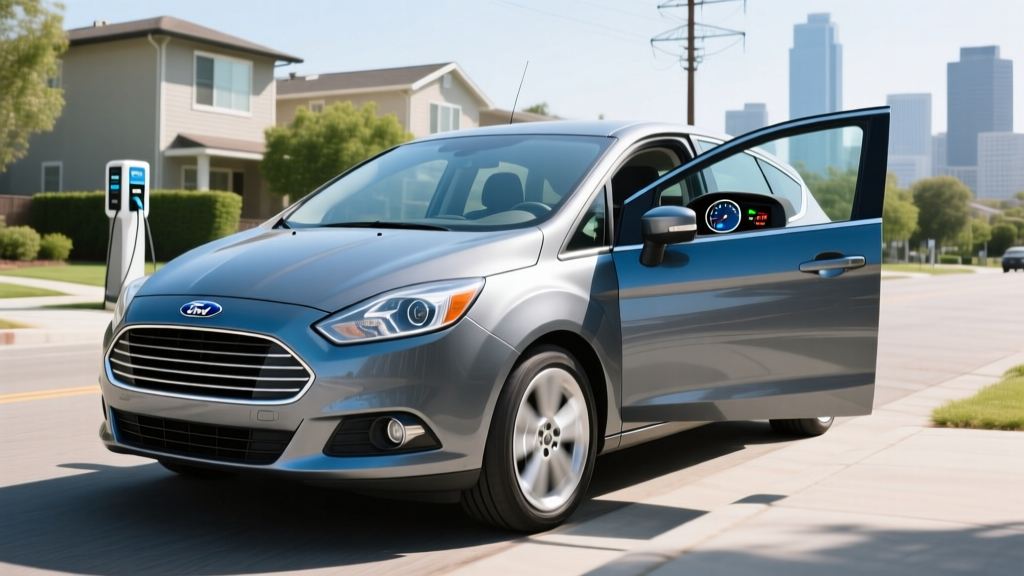
The 2013 Ford C-Max Hybrid was Ford's answer to the Toyota Prius v, offering a tall-hatchback body with hybrid efficiency and engaging driving dynamics. As a conventional hybrid (HEV), it requires no plug-in charging — it generates all its electricity through regenerative braking and its gasoline engine. In 2026, this model is available exclusively on the used market, where it represents a budget-friendly entry into hybrid ownership for buyers who want Prius-level fuel economy without the Prius price tag.
But the C-Max Hybrid's history is complicated. Ford initially advertised 47 MPG across the board, then faced an FTC settlement over inflated fuel-economy claims, eventually revising the sticker to 43 MPG combined for 2013–2014 models after a software update. Understanding what you're actually buying — and what to inspect on a 13-year-old hybrid — is critical before signing any paperwork.
Fuel Economy: EPA Numbers vs. Real-World MPG
The 2013 C-Max Hybrid's fuel economy story requires careful reading. Ford originally rated the car at 47 MPG city / 47 MPG highway / 47 MPG combined. After consumer complaints and an EPA review, Ford issued a software update and revised the official EPA label to reflect more conservative figures.
| Driving Cycle | EPA MPG | Real-World Expectation |
|---|---|---|
| City | 42 MPG | 40–45 MPG (hybrids excel in stop-and-go) |
| Highway | 38 MPG | 35–40 MPG (aerodynamic drag hurts at 70+ mph) |
| Combined | 40 MPG | 38–43 MPG depending on driving mix |
According to fueleconomy.gov, the post-revision 2013 C-Max Hybrid carries a 40 MPG combined rating. Real-world owner reports on fuel-tracking platforms typically cluster between 38 and 43 MPG combined, with city-heavy commuters occasionally exceeding the EPA estimate — a common trait of series-parallel hybrids that lean heavily on electric motor assist at low speeds.
HEV vs. PHEV: Understanding the C-Max Lineup
Ford sold two versions of the C-Max in 2013, and confusing them is a common buyer mistake:
| Specification | C-Max Hybrid (HEV) | C-Max Energi (PHEV) |
|---|---|---|
| Powertrain Type | Conventional Hybrid | Plug-In Hybrid |
| Plug-In Charging | No — self-charging | Yes — Level 1/Level 2 |
| Battery Capacity | 1.4 kWh (gross) | 7.6 kWh (gross) |
| Electric-Only Range | ~1 mile at low speed | 21 miles (EPA) |
| Combined MPG / MPGe | 40 MPG | 100 MPGe (electric) / 43 MPG (gas) |
| Total Range | ~550 miles | ~550 miles (gas + electric) |
| DC Fast Charging | No | No (Level 2 max only) |
| Original MSRP | ~$25,200 | ~$32,950 |
This guide focuses on the C-Max Hybrid (HEV). If you see a C-Max with a charge port on the driver's front fender and "Energi" badging, that's the PHEV variant — a fundamentally different vehicle with a much larger battery and plug-in capability. The conventional Hybrid has no external charge port and cannot be plugged in. It charges its small 1.4 kWh lithium-ion battery entirely through regenerative braking and the gasoline engine.
Powertrain Specs: Engine, Motor, and Combined Output
The 2013 C-Max Hybrid uses Ford's second-generation hybrid powertrain, a powersplit architecture similar in concept to Toyota's Hybrid Synergy Drive:
| Component | Specification |
|---|---|
| Engine | 2.0L Atkinson-cycle inline-4 |
| Engine Power | 141 hp @ 6,000 rpm |
| Electric Motor | Permanent-magnet AC synchronous |
| Motor Power | 118 hp (88 kW) |
| Combined System Output | 188 hp (net) |
| Transmission | Electronic CVT (eCVT — planetary gearset) |
| Drivetrain | Front-wheel drive |
| 0–60 mph | ~8.1 seconds |
| Battery Type | Lithium-ion (1.4 kWh gross) |
| Curb Weight | ~3,640 lbs |
The 188 combined horsepower gives the C-Max noticeably more punch than the contemporary Prius (134 hp), and the eCVT delivers smooth, linear acceleration without the rubber-band feel of belt-driven CVTs. The Atkinson-cycle engine sacrifices some low-end torque for thermal efficiency, but the electric motor fills the gap off the line. In practical terms, this is a hybrid that can merge onto a 70-mph freeway without drama — a legitimate advantage over less powerful competitors.
Battery Health, Warranty, and Replacement Cost
For any 13-year-old hybrid, the traction battery is the single biggest financial risk. Here's what you need to know about the C-Max Hybrid's battery:
Degradation Reality: The C-Max Hybrid's 1.4 kWh battery is small and operates within a narrow state-of-charge window (roughly 40–60% SoC), which is gentle on lithium-ion cells. Most owners report minimal capacity loss over 100,000–150,000 miles. Unlike full EVs where degradation directly reduces range, a hybrid's small battery mainly affects how long the engine can stay off at stops and low speeds. Even with 20–30% degradation, the car remains fully drivable — you'll just notice the engine cycling on more frequently.
Replacement Cost: A new OEM replacement battery from Ford runs approximately $2,000–$3,500 including installation at a dealership. Independent hybrid battery shops offer reconditioned or refurbished packs for $1,000–$2,000. Individual cell replacement is possible at specialist shops for $500–$1,200 if only a few modules have failed. Before purchasing any used C-Max, ask for a hybrid battery health report from a Ford dealer's diagnostic scan — this will show module voltage balance and overall state of health.
Reliability and Common Issues
The 2013 C-Max Hybrid has a mixed reliability record. The hybrid powertrain itself — the eCVT, motor, and battery — has proven durable, with many examples exceeding 200,000 miles without major hybrid-component failure. However, several non-powertrain issues are worth checking:
- Transmission fluid cooler line leaks: Some 2013 models developed leaks at the eCVT cooler line fittings. Check for fluid residue near the transmission and verify service records.
- 12V battery drain: Like many hybrids, the C-Max can drain its 12V auxiliary battery if left sitting for extended periods. A dead 12V battery prevents the car from starting, even if the hybrid battery is full.
- Door latch recalls: Ford issued recalls for door latch assemblies on 2013–2014 C-Max models. Verify recall completion via the NHTSA recall lookup using the VIN.
- SYNC infotainment glitches: Ford's first-generation SYNC system is known for frozen screens and Bluetooth pairing issues. Software updates may help, but the hardware is dated by 2026 standards.
- EVAP system codes: Purge valve and EVAP canister failures trigger check-engine lights. A common and relatively inexpensive fix ($150–$300).
Check the vehicle's recall status at nhtsa.gov/recalls and pull a vehicle history report to verify maintenance records before purchase.
Pricing in 2026: What a Used C-Max Hybrid Costs
The 2013 C-Max Hybrid has depreciated significantly from its original $25,200 MSRP. In the 2026 used market:
| Condition / Mileage | Typical Price Range |
|---|---|
| Excellent (under 80k miles) | $7,500 – $9,500 |
| Good (80k–120k miles) | $5,500 – $7,500 |
| Fair (120k–160k miles) | $4,000 – $5,500 |
| High-mileage (160k+ miles) | $3,000 – $4,500 |
Tax Credit Eligibility: The 2013 C-Max Hybrid does not qualify for the federal §30D new clean vehicle credit — that credit applies only to new vehicles meeting current battery-sourcing and MSRP requirements. However, if purchased from a dealer for under $25,000, it may qualify for the Used Clean Vehicle Credit (IRC §25E), which provides up to $4,000 or 30% of the sale price (whichever is less). Key requirements per irs.gov:
- Sale price must be $25,000 or less
- Buyer income limits: $75,000 single / $112,500 head of household / $150,000 joint
- Vehicle must be at least two model years old (2013 qualifies)
- Must purchase from a licensed dealer (private-party sales excluded)
- Vehicle must have a battery of at least 7 kWh — the C-Max Hybrid's 1.4 kWh battery does NOT meet this threshold
Who Should Buy the 2013 C-Max Hybrid?
Pros
- 40 MPG combined — strong real-world city efficiency
- 188 hp — more power than most competitors in its class
- Spacious hatchback cargo area (52.6 cu ft max)
- Low used pricing — under $6,000 for good examples
- No plug-in charging required
- Proven eCVT durability
Cons
- Revised EPA MPG lower than original 47 MPG claim
- Original battery warranty expired on all 2013 models
- Outdated SYNC infotainment with no Apple CarPlay/Android Auto
- Highway MPG drops noticeably above 70 mph
- No federal tax credit eligibility (battery too small)
- Discontinued — limited dealer support for some parts
Hybrid vs. PHEV vs. Full EV: Which Fits Your Needs?
If you're cross-shopping the used 2013 C-Max Hybrid, here's a decision framework to determine whether a conventional hybrid, a plug-in hybrid, or a full battery-electric vehicle (BEV) is the right move:
Choose the C-Max Hybrid (HEV) if:
- You cannot charge at home (no garage, no outlet access, apartment living)
- Your budget is under $8,000
- You want maximum simplicity — no plug, no charging apps, no range planning
- Your commute is city-heavy, where hybrid efficiency peaks
Choose a used PHEV (like the C-Max Energi or Prius Prime) if:
Choose a full EV (like a used Chevrolet Bolt or Nissan Leaf) if:
- You have reliable home charging (Level 2 strongly recommended)
- You want zero tailpipe emissions and minimal maintenance
- Your daily driving is predictable and within the vehicle's range
- You want to eliminate gasoline costs entirely
Frequently Asked Questions
How many MPG does the 2013 Ford C-Max Hybrid actually get?
The post-revision EPA rating is 42 city / 38 highway / 40 combined MPG. Real-world owners typically see 38–43 MPG combined, with city-heavy driving pushing toward the upper end. The original 47 MPG sticker was revised after an FTC settlement over inflated fuel-economy claims.
Can I plug in the 2013 C-Max Hybrid to charge it?
No. The C-Max Hybrid is a conventional HEV with no external charge port. It charges its 1.4 kWh battery through regenerative braking and the gasoline engine. If you want plug-in capability, look for the C-Max Energi (PHEV), which has a 7.6 kWh battery and 21 miles of electric-only range.
How far can the C-Max Energi PHEV go on electric only?
The 2013 C-Max Energi is EPA-rated for 21 miles of electric-only range. With a full charge and a full gas tank, total combined range is approximately 550 miles. The Energi charges on Level 1 (120V) in about 7 hours or Level 2 (240V) in roughly 2.5 hours. It does not support DC fast charging.
Is the 2013 C-Max Hybrid reliable, and what does a battery replacement cost?
The hybrid powertrain (eCVT, motor, battery) is generally durable past 200,000 miles. Common issues include EVAP system faults, SYNC infotainment glitches, and 12V battery drain. The original hybrid battery warranty has expired on all 2013 models. A new OEM replacement battery costs $2,000–$3,500; reconditioned packs run $1,000–$2,000. Get a hybrid battery health scan before purchase.
Does the 2013 C-Max Hybrid qualify for any tax credit in 2026?
No. The C-Max Hybrid's 1.4 kWh battery is below the 7 kWh minimum required for the federal Used Clean Vehicle Credit (IRC §25E). It never qualified for the new-vehicle §30D credit either. The C-Max Energi PHEV (7.6 kWh) may qualify for the used credit if income, price, and dealer-sale requirements are met. Check current rules at irs.gov.
What should I check before buying a used 2013 C-Max Hybrid?
Prioritize: (1) a hybrid battery diagnostic scan showing module voltage balance, (2) NHTSA recall completion (door latches), (3) transmission cooler line inspection for leaks, (4) maintenance records showing regular oil changes and eCVT fluid service, and (5) a clean vehicle history report with no major accidents or flood damage.