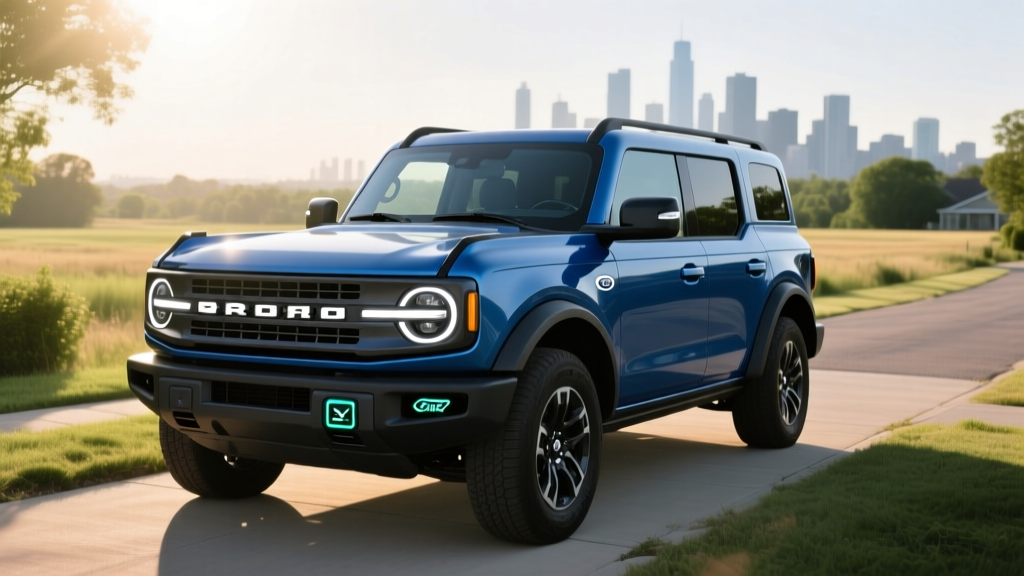
Ford has confirmed that a plug-in hybrid variant of the Bronco is in development, joining the automaker's growing electrified lineup alongside the Maverick hybrid and Escape PHEV. For off-road enthusiasts who want electric commuting capability without range anxiety on remote trails, the Ford Bronco PHEV represents a compelling middle ground. This guide covers everything confirmed and projected about the Bronco plug-in hybrid — from battery specs and electric-only range to pricing and federal tax credit eligibility — so you can decide whether it fits your driving life.
HEV vs PHEV: Understanding the Bronco's Electrification Path
Before diving into specs, it is critical to understand the difference between a conventional hybrid (HEV) and a plug-in hybrid (PHEV), because Ford currently offers the Bronco with neither — though both variants have been discussed in product roadmap leaks and industry reports.
| Feature | Conventional Hybrid (HEV) | Plug-In Hybrid (PHEV) |
|---|---|---|
| Plugs in to charge? | No — charges via engine and regenerative braking | Yes — has a dedicated charge port |
| Electric-only range | 0–2 miles at low speed | 20–50+ miles (depending on battery size) |
| Battery size | 1.0–1.5 kWh | 12–30+ kWh usable |
| Federal tax credit | Not eligible (§30D requires plug-in) | Eligible if battery ≥7 kWh and sourcing rules met |
| Best for | Drivers without home charging access | Drivers with home/work charging who commute short distances |
The Bronco PHEV will use a plug-in architecture, meaning it has a substantially larger battery than a conventional hybrid and can be driven on electricity alone for a meaningful distance. A conventional Bronco HEV, if offered, would not require plugging in but would deliver no electric-only range beyond low-speed crawling.
Projected Powertrain: Engine, Motors, and Combined Output
Ford has not published final powertrain specifications for the Bronco PHEV as of early 2026, but industry analysis and the architecture shared with the Ford Explorer PHEV (sold in Europe and China) provide strong indicators.
| Specification | Projected Bronco PHEV | Current Bronco (2.7L EcoBoost, for reference) |
|---|---|---|
| Engine | 2.3L EcoBoost I4 + electric motor | 2.7L EcoBoost V6 |
| Combined Horsepower | ~350–400 hp (estimated) | 330 hp |
| Combined Torque | ~450–500 lb-ft (estimated) | 415 lb-ft |
| Transmission | 10-speed automatic with integrated motor | 10-speed automatic |
| Drivetrain | 4WD (standard, as with all Broncos) | 4WD |
| Towing Capacity | TBD (likely ~3,500 lbs) | 3,500–4,500 lbs |
The electric motor integrated into the transmission housing will provide instant low-end torque — a significant advantage for off-road rock crawling and trail use where precise throttle modulation matters. Expect the combined output to exceed the current 2.7L V6, giving the PHEV variant a performance edge alongside its efficiency gains.
Battery, Electric-Only Range, and Charging Specs
The most important numbers for any PHEV buyer are battery capacity (measured in kWh — the total energy stored) and electric-only range (how far you can drive without the engine turning on).
| Charging Spec | Projected Figure |
|---|---|
| Usable Battery Capacity | ~15–20 kWh (estimated, NMC chemistry) |
| EPA Electric-Only Range | ~25–35 miles (estimated) |
| Total Combined Range (electric + gas) | ~400–450+ miles (estimated) |
| Level 1 Charging (120V, 1.4 kW) | ~12–16 hours for full charge |
| Level 2 Charging (240V, 7.2 kW) | ~2.5–3.5 hours for full charge |
| DC Fast Charging | Not expected (most PHEVs lack DC capability) |
Real-World Electric Range Expectations: If the EPA rates the Bronco PHEV at 30 miles electric-only, expect closer to 22–26 miles on the highway or in cold weather (below 40°F). Electric-only range drops significantly at higher speeds and in temperature extremes because cabin heating draws heavily from the battery. In mild city driving at 30–45 mph, you may slightly exceed the EPA figure thanks to regenerative braking.
The absence of DC fast charging is typical for PHEVs. The battery is small enough that Level 2 charging (240V) replenishes it in under four hours — fast enough to fully recharge overnight or during a workday. Level 1 (standard 120V outlet) will work but is slow; budget-conscious buyers who park near an outlet can make it work with overnight charging.
Fuel Economy: EPA MPG and Real-World Expectations
A PHEV's fuel economy depends entirely on how you use it. If you charge daily and drive within the electric-only range, you may burn almost no gasoline during the workweek. On long road trips where the battery depletes quickly, the vehicle operates as a conventional hybrid.
| Driving Scenario | Projected Efficiency |
|---|---|
| EPA Combined (charge-sustaining / hybrid mode) | ~22–26 MPG (estimated) |
| EPA City (hybrid mode) | ~24–28 MPG (estimated) |
| EPA Highway (hybrid mode) | ~20–23 MPG (estimated) |
| MPGe (electric + gas combined, EPA) | ~50–65 MPGe (estimated) |
| Real-World City (hybrid mode) | Often exceeds EPA by 1–3 MPG due to regen braking |
| Real-World Highway (hybrid mode) | Often 1–2 MPG below EPA due to boxy aero |
The Bronco's boxy shape, high ground clearance, and all-terrain tires work against highway efficiency. Drivers who frequently tow or run aggressive mud-terrain tires should expect MPG figures on the lower end of these estimates. The hybrid system's biggest efficiency win comes in stop-and-go city driving, where regenerative braking recaptures energy that a gas-only Bronco would waste as heat.
For context, the current gas-only 2.3L Bronco achieves an EPA-rated 20 city / 21 highway / 20 combined MPG according to fueleconomy.gov. The PHEV variant should deliver a meaningful improvement in charge-sustaining mode, and a dramatic improvement when operating on electricity.
Pricing, Trims, and Federal Tax Credit Eligibility
Ford has not announced official MSRP for the Bronco PHEV. Based on pricing premiums Ford applies to its other electrified models (the Escape PHEV commands roughly $5,000–$7,000 more than its gas counterpart), here is a projected pricing framework:
| Trim (Projected) | Estimated MSRP | After Potential §30D Credit |
|---|---|---|
| Big Bend PHEV | $48,000–$52,000 | $40,500–$44,500 |
| Outer Banks PHEV | $53,000–$57,000 | $45,500–$49,500 |
| Badlands PHEV | $58,000–$62,000 | $50,500–$54,500 |
| Wildtrak PHEV | $62,000–$66,000 | $54,500–$58,500 |
Federal §30D Tax Credit Eligibility Checklist (2026 rules):
- Battery capacity: Must be ≥7 kWh (Bronco PHEV projected to meet this)
- MSRP cap: SUVs must be ≤$80,000 (all trims projected to qualify)
- Buyer income cap: AGI ≤$150,000 single / $300,000 joint filers
- Battery sourcing: Critical minerals and battery components must meet phased-in domestic/free-trade-area sourcing thresholds per IRS §30D rules — partial credit ($3,750) if only one requirement met, full credit ($7,500) if both met
- Point-of-sale transfer: Eligible buyers can apply the credit as a dealer discount at purchase rather than waiting for tax filing
Note: Sourcing requirements tighten annually. Verify eligibility with a tax professional and check the IRS clean vehicle credit page before purchasing. State incentives (e.g., California, Colorado, New York) may stack on top.
Battery Longevity, Warranty, and Replacement Cost
Hybrid and PHEV battery longevity is a top concern for buyers, and for good reason — a traction battery replacement is the single most expensive repair an electrified vehicle can require.
Projected Battery Warranty: Federal law mandates that hybrid and PHEV batteries carry a minimum warranty of 8 years / 100,000 miles (10 years / 150,000 miles in CARB states including California, New York, and others). Ford typically adheres to this standard, covering battery capacity loss below 70% of original capacity.
In practice, modern NMC (nickel-manganese-cobalt) PHEV batteries degrade slowly. Data from Ford's Escape PHEV and similar platforms suggest 5–10% capacity loss over the first 100,000 miles under normal use. Because the Bronco PHEV's battery is larger than a conventional hybrid's but smaller than a full EV's, it cycles less aggressively than an EV battery — potentially extending its usable life.
If out-of-warranty replacement becomes necessary (typically 12–15+ years into ownership), expect a PHEV battery replacement to cost between $4,000 and $8,000 including labor, based on current PHEV battery pricing. This is significantly less than a full EV battery replacement ($10,000–$20,000+) because the PHEV battery pack is smaller.
Who Should Choose the Bronco PHEV vs a Full EV or Gas Bronco?
The Bronco PHEV occupies a specific niche. It is not the right choice for everyone, but for certain drivers, it solves problems that neither a gas Bronco nor a full EV can address alone.
Choose the Ford Bronco PHEV if:
- You have access to Level 1 or Level 2 charging at home or work
- Your daily commute is under 30 miles round-trip (you can drive mostly on electricity)
- You regularly take long road trips or drive to remote trailheads where charging infrastructure is sparse or nonexistent
- You want off-road capability with lower daily fuel costs
- You are not ready to commit to a full EV due to towing needs or remote-area driving
Stick with the gas Bronco if:
- You have no access to any form of plug-in charging
- You drive mostly highway miles and rarely in stop-and-go traffic
- You want the lowest upfront purchase price
- You plan to heavily modify the vehicle (lift kits, larger tires) which erodes efficiency gains
Choose a full EV (e.g., Rivian R1S, Jeep Recon) if:
- You have reliable home Level 2 charging and your daily driving is within EV range
- You want zero tailpipe emissions and the lowest per-mile fuel cost
- You rarely tow heavy loads or drive to areas without DC fast charging
Frequently Asked Questions
How many MPG does the Ford Bronco PHEV get?
In charge-sustaining (hybrid) mode after the battery is depleted, the Bronco PHEV is projected to achieve approximately 22–26 MPG combined. In city driving with regenerative braking, real-world figures may slightly exceed the EPA estimate. When operating within its electric-only range and charged regularly, gasoline consumption drops to near zero for daily commutes.
How far can the Bronco PHEV go on electric only?
Based on projected battery capacity and the Bronco's weight and aerodynamics, expect an EPA electric-only range of approximately 25–35 miles. Real-world range will be lower at highway speeds (expect ~20–25 miles at 70 mph) and in cold weather (below 40°F, expect a 20–30% reduction due to cabin heating demands).
Does the Ford Bronco PHEV qualify for the $7,500 federal tax credit?
It is projected to qualify, but eligibility depends on several factors under IRS §30D rules: the buyer's adjusted gross income must not exceed $150K (single) or $300K (joint), the vehicle MSRP must be under $80,000 (expected for all trims), and the battery must meet critical-mineral and component sourcing thresholds. The credit can be up to $7,500 (or $3,750 if only one sourcing requirement is met). Always verify with a tax professional before purchase.
Is the Bronco PHEV reliable, and what does battery replacement cost?
Ford's hybrid systems have proven reliable in the Escape PHEV and Maverick hybrid, with no widespread battery failure reports. The PHEV battery is warranted for at least 8 years/100,000 miles (10 years/150,000 miles in CARB states). Out-of-warranty replacement is projected at $4,000–$8,000. The 2.3L EcoBoost engine is a proven, well-understood powertrain with extensive service history.
Can the Bronco PHEV DC fast charge?
Almost certainly not. Like virtually all current PHEVs (including the Toyota RAV4 Prime and Jeep Wrangler 4xe), the Bronco PHEV is expected to support only Level 1 (120V) and Level 2 (240V) AC charging. The battery is small enough that a full Level 2 charge completes in roughly 2.5–3.5 hours, making DC fast charging unnecessary for most use cases.
When will the Ford Bronco PHEV be available?
Ford has confirmed a plug-in hybrid Bronco is in its product plan, but an exact on-sale date has not been announced as of early 2026. Industry estimates place it in the 2026–2027 model-year window. Specifications in this article are projections based on Ford's existing PHEV platforms and should be confirmed against official Ford announcements when available.
Pros
- Electric-only commuting eliminates daily fuel costs for short-trip drivers
- Instant electric torque enhances off-road crawling capability
- No range anxiety on remote trails — gas engine provides 400+ mile total range
- Likely qualifies for up to $7,500 federal tax credit (income/sourcing dependent)
- Federal battery warranty protects against premature degradation
Cons
- Higher upfront cost than gas-only Bronco (partially offset by tax credit)
- Boxy aerodynamics limit highway efficiency gains
- No DC fast charging capability
- Electric-only range limited to ~25–35 miles — not enough for all commutes
- Added battery weight may slightly reduce payload and affect handling