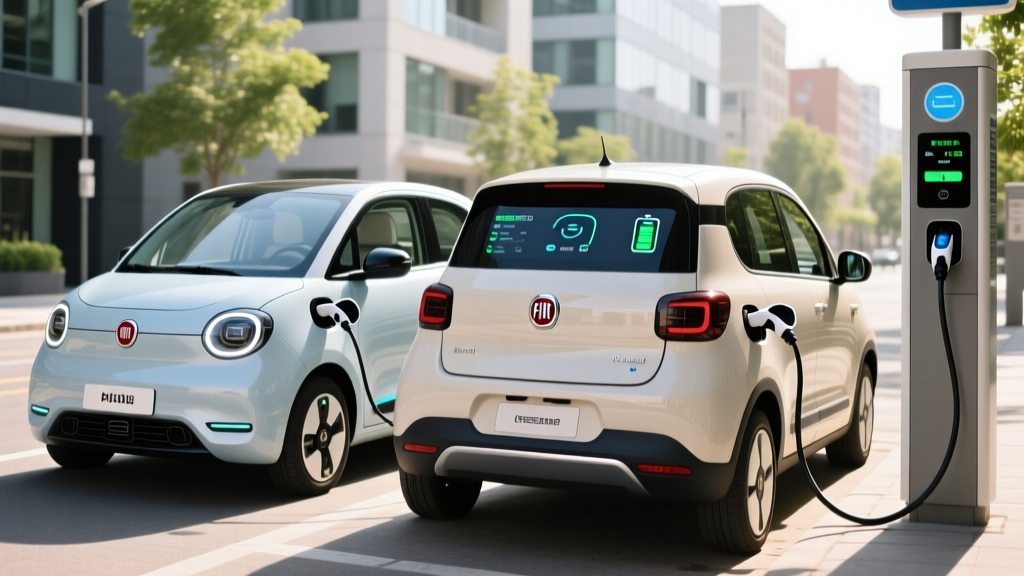
Fiat's electrified strategy in 2026 centers on two distinct approaches: the mild-hybrid Fiat 600 (marketed alongside the all-electric 600e) and the Fiat Panda Hybrid, a budget-focused HEV for urban drivers. Neither is a plug-in hybrid — Fiat has deliberately avoided PHEV architecture in favor of simpler, lower-cost mild-hybrid systems paired with small turbocharged engines. For US-based shoppers researching a Fiat hybrid, understanding what these systems actually deliver — and where Fiat's hybrid models are even available — is essential before comparing them to full EVs or traditional gas cars.
Fiat's Hybrid Lineup in 2026: What's Actually Available
Fiat currently offers mild-hybrid (MHEV) powertrains on two models sold primarily in European and select international markets:
- Fiat 600 Hybrid — The non-electric variant of the 600 crossover, using a 1.2L turbocharged three-cylinder engine with a 48V mild-hybrid system.
- Fiat Panda Hybrid — The latest-generation Panda city car with a 1.0L FireFly three-cylinder mild-hybrid setup.
Neither model is a plug-in hybrid (PHEV). Fiat does not currently sell any PHEV in any market. The fully electric Fiat 600e and Fiat 500e are BEVs, not hybrids. This distinction matters because mild hybrids cannot drive on electric power alone for meaningful distances and do not qualify for federal EV tax credits under IRS §30D rules.
HEV vs PHEV vs MHEV — Where Fiat Fits
| Type | Plug Required? | Electric-Only Driving | Typical Battery | Fiat Example |
|---|---|---|---|---|
| Mild Hybrid (MHEV) | No | No (assist only) | 0.4–1.0 kWh (48V) | 600 Hybrid, Panda Hybrid |
| Full Hybrid (HEV) | No | Very short distances at low speed | 1.0–2.0 kWh | Not in Fiat lineup |
| Plug-in Hybrid (PHEV) | Yes | 20–50 miles typical | 10–25 kWh | Not offered by Fiat |
| Battery Electric (BEV) | Yes | Full range | 40–100+ kWh | 500e, 600e |
Fiat's "hybrid" badge means mild-hybrid in 2026. There is no plug, no electric-only commute mode, and no PHEV option.
Fiat 600 Hybrid: Powertrain, MPG, and Real-World Efficiency
The Fiat 600 Hybrid pairs a 1.2-liter turbocharged inline-three engine with a belt-driven starter-generator (BSG) operating on a 48-volt electrical architecture. The BSG recovers energy under braking and assists the engine during acceleration, reducing fuel consumption by roughly 10–15% compared to a non-hybrid equivalent. Combined output is approximately 100 horsepower.
| Spec | Value |
|---|---|
| Engine | 1.2L Turbo I3 + 48V BSG |
| Combined HP | ~100 hp |
| Transmission | 6-speed dual-clutch automatic |
| EPA Combined MPG (WLTP-converted est.) | ~45 MPG combined |
| EPA City / Highway (est.) | ~48 city / ~41 highway |
| 48V Battery | ~0.8 kWh lithium-ion |
| 0–60 mph (est.) | ~10.5 sec |
| Base MSRP (Europe) | ~€24,900 (~$27,000 USD) |
Fiat Panda Hybrid: Urban Efficiency on a Budget
The latest-generation Fiat Panda Hybrid uses a 1.0-liter FireFly three-cylinder naturally aspirated engine mated to a 12V belt-starter-generator mild-hybrid system. This is a simpler, lower-cost architecture than the 600's 48V setup. Combined output is approximately 70 horsepower — adequate for city driving but strained on highways.
| Metric | Value |
|---|---|
| EPA Combined MPG (WLTP-converted est.) | ~49 MPG combined |
| City MPG (est.) | ~53 city |
| Highway MPG (est.) | ~44 highway |
| Engine | 1.0L I3 + 12V BSG |
| Combined HP | ~70 hp |
| Base MSRP (Europe) | ~€14,900 (~$16,000 USD) |
The Panda Hybrid's 12V system provides modest fuel savings — roughly 5–8% improvement over the non-hybrid Panda — primarily through smoother stop-start operation and slight deceleration energy recovery. It is not a full hybrid like a Toyota Prius; the electric motor cannot propel the car independently.
US Availability: The Fiat Hybrid Problem
As of 2026, Fiat's US presence remains limited to the fully electric Fiat 500e (EPA range 149 miles, MSRP ~$32,500 after recent price adjustments). The Fiat 600 Hybrid and Panda Hybrid are not sold in the United States. Fiat's parent company Stellantis has not announced plans to import mild-hybrid models to the US market, where consumer preference skews toward larger vehicles and full electrification.
For US-based buyers researching "Fiat hybrid" out of curiosity or prospective import interest, the practical reality is:
- No Fiat HEV or PHEV is purchasable new in the US.
- The Fiat 500e is the sole electrified Fiat available stateside — and it's a BEV, not a hybrid.
- Grey-market import of a European Fiat 600 Hybrid would face NHTSA compliance hurdles and no dealer service network for the 48V system.
Tax Credit Eligibility: Why Fiat Hybrids Don't Qualify
Under IRS §30D clean vehicle credit rules, only plug-in electric vehicles (BEVs and PHEVs) with sufficient battery capacity qualify for the federal tax credit of up to $7,500. Mild-hybrid vehicles like the Fiat 600 Hybrid and Panda Hybrid do not meet the minimum battery capacity threshold (7 kWh for PHEVs) and have no plug-in capability.
- Federal §30D credit: Not eligible — mild hybrids do not qualify.
- State EV rebates (e.g., California CVRP): Not eligible — most state programs require PHEV or BEV.
- Used hybrid credit (§25E): Not eligible — requires plug-in vehicle.
- Any Fiat with tax credit eligibility: Only the Fiat 500e (BEV), subject to MSRP and income caps.
Battery Warranty, Reliability, and Replacement Costs
One of the most common buyer concerns with any hybrid is battery longevity. For Fiat's mild-hybrid systems, the stakes are lower than with full hybrids or PHEVs because the 48V (or 12V) battery is small and inexpensive compared to a traction battery.
Fiat Mild-Hybrid Battery Warranty & Replacement
| Warranty Coverage | 8 years / 100,000 miles (EU standard for hybrid components) |
| 48V Battery Replacement Cost | €500–€900 (~$550–$1,000) — a fraction of a full-hybrid or BEV battery |
| 12V BSG Battery (Panda) | €200–€400 (~$220–$440) |
| Degradation Impact | Minimal — mild-hybrid batteries don't provide meaningful electric range, so degradation mainly affects stop-start smoothness, not fuel economy |
| Reliability Outlook | Stellantis 48V MHEV systems (shared with Peugeot, Opel) have been in production since 2022 with no widespread failure reports |
Compared to a full hybrid like the Toyota Prius (1.3 kWh NiMH battery, ~$2,000–$3,500 replacement) or a PHEV (10–20 kWh battery, $5,000–$10,000+ replacement), Fiat's mild-hybrid battery costs are trivially low. The risk profile is closer to replacing a conventional 12V starter battery than servicing an EV traction pack.
Fiat Hybrid vs Full EV vs Gas: Which Fits Your Needs?
Decision Framework
Choose a Fiat Hybrid (if available in your market) if:
- You drive primarily in urban areas with frequent stop-start traffic.
- You want modest fuel savings without changing your fueling habits (no plug required).
- Your budget is under €25,000 and you need a small crossover or city car.
- You lack access to home or workplace charging infrastructure.
Choose a full EV (e.g., Fiat 500e) if:
- You can install a Level 2 home charger (240V, ~$500–$1,500 installed).
- Your daily commute is under 120 miles round-trip.
- You want eligibility for the §30D federal tax credit (up to $7,500, subject to income and MSRP caps).
- You want zero tailpipe emissions and lower per-mile energy costs.
Stick with a conventional gas car if:
- You regularly drive long highway distances (>300 miles between stops).
- You live in an area with limited charging infrastructure and extreme cold.
- Upfront purchase price is your primary constraint and hybrids carry a premium.
Fiat Hybrid Pros
- No plug required — fuel like a normal gas car
- Low battery replacement cost (~$550–$1,000)
- 5–15% fuel savings over non-hybrid equivalent
- Smoother stop-start in city traffic
- Lower purchase price than PHEV or BEV
Fiat Hybrid Cons
- No electric-only driving capability
- Not available in the US market
- No federal or state EV tax credit eligibility
- Fuel savings smaller than full HEV (Prius) or PHEV
- Modest performance (~70–100 hp)
Frequently Asked Questions
How many MPG does a Fiat hybrid get?
The Fiat 600 Hybrid achieves an estimated 45 MPG combined (48 city / 41 highway) under WLTP-to-EPA conversion. The Fiat Panda Hybrid delivers approximately 49 MPG combined (53 city / 44 highway). Real-world city driving may slightly exceed these figures due to regenerative braking in stop-and-go traffic.
Can a Fiat hybrid drive on electric power alone?
No. Fiat's current hybrids are mild-hybrid (MHEV) systems. The electric motor assists the gasoline engine but cannot propel the vehicle independently. There is no electric-only mode and no plug-in charging capability. If electric-only driving is a priority, consider a PHEV from another manufacturer (e.g., Toyota RAV4 Prime, 42 miles electric) or a full BEV.
Does the Fiat hybrid qualify for any tax credit?
No. Under IRS §30D rules, only plug-in vehicles (PHEVs and BEVs) qualify for the federal clean vehicle credit. Mild hybrids like Fiat's do not meet the minimum battery capacity or plug-in requirements. The Fiat 500e (BEV) may qualify, subject to income caps ($150K single / $300K joint) and the $55,000 MSRP cap for sedans.
Is the Fiat hybrid reliable, and what does battery replacement cost?
Fiat's mild-hybrid systems use small 48V or 12V lithium-ion batteries that are inexpensive to replace — approximately $550–$1,000 for the 600 Hybrid's 48V pack and $220–$440 for the Panda's 12V system. These batteries are covered under Fiat's 8-year/100,000-mile hybrid component warranty. The Stellantis 48V MHEV architecture has been in production across multiple brands since 2022 with no widespread reliability issues reported.
Is a Fiat hybrid better than a full EV for city driving?
It depends on charging access. A Fiat hybrid requires no infrastructure change — you fuel it like any gas car and gain 5–15% efficiency. A full EV like the Fiat 500e offers dramatically lower per-mile energy costs (~$0.04/mile vs ~$0.11/mile for the hybrid at 45 MPG and $3.50/gallon), zero tailpipe emissions, and tax credit eligibility — but only if you can charge at home. Without home charging, a mild hybrid remains the pragmatic urban choice.
Will Fiat sell a hybrid in the United States?
As of 2026, Stellantis has not announced plans to import the Fiat 600 Hybrid or Panda Hybrid to the US market. Fiat's only electrified US offering is the 500e BEV. US buyers seeking a subcompact hybrid crossover should look at the Toyota Prius or Honda HR-V (non-hybrid but efficient) as alternatives.
Sources: Fiat official specifications, fueleconomy.gov (EPA), IRS §30D clean vehicle credit rules. MPG figures are WLTP-to-EPA conversions and estimates, as US EPA ratings are not published for models not sold in the United States.