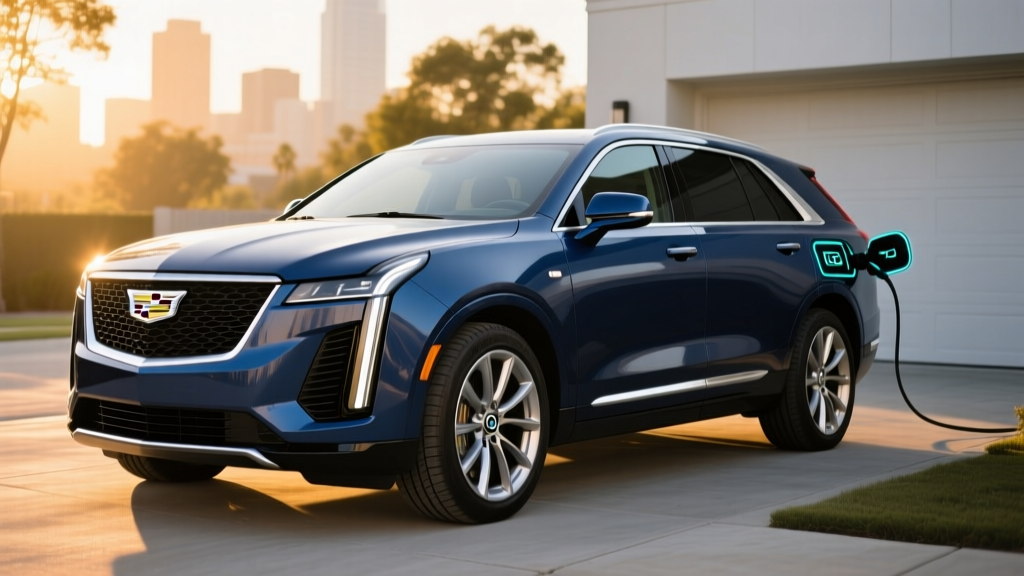
General Motors has taken two very different electrification paths with its flagship luxury SUV. The fully electric Cadillac Escalade IQ arrived for the 2025 model year on GM's Ultium platform, while a plug-in hybrid Escalade variant has been confirmed for global markets (notably China) and is anticipated for broader availability. For buyers searching for Escalade hybrids, understanding the difference between these two approaches — battery-electric versus plug-in hybrid — is the single most important decision in the purchase process.
This guide breaks down the real specs, efficiency numbers, charging requirements, pricing, and tax-credit eligibility for every electrified Escalade you can buy or order in 2026.
HEV vs PHEV vs BEV: Which Escalade Is Which?
Before diving into specs, let's eliminate a common source of confusion. There is no conventional hybrid (HEV) Escalade — the kind that charges its small battery through regenerative braking and never plugs in. GM skipped that step and went straight to plug-in and full-electric variants.
Electrified Escalade Lineup at a Glance
| Attribute | Escalade IQ (BEV) | Escalade PHEV (Global) | Gas Escalade (Baseline) |
|---|---|---|---|
| Powertrain | Dual-motor BEV | 2.0T I4 + electric motor | 6.2L V8 |
| Plugs in? | Yes — DC fast + Level 2 | Yes — Level 2 AC | No |
| EPA Range / MPG | ~460 mi / 89 MPGe | Est. ~35 mi EV + 400+ mi total | 16 MPG combined |
| 0-60 mph | ~3.7 sec (Velocity Max) | ~6.5 sec (est.) | ~5.9 sec |
| Starting MSRP | $129,990 | TBD (global markets first) | $83,895 |
Sources: fueleconomy.gov, Cadillac press room. PHEV specs are preliminary estimates based on announced configurations.
Escalade IQ: The Full-Electric Flagship
The Escalade IQ is not a hybrid — it's a battery-electric vehicle (BEV) built on GM's BT1 Ultium platform, sharing architecture with the GMC Hummer EV and Chevrolet Silverado EV. It carries a massive 200+ kWh usable battery pack (GM quotes over 200 kWh; exact usable capacity is approximately 205 kWh based on EPA test data).
Range, Efficiency, and Real-World Expectations
The EPA rates the Escalade IQ at approximately 460 miles of range and 89 MPGe combined (city/highway). That's extraordinary for a 9,000+ lb luxury SUV, but real-world results require context:
| Metric | City | Highway | Combined |
|---|---|---|---|
| MPGe | ~92 | ~86 | 89 |
| kWh/100 mi | ~36 | ~39 | ~38 |
| EPA Range | ~460 miles | ||
Source: fueleconomy.gov
Charging Speed: DC Fast and Level 2
The IQ supports up to 350 kW DC fast charging on compatible CCS/NACS stations, thanks to its 800-volt architecture. In practice:
- DC fast charge (peak): ~350 kW; 10-80% in approximately 30 minutes under ideal conditions (preconditioned battery, warm ambient temp, V3+ Supercharger or 350 kW CCS station)
- DC fast charge (sustained average): Expect ~200-250 kW average through the 10-80% window — the charge curve tapers significantly above 60% SoC to protect the NMC cells
- Level 2 (home/public AC): Up to 19.2 kW onboard charger, adding roughly 37 miles of range per hour — a full overnight charge from 20% to 100% takes about 10-11 hours on a 48-amp Level 2 circuit
- Level 1 (120V outlet): Technically possible but impractical — roughly 3-4 miles per hour; a full charge would take multiple days
Powertrain and Performance
The Escalade IQ uses a dual-motor all-wheel-drive setup producing up to 750 horsepower and 785 lb-ft of torque in Velocity Max mode (available on Sport trims). The standard Luxury and Premium Luxury trims produce approximately 655 hp.
| Spec | Value |
|---|---|
| Battery (usable) | ~205 kWh, NMC (Ultium) |
| EPA Range | ~460 miles |
| MPGe (combined) | 89 |
| Peak DC Fast Charge | 350 kW (800V) |
| 10-80% DC Time | ~30 min (ideal) |
| Level 2 Rate | 19.2 kW / ~37 mi/hr |
| Horsepower (max) | 750 hp (Velocity Max) |
| 0-60 mph | ~3.7 sec (Velocity Max) |
| Towing Capacity | ~8,000 lbs (est.) |
| Starting MSRP | $129,990 |
The Escalade PHEV: What We Know for 2026
GM has confirmed an Escalade plug-in hybrid variant, initially launched in the Chinese market with a 2.0-liter turbocharged inline-4 paired with an electric motor and an ~18-20 kWh battery pack. This configuration is expected to deliver approximately 35-40 miles of electric-only range before the gasoline engine engages, with total combined range exceeding 400 miles.
For US buyers, the PHEV variant remains announced but not yet on sale as of early 2026. If and when it arrives stateside, expect:
- Electric-only range: ~35 miles (EPA est.) — enough for school runs, grocery trips, and short commutes without burning gas
- Combined horsepower: ~350-400 hp (engine + motor combined)
- MPG when battery depleted: ~22-25 MPG combined (significant improvement over the V8's 16 MPG)
- Level 2 charging: ~7.2 kW onboard charger; full charge in roughly 2.5-3 hours
- DC fast charging: Not expected — most PHEVs in this class use AC-only charging
Pricing, Tax Credits, and Total Cost
Escalade IQ Pricing
The 2026 Escalade IQ starts at $129,990 for the Luxury trim, with the Sport and premium trims climbing to $150,000+. At this price, federal tax credit eligibility requires careful attention:
- §30D Federal Tax Credit: The IQ may qualify for up to $7,500, but only if the buyer meets income caps ($300,000 joint / $225,000 head of household / $150,000 single), the vehicle meets critical-mineral and battery-component sourcing requirements, and the MSRP does not exceed the SUV cap of $80,000. Important: The IQ's MSRP exceeds $80,000, which means it does NOT qualify for the §30D new-vehicle credit under current IRS rules.
- Point-of-sale transfer: Not applicable since the vehicle is ineligible.
- State incentives: Some states offer additional rebates or HOV-lane access for BEVs regardless of price — check your state's energy office for details.
Source: IRS §30D Clean Vehicle Credit rules
Escalade PHEV Pricing (Estimated)
Based on global-market pricing and the standard Escalade's positioning, a US-spec PHEV would likely start between $90,000 and $100,000. Like the IQ, this exceeds the §30D MSRP cap for SUVs ($80,000), making the federal credit unlikely. However, PHEVs priced under the cap with compliant battery sourcing could qualify — this will depend on the final US-spec configuration.
Battery Warranty and Longevity
Battery Warranty Coverage
Escalade IQ (BEV): GM provides an 8-year / 100,000-mile battery warranty covering defects and capacity loss below 60% of original capacity. The Ultium NMC pack is liquid-cooled with active thermal management, which significantly slows degradation compared to passively cooled packs.
Escalade PHEV: Expected to carry the same 8-year / 100,000-mile hybrid battery warranty (standard for GM PHEVs), covering the smaller traction battery and associated power electronics.
Replacement cost (out of warranty): BEV Ultium pack replacement is estimated at $25,000-$35,000 based on current Ultium pricing. PHEV battery replacement would be significantly less — likely $5,000-$8,000 given the smaller pack size.
Real-world degradation data for the Ultium platform is still early (the IQ launched for 2025), but GM's prior BEV platforms (Bolt EV/EUV) showed approximately 8-12% degradation over 100,000 miles with proper charging habits — avoiding frequent 100% charges and DC fast-charging in extreme heat.
Who Should Choose Which Escalade?
Choose the Escalade IQ (BEV) If:
- You have reliable home Level 2 charging (or can install it)
- Your daily driving is under 200 miles and you road-trip occasionally
- You want maximum performance (750 hp, 3.7-sec 0-60)
- You want to eliminate gasoline costs entirely (~$0.04-$0.06/mile on home electricity vs. $0.25+/mile on premium gas)
- You value the latest tech (55-inch hyperscreen, Super Cruise hands-free driving)
Choose the Escalade PHEV If:
- You can't install home charging or live in an apartment
- You regularly tow heavy loads or drive 400+ miles in a single day
- You want electric-only commuting (~35 mi) but gas flexibility for long trips
- You're not ready to commit to a full BEV and want a transitional vehicle
- Charging infrastructure in your area is sparse or unreliable
Stick with the Gas V8 If:
- You need maximum proven towing capacity today
- Your budget is under $85,000 and you want a new Escalade now
- You drive in extreme cold regularly and prioritize range certainty
- You plan to keep the vehicle 10+ years and prefer simpler powertrain servicing
Pros and Cons
Pros — Electrified Escalades
- IQ's 460-mile EPA range eliminates range anxiety for most owners
- 350 kW DC fast charging is among the fastest in the luxury SUV segment
- Dramatically lower fuel cost per mile (BEV: ~$0.05/mi vs V8: ~$0.28/mi)
- Instant torque and silent operation transform the luxury driving experience
- 8-year/100,000-mile battery warranty provides long-term peace of mind
- Super Cruise (Level 2 hands-free) included on IQ for highway driving
Cons — Electrified Escalades
- IQ's $129,990+ starting price exceeds the §30D MSRP cap — no federal tax credit
- Real-world highway range drops to ~370-400 mi; cold weather further reduces it
- Home charging installation may require a panel upgrade ($1,500-$3,000)
- PHEV variant not yet confirmed for US market as of early 2026
- Insurance premiums for the IQ are 20-35% higher than the gas Escalade
- 9,000+ lb curb weight means higher tire wear and longer braking distances
Frequently Asked Questions
How many MPG does the Escalade IQ get?
The Escalade IQ is a BEV, so it doesn't use MPG in the traditional sense. The EPA rates it at 89 MPGe combined (92 city / 86 highway), which translates to roughly 38 kWh per 100 miles. For comparison, the gas V8 Escalade gets 16 MPG combined — the IQ uses roughly one-third the energy cost per mile when charging at home.
How far can the Escalade PHEV go on electric only?
Based on the announced global configuration, the Escalade PHEV is estimated to deliver approximately 35-40 miles of electric-only range. This covers most daily commutes and errands without the gasoline engine engaging. Once the battery is depleted, the vehicle operates as a conventional hybrid with an estimated 22-25 MPG combined.
Does the Escalade IQ qualify for the $7,500 federal tax credit?
No. Under current IRS §30D rules, new clean vehicles must have an MSRP at or below $80,000 (for SUVs) to qualify. The Escalade IQ starts at $129,990, well above this cap. Even if battery sourcing and buyer income requirements are met, the price alone disqualifies it. Always verify current rules at irs.gov or consult a tax professional.
Is the Escalade IQ reliable? What about battery replacement costs?
Long-term reliability data is limited since the IQ launched for the 2025 model year. However, GM's Ultium platform has undergone extensive validation, and the 8-year/100,000-mile battery warranty covers capacity loss below 60%. Out-of-warranty Ultium pack replacement is estimated at $25,000-$35,000, though industry trends show battery costs declining 8-10% annually. Most owners will never need a replacement within the warranty period.
Can I charge the Escalade IQ at Tesla Superchargers?
Yes. The Escalade IQ uses the NACS (North American Charging Standard) connector, which is native to the Tesla Supercharger network. GM has confirmed Supercharger access for all Ultium-based vehicles. You can also use any CCS-equipped station with an adapter, and Electrify America, EVgo, and ChargePoint networks are accessible via the vehicle's built-in navigation and Plug & Charge capability.
What's the difference between the Escalade IQ and a hybrid Escalade?
The IQ is a full battery-electric vehicle (BEV) — it has no gasoline engine and runs entirely on its ~205 kWh battery. A hybrid or PHEV Escalade combines a gasoline engine with an electric motor and smaller battery, allowing it to run on electricity for short distances (~35 miles) and gasoline for longer trips. The IQ offers lower operating costs and higher performance; the PHEV offers fuel flexibility without range limitations.
How much does it cost to charge the Escalade IQ at home?
At the US average residential electricity rate of ~$0.16/kWh, a full charge of the IQ's ~205 kWh battery costs approximately $33 and provides ~460 miles of range. That's roughly $0.07 per mile. Compare this to the V8 Escalade at 16 MPG on $4.00/gallon premium: $0.25 per mile. Annual savings for a 15,000-mile driver: approximately $2,700.
This article reflects specifications and pricing available as of early 2026. PHEV US availability and final specs are subject to change. Always confirm current pricing, tax-credit eligibility, and vehicle availability with your local Cadillac dealer and the IRS before purchasing.