The search for an "elf bike car hybrid" usually leads to one specific vehicle: the Organic Transit ELF, a solar-assisted, three-wheeled electric velomobile that blurs the line between bicycle and automobile. But the term also captures a broader buyer question — can a small, electric-assist vehicle replace a conventional hybrid or plug-in hybrid for daily commuting? This guide breaks down what the ELF actually is, how its electric-assist powertrain works, and where it fits against real hybrid cars (HEVs) and plug-in hybrids (PHEVs) in 2026.
What the ELF Bike Car Hybrid Actually Is
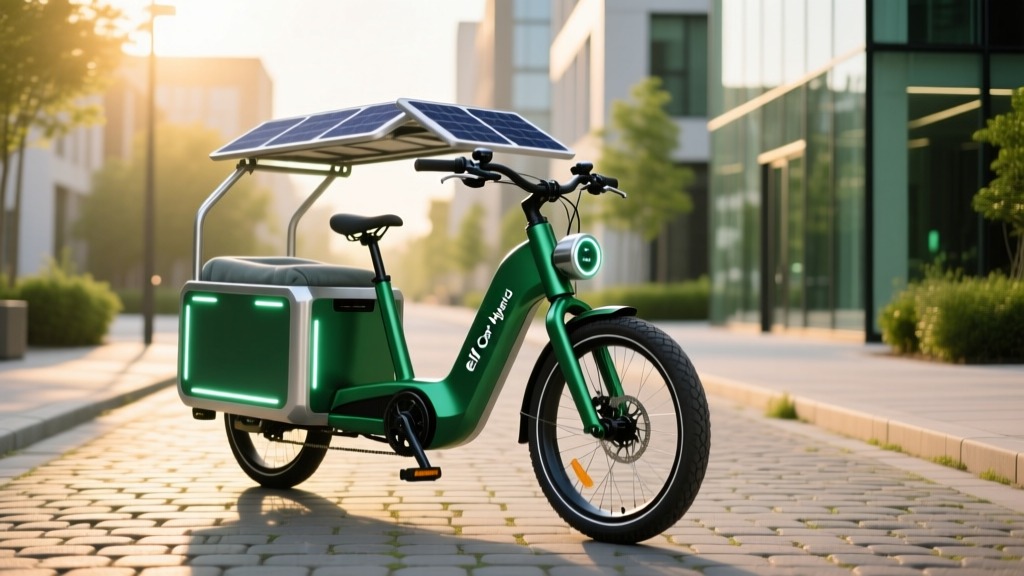
The Organic Transit ELF is a three-wheeled, pedal-assisted electric vehicle classified under federal law as a bicycle — specifically, an electric-assisted bicycle under 15 U.S.C. §2085, provided its motor output does not exceed 750 watts and its top motor-only speed stays at or below 20 mph on level ground. It is not a car, not a Neighborhood Electric Vehicle (NEV), and not a hybrid in the automotive sense. It has no gasoline engine, no transmission, and no automotive-grade battery pack.
That said, the ELF's enclosed cabin, turn signals, headlights, taillights, and side mirrors give it a car-like presence that earns it the "bike car hybrid" nickname. It is designed for last-mile commuting, campus travel, and urban errands — not highway driving.
ELF Powertrain and Electric-Assist Specs
The ELF's powertrain is fundamentally different from any automotive hybrid. Here is what you are working with:
| Spec | Detail |
|---|---|
| Motor Output | 750W (federal e-bike limit, rear hub motor) |
| Battery | 48V lithium-ion (approx. 0.72–1.44 kWh depending on pack config) |
| Motor-Only Range | ~15–30 miles (varies by battery size, terrain, rider weight) |
| Pedal-Assist Range | Effectively unlimited (human power extends range) |
| Top Speed (Motor Only) | 20 mph (federal Class 2 e-bike cap) |
| Solar Panel | 60W roof-mounted panel (adds ~5 miles/day in full sun) |
| Charge Time (120V outlet) | ~2–4 hours depending on pack size |
| Vehicle Weight | ~160 lbs (base) |
| Cargo Capacity | Rear cargo area, rated for ~250 lbs total payload |
| MSRP (When Available) | $4,000–$10,000+ (model/config dependent; see availability note below) |
For context, a single kilowatt-hour (kWh) is the energy unit that matters here. The ELF's battery holds roughly 0.72 to 1.44 kWh — that is less than 2% of the usable capacity in a typical PHEV like the Toyota RAV4 Prime (18.1 kWh) or a BEV like the Hyundai Ioniq 5 (77.4 kWh). The motor's 750W output means it draws 0.75 kW at full power — comparable to a space heater on low.
ELF vs. Real Hybrid Cars (HEV) vs. Plug-In Hybrids (PHEV)
If you are cross-shopping an ELF with an actual hybrid automobile, you are comparing fundamentally different vehicle classes. Here is how the physics and economics stack up:
| Attribute | HEV (e.g., Toyota Prius 2026) | PHEV (e.g., Toyota RAV4 Prime 2026) | ELF Trike |
|---|---|---|---|
| Legal Class | Passenger automobile | Passenger automobile | Electric-assisted bicycle |
| Gasoline Engine | Yes (2.0L 4-cyl) | Yes (2.5L 4-cyl) | No |
| Plug-In Charging | No | Yes (Level 1/2) | Yes (120V standard outlet) |
| EPA Combined MPG / MPGe | 57 MPG combined | 94 MPGe (EV mode) / 38 MPG (gas) | N/A (not EPA-rated) |
| Electric-Only Range | N/A | 42 miles | ~15–30 mi (motor only) |
| Total Range | ~600+ miles | ~490 miles combined | ~15–30 mi + pedaling |
| Highway Capable | Yes | Yes | No (max ~20 mph) |
| Passengers | 5 | 5 | 1 (rider only) |
| Federal Tax Credit | No (§30D is EV/PHEV only) | Up to $7,500 (if eligible) | No |
| Weather Protection | Full (HVAC, crash structure) | Full (HVAC, crash structure) | Partial (enclosed cabin, no HVAC) |
| Base MSRP (2026) | ~$29,445 | ~$44,515 | $4,000–$10,000+ |
How Many MPG Does a Hybrid Get, and How Does the ELF Compare?
The ELF does not burn gasoline, so MPG does not apply. But the energy-equivalent question is: how efficient is it per mile?
At 750W output, the ELF consumes roughly 0.75 kWh per hour of full-motor riding. At 20 mph, that translates to approximately 0.0375 kWh per mile, or about 37.5 watt-hours per mile. At the U.S. average electricity rate of ~$0.17/kWh (EIA, 2025 data), that is roughly $0.006 per mile — essentially negligible.
For comparison, here is what leading automotive hybrids deliver per the EPA on fueleconomy.gov:
| Model | Type | City MPG | Hwy MPG | Combined MPG | EV-Only Range |
|---|---|---|---|---|---|
| Toyota Prius | HEV | 57 | 56 | 57 | N/A |
| Hyundai Elantra Hybrid | HEV | 53 | 56 | 54 | N/A |
| Toyota RAV4 Prime | PHEV | 94 MPGe | 84 MPGe | 94 MPGe | 42 mi |
| Ford Escape PHEV | PHEV | 102 MPGe | 89 MPGe | 102 MPGe | 37 mi |
| Honda Accord Hybrid | HEV | 51 | 44 | 48 | N/A |
Real-world MPG note: Conventional hybrids (HEVs) frequently exceed their EPA city estimates in stop-and-go traffic because regenerative braking recovers more energy at low speeds. On the highway, where the gas engine does more of the work, real-world MPG often dips 3–5 MPG below the EPA sticker. PHEVs in EV mode deliver MPGe figures that assume you start with a full charge; once the battery depletes, you revert to the gas-mode MPG figure.
Battery, Charging, and Longevity: ELF vs. Automotive Hybrids
The ELF's battery is a small lithium-ion pack — typically 48V with a capacity between 0.72 and 1.44 kWh depending on configuration. It charges from a standard 120V household outlet in 2–4 hours. There is no DC fast charging capability, nor would it be practical for a pack this small. The roof-mounted 60W solar panel provides trickle charging that adds roughly 5 miles of range per day in direct sunlight — useful for extending range between plug-in charges, but not a primary charging source.
Automotive hybrid batteries are vastly different in scale and durability:
The ELF's battery, by contrast, is a consumer-grade e-bike pack with no federally mandated warranty floor. Organic Transit historically offered a 1-year warranty on the battery. Replacement packs are estimated at $500–$1,500 depending on capacity. Expect 500–800 full charge cycles before noticeable degradation — roughly 3–5 years of daily commuting use before capacity drops to ~80% of original.
Tax Credits, Incentives, and the ELF
The ELF does not qualify for the IRS §30D Clean Vehicle Credit. That credit applies only to new plug-in electric drive motor vehicles — BEVs and PHEVs that meet battery-sourcing, critical-mineral, MSRP cap ($55,000 for SUVs/vans/pickups; $50,000 for sedans), and buyer income limits (AGI ≤ $150,000 single / $300,000 joint) requirements. See the IRS §30D guidelines for current-year eligibility details.
Some states and municipalities offer e-bike purchase incentives — typically $300–$1,500 — that could apply to the ELF. Check your state energy office or local transportation authority for current programs. Colorado, for example, has offered e-bike tax credits; various cities (Denver, Boulder, Portland) have run point-of-sale rebate programs for e-bikes and cargo e-bikes.
For comparison, a qualifying PHEV like the RAV4 Prime can receive up to $7,500 as a point-of-sale transfer under §30D, dramatically reducing its effective price. The ELF receives no such federal benefit.
Who Should Choose the ELF vs. a Hybrid or EV?
The decision comes down to trip distance, speed requirements, and weather tolerance.
Choose the ELF If:
- Your one-way commute is under 15 miles on surface streets or bike paths
- You want zero gasoline use and minimal electricity cost
- You live in a mild climate (no heavy snow or extreme cold)
- You have secure storage — the ELF is a theft target at $4,000+
- You want cargo capacity (groceries, gear) beyond a standard e-bike
- You value the solar trickle-charge feature for off-grid resilience
Choose a Hybrid/PHEV/EV If:
- You need highway speeds (65+ mph) or travel more than 30 miles one-way
- You carry passengers regularly
- You need HVAC (heating and air conditioning) for year-round comfort
- You want crash-tested safety (airbags, crumple zones, IIHS/NHTSA ratings)
- You need to drive in winter weather with confidence
- You want federal tax credit eligibility (§30D, up to $7,500)
ELF Availability and Market Reality in 2026
Organic Transit, the Durham, North Carolina-based company behind the ELF, has experienced production and financial challenges over the years. As of early 2026, new ELF units are not widely available through standard retail channels. Interested buyers should verify current production status directly with the manufacturer or explore the used/resale market.
If the ELF is unavailable, comparable alternatives in the enclosed electric trike / cargo e-bike space include:
- ElectraMeccanica SOLO — a single-seat, three-wheeled BEV (classified as a motorcycle, not a bicycle) with ~100 miles of range and highway capability, starting around $18,500
- Urban Arrow cargo e-bikes — open-air but highly capable cargo haulers with Bosch mid-drive motors, 30–50 mile range, and $5,000–$7,000 pricing
- Lectric XPress 750 — a more affordable utility e-bike with a 750W hub motor, ~45-mile range, and pricing under $2,000
Frequently Asked Questions
Is the ELF bike car hybrid street-legal?
The ELF is classified as an electric-assisted bicycle under federal law, meaning it is legal on bike paths, bike lanes, and most roads where bicycles are permitted. It is not legal on highways or limited-access roads. State and local e-bike regulations vary — some jurisdictions restrict Class 2 e-bikes (throttle-equipped, like the ELF) from certain multi-use paths. Check your local ordinances.
How far can the ELF go on electric power alone?
Motor-only range is approximately 15–30 miles, depending on battery configuration (0.72–1.44 kWh), terrain, rider weight, and ambient temperature. Cold weather (below 40°F) can reduce lithium-ion battery output by 20–30%, cutting range accordingly. Pedal-assist mode extends range significantly since human power supplements the motor.
Does the ELF qualify for the $7,500 federal EV tax credit?
No. The IRS §30D Clean Vehicle Credit applies only to plug-in electric drive motor vehicles (BEVs and PHEVs) that meet specific battery capacity, sourcing, MSRP, and buyer income requirements. The ELF is classified as a bicycle, not a motor vehicle, and does not qualify. Some state and local e-bike incentive programs may apply.
Is the ELF safe compared to a car?
The ELF has no airbags, no crash-test ratings from NHTSA or IIHS, and minimal crumple-zone engineering. Its enclosed cabin offers better visibility and weather protection than a standard bicycle, but in any collision with an automobile, the ELF rider is extremely vulnerable. For mixed-traffic commuting at speeds above 25 mph, an automobile (hybrid, PHEV, or BEV) provides dramatically more occupant protection.
How reliable is the ELF, and what does battery replacement cost?
The ELF's mechanical simplicity (single hub motor, no transmission, no engine) means fewer failure points than a car. However, Organic Transit's limited production scale means parts availability and service support can be challenging compared to mainstream automakers. Battery replacement is estimated at $500–$1,500 depending on pack size — far less than an automotive hybrid battery ($2,000–$9,000) but also far less durable in terms of cycle life and warranty coverage.
Hybrid vs. PHEV vs. EV — which fits my commute?
If your daily round-trip is under 40 miles and you can charge at home, a PHEV gives you electric-only commuting with gas-engine backup for longer trips — the best of both worlds. If you drive 200+ miles daily or lack home charging access, an HEV delivers excellent MPG without plug-in requirements. If you have home charging and want the lowest per-mile cost, a BEV eliminates gasoline entirely. If your commute is under 15 miles on bike-friendly roads and you want zero fuel cost, an electric-assist trike like the ELF can work — but it is a bicycle replacement, not a car replacement.