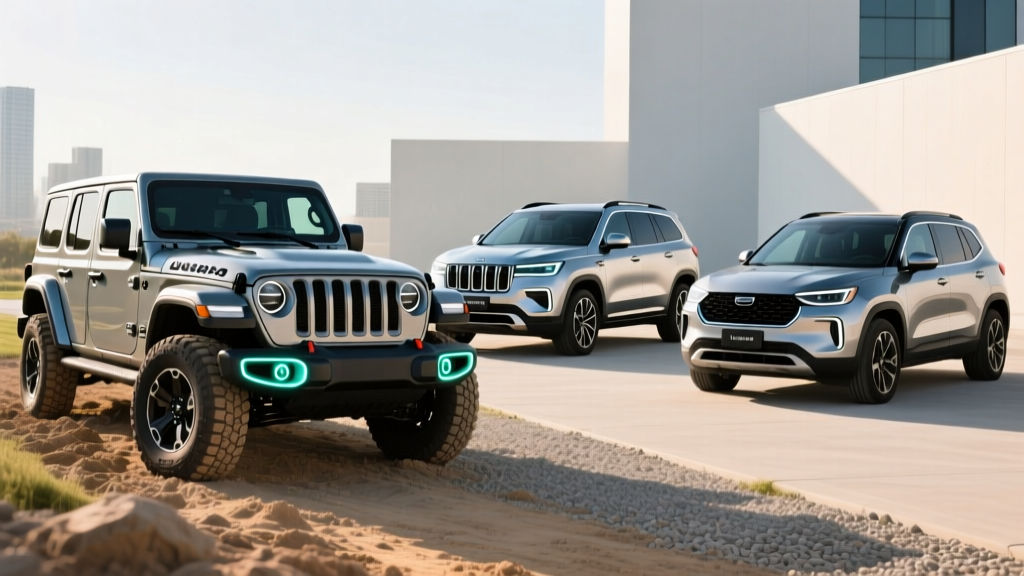
If you've been searching for an electric hybrid Jeep, you're looking at one of the most diverse plug-in hybrid lineups in the industry. For 2026, Jeep offers three distinct 4xe (pronounced "four-by-e") plug-in hybrid models spanning a rugged body-on-frame off-roader, a three-row family SUV, and a compact crossover. Each uses a different powertrain architecture, battery size, and electric-only range — and none of them are conventional hybrids. Every current Jeep electrified model sold in the U.S. is a plug-in hybrid (PHEV), meaning you can charge from a wall outlet and drive on electricity alone before the gas engine kicks in.
This guide breaks down the full 2026 Jeep 4xe lineup with exact EPA figures, real-world expectations, pricing, federal tax credit eligibility, and a clear framework for deciding which model — or whether a full EV — fits your needs.
HEV vs PHEV: What Jeep Actually Sells in 2026
Before diving into specs, it's critical to understand the distinction, because many buyers conflate the two:
Conventional Hybrid (HEV)
A standard hybrid like the Toyota RAV4 Hybrid uses a small battery (typically 1–2 kWh) recharged solely through regenerative braking and the gas engine. You never plug it in. Electric-only driving is limited to very low speeds and short distances. The main benefit is improved MPG.
Plug-In Hybrid (PHEV) — Jeep 4xe
A plug-in hybrid carries a much larger battery (14–25 kWh usable in Jeep's lineup) that you charge from a Level 1 or Level 2 outlet. This enables meaningful electric-only driving — typically 25–44 miles — before the gasoline engine seamlessly takes over for combined range exceeding 400 miles. You get EV-like daily commuting with gas-engine freedom for road trips.
Jeep does not currently sell a conventional HEV in the U.S. market. Every electrified Jeep is a PHEV. If you see "Jeep hybrid" referenced online, it's almost certainly referring to a 4xe plug-in model. The mild-hybrid eTorque system that appeared in earlier Wrangler and Ram models has been discontinued.
2026 Jeep 4xe Lineup: Side-by-Side Specs
| Spec | Wrangler 4xe | Grand Cherokee 4xe | Compass 4xe |
|---|---|---|---|
| Powertrain | 2.0L turbo I4 + 2 electric motors | 2.0L turbo I4 + 2 electric motors | 1.3L turbo I3 + rear electric motor |
| Combined Horsepower | 375 hp / 470 lb-ft | 375 hp / 470 lb-ft | 240 hp / 390 lb-ft |
| Battery (Usable) | 17.3 kWh (NMC) | 17.3 kWh (NMC) | 15.5 kWh (NMC) |
| EPA Electric Range | 22 miles | 26 miles | 32 miles |
| EPA Combined MPGe | 49 MPGe | 56 MPGe | 72 MPGe |
| Gas-Only MPG (Combined) | 20 MPG | 23 MPG | 29 MPG |
| Total Range | ~370 miles | ~440 miles | ~430 miles |
| 0–60 mph | 6.0 sec | 6.0 sec | 6.8 sec |
| Max AC Charge Rate | 7.2 kW (Level 2) | 7.2 kW (Level 2) | 7.4 kW (Level 2) |
| DC Fast Charge | No | No | No |
| Level 2 Charge Time (0–100%) | ~2.5 hours | ~2.5 hours | ~2.0 hours |
| Level 1 Charge Time (120V) | ~12 hours | ~12 hours | ~10 hours |
| Towing Capacity | 3,500 lbs | 6,000 lbs | 2,000 lbs |
| Base MSRP (2026) | $52,995 | $60,995 | $38,495 |
Sources: fueleconomy.gov, Jeep/ Stellantis official specifications.
Fuel Economy: EPA Numbers vs Real-World MPG
| Model | City MPG (gas) | Highway MPG (gas) | Combined MPG (gas) | Combined MPGe (elec+gas) |
|---|---|---|---|---|
| Wrangler 4xe | — | — | 20 | 49 |
| Grand Cherokee 4xe | 23 | 24 | 23 | 56 |
| Compass 4xe | 30 | 28 | 29 | 72 |
Real-world reality check: These MPGe figures assume you're regularly plugging in and driving within the electric-only range. If you never charge a 4xe, you're simply driving a heavy hybrid — and the Wrangler 4xe's brick-like aerodynamics and all-terrain tires push real-world gas-only highway fuel economy closer to 17–18 MPG at 75 mph. The Grand Cherokee 4xe settles around 21–22 MPG highway when the battery is depleted.
The Compass 4xe is the efficiency standout. Owners who charge nightly and commute under 30 miles report burning almost no gasoline for weeks. On a depleted battery, expect about 27–28 MPG combined in mixed driving — still a meaningful improvement over the gas-only Compass.
Cold-weather impact: Electric-only range drops 15–25% in freezing temperatures across all three models. A Grand Cherokee 4xe rated for 26 electric miles may deliver only 19–21 miles at 20°F. This is normal PHEV behavior caused by increased battery internal resistance and cabin heating demand.
Charging: What to Expect at Home and on the Go
No Jeep 4xe model supports DC fast charging. This is a deliberate engineering trade-off — the relatively small batteries don't need it, and adding DC fast-charge hardware would increase weight, cost, and packaging complexity in vehicles already managing off-road hardware.
Here's what charging actually looks like:
- Level 1 (120V household outlet): All 4xe models come with a portable cordset. A full charge takes 10–12 hours. This works fine if you park overnight and drive less than your electric range daily.
- Level 2 (240V): With a 7.2–7.4 kW onboard charger, all three models reach a full charge in 2–2.5 hours on a Level 2 station. A home Level 2 installation typically costs $500–$1,500 for equipment plus $800–$2,500 for electrician labor, depending on panel proximity and local permitting. Consult a licensed electrician for your specific setup.
- Public Level 2: You can top up at any J1772 public station, but the small battery means you'll rarely need more than 30–60 minutes at a destination charger.
kW vs kWh reminder: The 4xe's onboard charger accepts up to 7.2 kW (power, or the rate of energy flow). The battery stores 15.5–17.3 kWh (energy capacity, like gallons in a fuel tank). Charging from empty at 7.2 kW into a 17.3 kWh battery takes roughly 17.3 ÷ 7.2 = 2.4 hours.
Tax Credits and Pricing: What You'll Actually Pay
Federal tax credit eligibility for Jeep 4xe models is governed by IRS §30D rules, which have become significantly more restrictive due to battery sourcing and critical mineral requirements. Here's where each model stands for 2026:
- Compass 4xe ($38,495): Falls under the $80,000 SUV MSRP cap. May qualify for up to $3,750–$7,500 depending on battery component and critical mineral sourcing compliance for the specific model year. Verify current eligibility on the IRS Clean Vehicle provisions page before purchasing.
- Wrangler 4xe ($52,995+): Under the $80,000 SUV MSRP cap. Eligibility depends on battery sourcing. Historically has qualified for partial or full credit — confirm with your dealer and cross-reference the IRS qualifying vehicle list.
- Grand Cherokee 4xe ($60,995+): Under the $80,000 SUV MSRP cap. Same sourcing-dependent eligibility as Wrangler. Higher trims (Summit Reserve) can push close to the cap when options are added.
Buyer income caps apply: Modified adjusted gross income must not exceed $150,000 (single), $225,000 (head of household), or $300,000 (joint filing). The credit can be transferred to the dealer as a point-of-sale discount under current rules.
State incentives: Many states offer additional rebates or HOV lane access for PHEVs. These vary significantly by jurisdiction — check your state's energy office or DMV for current programs.
Reliability, Battery Warranty, and Replacement Costs
Jeep 4xe Battery & Powertrain Warranty
- Hybrid/PHEV Battery: 10 years / 100,000 miles (whichever comes first), covering defects and capacity loss below 70% of original capacity
- Powertrain (engine + electric motors + transmission): 5 years / 60,000 miles
- Bumper-to-bumper: 3 years / 36,000 miles
The 10-year/100,000-mile battery warranty is among the best in the industry and directly addresses the top concern PHEV buyers raise. In practice, Jeep 4xe batteries have shown modest degradation — most owners report losing 1–2 miles of electric range over the first 3–4 years of regular use.
Battery replacement cost: Out of warranty, a Jeep 4xe traction battery replacement runs approximately $8,000–$12,000 including labor, depending on the model. This is a significant sum, but the 10-year warranty window covers the vast majority of ownership periods. The 12V auxiliary battery (a standard AGM unit) is separate and costs $200–$350 to replace.
Reliability considerations: The 2.0L turbo engine used in the Wrangler and Grand Cherokee 4xe has been in the Stellantis lineup since 2018 and is generally well-regarded. The 8-speed automatic transmission is shared across millions of Stellantis vehicles. The more complex concern is the integration of high-voltage components with serious off-road use — water fording, extreme articulation, and impact loads. Jeep rates the Wrangler 4xe for the same Trail Rated duties as gas models, including 30 inches of water fording, and the high-voltage system is sealed accordingly.
Who Should Buy a Jeep 4xe — And Who Shouldn't
Choose a Jeep 4xe PHEV if:
- Your daily commute is under 30 miles and you can charge at home
- You want genuine off-road capability (Wrangler) or towing capacity (Grand Cherokee) without full EV range limitations
- You regularly take road trips to areas with sparse charging infrastructure
- You want to reduce fuel consumption without committing to a full battery-electric vehicle
- You value the ability to drive on electric power silently on trails (a real advantage for wildlife areas and noise-sensitive environments)
Consider a full BEV instead if:
- You have reliable home charging and rarely drive more than 250 miles in a day
- You want near-zero maintenance (no oil changes, no spark plugs, no transmission fluid)
- Your priority is minimizing per-mile energy cost — electricity at $0.13/kWh costs roughly $0.04/mile vs. $0.15/mile for gas at $3.20/gallon and 22 MPG
- You want access to the full $7,500 federal credit without battery-sourcing uncertainty (some BEVs have clearer eligibility)
Stick with a gas-only vehicle if:
- You cannot charge at home or work — a PHEV you never plug in is just a heavier, more expensive gas car
- Your budget is strictly under $35,000 — the 4xe premium over gas equivalents is $6,000–$10,000
- You drive primarily long highway miles where the electric range is irrelevant and the added weight hurts fuel economy
Pros
- Electric-only commuting eliminates daily gas use for short trips
- No range anxiety — gas engine provides 370–440 miles total range
- Wrangler 4xe retains full Trail Rated off-road capability
- Strong combined torque (470 lb-ft on Wrangler/GC) for towing and passing
- 10-year/100,000-mile battery warranty
- Federal tax credit potential reduces effective price
Cons
- No DC fast charging — public charging is Level 2 only
- Electric range is modest (22–32 miles) compared to newer PHEVs like the RAV4 Prime (42 mi)
- Gas-only MPG is poor when battery is depleted, especially Wrangler
- $6,000–$10,000 price premium over gas-only equivalents
- Heavy: battery adds ~600 lbs, affecting tire wear and braking distances
- Tax credit eligibility uncertain due to battery sourcing rules
Frequently Asked Questions
How many MPG does a Jeep hybrid get?
It depends on the model and whether the battery is charged. On electric power plus gas combined, the Compass 4xe achieves 72 MPGe, the Grand Cherokee 4xe reaches 56 MPGe, and the Wrangler 4xe gets 49 MPGe. On gas alone with a depleted battery, expect 20 MPG combined (Wrangler), 23 MPG (Grand Cherokee), or 29 MPG (Compass). Real-world gas-only highway driving will be 2–4 MPG lower than these combined figures.
How far can a Jeep 4xe go on electric only?
The EPA-rated electric-only ranges are: Wrangler 4xe — 22 miles, Grand Cherokee 4xe — 26 miles, Compass 4xe — 32 miles. In real-world conditions, expect 15–20% less range in freezing temperatures and slightly less at sustained highway speeds above 70 mph. For most commuters with a sub-25-mile round trip and nightly charging, the Wrangler or Grand Cherokee covers the daily drive entirely on electricity.
Is the Jeep 4xe a conventional hybrid or a plug-in hybrid?
Every Jeep 4xe is a plug-in hybrid (PHEV). This means you can plug it into a standard 120V outlet or a 240V Level 2 charger to replenish the battery. Jeep does not currently sell a conventional (non-plug-in) hybrid in the United States. If you don't plug it in, it still functions as a hybrid — but you'll miss the entire electric-only benefit and simply drive a heavier, thirstier vehicle.
Does the Jeep 4xe qualify for the $7,500 federal tax credit?
Eligibility is model-year and build-date specific due to IRS battery component and critical mineral sourcing requirements under §30D. Some 4xe models have qualified for the full $7,500, some for a partial $3,750, and eligibility can change as supply chains shift. Always verify current status on the IRS Clean Vehicle list and confirm with your dealer before relying on the credit in your purchase decision. Buyer income caps also apply.
How long will the Jeep 4xe battery last and what does replacement cost?
Jeep warranties the 4xe high-voltage battery for 10 years or 100,000 miles against defects and capacity loss below 70%. Real-world data from 2021–2024 4xe owners shows modest degradation of roughly 5–8% over 3–4 years of regular charging. Out-of-warranty replacement costs approximately $8,000–$12,000. Most owners will never need a battery replacement within the warranty period.
Can I take a Jeep Wrangler 4xe off-road like a gas Wrangler?
Yes. The Wrangler 4xe is Trail Rated and matches gas Wranglers for ground clearance, approach/departure angles, and water fording depth (30 inches on Rubicon trims). The high-voltage battery pack is mounted under the rear seat in a sealed enclosure. The electric motors actually provide an off-road advantage: instant torque at zero RPM for precise rock crawling without needing to build engine revs. The added ~600 lbs of battery weight is noticeable on soft surfaces like sand but is generally manageable.
Which Jeep 4xe model is right for me?
Wrangler 4xe if you prioritize off-road capability, open-air driving, and want the most iconic Jeep experience with electric commuting. Grand Cherokee 4xe if you need three rows, premium comfort, 6,000-lb towing, and a more refined daily driver. Compass 4xe if you want the most affordable entry point, the longest electric range, the best MPGe, and a compact footprint for urban driving.