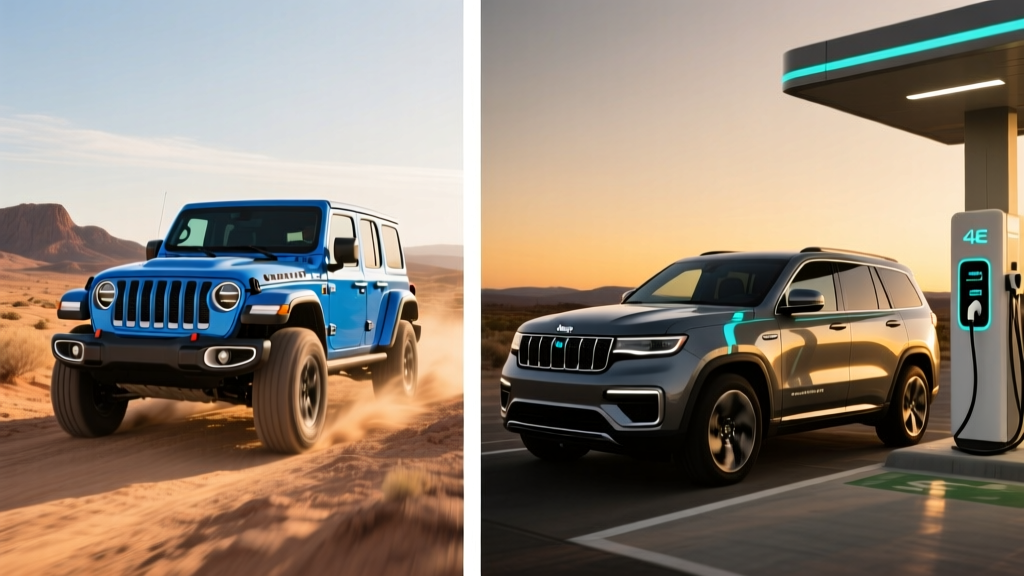
If you've been asking does Jeep have a hybrid, the answer is yes — but with an important distinction. As of the 2026 model year, Jeep's electrified lineup consists entirely of plug-in hybrids (PHEVs) branded under the 4xe (four-by-e) badge. Jeep does not currently sell a conventional hybrid (HEV) that generates its own electricity without a plug. Instead, the automaker has committed to the PHEV formula: a turbocharged gas engine paired with a sizable battery and electric motor, offering a meaningful electric-only driving range before the gas engine takes over.
The two models carrying the 4xe powertrain are the Jeep Wrangler 4xe and the Jeep Grand Cherokee 4xe. Both offer 25–26 miles of electric-only range, combined outputs above 375 horsepower, and the off-road capability Jeep is known for. Below, we break down exactly what these PHEVs deliver in range, efficiency, pricing, and real-world ownership — so you can decide whether a Jeep 4xe fits your garage or whether a full EV or conventional hybrid makes more sense.
HEV vs. PHEV: What Jeep Actually Offers
Before diving into specs, it's critical to understand the difference between hybrid types, because it affects how you'll use the vehicle daily.
| Feature | Conventional Hybrid (HEV) | Plug-In Hybrid (PHEV) — Jeep 4xe |
|---|---|---|
| Plug-in charging required? | No — self-charges via regenerative braking and engine | Yes — plug in to access full electric range |
| Battery size | Small (~1–2 kWh) | Large (~17.3 kWh usable) |
| Electric-only range | Less than 1 mile at low speeds | 25–26 miles (EPA) |
| Federal tax credit eligible? | No | Up to $3,750 under §30D (subject to sourcing/income rules) |
| Gas engine | Smaller, optimized for efficiency | Full turbocharged engine for power + off-road capability |
Jeep's decision to skip the conventional hybrid and go straight to PHEV means that 4xe owners who charge at home can commute electrically most weekdays while retaining unlimited gas range for road trips and trails. If you never plug in, a 4xe still functions as a hybrid — but you'll see lower MPG than the EPA sticker suggests and miss the entire point of the larger battery.
2026 Jeep Wrangler 4xe: Range, MPG, and Powertrain
The Wrangler 4xe is the best-selling plug-in hybrid in the United States, and for good reason: it's the only PHEV you can take rock crawling. The 2026 model continues with the proven powertrain — a 2.0-liter turbocharged inline-four paired with two electric motors integrated into the eight-speed automatic transmission.
| Specification | 2026 Jeep Wrangler 4xe |
|---|---|
| Combined horsepower | 375 hp |
| Combined torque | 470 lb-ft |
| Gas engine | 2.0L turbo I-4 (270 hp / 295 lb-ft alone) |
| Battery (usable) | 17.3 kWh, NMC lithium-ion |
| EPA electric-only range | 25 miles |
| EPA combined (hybrid mode) | 20 MPG |
| EPA city / highway (hybrid) | 20 / 20 MPG |
| MPGe (electric + gas combined) | 49 MPGe |
| Total range (gas + electric) | ~370 miles |
| Level 2 charge time (0–100%) | ~2.5 hours at 7.2 kW |
| DC fast charging | Not available |
| 0–60 mph | ~6.0 seconds |
| Towing capacity | 3,500 lbs |
2026 Jeep Grand Cherokee 4xe: The Family-Friendly PHEV
If the Wrangler's solid axles and removable doors aren't your thing, the Grand Cherokee 4xe applies the same 4xe philosophy to a refined, family-oriented SUV. It shares the 2.0L turbo PHEV architecture but benefits from better aerodynamics, a more comfortable ride, and a quieter cabin.
| Specification | 2026 Jeep Grand Cherokee 4xe |
|---|---|
| Combined horsepower | 375 hp |
| Combined torque | 470 lb-ft |
| Gas engine | 2.0L turbo I-4 |
| Battery (usable) | 17.3 kWh, NMC lithium-ion |
| EPA electric-only range | 26 miles |
| EPA combined (hybrid mode) | 23 MPG |
| EPA city / highway (hybrid) | 23 / 24 MPG |
| MPGe (electric + gas combined) | 56 MPGe |
| Total range (gas + electric) | ~440 miles |
| Level 2 charge time (0–100%) | ~2.5 hours at 7.2 kW |
| DC fast charging | Not available |
| 0–60 mph | ~6.0 seconds |
| Towing capacity | 6,000 lbs (class-leading for PHEV SUVs) |
The Grand Cherokee 4xe's extra mile of electric range and 3 MPG advantage in hybrid mode come down to its sleeker shape and more car-like unibody construction. For a daily commute under 25 miles each way, Grand Cherokee 4xe owners who charge nightly can go weeks without visiting a gas station.
Fuel Economy: EPA MPG vs. Real-World Results
Hybrid and PHEV fuel economy is notoriously dependent on driving habits and charging frequency. Here's what to actually expect from the Jeep 4xe lineup.
| Scenario | Wrangler 4xe | Grand Cherokee 4xe |
|---|---|---|
| EPA combined (hybrid mode, battery depleted) | 20 MPG | 23 MPG |
| Real-world highway, 70 mph, battery depleted | 18–19 MPG | 21–22 MPG |
| Real-world city, mild weather, battery depleted | 20–21 MPG | 24–25 MPG |
| Electric-only commute (daily charging) | 0 gas used (up to 25 mi) | 0 gas used (up to 26 mi) |
| Cold weather (below 30°F), battery depleted | 16–18 MPG | 19–21 MPG |
According to data from fueleconomy.gov, the Wrangler 4xe's 20 MPG combined in hybrid mode is below average for PHEVs — a direct consequence of its brick-like aerodynamics and off-road hardware. The Grand Cherokee 4xe performs better but still trails PHEV competitors like the Toyota RAV4 Prime (38 MPG hybrid mode). The trade-off is capability: neither the RAV4 Prime nor any competing PHEV can match the Wrangler's trail rating or the Grand Cherokee's 6,000-lb tow rating.
Charging the Jeep 4xe: Home and Public Options
Both 4xe models use a standard J1772 connector for Level 1 (120V) and Level 2 (240V) AC charging. Neither supports DC fast charging — a limitation that matters if you were hoping to top up on road trips.
| Charging Level | Power | Time (0–100%) | Range Added per Hour |
|---|---|---|---|
| Level 1 (120V household outlet) | ~1.4 kW | ~12–14 hours | ~2 miles |
| Level 2 (240V home/public) | 7.2 kW | ~2.5 hours | ~10 miles |
| DC Fast Charge | N/A — not supported | N/A | N/A |
Home charging reality: Most 4xe owners install a Level 2 home charger (240V, 32–40 amp circuit). A full charge takes about 2.5 hours, meaning you can easily recharge during the workday if you have a garage outlet or overnight on a standard Level 2 unit. Expect to spend $500–$1,200 on a quality Level 2 charger and $600–$2,000 on electrician installation, depending on whether your panel needs an upgrade. Always consult a licensed electrician for final specifications.
Level 1 charging from a standard 120V outlet technically works but adds only about 2 miles of range per hour. For a 25-mile battery, that's a 12+ hour session — usable only if your daily commute is very short and you can leave the vehicle plugged in around the clock.
Pricing, Trims, and Federal Tax Credit Eligibility
Jeep 4xe models carry a premium over their gas-only counterparts, but available incentives can narrow the gap significantly.
| Model & Trim | 2026 MSRP (approx.) | Federal §30D Credit | Effective Price After Credit |
|---|---|---|---|
| Wrangler 4xe Sport S | $51,790 | Up to $3,750 | ~$48,040 |
| Wrangler 4xe Willys | $54,790 | Up to $3,750 | ~$51,040 |
| Wrangler 4xe Rubicon | $59,790 | Up to $3,750 | ~$56,040 |
| Grand Cherokee 4xe Base | $62,090 | Up to $3,750 | ~$58,340 |
| Grand Cherokee 4xe Overland | $69,090 | Up to $3,750 | ~$65,340 |
- Credit amount: Up to $3,750 for qualifying PHEVs (partial credit based on battery component and critical mineral sourcing requirements).
- MSRP cap: SUVs must be under $80,000 — all 4xe trims qualify.
- Income cap: Modified AGI must not exceed $150,000 (single), $225,000 (head of household), or $300,000 (joint).
- Battery sourcing: Vehicles must meet critical mineral and battery component requirements per IRS guidelines. Sourcing rules tighten annually — confirm eligibility at purchase.
- Point-of-sale transfer: You can transfer the credit to the dealer at purchase for an immediate price reduction rather than waiting for tax filing.
Always verify current eligibility with your tax professional and the IRS before purchasing. Rules and qualifying vehicle lists change regularly.
Reliability, Battery Warranty, and Replacement Costs
Battery longevity is the number one concern for hybrid and PHEV buyers. Here's what Jeep provides and what to expect long-term.
- Coverage: 8 years / 100,000 miles (whichever comes first)
- Capacity threshold: Warranty covers battery if capacity drops below 70% of original
- What's covered: Battery pack, power electronics, electric motor, and associated high-voltage components
- Transferable: Yes, warranty transfers to subsequent owners
The 17.3 kWh NMC battery pack in the 4xe is liquid-cooled, which helps mitigate degradation compared to passively cooled packs. Based on data from early 2021–2022 Wrangler 4xe models now accumulating 80,000+ miles, most owners report minimal capacity loss — typically 5–8% after three to four years of regular use. The thermal management system and the fact that the battery is never fully depleted (a buffer of roughly 15% is reserved at the bottom) contribute to long-term health.
Replacement cost: If the battery does need replacement outside warranty, expect a dealer quote in the $8,000–$12,000 range for the pack plus labor. Third-party hybrid battery rebuilders are beginning to offer cell-level repairs for $3,000–$5,000, though availability for the 4xe platform is still maturing as these vehicles age.
Overall reliability of the 4xe powertrain has been mixed. While the electric components have proven durable, some owners have reported issues with the 2.0L turbo engine (a carryover concern from earlier FCA/Stellantis applications) and software glitches in the powertrain control module. Jeep has addressed many of these through recalls and TSBs. Check NHTSA recall listings for specific model-year campaigns before buying used.
Who Should Buy a Jeep 4xe — and Who Shouldn't
- You need genuine off-road capability (Wrangler) or 6,000-lb towing (Grand Cherokee) and want some electric driving.
- Your daily commute is under 25 miles round-trip and you can charge at home.
- You want to reduce fuel consumption without committing to a full EV's range limitations on remote trips.
- You value the instant torque of the electric motor for low-speed trail crawling (the Wrangler 4xe is notably smoother on rocks than the gas version).
- You want zero tailpipe emissions and don't need off-road or heavy-towing capability.
- Your commute is longer than 25 miles — a BEV like the Hyundai Ioniq 5 (310+ mile range) eliminates gas entirely.
- You want lower maintenance costs (no oil changes, no turbo engine, fewer moving parts).
- You want access to the full $7,500 federal tax credit (many BEVs qualify for more than the 4xe's $3,750).
- You cannot charge at home or at work — a PHEV driven without charging is just a heavy, less-efficient hybrid.
- You want maximum MPG without behavioral changes (a Toyota RAV4 Hybrid delivers 39 MPG combined with no plug).
- Your budget is tighter — conventional hybrids cost $5,000–$10,000 less than 4xe models.
Jeep 4xe Pros
- 25–26 miles of real electric-only range covers most commutes
- 375 hp / 470 lb-ft — more torque than V-8 gas Wranglers
- Best-in-class off-road PHEV (Wrangler) and tow rating (Grand Cherokee)
- Eligible for up to $3,750 federal tax credit + point-of-sale transfer
- No range anxiety — gas engine provides unlimited range for road trips
- Liquid-cooled battery with 8yr/100k warranty
Jeep 4xe Cons
- Low hybrid-mode MPG (20–23) once battery depletes — worse than most competitors
- No DC fast charging — road-trip top-ups require Level 2 patience
- $5,000–$8,000 premium over equivalent gas-only trims
- Heavy curb weight (5,400–5,500 lbs) hurts efficiency and tire wear
- Only partial $3,750 tax credit (not the full $7,500 available to some BEVs)
- Some model-year reliability concerns with 2.0L turbo and software
Frequently Asked Questions
Does Jeep make a regular hybrid that doesn't need to be plugged in?
No. As of 2026, Jeep only offers plug-in hybrids (PHEVs) under the 4xe badge. The Wrangler 4xe and Grand Cherokee 4xe both require plugging in to access their full electric-only range. If you drive them without ever charging, they function as hybrids but deliver lower MPG than dedicated HEVs due to the extra battery weight.
How many MPG does the Jeep 4xe get?
In hybrid mode (battery depleted), the Wrangler 4xe gets 20 MPG combined (20 city / 20 highway) and the Grand Cherokee 4xe gets 23 MPG combined (23 city / 24 highway). When factoring in electric-only driving, the MPGe ratings are 49 MPGe (Wrangler) and 56 MPGe (Grand Cherokee). Real-world results vary significantly based on charging frequency — owners who charge daily and commute under 25 miles may use very little gasoline at all.
How far can the Jeep 4xe go on electric only?
The EPA rates the Wrangler 4xe at 25 miles and the Grand Cherokee 4xe at 26 miles of electric-only range. In real-world conditions, expect 20–23 miles at highway speeds or in cold weather, and up to 27–28 miles in gentle city driving with regenerative braking maximized.
Is the Jeep 4xe reliable, and what does a battery replacement cost?
The 4xe electric powertrain components (motor, inverter, battery) have proven generally reliable, with most high-mileage owners reporting 5–8% battery degradation after 3–4 years. The battery is covered by an 8-year/100,000-mile warranty down to 70% capacity. Out-of-warranty battery replacement costs approximately $8,000–$12,000 at a dealer. Some model years have had software and 2.0L turbo engine recalls — check NHTSA before buying.
Does the Jeep 4xe qualify for a tax credit?
Yes, the Jeep 4xe models qualify for a partial federal tax credit of up to $3,750 under IRS §30D, subject to buyer income limits ($150K single / $300K joint), MSRP caps (under $80K for SUVs — all trims qualify), and battery critical-mineral sourcing requirements that tighten each year. The credit can be transferred to the dealer at point of sale for an immediate price reduction. Verify current eligibility on the IRS clean vehicle credits page and with your tax professional before purchasing.
Can I charge the Jeep 4xe at a public fast charger?
No. The Jeep 4xe does not support DC fast charging. You can use public Level 2 chargers (J1772 connector) at up to 7.2 kW, which fully recharges the battery in about 2.5 hours. For faster top-ups on road trips, you're limited to the gas engine.
Hybrid vs. PHEV vs. EV — which should I choose?
If you can charge at home and commute under 25 miles, the Jeep 4xe PHEV gives you electric weekday driving plus gas flexibility for weekends. If you can't charge at home, a conventional hybrid like the Toyota RAV4 Hybrid delivers better MPG without any plug. If you want zero emissions, lower maintenance, and a larger tax credit, a full EV like the Tesla Model Y or Hyundai Ioniq 5 is the better path — but you'll sacrifice the off-road and heavy-towing capabilities that define the Jeep brand.