Short Answer: Yes, Chevy Makes Several Hybrids in 2026
If you've been asking "does Chevy make a hybrid?" the answer is yes — and the lineup has expanded significantly for the 2026 model year. Chevrolet currently offers three distinct hybrid vehicles spanning a compact SUV, a midsize sedan, and a performance sports car. What Chevy does not offer in 2026 is a plug-in hybrid (PHEV). Every Chevy hybrid on sale today is a conventional hybrid (HEV), meaning the battery recharges through regenerative braking and the gasoline engine — no plug-in required.
That distinction matters enormously for buyers. A conventional hybrid like the 2026 Chevy Equinox Hybrid delivers strong fuel economy without any change to your fueling routine. A PHEV, by contrast, offers 25–40 miles of electric-only driving but requires home charging access to realize its benefits. Chevy's current strategy leans on conventional hybrids for mainstream models while reserving full battery-electric vehicles (BEVs) like the Equinox EV and Blazer EV for buyers ready to plug in full-time.
HEV vs. PHEV — What's the Difference?
| Feature | Conventional Hybrid (HEV) | Plug-in Hybrid (PHEV) |
|---|---|---|
| Plug-in charging? | No — self-charging via regen + engine | Yes — plug in for electric-only miles |
| Battery size | 1.0–2.0 kWh (small) | 13–25 kWh (large) |
| Electric-only range | None (motor assists engine only) | 25–45 miles typical |
| Federal tax credit (§30D) | No | Up to $7,500 (if eligible) |
| Home charger needed? | No | Recommended for full benefit |
| Example (Chevy) | 2026 Equinox Hybrid | None currently (Volt discontinued 2019) |
2026 Chevy Equinox Hybrid: The Volume Player
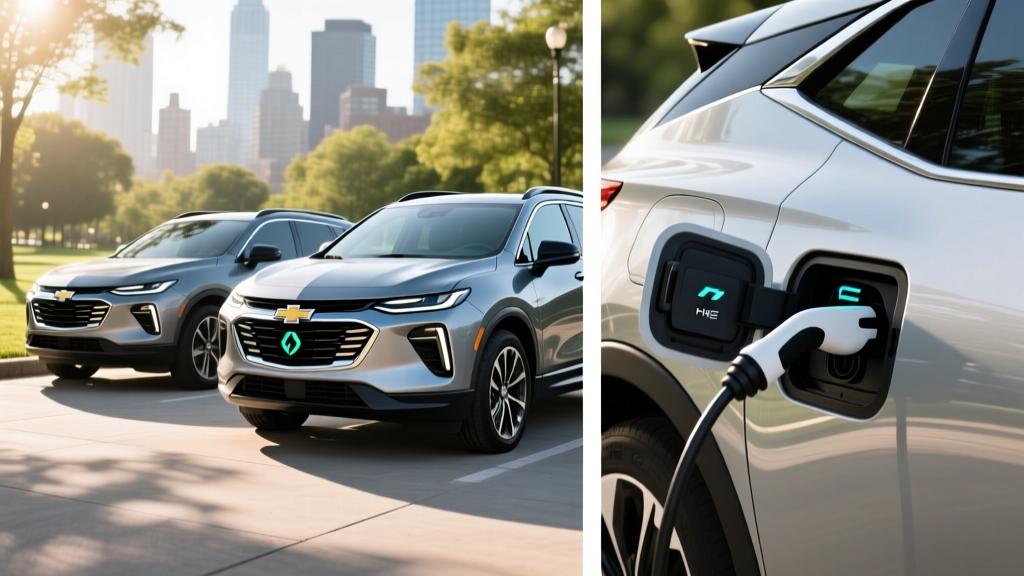
The 2026 Chevrolet Equinox Hybrid is the model most shoppers land on when researching Chevy hybrids. It pairs a turbocharged 1.5-liter four-cylinder engine with two electric motors and a small lithium-ion battery pack, producing a combined 192 horsepower. Power is routed through a continuously variable transmission (CVT) to either the front wheels or all four, depending on trim.
| Spec | Value |
|---|---|
| Powertrain | 1.5L turbo I4 + 2 electric motors |
| Combined HP | 192 hp |
| Transmission | CVT |
| Drivetrain | FWD standard, AWD available |
| Battery | ~1.8 kWh lithium-ion (self-charging) |
| EPA MPG (FWD) | 38 city / 39 hwy / 38 combined |
| EPA MPG (AWD) | 36 city / 37 hwy / 36 combined |
| Starting MSRP | ~$31,900 (LT trim) |
| Federal Tax Credit | Not eligible (§30D requires plug-in) |
How Many MPG Does the Equinox Hybrid Get?
The EPA rates the front-wheel-drive Equinox Hybrid at 38 MPG combined (38 city / 39 highway). The all-wheel-drive version drops slightly to 36 combined. For context, the gas-only 2026 Equinox with the same 1.5L turbo achieves 28 MPG combined — a roughly 10 MPG improvement with the hybrid system.
| Model | City | Highway | Combined |
|---|---|---|---|
| Equinox Hybrid FWD | 38 MPG | 39 MPG | 38 MPG |
| Equinox Hybrid AWD | 36 MPG | 37 MPG | 36 MPG |
| Equinox Gas 1.5T FWD | 26 MPG | 31 MPG | 28 MPG |
Real-world note: Conventional hybrids like the Equinox Hybrid tend to meet or slightly exceed their EPA city rating in stop-and-go traffic, where regenerative braking recaptures the most energy. Highway fuel economy, however, can dip 2–4 MPG below the sticker at sustained 75–80 mph speeds, especially with roof cargo or in cold weather. Expect roughly 34–36 MPG combined in mixed real-world driving with the FWD model, per aggregated owner reports on fueleconomy.gov.
2026 Chevy Malibu Hybrid: The Sedan Option
Chevy continues the Malibu Hybrid into 2026, catering to sedan buyers who want hybrid efficiency without an SUV footprint. The Malibu Hybrid uses a 1.5-liter turbo four-cylinder paired with a mild-hybrid electric assist system producing 175 combined horsepower.
The EPA rates the 2026 Malibu Hybrid at 44 city / 43 highway / 44 combined MPG — competitive with the Toyota Camry Hybrid and Honda Accord Hybrid. Real-world city driving often yields 45+ MPG thanks to aggressive regenerative braking in traffic. Highway cruising at 70 mph typically returns 40–42 MPG.
Pricing starts around $29,500 for the base LT Hybrid trim. Like all Chevy conventional hybrids, the Malibu Hybrid does not qualify for the federal §30D EV tax credit, which is reserved for plug-in vehicles meeting battery-sourcing and MSRP-cap requirements per the IRS.
2026 Corvette E-Ray: The Performance Hybrid
The 2026 Chevrolet Corvette E-Ray is Chevy's halo hybrid — and it's nothing like the efficiency-focused Equinox or Malibu. The E-Ray pairs the Corvette Stingray's 6.2-liter V8 (495 hp) with a front-axle electric motor (160 hp) for a combined 655 horsepower and standard all-wheel drive. It sprints to 60 mph in an estimated 2.5 seconds.
The E-Ray's hybrid system is performance-oriented, not efficiency-oriented. EPA fuel economy lands around 19 combined MPG — better than a base Stingray's 18 MPG but hardly the point. The small battery pack (approximately 1.9 kWh) provides brief electric-only creeping at low speeds for silent neighborhood starts, but this is measured in blocks, not miles.
MSRP starts at approximately $106,000 for the 1LZ coupe. No federal tax credit applies.
Does Chevy Make a Plug-in Hybrid (PHEV)?
Not in 2026. Chevrolet discontinued the Volt PHEV after the 2019 model year and has not introduced a replacement. GM's electrification strategy channels plug-in buyers toward full BEVs like the Equinox EV (319 miles EPA range) and Blazer EV rather than PHEVs. If you specifically want electric-only commuting miles with a gas-engine backup from a Chevy, you'll need to look at the used Volt market or cross-shop competitors like the Toyota RAV4 Prime (42 miles electric-only), Hyundai Tucson PHEV (33 miles), or Jeep Wrangler 4xe (22 miles).
This is a notable gap in Chevy's lineup. PHEVs appeal to buyers who want EV-like daily commuting (30–40 miles electric) with road-trip flexibility. The absence of a Chevy PHEV means buyers in this segment must look elsewhere or choose between a conventional hybrid (no plug) and a full BEV (no gas).
Hybrid vs. PHEV vs. Full EV: Which Fits You?
Decision Framework
Choose a Chevy Hybrid (HEV) if:
- You cannot install a home charger (apartment, street parking, no garage)
- You want better fuel economy with zero routine changes — just fill up with gas
- Your budget is under $35,000 and you want a new vehicle
- You drive 12,000–15,000 miles/year and want to cut fuel costs 25–35%
Choose a PHEV (non-Chevy) if:
- You have home Level 2 charging and a commute under 40 miles round-trip
- You want electric-only daily driving but need gas flexibility for longer trips
- You can benefit from the up-to-$7,500 federal §30D tax credit (income, MSRP, and sourcing rules apply)
Choose a full BEV (e.g., Chevy Equinox EV) if:
- You have reliable home charging and your daily driving is under 250 miles
- You want zero tailpipe emissions and minimal maintenance (no oil changes, fewer moving parts)
- You're eligible for the federal tax credit, which can bring the Equinox EV's effective price close to the hybrid's
Battery Warranty and Reliability: What to Expect
Chevy Hybrid Battery Warranty
Chevrolet covers the hybrid battery and related powertrain components for 8 years or 100,000 miles (whichever comes first) on the Equinox Hybrid and Malibu Hybrid. In states that follow California Air Resources Board (CARB) emissions standards — including California, New York, Massachusetts, and several others — the hybrid battery warranty extends to 10 years or 150,000 miles.
This is consistent with the industry standard. Toyota, Honda, and Hyundai offer similar 8–10 year hybrid battery coverage.
Is the Chevy Equinox Hybrid Reliable?
Chevrolet's hybrid system in the Equinox and Malibu uses a well-proven parallel-hybrid architecture that GM has refined over more than a decade. The 1.5L turbo engine is shared with the gas-only models and has a strong track record. The electric motors and CVT are relatively simple components with fewer wear items than a traditional automatic transmission.
Hybrid battery replacement cost, should it be needed outside warranty, typically ranges from $2,000 to $4,000 for a conventional hybrid's small pack — far less than a full EV battery replacement. However, with the 8–10 year warranty and the proven longevity of modern lithium-ion hybrid batteries, most owners never face this expense. Data from long-term hybrid owners suggests conventional hybrid batteries routinely last 150,000–200,000+ miles before significant degradation, per aggregated reliability surveys.
For crash-test ratings and safety data, check the NHTSA and IIHS listings for the specific model year.
Tax Credit Eligibility: What Chevy Hybrids Qualify For
Here's the bottom line: no conventional Chevy hybrid qualifies for the federal §30D clean vehicle tax credit. The §30D credit (up to $7,500) applies exclusively to plug-in electric vehicles — BEVs and PHEVs — that meet battery-component sourcing, critical-mineral, MSRP cap, and buyer income requirements. Since Chevy's hybrids have no plug and battery packs under 2 kWh, they are ineligible.
However, there are indirect financial benefits:
- Lower fuel costs: At 38 MPG combined vs. 28 MPG for the gas Equinox, a driver covering 15,000 miles/year at $3.50/gallon saves approximately $500–$600 annually with the hybrid.
- State incentives: A handful of states offer rebates or HOV-lane access for hybrids, though most have shifted incentives to plug-in vehicles. Check your state's energy office for current programs.
- Lower total cost of ownership: The hybrid's premium over the gas model (typically $1,500–$2,500) is often recouped within 3–4 years through fuel savings alone.
If the federal tax credit is a priority for you, consider the 2026 Chevy Equinox EV, which starts around $33,000 and may qualify for the full $7,500 credit depending on your income, the vehicle's MSRP, and current battery-sourcing rules. Always verify eligibility against the latest IRS §30D guidance before purchasing.
Pros and Cons: Chevy's Hybrid Lineup
✅ Pros
- No plug-in required — zero change to fueling routine
- 36–44 MPG combined depending on model (25–35% better than gas equivalents)
- 8–10 year / 100,000–150,000 mile hybrid battery warranty
- Lower purchase price than comparable PHEVs or BEVs
- Proven, simple hybrid architecture with strong reliability outlook
- AWD available on Equinox Hybrid for snow-belt buyers
❌ Cons
- No Chevy PHEV option — can't get electric-only commuting from a new Chevy
- No federal tax credit eligibility for conventional hybrids
- Real-world highway MPG can fall 2–4 MPG below EPA sticker
- Hybrid premium over gas models adds $1,500–$2,500 to purchase price
- Corvette E-Ray hybrid is performance-only, not efficiency-focused
- CVT driving feel may not suit buyers who prefer stepped automatics
Frequently Asked Questions
How many MPG does the Chevy Equinox Hybrid get?
The 2026 Equinox Hybrid FWD is EPA-rated at 38 city / 39 highway / 38 combined MPG. The AWD version rates 36/37/36. In real-world mixed driving, expect 34–36 MPG combined, with city driving sometimes exceeding the EPA estimate and sustained highway cruising falling slightly short.
Does Chevy make a plug-in hybrid in 2026?
No. Chevrolet does not currently sell a plug-in hybrid. The Chevy Volt PHEV was discontinued after 2019. GM directs plug-in buyers to full electric vehicles like the Equinox EV and Blazer EV. If you need a PHEV, competitors like the Toyota RAV4 Prime and Hyundai Tucson PHEV fill this segment.
Is the Chevy hybrid battery expensive to replace?
Out-of-warranty replacement for a Chevy conventional hybrid battery typically costs $2,000–$4,000. However, the battery is covered by an 8-year/100,000-mile warranty (10 years/150,000 miles in CARB states), and modern hybrid batteries commonly last 150,000–200,000+ miles. Most owners never replace the hybrid battery.
Does the Chevy Equinox Hybrid qualify for a tax credit?
No. The federal §30D clean vehicle credit (up to $7,500) applies only to plug-in vehicles — BEVs and PHEVs. Since the Equinox Hybrid is a conventional (non-plug-in) hybrid, it is ineligible. Some states may offer minor hybrid incentives; check your state energy office. The Equinox EV may qualify for the federal credit depending on income, MSRP, and sourcing rules.
Hybrid vs. full EV — should I get the Equinox Hybrid or Equinox EV?
Choose the Equinox Hybrid if you lack home charging, drive long highway routes frequently, or want a lower purchase price (~$32K). Choose the Equinox EV (~$33K before credit) if you have home charging, want the lowest operating costs, and may qualify for the $7,500 federal credit. The EV's effective post-credit price can be lower than the hybrid's, but only if you meet all §30D eligibility requirements.
Can I tow with the Chevy Equinox Hybrid?
The 2026 Equinox Hybrid has a maximum towing capacity of approximately 1,500 pounds when properly equipped — suitable for a small utility trailer or a pair of dirt bikes, but not a boat or camper. If you need more towing capacity, the gas-only Equinox rates up to 1,500 pounds as well; for serious towing, look at the Chevy Blazer or Traverse.