Quick Verdict: The Dodge Hornet R/T Plug-In Hybrid at a Glance
The Dodge Hornet hybrid is a plug-in hybrid electric (PHEV) compact crossover that pairs a turbocharged gasoline engine with an electric motor and a 15.5 kWh battery pack. Sold under the R/T trim, it delivers 288 combined horsepower, an EPA-estimated 32 miles of electric-only range, and the ability to drive purely on electricity for daily commutes before the gas engine seamlessly takes over for longer trips. For 2026, the Hornet R/T remains Dodge's sole electrified offering in the U.S. market — a bridge between the brand's performance heritage and the practical realities of buyers who aren't ready to commit to a full battery-electric vehicle.
If you're searching for a dodge hornet hybrid, here's the essential context: this is a PHEV, not a conventional self-charging hybrid (HEV). You can plug it in to maximize electric driving, but you never have to — the gas engine covers you fully when the battery depletes. That dual capability is the core appeal, and it's what separates this vehicle from both the gas-only Hornet GT and full EVs like the Hyundai Ioniq 5 or Tesla Model Y.
HEV vs. PHEV: What the Hornet Actually Is
Before digging into specs, it's critical to clarify the distinction because buyers frequently confuse these two electrified powertrain types:
| Feature | Conventional Hybrid (HEV) | Plug-In Hybrid (PHEV) — Hornet R/T |
|---|---|---|
| Battery size | 1–2 kWh (small) | 15.5 kWh (large) |
| Electric-only range | 0.5–2 miles at low speed | 32 miles EPA est. |
| Plug-in charging | No — charges via regen and engine | Yes — Level 1 or Level 2 |
| Gas-only driving | Yes, always blended | Yes, after battery depletes |
| Federal tax credit | No | Potentially up to $3,750 (§30D) |
| Best for | Drivers who never want to plug in | Drivers with home charging who want electric commutes + gas flexibility |
The Dodge Hornet R/T is firmly in the PHEV column. There is no conventional HEV version of the Hornet sold in the United States. If you want a Dodge-branded vehicle that doesn't plug in, the gas-only Hornet GT with its 2.0L turbo four-cylinder is the alternative — but it offers no electric-only capability.
Powertrain Specs: Engine, Motor, and Combined Output
| Specification | 2026 Dodge Hornet R/T PHEV |
|---|---|
| Engine | 1.3L turbocharged 4-cylinder |
| Engine output | 180 hp / 199 lb-ft torque |
| Electric motor | Rear-axle mounted, 121 hp |
| Combined system output | 288 hp / 383 lb-ft torque |
| Transmission | 6-speed automatic (front axle) |
| Drivetrain | AWD (eAWD — engine drives front, motor drives rear) |
| 0–60 mph | 5.6 seconds (manufacturer est.) |
| Battery capacity | 15.5 kWh (lithium-ion, NMC chemistry) |
| Battery location | Under rear seat / cargo floor |
| Towing capacity | Not rated for towing |
The powertrain architecture is borrowed from the Stellantis parts bin — specifically shared with the Alfa Romeo Tonale PHEV, which rides on the same platform. The front axle is driven by the 1.3L turbo engine through a conventional automatic transmission, while the rear axle is powered exclusively by the electric motor. This "eAWD" setup means all-wheel drive is available whenever battery charge permits, and it delivers genuinely quick acceleration for a compact crossover. The 5.6-second 0–60 time puts it ahead of most competitors in the segment, including the Toyota RAV4 Prime (5.7 sec) and well ahead of the Ford Escape PHEV (which is FWD-only).
EPA Fuel Economy and Electric-Only Range
This is where PHEV ownership either pays off or disappoints, depending entirely on your driving habits and charging access.
| Driving Mode | EPA Estimate |
|---|---|
| Electric-only range | 32 miles |
| Charge-depleting MPGe (combined) | 77 MPGe |
| Gas-only (charge-sustaining) — City | 29 MPG |
| Gas-only (charge-sustaining) — Highway | 28 MPG |
| Gas-only (charge-sustaining) — Combined | 29 MPG |
| Total combined range (electric + gas) | ~370 miles |
| Fuel tank capacity | 11.2 gallons |
Real-world expectations: The 32-mile electric range is achievable in mild weather (55–75°F) with moderate city and suburban driving. In cold weather (below 30°F), expect that to drop to roughly 22–26 miles due to cabin heating demands and reduced battery efficiency. Highway driving at 70+ mph will also reduce electric range to approximately 25–28 miles. When the battery depletes and the gas engine takes over, the 29 MPG combined figure is reasonable — EPA data on fueleconomy.gov confirms this rating. In city driving with frequent regenerative braking opportunities, some owners report 31–33 MPG on gas alone, slightly exceeding the EPA city estimate.
The critical insight for PHEV economics: if your daily round-trip commute is under 30 miles and you charge at home every night, you may use gasoline only on weekend road trips. Several Hornet R/T owners report going 1,500–2,000 miles between fill-ups under these conditions. If you never plug in, however, you're essentially driving a 29 MPG compact crossover — respectable, but not dramatically better than the gas-only Hornet GT (which gets 24 MPG combined) to justify the PHEV premium on fuel savings alone.
Battery Charging: Speeds, Times, and Home Setup
The Hornet R/T's 15.5 kWh battery can be replenished through three methods:
| Charging Method | Power | 0–100% Time | Notes |
|---|---|---|---|
| Level 1 (120V household outlet) | ~1.4 kW | ~11 hours | Works for overnight; slow for daily use |
| Level 2 (240V home/public charger) | ~7.4 kW (onboard charger max) | ~2.5 hours | Recommended for daily PHEV use |
| DC fast charging | Not supported | N/A | No CCS or NACS port for DC charging |
| Regenerative braking | Variable | Partial recovery | Recaptures energy during deceleration |
No DC fast charging: This is a notable limitation. The Hornet R/T can only accept AC charging through its J1772 port. You cannot use Electrify America, Tesla Supercharger, or any DC fast-charging network to replenish the battery. For a 15.5 kWh pack, this is less of a practical problem than it would be for a full EV — the battery is small enough that a Level 2 charger refills it in roughly 2.5 hours. But on a road trip, once the electric range is depleted, you're running on gas until you find an overnight Level 2 stop.
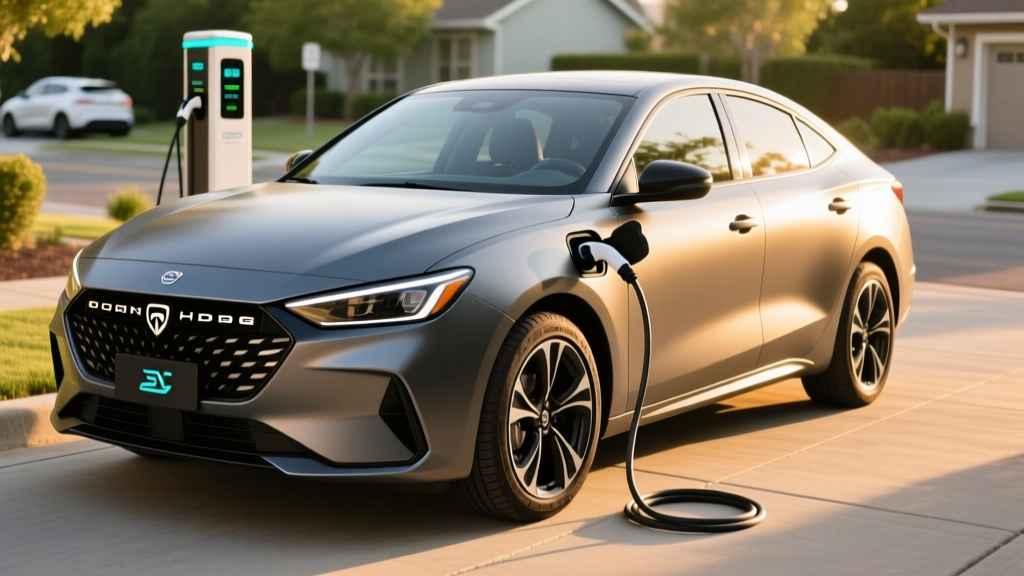
Home charging recommendation: Most PHEV owners install a Level 2 home charger (240V, 32–48 amp circuit) to wake up to a full battery every morning. A quality Level 2 unit like the ChargePoint Home Flex or Emporia Vue costs $400–$700 for the equipment. Professional installation by a licensed electrician typically runs $500–$1,500 depending on your panel capacity and the distance from your electrical panel to the garage or driveway. If your home has a 200-amp electrical panel with spare capacity, expect total Level 2 setup costs between $900–$2,200. Older homes with 100-amp panels may need a panel upgrade ($1,500–$3,000 additional) before adding a dedicated EV circuit.
Pricing, Trims, and Federal Tax Credit Eligibility
The 2026 Dodge Hornet R/T PHEV is available in two primary configurations:
| Trim | Base MSRP | Key Features |
|---|---|---|
| R/T | ~$41,500 | PHEV powertrain, 18" wheels, 10.25" infotainment, heated front seats, wireless CarPlay/Android Auto |
| R/T Plus | ~$46,000 | Adds leather seats, panoramic sunroof, Harman Kardon audio, hands-free power liftgate, ADAS suite |
Federal tax credit (§30D): Under current IRS rules, the Hornet R/T PHEV may qualify for a partial federal tax credit of up to $3,750, not the full $7,500. The credit amount depends on whether the vehicle's battery meets critical mineral and battery component sourcing requirements set by the Inflation Reduction Act. As of the 2026 tax year, the Hornet R/T's battery sourcing has historically met the critical minerals threshold ($3,750) but not the battery component manufacturing threshold (additional $3,750), resulting in the partial credit.
However, eligibility is not automatic. You must also meet these requirements:
- Income caps: Modified AGI must not exceed $150,000 (single), $225,000 (head of household), or $300,000 (married filing jointly)
- MSRP cap: The vehicle's MSRP must not exceed $80,000 for SUVs/crossovers (the Hornet clears this easily)
- Point-of-sale transfer: As of 2024+, you can transfer the credit to the dealer at purchase for an immediate price reduction, or claim it on your federal tax return
- Final assembly: Vehicle must undergo final assembly in North America (the Hornet is assembled in Italy — this has been a complicating factor for Stellantis PHEVs; verify current eligibility at fueleconomy.gov before purchasing)
Important tax credit caveat: The Hornet R/T's Italian assembly location has historically raised questions about §30D eligibility, which requires North American final assembly. Stellantis has made production adjustments for certain models, but you should verify the current VIN-eligibility status at the IRS qualified vehicles list before signing a purchase agreement. Tax rules change — consult a tax professional for your specific situation.
Some states offer additional rebates or HOV lane access for PHEVs. California's Clean Vehicle Rebate Project (CVRP), Colorado's state tax credit, and New York's Drive Clean Rebate are examples, but amounts and eligibility vary by jurisdiction and change frequently. Check your state's energy or environmental agency website for current programs.
Battery Warranty, Reliability, and Replacement Costs
| Coverage | Term |
|---|---|
| Hybrid/EV battery warranty | 8 years / 100,000 miles (whichever comes first) |
| Powertrain warranty | 5 years / 60,000 miles |
| Bumper-to-bumper warranty | 3 years / 36,000 miles |
| Battery capacity retention threshold | Typically 60–70% of original capacity during warranty period |
The 8-year/100,000-mile battery warranty is standard for PHEVs and is actually mandated by the EPA for emissions-related components in California Air Resources Board (CARB) states, which many manufacturers apply nationwide. This warranty covers defects and excessive capacity loss — if the battery drops below roughly 60–70% of its original 15.5 kWh capacity within the warranty window, Dodge will repair or replace it at no cost.
Real-world reliability: The 1.3L turbo engine and 6-speed automatic transmission are proven Stellantis units used across multiple global models. The eAWD system is shared with the Alfa Romeo Tonale, which has been on sale in Europe since 2022. Early reliability data from the Hornet PHEV is limited, but the underlying powertrain components have an established track record. One area to watch: the dual-clutch-style interaction between the engine and electric motor can produce occasional hesitation during the handoff from electric to gas mode, particularly under hard acceleration from low speeds. This is a characteristic of the powertrain architecture, not a defect, but it's worth experiencing on a test drive.
Battery replacement cost (out of warranty): If the 15.5 kWh battery pack requires replacement after the warranty expires, expect a dealer-installed replacement to cost between $5,000 and $8,000 including parts and labor. This is significantly less than full EV battery replacements (which can exceed $15,000–$20,000) because the PHEV pack is much smaller. Third-party hybrid battery rebuilders may offer refurbished packs for $3,000–$4,500, though availability for newer Stellantis PHEV platforms is still developing. In practice, most PHEV batteries outlast their warranty periods — data from Toyota's PHEV fleet (RAV4 Prime, Prius Prime) shows minimal degradation in the first 100,000 miles.
Who Should Buy the Hornet Hybrid — and Who Shouldn't
Pros
- Quick 5.6-second 0–60 with 288 hp — genuinely fun to drive
- 32-mile electric range covers most daily commutes
- AWD standard with eAWD system
- No range anxiety — gas engine covers long trips
- Compact size easy to park; premium interior on R/T Plus
- Partial federal tax credit may reduce effective price
Cons
- No DC fast charging capability
- 29 MPG gas-only is modest for a PHEV — RAV4 Prime gets 38 MPG
- Cargo space reduced vs. gas Hornet due to battery placement
- Starting price above $41,000 before incentives
- Italian assembly may complicate federal tax credit eligibility
- Engine/motor handoff can feel unrefined under hard acceleration
Choose the Dodge Hornet R/T PHEV if:
- You have home Level 2 charging and a commute under 30 miles round-trip
- You want AWD and quick acceleration in a compact crossover
- You need gas flexibility for frequent road trips beyond EV range
- You prefer Dodge's styling and infotainment over Toyota or Ford alternatives
- You want to reduce gas consumption without committing to a full EV
Look elsewhere if:
- You want maximum fuel economy: The Toyota RAV4 Prime delivers 38 MPG gas-only and 42 miles electric — substantially more efficient
- You need DC fast charging: No PHEV currently offers it; only full EVs do
- You want a full EV experience: The Hyundai Ioniq 5 (~$42,000, 300+ mile range, 10–80% DC charge in 18 min) is a strong alternative if you can charge at home
- Budget is tight: The gas-only Hornet GT starts around $32,000 and gets 24 MPG combined — the $9,000+ PHEV premium takes years to recoup on fuel savings alone
Frequently Asked Questions
How many MPG does the Dodge Hornet hybrid get?
The Hornet R/T PHEV gets an EPA-estimated 29 MPG combined (29 city / 28 highway) when running on gasoline after the battery is depleted. In electric mode, it achieves 77 MPGe combined. Real-world city driving with regenerative braking can push gas-only MPG to 31–33, while sustained highway driving at 75+ mph may drop it to 26–27 MPG.
How far can the Dodge Hornet go on electric only?
The EPA rates the Hornet R/T at 32 miles of electric-only range. In real-world conditions, expect 25–28 miles on the highway and 22–26 miles in cold weather (below 30°F). For city driving in mild weather, the full 30–32 miles is achievable.
Does the Dodge Hornet hybrid qualify for a tax credit?
It may qualify for a partial federal tax credit of up to $3,750 under IRS §30D, depending on battery sourcing compliance and your income level. However, the Hornet's Italian assembly location has historically complicated the North American final assembly requirement. Always verify current eligibility at fueleconomy.gov and the IRS qualified vehicles list before purchasing. State incentives may also apply depending on your jurisdiction.
Is the Dodge Hornet hybrid reliable?
The Hornet R/T uses proven Stellantis powertrain components shared with other global models including the Alfa Romeo Tonale. The 1.3L turbo engine and eAWD system have an established track record. Dodge backs the hybrid battery with an 8-year/100,000-mile warranty. Long-term reliability data specific to the Hornet is still accumulating given its recent market introduction.
What does it cost to replace the Hornet hybrid battery?
Out-of-warranty replacement of the 15.5 kWh battery pack is estimated at $5,000–$8,000 through a Dodge dealer. Third-party refurbished options may become available at $3,000–$4,500 as the platform matures. The 8-year/100,000-mile warranty covers defects and excessive capacity loss, and most PHEV batteries retain adequate capacity well beyond their warranty period.
Do I have to plug in the Dodge Hornet hybrid?
No — but you should, to get the benefit. If you never plug in, the Hornet R/T operates as a gas-powered crossover getting 29 MPG combined. The entire value proposition of a PHEV depends on regularly charging the battery to use the 32-mile electric range. Without home or workplace charging, a conventional hybrid or efficient gas car may be a better financial choice.
Hybrid vs. PHEV vs. EV — which is right for me?
A conventional hybrid (HEV) like the Toyota RAV4 Hybrid is best if you have no charging access and want better MPG without behavior change. A PHEV like the Hornet R/T is ideal if you have home charging, a short commute, and need gas flexibility for road trips. A full EV like the Ioniq 5 is the right choice if you want zero gasoline use, have reliable home charging, and your longest regular trips fall within the vehicle's range (or you're comfortable with DC fast charging on road trips).