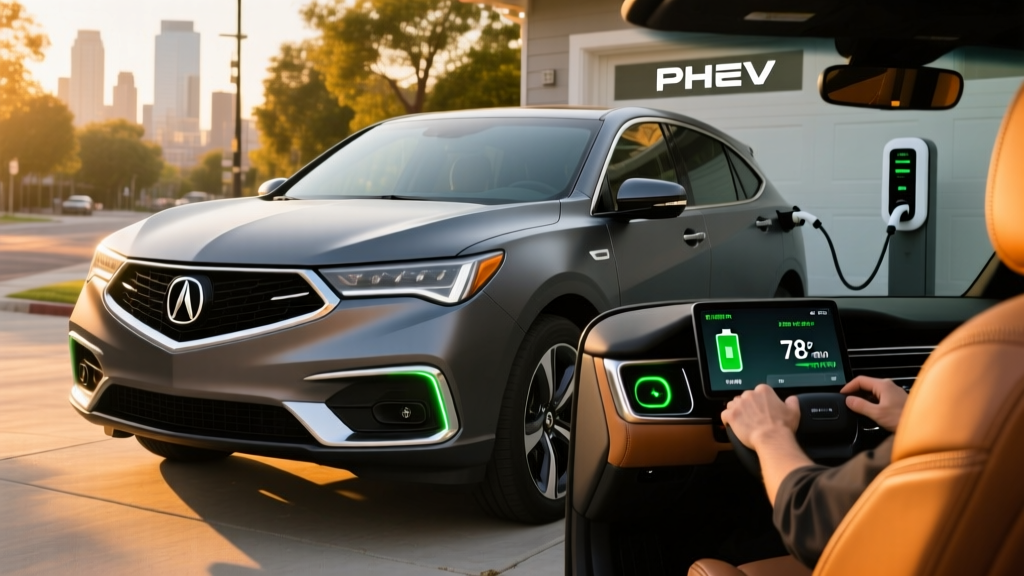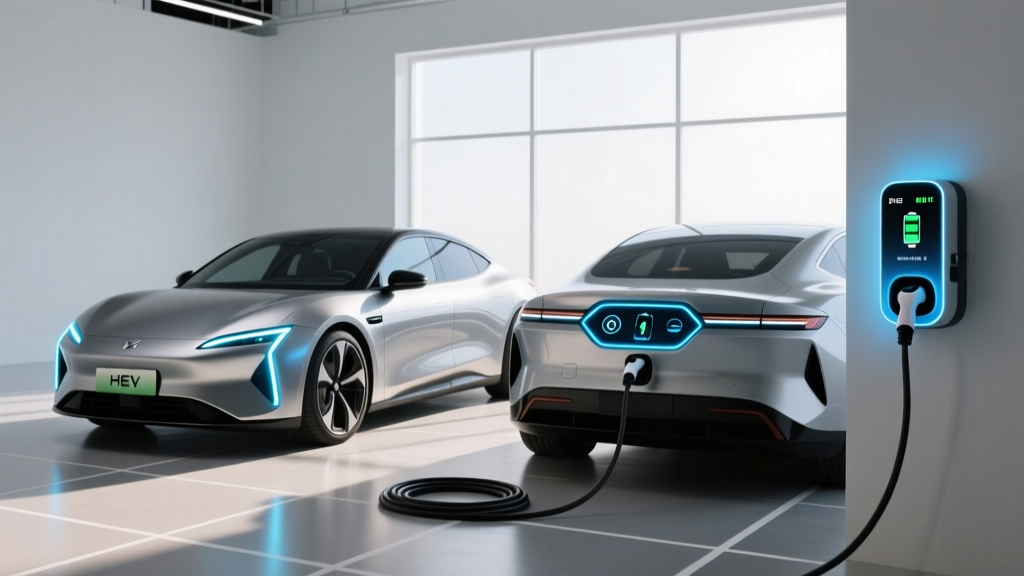
If you've shopped for a hybrid lately, you've probably noticed two very different badges on the tailgate: "Hybrid" and "Plug-In Hybrid." They sound similar, but the answer to do you plug in hybrid cars depends entirely on which type you choose. Conventional hybrids (HEVs) never see a plug. Plug-in hybrids (PHEVs) thrive on one. This guide untangles the two, with real EPA numbers, battery specs, and ownership costs so you can pick the right powertrain for your garage.
HEV vs PHEV: The Core Difference in One Sentence
A conventional hybrid (HEV) generates all its electricity internally — through regenerative braking and its gasoline engine — and never needs to be plugged in. A plug-in hybrid (PHEV) carries a much larger battery that you charge from a wall outlet or public charger, enabling 20–50 miles of pure electric driving before the gas engine takes over.
| Feature | Conventional Hybrid (HEV) | Plug-In Hybrid (PHEV) |
|---|---|---|
| Plug in to charge? | No — self-charging via regen + engine | Yes — plug in for electric-only miles |
| Battery size | 0.6 – 1.6 kWh | 11 – 25 kWh (usable) |
| Electric-only range | ~1 mile at low speed | 20 – 50 miles (EPA) |
| DC fast charging | Not applicable | Rare; most are AC Level 2 only |
| Federal tax credit (§30D) | No | Up to $7,500 (if eligible) |
| Best for | No home charging access | Home charging + short commutes |
Do You Plug In a Conventional Hybrid (HEV)?
No. A conventional hybrid like the 2026 Toyota RAV4 Hybrid or Honda CR-V Hybrid has a small battery (typically around 1.0–1.6 kWh) that is recharged exclusively by the gasoline engine and regenerative braking. You drive it exactly like a gas car — fill up at the station, never touch a charging cable. The electric motor simply assists the engine during acceleration and captures energy during braking, boosting fuel economy without any change in driver behavior.
This is the hybrid most people picture: no plug, no range anxiety, no charging apps. The trade-off is that you can't drive on electricity alone for meaningful distances. The electric motor is a helper, not a primary propulsion source.
Real-World MPG: HEVs Often Beat the EPA Sticker
One of the pleasant surprises of owning a conventional hybrid is that city MPG often exceeds the EPA estimate. Hybrids recapture braking energy in stop-and-go traffic, so the more you stop, the more efficient they become. Highway driving, where regenerative braking is minimal, typically returns lower numbers.
| 2026 Model (HEV) | City MPG | Highway MPG | Combined MPG | Real-World Note |
|---|---|---|---|---|
| Toyota RAV4 Hybrid AWD | 41 | 38 | 39 | Owners report 38–44 combined; city driving favors the high end |
| Honda CR-V Hybrid AWD | 40 | 34 | 37 | Highway-heavy commutes may dip to 33–35 MPG |
| Toyota Camry Hybrid FWD | 53 | 50 | 52 | One of the most efficient non-PHEV sedans on the market |
| Hyundai Tucson Hybrid AWD | 38 | 38 | 38 | Consistent across driving conditions per fueleconomy.gov |
Do You Plug In a Plug-In Hybrid (PHEV)?
Yes — and you should, because plugging in is how a PHEV unlocks its biggest advantage. A plug-in hybrid like the 2026 Toyota RAV4 Prime or Chrysler Pacifica Hybrid carries a substantially larger battery (11–25 kWh usable) that delivers 20–50 miles of gasoline-free driving. Once that electric range is depleted, the vehicle seamlessly transitions into conventional hybrid mode.
If you never plug in a PHEV, you're essentially driving a heavier, more expensive conventional hybrid. The engine and regenerative braking can maintain the battery at a low state of charge, but you'll miss out on the electric-only miles that justify the price premium.
PHEV Electric-Only Range and Charging Times
| 2026 PHEV Model | Battery (kWh usable) | EV Range (EPA mi) | Total Range (mi) | Level 1 (120V) Charge | Level 2 (240V) Charge | DC Fast Charge |
|---|---|---|---|---|---|---|
| Toyota RAV4 Prime | 14.9 | 42 | ~600 | ~12 hours | ~2.5 hours (6.6 kW) | No |
| Chrysler Pacifica Hybrid | 16.0 | 32 | ~520 | ~14 hours | ~2 hours (7.2 kW) | No |
| Jeep Wrangler 4xe | 17.3 | 22 | ~370 | ~12 hours | ~2 hours (7.2 kW) | No |
| Hyundai Tucson PHEV | 13.8 | 33 | ~420 | ~11 hours | ~2 hours (7.2 kW) | No |
kW vs kWh reminder: kW (kilowatts) measures charging power — how fast energy flows into the battery. kWh (kilowatt-hours) measures battery capacity — how much energy it stores. A 7.2 kW Level 2 charger filling a 14.9 kWh battery takes roughly two hours from empty.
Most PHEVs do not support DC fast charging. The battery is small enough that a Level 2 home charger refills it overnight or during a workday, which is the intended use case. A handful of newer PHEVs (like certain European models) offer DC capability at 22–50 kW, but this remains the exception.
Hybrid vs PHEV vs Full EV: Which Fits Your Life?
Choosing between an HEV, a PHEV, and a battery-electric vehicle (BEV) comes down to three questions: Can you charge at home? How far is your daily commute? And how often do you take long road trips?
Choose a conventional hybrid (HEV) if:
- You have no access to home or workplace charging
- You want maximum fuel economy with zero behavior change
- Your budget is tighter — HEVs typically cost $1,500–$3,000 less than PHEV equivalents
Choose a plug-in hybrid (PHEV) if:
- You can install a Level 2 charger at home or have workplace charging
- Your daily round-trip commute is under 40 miles (most PHEVs cover this on electricity alone)
- You want electric daily driving but need gas flexibility for road trips or towing
Choose a full EV (BEV) if:
- You have reliable home charging and your commute is under 250 miles
- You want zero tailpipe emissions and minimal maintenance (no oil changes, fewer moving parts)
- You're ready to plan longer trips around DC fast-charging stops
Pricing, Tax Credits, and Total Cost of Ownership
Conventional hybrids carry a modest premium over their gas-only siblings — typically $1,500 to $3,000 — and do not qualify for the federal §30D clean vehicle tax credit. However, they are eligible for certain state incentives in places like California and Colorado, so check your local rules.
PHEVs carry a larger premium ($4,000–$8,000 over gas equivalents) but can qualify for the federal §30D tax credit of up to $7,500, which can be applied at the point of sale starting in 2024 and continuing through 2026. Eligibility depends on several factors:
- MSRP caps: Vans, SUVs, and pickup trucks must be under $80,000; sedans under $55,000
- Buyer income limits: Modified AGI must not exceed $150,000 (single), $225,000 (head of household), or $300,000 (joint)
- Battery sourcing: Increasing percentages of critical minerals and battery components must be sourced from the U.S. or free-trade-agreement partners — this narrows eligible models each year (IRS §30D details)
- Final assembly: Vehicle must be assembled in North America
Always verify eligibility on the IRS website or with a tax professional before relying on the credit, as battery-sourcing rules tighten annually and can remove previously eligible models mid-year.
5-Year Ownership Cost Snapshot
| Cost Factor | HEV (e.g., RAV4 Hybrid) | PHEV (e.g., RAV4 Prime) | BEV (e.g., Tesla Model Y) |
|---|---|---|---|
| Base MSRP (approx.) | $33,000 | $44,000 | $44,000 |
| Federal tax credit | $0 | Up to $7,500* | Up to $7,500* |
| Fuel/energy (5 yrs, 75k mi) | ~$6,800 (gas) | ~$3,200 (electric + gas) | ~$2,800 (electric) |
| Maintenance (5 yrs) | ~$3,500 | ~$3,000 | ~$1,800 |
| Estimated 5-yr total | ~$43,300 | ~$42,700 | ~$41,100 |
*Assumes full §30D eligibility. Actual credit varies by model, buyer income, and battery-sourcing compliance. PHEV fuel cost assumes 70% of daily miles driven on electricity with home Level 2 charging.
Battery Reliability, Warranty, and Replacement Costs
Hybrid battery longevity is one of the most common concerns among first-time hybrid buyers. The data is reassuring: modern hybrid batteries from Toyota, Honda, and Hyundai are engineered to last the life of the vehicle, and failure rates are low.
Federal mandate: Hybrid and PHEV battery packs must be warranted for a minimum of 8 years / 100,000 miles under EPA emissions-related component rules. In California Air Resources Board (CARB) states, coverage extends to 10 years / 150,000 miles.
| Brand | Hybrid Battery Warranty | Replacement Cost (out of warranty) | Real-World Longevity Notes |
|---|---|---|---|
| Toyota | 10 yr / 150,000 mi (nationwide for 2020+ models) | $2,500 – $4,500 (depending on model) | Prius taxis routinely exceed 300,000 mi on original battery |
| Honda | 8 yr / 100,000 mi (10/150k in CARB states) | $2,000 – $4,000 | Accord and CR-V Hybrid packs show minimal degradation in long-term tests |
| Hyundai/Kia | 10 yr / 100,000 mi | $2,500 – $5,000 | Strong track record; some models offer lifetime hybrid component coverage for original owner |
For PHEVs, the larger battery means higher replacement costs — typically $4,000 to $8,000 out of warranty — but the same 8–10 year coverage applies. Real-world degradation in PHEVs is modest: expect 10–15% range loss over 10 years based on current lithium-ion chemistry data. Toyota's RAV4 Prime, for instance, uses a nickel-metal-hydride (NiMH) pack in some trims and NMC lithium-ion in others; both chemistries have proven durable in field data.
Pros and Cons at a Glance
Conventional Hybrid (HEV)
Pros:
- No plug needed — zero infrastructure requirements
- 40–52 MPG combined in top models
- Lower purchase price than PHEV/BEV
- Proven reliability over 25+ years of production
- Excellent city MPG (often beats EPA estimate)
Cons:
- No electric-only driving (beyond ~1 mi at low speed)
- No federal tax credit
- Still 100% gasoline-dependent
Plug-In Hybrid (PHEV)
Pros:
- 20–50 miles of electric-only commuting
- Gas engine eliminates range anxiety on road trips
- Eligible for up to $7,500 federal tax credit*
- Daily driving can be nearly gas-free with home charging
- Strong combined horsepower (RAV4 Prime: 302 hp, 0–60 in 5.7s)
Cons:
- Higher upfront cost ($4,000–$8,000 premium over gas models)
- Requires home or workplace charging to justify the premium
- Heavier than HEV, slightly lower MPG once battery is depleted
- Most lack DC fast charging
Frequently Asked Questions
How many MPG does a hybrid get?
Conventional hybrids range from 37 MPG combined (Honda CR-V Hybrid AWD) to 57 MPG combined (Toyota Prius). PHEVs achieve 30–40 MPG combined once the battery is depleted, but their MPGe rating — which accounts for electric driving — can exceed 90 MPGe when regularly charged. Check fueleconomy.gov for model-specific EPA figures.
How far can a PHEV go on electric only?
Current 2026 PHEVs deliver 20–50 miles of EPA-rated electric-only range. The Toyota RAV4 Prime leads at 42 miles; the Hyundai Tucson PHEV achieves 33 miles. This covers most American commutes (the U.S. Census Bureau reports an average one-way commute of 26 miles).
Do conventional hybrids need to be plugged in?
No. A conventional hybrid charges its small battery entirely through regenerative braking and the gasoline engine. There is no plug, no charging cable, and no electric-only range to manage.
Can a PHEV charge on a regular household outlet?
Yes. Every PHEV comes with a Level 1 (120V) charging cord that plugs into a standard household outlet. The trade-off is time: a full charge takes 10–14 hours on Level 1 versus 2–3 hours on a 240V Level 2 home charger. For daily use, most PHEV owners install a Level 2 unit ($500–$1,500 installed).
Is a hybrid battery expensive to replace?
Out of warranty, hybrid battery replacement runs $2,000–$5,000 for HEVs and $4,000–$8,000 for PHEVs, depending on the model. However, federal law mandates at least 8 years/100,000 miles of coverage (10/150k in CARB states), and real-world data shows most hybrid batteries outlast the warranty by a wide margin.
Does a hybrid qualify for a tax credit?
Conventional hybrids (HEVs) do not qualify for the federal §30D clean vehicle credit. Qualifying PHEVs may be eligible for up to $7,500, subject to MSRP caps, buyer income limits, and battery-sourcing requirements. Always check the IRS clean vehicle credit page for current eligibility before purchasing.
Which is better: hybrid, PHEV, or full EV?
There is no universal answer. If you lack home charging, an HEV is the pragmatic choice. If you can charge at home and commute under 40 miles daily, a PHEV gives you electric commuting with gas-powered road-trip freedom. If you have home charging and rarely exceed 250 miles between stops, a BEV offers the lowest operating cost and zero tailpipe emissions.
Sources: EPA fuel economy data from fueleconomy.gov; federal tax credit rules from IRS.gov §30D; manufacturer specifications from Toyota, Honda, Hyundai, and Stellantis 2026 model-year press materials.