If you've ever browsed a dealership lot and wondered, "Do you have to charge hybrid cars?" you're not alone. The answer depends entirely on which type of hybrid you're looking at. The automotive market in 2026 offers two distinct flavors of hybrid technology, and confusing them is one of the most common mistakes new electrified-vehicle shoppers make.
Here's the short version: conventional hybrids (HEVs) never need to be plugged in. They generate all their electricity internally through regenerative braking and their gasoline engine. Plug-in hybrids (PHEVs), on the other hand, can and should be plugged in to unlock their electric-only driving range — but they'll still operate as regular hybrids if you never charge them.
Below, we break down exactly how each system works, what the real-world fuel economy looks like, what battery ownership entails, and how to decide whether a hybrid, PHEV, or full battery-electric vehicle (BEV) is right for your situation.
HEV vs PHEV: The Charging Question, Settled
The confusion is understandable. Automakers use the word "hybrid" for both technologies, yet the ownership experience is fundamentally different. Let's clarify the distinction once and for all.
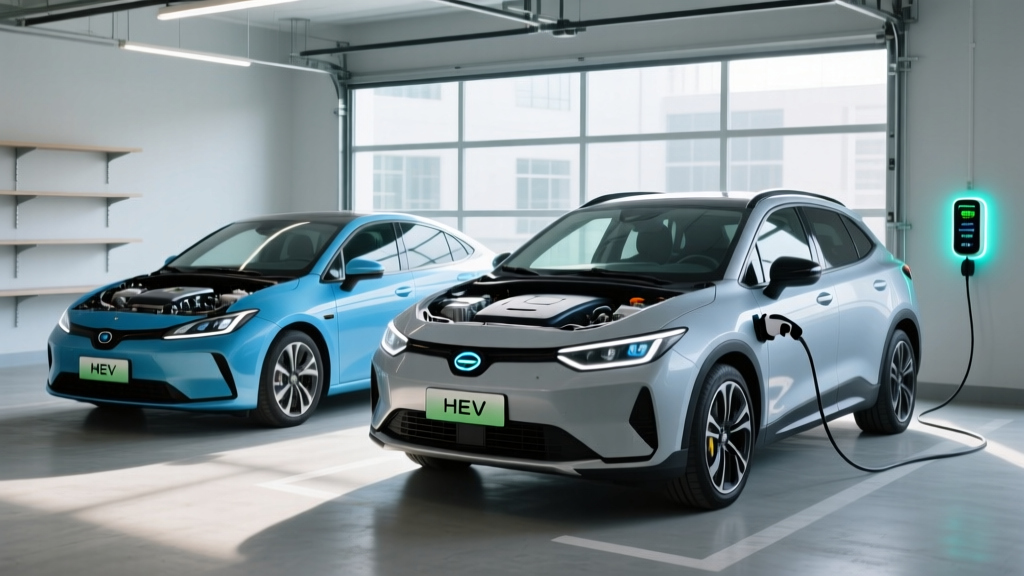
Conventional Hybrid (HEV)
A conventional hybrid pairs a gasoline engine with a small electric motor and a compact battery pack (typically 1–2 kWh). The battery is recharged exclusively through regenerative braking and the engine itself. You never plug it in. You fuel it like any other gas car, and the hybrid system works invisibly in the background to improve fuel economy. Examples: Toyota Prius, Honda CR-V Hybrid, Hyundai Tucson Hybrid.
Plug-In Hybrid (PHEV)
A PHEV uses a significantly larger battery (typically 12–25 kWh in 2026 models) and a more powerful electric motor. It can drive on electricity alone for a meaningful distance — usually 25 to 50 miles — before the gasoline engine kicks in. You plug it in to access that electric range. If you don't plug it in, it still drives as a conventional hybrid, just with reduced efficiency due to the heavier battery. Examples: Toyota RAV4 Prime, Jeep Wrangler 4xe, Chrysler Pacifica Hybrid.
The bottom line: if someone asks you whether hybrid cars need charging, the precise answer is that conventional hybrids do not, and plug-in hybrids benefit enormously from it but don't strictly require it.
Fuel Economy: What the EPA Numbers Actually Look Like
Hybrids shine in stop-and-go city driving, where regenerative braking recovers energy that a conventional gas car wastes as heat in the brake pads. This is why many hybrids achieve higher city MPG than highway MPG — the opposite of most gas-only vehicles.
Here's a snapshot of EPA-rated fuel economy for several popular 2026 hybrid and PHEV models, sourced from fueleconomy.gov:
| Vehicle | Type | City MPG | Hwy MPG | Combined MPG | PHEV EV Range |
|---|---|---|---|---|---|
| Toyota Prius | HEV | 57 | 56 | 57 | N/A |
| Toyota Prius Prime | PHEV | 52 (hybrid) | 48 (hybrid) | 50 (hybrid) | 44 mi |
| Honda CR-V Hybrid | HEV | 43 | 36 | 40 | N/A |
| Toyota RAV4 Prime | PHEV | 40 (hybrid) | 36 (hybrid) | 38 (hybrid) | 42 mi |
| Hyundai Tucson Hybrid | HEV | 38 | 38 | 38 | N/A |
| Ford Escape PHEV | PHEV | 42 (hybrid) | 37 (hybrid) | 40 (hybrid) | 37 mi |
| Chrysler Pacifica Hybrid | PHEV | 29 (hybrid) | 30 (hybrid) | 30 (hybrid) | 32 mi |
Real-World MPG vs. EPA Stickers
One of the pleasant surprises of hybrid ownership is that real-world city MPG often meets or even exceeds EPA estimates. Because regenerative braking is most effective at lower speeds with frequent stops, drivers in urban environments regularly report beating EPA city figures by 2–5 MPG in models like the Prius and CR-V Hybrid.
Highway driving is a different story. At sustained 70–80 mph speeds, the electric motor contributes less and the gasoline engine does most of the work. Expect real-world highway fuel economy to land within 1–3 MPG of the EPA estimate — or slightly below if you drive aggressively or face headwinds and elevation changes.
For PHEVs, the real-world electric-only range also depends on conditions. A RAV4 Prime rated at 42 miles of EV range may deliver only 33–36 miles in cold weather (below 40°F) due to cabin heating demands and reduced battery efficiency. In mild conditions with light throttle use, some owners report squeezing out 45+ miles.
PHEV Charging: Speeds, Connectors, and Times
If you opt for a PHEV, understanding the charging logistics is essential. Unlike full BEVs, most PHEVs have smaller batteries that charge relatively quickly — but there are important limitations.
| Spec | Toyota RAV4 Prime | Prius Prime | Ford Escape PHEV |
|---|---|---|---|
| Battery (usable kWh) | 14.9 kWh | 10.9 kWh | 11.2 kWh |
| Level 1 (120V) charge time | ~12 hours | ~11 hours | ~10–14 hours |
| Level 2 (240V) charge time | ~2.5 hours | ~2 hours | ~3.5 hours |
| DC fast charging | No | No | No |
| Onboard charger | 6.6 kW | 3.3 kW (6.6 kW opt.) | 3.7 kW |
| Combined HP | 302 hp | 220 hp | 210 hp |
| Total combined range | ~600 mi | ~480 mi | ~430 mi |
A critical detail that catches many PHEV buyers off guard: virtually no PHEVs support DC fast charging. The batteries are small enough that Level 2 charging fills them in 2–4 hours, which covers overnight home charging and destination charging adequately. But you won't be pulling into a 150 kW Electrify America stall and topping off in 15 minutes. For road-trip charging flexibility, a full BEV is the better tool.
Also note the distinction between kW (power — the rate of energy flow) and kWh (energy — the battery's total capacity). A 6.6 kW onboard charger can push energy into a 14.9 kWh battery faster than a 3.3 kW charger, which is why the RAV4 Prime charges in roughly half the time of a base Prius Prime on Level 2.
Powertrain and Performance: More Than Just Efficiency
Hybrids aren't just about MPG — many deliver genuinely strong performance thanks to the instant torque of their electric motors.
The Toyota RAV4 Prime is the standout example: its 302 combined horsepower (from a 2.5-liter four-cylinder engine paired with front and rear electric motors) delivers a 0–60 mph time of around 5.7 seconds, making it one of the quickest vehicles in Toyota's lineup. The Prius Prime, redesigned for its current generation, produces 220 combined horsepower — a dramatic improvement over the anemic output of earlier plug-in Prius models.
Conventional hybrids are generally tuned for efficiency over performance, but even here the electric motor's low-end torque makes them feel responsive around town. The Honda CR-V Hybrid's 204 hp combined output provides confident merging and passing. The Hyundai Tucson Hybrid's 226 hp makes it one of the more powerful options in its segment.
Pricing, Tax Credits, and the Total Cost Picture
Hybrids command a premium over their gas-only siblings, but the gap has narrowed considerably. Here's what the pricing landscape looks like for 2026:
- Toyota Prius (HEV): Starting MSRP ~$29,000–$36,000 depending on trim
- Toyota Prius Prime (PHEV): Starting MSRP ~$34,000–$41,000
- Toyota RAV4 Prime (PHEV): Starting MSRP ~$44,500–$49,000
- Honda CR-V Hybrid (HEV): Starting MSRP ~$36,000–$41,000
- Ford Escape PHEV: Starting MSRP ~$40,000–$45,000
Federal Tax Credit Eligibility for PHEVs
Under IRS §30D rules, some PHEVs may qualify for a federal clean vehicle credit of up to $7,500 — but eligibility is far from guaranteed and hinges on several requirements that change periodically. Key constraints include:
- MSRP caps: Vans, SUVs, and pickup trucks must have an MSRP at or below $80,000; sedans and other vehicles must be at or below $55,000.
- Buyer income limits: Adjusted gross income cannot exceed $150,000 (single), $225,000 (head of household), or $300,000 (joint filing).
- Battery sourcing requirements: Critical minerals and battery components must meet phased-in domestic-sourcing thresholds that tighten each year through 2032.
- Point-of-sale transfer: As of 2024, eligible buyers can transfer the credit to the dealer at purchase, reducing the upfront cost rather than waiting for a tax refund.
Conventional HEVs do not qualify for the §30D federal tax credit — the credit applies only to plug-in vehicles (PHEVs and BEVs). Always verify current eligibility on irs.gov before purchasing, as battery sourcing compliance can shift mid-year.
Battery Longevity, Warranty, and Replacement Costs
Battery reliability is consistently the top concern among hybrid shoppers, and it's an area where the data is reassuring. Unlike full EVs with large, expensive battery packs, hybrid batteries are smaller, less stressed, and proven over decades of real-world use.
Hybrid Battery Warranty Standards (2026)
Every major automaker covers hybrid and PHEV battery packs for a minimum of 8 years / 100,000 miles. In states that follow California Air Resources Board (CARB) emissions standards — which include California, New York, Massachusetts, Washington, and over a dozen others — the warranty extends to 10 years / 150,000 miles.
Toyota, Honda, Hyundai, and Ford all honor these terms. The warranty covers battery capacity loss below a specified threshold (typically 60–70% of original capacity) as well as complete failure.
Real-World Battery Lifespan
Data from fleet operators, taxi services, and long-term owners consistently shows that modern hybrid batteries last 150,000–200,000+ miles before requiring replacement. The original Toyota Prius, introduced in the US in 2000, has documented cases of batteries exceeding 300,000 miles with minimal degradation.
The reason: hybrid batteries operate in a narrow state-of-charge window (typically 40–80%), which dramatically reduces the chemical stress that causes degradation in full EVs that regularly charge to 100% or discharge to near zero.
Replacement Cost If You're Out of Warranty
If a hybrid battery does fail outside the warranty period, replacement costs in 2026 typically range from:
- HEV battery: $2,000–$4,000 (parts and labor)
- PHEV battery: $4,000–$8,000 (parts and labor)
Refurbished and aftermarket battery options have become increasingly available, often cutting these costs by 30–50%. Independent hybrid-specialist shops can also perform replacements at lower labor rates than dealerships.
Hybrid vs. PHEV vs. Full EV: Which Should You Choose?
The right electrified vehicle depends on your daily driving pattern, home charging access, and budget. Here's a practical decision framework:
Choose a Conventional Hybrid (HEV) If:
- You have no access to home or workplace charging
- You want maximum fuel economy with zero behavior change
- Your budget is tighter (HEVs are typically $3,000–$6,000 less than PHEV equivalents)
- You frequently take long road trips and don't want to plan around charging
Choose a Plug-In Hybrid (PHEV) If:
- You can charge at home (even a standard 120V outlet works overnight for most PHEVs)
- Your daily commute is under 40 miles round-trip (you'll drive mostly on electricity)
- You want EV-like daily driving but need gas-engine flexibility for road trips
- You want to reduce fuel consumption dramatically without range anxiety
Choose a Full Battery-Electric Vehicle (BEV) If:
- You have reliable Level 2 home charging
- Your daily driving is within the vehicle's range and you can plan road-trip charging
- You want the lowest per-mile "fuel" cost and minimal maintenance
- You want access to the full $7,500 federal tax credit (more BEVs qualify than PHEVs)
Reliability: What the Data Shows
Hybrids as a category have compiled an excellent reliability record over two decades. Toyota's Hybrid Synergy Drive system, in particular, is widely regarded as one of the most durable powertrains ever mass-produced. Consumer Reports and J.D. Power data consistently rank Toyota and Lexus hybrids among the most reliable vehicles in their respective segments.
The electric motor in a hybrid has far fewer moving parts than a conventional automatic transmission, and regenerative braking reduces wear on the friction brake pads and rotors. Many hybrid owners report original brake pads lasting 80,000–100,000 miles thanks to the regen system handling most deceleration.
For PHEVs, the added complexity of a larger battery, more powerful motor, and dual powertrain system introduces slightly more potential failure points than a conventional HEV. However, real-world reliability data from the RAV4 Prime, Pacifica Hybrid, and Escape PHEV has been solid, with no widespread systemic issues reported as of the 2026 model year.
Frequently Asked Questions
Do you have to charge a hybrid car?
No — if it's a conventional hybrid (HEV) like the Toyota Prius or Honda CR-V Hybrid, you never plug it in. The battery charges itself through regenerative braking and the gasoline engine. If it's a plug-in hybrid (PHEV) like the RAV4 Prime or Prius Prime, you can plug it in to access 25–50 miles of electric-only range, but the car still drives as a regular hybrid if you skip charging.
How many MPG does a hybrid get?
It varies by model. The 2026 Toyota Prius achieves an EPA-estimated 57 MPG combined. The Honda CR-V Hybrid delivers 40 MPG combined. The Hyundai Tucson Hybrid gets 38 MPG combined. PHEVs in hybrid mode (battery depleted) typically achieve 30–50 MPG combined depending on the model.
How far can a PHEV go on electric only?
Current 2026 PHEVs offer between 25 and 50 miles of electric-only range. The Prius Prime leads at 44 miles, the RAV4 Prime offers 42 miles, and the Ford Escape PHEV provides 37 miles. Cold weather and aggressive acceleration can reduce these figures by 15–25%.
Is a hybrid reliable, and what does battery replacement cost?
Yes — hybrids are among the most reliable vehicles on the road, with Toyota's system backed by over 25 years of proven durability. Hybrid batteries are covered by 8-year/100,000-mile warranties (10 years/150,000 miles in CARB states). Out-of-pocket replacement runs $2,000–$4,000 for HEVs and $4,000–$8,000 for PHEVs, though most batteries last 150,000–200,000+ miles.
Does a hybrid qualify for a tax credit?
Conventional hybrids (HEVs) do not qualify for the federal §30D clean vehicle credit — only plug-in vehicles do. Some PHEVs may qualify for up to $7,500, but eligibility depends on MSRP caps, buyer income limits, and battery-sourcing requirements that change annually. Check current rules at irs.gov. Some states offer additional rebates for PHEVs; check your state's energy office or afdc.energy.gov for local incentives.
What happens if I never plug in my PHEV?
The car operates as a conventional hybrid, using the gasoline engine and regenerative braking to manage the battery. You'll get lower MPG than a purpose-built HEV (because you're carrying the weight of a larger battery you're not utilizing), but the car functions perfectly. That said, you're paying a premium for the PHEV system you're not taking advantage of — an HEV would be the more cost-effective choice in that scenario.
Can a PHEV use DC fast chargers?
No. As of 2026, virtually no production PHEVs support DC fast charging. Their batteries are small enough that Level 2 (240V) charging fills them in 2–4 hours, which is sufficient for overnight home charging. If you need rapid public charging capability, a full BEV is the better choice.