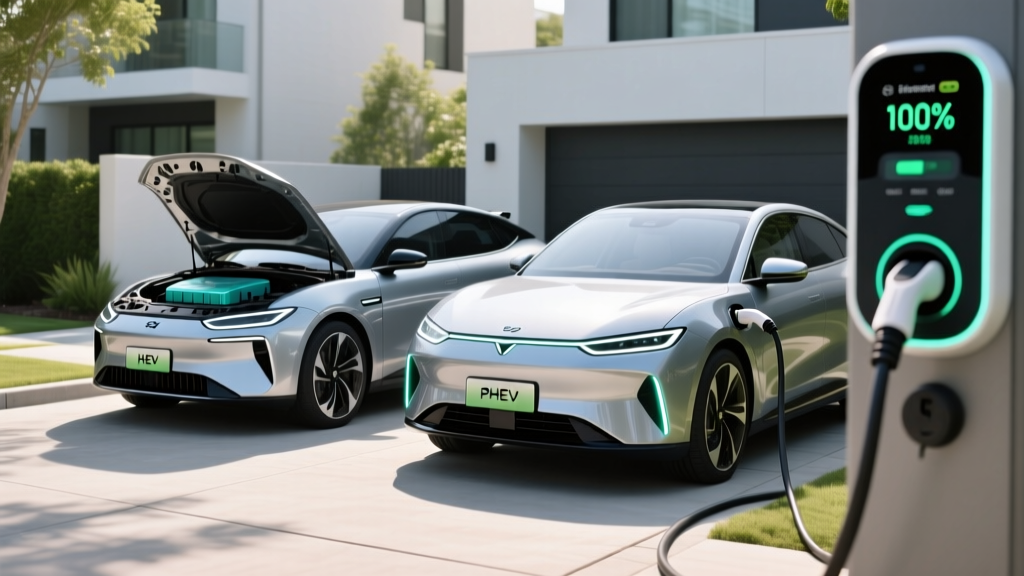
If you have searched for a clear definition hybrid auto and ended up more confused than when you started, you are not alone. Automakers use the word "hybrid" to describe two fundamentally different powertrains: the conventional hybrid electric vehicle (HEV) and the plug-in hybrid electric vehicle (PHEV). Both pair a gasoline engine with an electric motor, but how they store energy, how far they drive on electricity, and whether they qualify for federal tax credits differ enormously.
This guide gives you the precise definitions, the hard EPA numbers, and the ownership math you need to decide which electrified powertrain — or a full battery-electric vehicle (BEV) — fits your driving life in 2026.
The Core Definition: What Makes a Car a Hybrid?
A hybrid automobile is any vehicle that combines an internal combustion engine (ICE) with at least one electric motor and a battery pack to propel the wheels. The electric motor can assist the engine during acceleration, recover energy during braking (regenerative braking), and in some cases drive the vehicle on electricity alone for short distances.
That broad definition splits into two distinct architectures that buyers need to understand before stepping into a dealership.
Conventional Hybrid (HEV)
A conventional hybrid has a small battery (typically 1.0–2.0 kWh) that charges exclusively through regenerative braking and the gasoline engine. You never plug it in. The electric motor assists the engine and enables brief low-speed electric driving, but the gas engine remains the primary energy source. Examples: Toyota Prius, Honda Accord Hybrid, Hyundai Tucson Hybrid.
Plug-In Hybrid (PHEV)
A plug-in hybrid carries a much larger battery (typically 12–25+ kWh usable) that you charge by plugging into a wall outlet, Level 2 charger, or occasionally a DC fast charger. A PHEV can drive 25–50+ miles on electricity alone before the gasoline engine engages, effectively functioning as a short-range EV for daily commutes and a hybrid for longer trips. Examples: Toyota RAV4 Prime, Jeep Wrangler 4xe, Chrysler Pacifica Hybrid.
HEV vs PHEV: Side-by-Side Specification Breakdown
The table below uses two of the most popular nameplates in each category — the 2026 Toyota Prius (HEV) and the 2026 Toyota RAV4 Prime (PHEV) — to illustrate how these architectures compare on paper and in practice. All figures sourced from fueleconomy.gov and Toyota's official specifications.
| Specification | 2026 Toyota Prius (HEV) | 2026 Toyota RAV4 Prime (PHEV) |
|---|---|---|
| Powertrain | 2.0L 4-cyl + 2 electric motors | 2.5L 4-cyl + 2 electric motors |
| Combined Horsepower | 196 hp | 302 hp |
| Battery Capacity (usable) | ~1.4 kWh (NiMH/Li-ion) | ~18.1 kWh (Li-ion) |
| Electric-Only Range | N/A (assist only) | 42 miles (EPA) |
| Total Combined Range | ~620 miles | ~600 miles (EV + gas) |
| EPA Combined MPG / MPGe | 57 MPG combined | 94 MPGe (EV mode) / 38 MPG (gas) |
| EPA City / Highway MPG | 57 city / 56 highway | 40 city / 36 highway (gas mode) |
| Charging (Level 2, 240V) | Not applicable | ~2.5 hours (6.6 kW onboard charger) |
| DC Fast Charging | No | No (most PHEVs lack DCFC) |
| 0–60 mph | 7.2 seconds | 5.7 seconds |
| Base MSRP | $29,450 | $44,900 |
| Federal Tax Credit (§30D) | Not eligible | Up to $7,500 (eligibility varies) |
How Many MPG Does a Hybrid Actually Get?
Hybrid fuel economy varies by vehicle class, but the efficiency advantage over a gas-only counterpart is typically 30–50% in combined driving. Here is a snapshot of EPA ratings for popular 2026 hybrid models:
| Model | Type | City MPG | Highway MPG | Combined MPG |
|---|---|---|---|---|
| Toyota Prius | HEV | 57 | 56 | 57 |
| Hyundai Elantra Hybrid | HEV | 53 | 56 | 54 |
| Honda Accord Hybrid | HEV | 51 | 44 | 48 |
| Toyota Camry Hybrid | HEV | 53 | 50 | 52 |
| Ford Maverick Hybrid | HEV | 42 | 33 | 37 |
| Toyota RAV4 Hybrid | HEV | 41 | 38 | 40 |
| Honda CR-V Hybrid | HEV | 43 | 36 | 40 |
| Hyundai Tucson Hybrid | HEV | 38 | 38 | 38 |
Real-world MPG vs. EPA sticker: Conventional hybrids often exceed their EPA city rating in stop-and-go traffic because regenerative braking recovers energy that a gas car wastes as heat. On the highway, where regen opportunities are fewer and aerodynamic drag dominates, real-world MPG may drop 3–5 MPG below the sticker. In cold weather (below 30°F), expect a 5–10% reduction as the engine runs more frequently to heat the cabin and warm up the battery.
PHEV Electric-Only Range: How Far Can You Go Without Gas?
Electric-only range is the PHEV's defining advantage. Here is what current 2026 models deliver on a full charge, per EPA testing:
- Toyota RAV4 Prime: 42 miles EV-only
- Toyota Prius Prime: 44 miles EV-only
- Chrysler Pacifica Hybrid: 32 miles EV-only
- Jeep Wrangler 4xe: 22 miles EV-only
- Hyundai Tucson PHEV: 33 miles EV-only
- Kia Sportage PHEV: 34 miles EV-only
- BMW X5 xDrive50e: 38 miles EV-only
Real-world caveat: EPA EV-range tests include mixed city/highway driving at moderate temperatures. If your commute is entirely highway at 70+ mph, expect 20–30% fewer electric miles. In winter, cabin heating draws from the battery, potentially reducing EV range by 15–25%. Conversely, gentle city driving at 50°F may yield 5–10% more range than the sticker.
For most PHEV owners with a commute under 35 miles round-trip and access to overnight home charging, gasoline consumption drops to near zero on weekdays. The engine only fires on weekend road trips — a genuine best-of-both-worlds scenario for households not ready to commit to a full BEV.
Pricing, Tax Credits, and Total Cost of Ownership
Hybrids carry a price premium over their gas-only siblings, typically $1,500–$3,500 for an HEV and $5,000–$10,000 for a PHEV. The fuel savings often offset the premium within 3–6 years for an HEV, depending on annual mileage and local gas prices.
Federal Tax Credit Rules (§30D) for PHEVs
Under current IRS rules, a new PHEV may qualify for up to $7,500 in federal tax credits, but eligibility is far from automatic. The requirements, as published by the IRS, include:
- Battery capacity: At least 7 kWh (most PHEVs qualify)
- MSRP caps: Vans/SUVs/pickups ≤ $80,000; sedans ≤ $55,000
- Buyer income limits: AGI ≤ $150,000 (single), $225,000 (head of household), $300,000 (joint)
- Critical minerals & battery component sourcing: Must meet escalating annual thresholds for North American content
- Final assembly: Must occur in North America
- Point-of-sale transfer: You can apply the credit as a down-payment reduction at the dealer (effective 2024+)
Key 2026 reality: Several popular PHEVs have lost partial or full credit eligibility due to battery-sourcing rules that tighten each year. Always verify a specific model's current status on fueleconomy.gov's tax credit lookup before purchasing. Conventional HEVs never qualify for the §30D new-vehicle credit because their batteries are too small.
Battery Longevity, Warranty, and Replacement Costs
Hybrid battery warranty standard: Federal law mandates that hybrid and PHEV battery packs carry a minimum warranty of 8 years / 100,000 miles. In California Air Resources Board (CARB) states, that extends to 10 years / 150,000 miles. Many automakers match or exceed these minimums across all 50 states.
How long do hybrid batteries actually last? Real-world data from fleet operators and long-term owners shows most HEV and PHEV battery packs retain 85–95% of their original capacity at 150,000 miles. Toyota's nickel-metal hydride and lithium-ion hybrid packs have demonstrated exceptional longevity, with many Prius taxis surpassing 300,000 miles on the original battery. PHEV batteries, being larger and liquid-cooled, often degrade even more slowly as a percentage of total capacity.
Replacement cost if out of warranty:
- HEV battery replacement: $2,000–$4,500 (parts + labor)
- PHEV battery replacement: $5,000–$9,000 (parts + labor)
- Refurbished/remanufactured HEV packs are increasingly available for $1,000–$2,000 from third-party suppliers
The fear of a $10,000+ surprise battery bill is largely a myth for hybrids. The packs are smaller, less stressed, and cheaper to replace than full BEV batteries. Combined with the 8–10 year warranty, battery risk should not deter most buyers.
Hybrid vs PHEV vs Full EV: Which Fits Your Life?
Choose a conventional hybrid (HEV) if:
- You cannot charge at home (apartment, street parking, no garage)
- You want maximum MPG with zero behavior change — no plugging in, no apps
- Your budget is under $35,000 and you want the lowest upfront cost among electrified vehicles
- You drive mostly city/stop-and-go where regenerative braking maximizes efficiency
Choose a plug-in hybrid (PHEV) if:
- You have access to home Level 2 charging (or a 120V outlet for overnight trickle charging)
- Your daily commute is under 40 miles round-trip (so you can drive mostly on electricity)
- You take regular road trips where charging infrastructure is sparse or unreliable
- You want EV-like daily driving without range anxiety on long trips
Choose a full battery-electric vehicle (BEV) if:
- You have reliable home charging and your daily driving is under 250 miles
- You want zero tailpipe emissions and the lowest per-mile fuel cost (electricity vs. gas)
- You want to eliminate oil changes, spark plugs, and exhaust-system maintenance
- You qualify for the full $7,500 federal tax credit on an eligible BEV
Pros and Cons: Hybrid Ownership in 2026
Pros
- 30–50% better fuel economy vs. gas-only equivalents with no charging required (HEV)
- PHEVs offer 25–44 miles of gas-free daily driving plus 500+ total range
- No range anxiety — gas stations are everywhere for longer trips
- Proven reliability; hybrid batteries routinely last 150,000+ miles
- Lower purchase price than most BEVs; no home charger installation needed for HEVs
- Strong resale value, especially Toyota and Honda hybrid models
Cons
- HEVs do not qualify for the $7,500 federal EV tax credit
- PHEVs are heavier and more complex (two full powertrains) than either a pure BEV or a pure ICE car
- PHEV electric range drops significantly in cold weather and at highway speeds
- Most PHEVs lack DC fast charging, limiting on-the-go electric replenishment
- Hybrid systems add $1,500–$10,000 to the purchase price vs. gas-only trims
- Still burning gasoline — not a zero-emissions solution
Frequently Asked Questions
Do hybrid cars need to be plugged in?
No. Conventional hybrids (HEVs) charge their battery entirely through regenerative braking and the gasoline engine. You never plug them in. Only plug-in hybrids (PHEVs) require or benefit from being plugged into an external power source.
How long do hybrid batteries last before needing replacement?
Most hybrid batteries last the life of the vehicle under normal use. Real-world data shows 150,000–300,000+ miles is common. Federal law mandates at minimum an 8-year/100,000-mile warranty (10 years/150,000 miles in CARB states). Out-of-warranty replacement costs $2,000–$4,500 for an HEV and $5,000–$9,000 for a PHEV.
Is a hybrid worth it if gas prices drop?
Even at $2.50/gallon, a 57-MPG Prius saves roughly $700–$900/year in fuel costs vs. a 28-MPG gas-only compact SUV (assuming 15,000 miles/year). At $4.00/gallon, savings jump to $1,400–$1,800/year. The hybrid premium typically pays for itself in 3–6 years regardless of moderate gas price fluctuations.
Can a PHEV drive on electricity only at highway speeds?
Yes, most modern PHEVs can sustain highway speeds (up to 80–85 mph) on electric power alone. However, aerodynamic drag at highway speeds drains the battery 25–35% faster than the EPA mixed-cycle test suggests, so your real-world EV range on a highway-only trip will be notably lower than the sticker figure.
Do hybrids cost more to maintain than gas cars?
No. Hybrids typically cost the same or slightly less to maintain. Regenerative braking reduces wear on brake pads (often lasting 80,000–100,000+ miles). The engine runs less, reducing oil degradation. There are no additional routine maintenance items unique to the hybrid system.
Does a hybrid qualify for the $7,500 federal tax credit?
Conventional hybrids (HEVs) do not qualify for the §30D new clean vehicle credit — their batteries are too small. Some PHEVs qualify for up to $7,500, but eligibility depends on MSRP caps, buyer income, battery sourcing requirements, and North American final assembly. Always check the current status on fueleconomy.gov before purchasing.