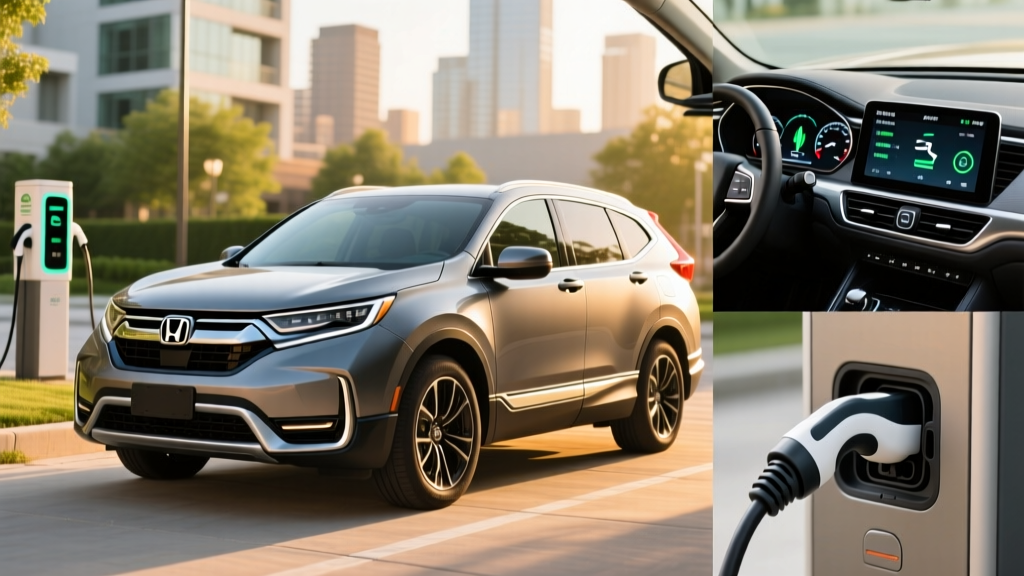
If you're researching the CR-V Sport Hybrid 2026 model year, you're looking at one of Honda's most popular hybrid trims — a conventional hybrid (HEV) that pairs a 2.0-liter four-cylinder engine with a two-motor system for a combined 204 horsepower and up to 40 MPG in city driving. This guide breaks down the exact EPA figures, real-world efficiency expectations, powertrain details, battery warranty coverage, and whether this hybrid makes more sense for your situation than a plug-in hybrid or a full battery-electric vehicle.
Let's be precise from the start: the CR-V Sport Hybrid is a conventional hybrid. It does not plug in. It regenerates energy through braking and engine operation to charge a small onboard battery. If you're looking for electric-only driving or federal tax-credit eligibility, you'll want to understand how this HEV compares to PHEV and BEV alternatives — which we cover below.
2026 CR-V Sport Hybrid: Core Specifications at a Glance
| Specification | Value |
|---|---|
| Powertrain | 2.0L Atkinson-cycle I4 + two-motor hybrid system |
| Combined Horsepower | 204 hp (146 hp engine + electric motors) |
| Combined Torque | 247 lb-ft (electric motor peak) |
| Drivetrain | FWD standard; AWD available (Sport Hybrid AWD) |
| EPA Fuel Economy (FWD) | 43 city / 36 highway / 40 combined MPG |
| EPA Fuel Economy (AWD) | 40 city / 34 highway / 37 combined MPG |
| Fuel Tank Capacity | 14.0 gallons |
| Total Driving Range (FWD) | ~560 miles |
| Total Driving Range (AWD) | ~518 miles |
| 0–60 mph (est.) | ~7.8 seconds |
| Cargo Volume (rear seats up) | 36.3 cu ft |
| Cargo Volume (rear seats folded) | 76.5 cu ft |
| Towing Capacity | 1,000 lbs |
| Base MSRP (Sport Hybrid FWD) | $35,395 |
| Base MSRP (Sport Hybrid AWD) | $36,895 |
| Hybrid Battery Warranty | 8 years / 100,000 miles (10 yr / 150,000 mi in CARB states) |
| Vehicle Warranty | 3 yr / 36,000 mi bumper-to-bumper; 5 yr / 60,000 mi powertrain |
Fuel Economy Breakdown: EPA Ratings vs. Real-World MPG
| Drivetrain | City | Highway | Combined |
|---|---|---|---|
| FWD | 43 MPG | 36 MPG | 40 MPG |
| AWD | 40 MPG | 34 MPG | 37 MPG |
Source: fueleconomy.gov
Hybrid Powertrain: How the Two-Motor System Works
The 2026 CR-V Sport Hybrid uses Honda's fourth-generation two-motor hybrid system. Here's what's under the hood:
- Engine: 2.0-liter Atkinson-cycle inline-4 producing 146 hp and 134 lb-ft of torque. The Atkinson cycle sacrifices some low-end power for greater thermal efficiency — ideal for a hybrid where electric motors fill the torque gap.
- Drive Motor: One electric motor directly drives the front wheels, delivering peak torque of 247 lb-ft from a standstill. This is what gives the CR-V Hybrid its responsive off-the-line feel.
- Generator Motor: A second motor acts as a generator, converting engine output into electricity to either power the drive motor or charge the hybrid battery.
- Hybrid Battery: A lithium-ion pack (approximately 1.1 kWh usable capacity) located beneath the cargo floor. This is a small battery by design — it's not meant for extended electric-only driving but rather for assist, regeneration storage, and smooth stop-start operation.
- Transmission: No traditional geared transmission. Honda uses an e-CVT (electronically controlled continuously variable transmission) that seamlessly blends engine and motor power.
The system intelligently switches between three modes: EV Drive (battery powers the motor for short, low-speed bursts), Hybrid Drive (engine generates electricity for the drive motor), and Engine Drive (engine directly drives the wheels via a lock-up clutch at steady highway speeds). You don't select these modes manually — the system optimizes automatically.
HEV vs. PHEV vs. BEV: Which Electrified CR-V Fits You?
The CR-V lineup includes a conventional hybrid (the Sport Hybrid and other hybrid trims) but as of the 2026 model year, Honda has not offered a CR-V plug-in hybrid (PHEV) in the U.S. market. For context, here's how the three electrification levels compare:
| Factor | HEV (CR-V Sport Hybrid) | PHEV (e.g., Toyota RAV4 Prime) | BEV (e.g., Tesla Model Y) |
|---|---|---|---|
| Plugs in? | No | Yes | Yes |
| Electric-Only Range | ~1 mile (low-speed only) | 35–42 miles typical | 260–330+ miles |
| Fuel / Energy | Gasoline only | Gasoline + electricity | Electricity only |
| Combined Efficiency | 37–40 MPG | 38 MPG gas + 94 MPGe electric | 110–130 MPGe |
| Home Charging Needed? | No | Recommended (Level 2) | Required (Level 2) |
| Federal Tax Credit (§30D) | Not eligible | Up to $7,500 (if eligible) | Up to $7,500 (if eligible) |
| Upfront Cost Premium | ~$1,500 over gas model | ~$5,000–$8,000 over gas | Varies widely |
| Best For | No charging access; simple ownership | Short commutes + road-trip flexibility | Home charging + lower running costs |
- Choose the CR-V Sport Hybrid (HEV) if: You lack access to home or workplace charging, you want better fuel economy with zero change to your refueling habits, and you prefer a lower upfront cost with no plug-in complexity.
- Choose a PHEV (like the RAV4 Prime or Tucson PHEV) if: You can install a Level 2 charger at home, your daily commute is under 40 miles (covering most trips on electricity), but you still want gasoline flexibility for longer road trips.
- Choose a full BEV if: You have reliable home charging, your daily driving is predictable, you want to eliminate gasoline costs entirely, and you're prepared for longer trip planning around DC fast-charging stops.
Pricing, Trims, and Tax Credit Eligibility
The 2026 Honda CR-V Sport Hybrid is positioned in the middle of the CR-V hybrid range. Here's the pricing breakdown:
- Sport Hybrid FWD: $35,395 MSRP (includes $1,395 destination)
- Sport Hybrid AWD: $36,895 MSRP
- Sport Touring Hybrid AWD (top trim): $40,895 MSRP
Federal tax credit: The CR-V Sport Hybrid is a conventional hybrid (HEV). It does not qualify for the IRS §30D Clean Vehicle Credit, which requires a plug-in electric vehicle with a minimum battery capacity of 7 kWh. The hybrid battery in the CR-V Sport is approximately 1.1 kWh — far below the threshold. No federal purchase incentive applies.
State incentives: A small number of states or utilities offer rebates for conventional hybrids, but these are increasingly rare as incentive programs shift toward PHEVs and BEVs. Check your state energy office or local utility for current programs. Do not count on a state hybrid rebate — most have been phased out.
For the latest on federal credit rules, consult the IRS §30D Clean Vehicle Credit page directly, as eligibility requirements (income caps, MSRP caps, battery sourcing) apply to plug-in vehicles only.
Battery Warranty, Longevity, and Replacement Costs
• Standard coverage: 8 years or 100,000 miles (whichever comes first)
• CARB-state coverage: 10 years or 150,000 miles in states that follow California Air Resources Board emissions rules (CA, CO, CT, DE, ME, MD, MA, MN, NJ, NM, NY, OR, RI, VT, VA, WA, and DC as of 2026)
• What's covered: Defects in materials/workmanship and capacity loss below a defined threshold (typically ~60–70% of original capacity, as determined by Honda's diagnostic tool)
How long do Honda hybrid batteries actually last? Honda's lithium-ion hybrid batteries in the CR-V have a strong track record. Because the battery is small (~1.1 kWh) and the system manages charge/discharge cycles conservatively (never fully depleting or fully charging the pack), degradation is minimal. Based on data from previous-generation CR-V Hybrids and the Accord Hybrid, most packs retain well over 90% of their original capacity at 100,000 miles. Failures before 150,000 miles are uncommon.
Replacement cost if out of warranty: A replacement hybrid battery pack for the CR-V Hybrid typically costs between $2,000 and $3,500 (parts only) at a Honda dealer, with labor adding approximately $300–$600. Third-party refurbishers offer reconditioned packs for $1,200–$2,000 installed. This is significantly less than a full EV battery replacement because the pack is small and simpler.
Maintenance note: Unlike full EVs, the CR-V Hybrid still requires regular gasoline-engine maintenance — oil changes (every 7,500–10,000 miles with synthetic), coolant flushes, spark plugs (~100,000 miles), and transmission fluid service. Factor this into your long-term cost calculations versus a BEV.
Reliability, Safety, and Ownership Costs
Honda's hybrid powertrain has accumulated years of real-world data through the Accord Hybrid, Insight (discontinued), and CR-V Hybrid (introduced in the U.S. for the 2020 model year). The fourth-generation two-motor system in the 2026 CR-V is a mature, well-tested design.
Safety ratings: The 2026 CR-V carries top marks from both major U.S. testing agencies. It earned a 5-Star Overall Rating from NHTSA and is expected to qualify as an IIHS Top Safety Pick+ when equipped with the standard Honda Sensing suite (adaptive cruise control, lane-keeping assist, automatic emergency braking, and road-sign recognition).
Estimated 5-year ownership cost advantages vs. gas-only CR-V:
| Cost Factor | CR-V Gas (AWD, 28 MPG comb.) | CR-V Sport Hybrid (AWD, 37 MPG comb.) |
|---|---|---|
| Fuel cost (5 yr at $3.40/gal avg) | $9,107 | $6,892 |
| Fuel savings over 5 years | — | ~$2,215 |
| Maintenance (est. 5 yr) | $2,800 | $2,800 (similar — same engine) |
| Insurance (est. annual avg) | $1,550/yr | $1,600/yr (slightly higher) |
| Upfront price premium | — | ~$1,500 over comparable gas AWD |
| Net 5-year advantage | — | ~$465 savings after premium |
The hybrid's fuel-cost advantage grows substantially if gas prices rise above $3.40/gallon or if your driving is predominantly city (where the hybrid's MPG advantage is largest). At $4.00/gallon with mostly city driving, 5-year fuel savings could exceed $3,500 — making the hybrid a clear financial win even before considering its stronger resale value.
Pros and Cons: The Honest Assessment
- 40 MPG combined (FWD) with no plug-in requirement
- Strong low-end torque (247 lb-ft) from electric motor
- Spacious cargo area (36.3 cu ft) — hybrid battery doesn't compromise space
- Top safety ratings (NHTSA 5-star, IIHS TSP+ expected)
- 8 yr / 100,000 mi hybrid battery warranty (10/150k in CARB states)
- Strong resale value — Honda CR-V historically retains value well
- AWD available on Sport Hybrid trim
- Highway MPG (34–36) trails city MPG significantly
- No federal tax credit — HEV doesn't qualify for §30D
- No PHEV CR-V option in U.S. market for electric-only commuting
- Towing limited to 1,000 lbs (gas CR-V tows 1,500 lbs)
- Engine noise under hard acceleration (e-CVT drone)
- Sport trim lacks premium features found in Sport Touring
- Real-world highway efficiency may disappoint on long road trips
Frequently Asked Questions
How many MPG does the 2026 CR-V Sport Hybrid get?
The EPA rates the FWD model at 43 city / 36 highway / 40 combined MPG. The AWD version drops to 40 city / 34 highway / 37 combined MPG. In real-world driving, expect to match or exceed city figures (44–47 MPG) but fall slightly short on the highway (33–35 MPG FWD). Your results will vary based on driving style, terrain, and climate.
Does the CR-V Sport Hybrid plug in?
No. The CR-V Sport Hybrid is a conventional hybrid (HEV). It charges its small battery through regenerative braking and the gasoline engine. You never plug it in — you simply fill up at a gas station as you would with any other vehicle.
Is there a plug-in hybrid (PHEV) CR-V?
As of the 2026 model year, Honda does not offer a CR-V PHEV in the United States. If you want a compact SUV PHEV with electric-only range, competitors include the Toyota RAV4 Prime (42 miles electric), Hyundai Tucson PHEV (33 miles), and Mitsubishi Outlander PHEV (38 miles).
Is the CR-V Hybrid reliable and what does battery replacement cost?
Honda's hybrid system is well-proven across multiple models. The hybrid battery is covered for 8 years/100,000 miles (10 years/150,000 miles in CARB states). Out-of-warranty replacement runs $2,000–$3,500 at a dealer, significantly less than EV battery replacements due to the small pack size. Most packs last well beyond the warranty period without significant degradation.
Does the 2026 CR-V Sport Hybrid qualify for any tax credit?
No federal tax credit applies. The IRS §30D Clean Vehicle Credit requires a plug-in vehicle with at least 7 kWh of battery capacity — the CR-V Hybrid's ~1.1 kWh pack doesn't qualify. Some states or utilities may offer small hybrid incentives, but these are increasingly rare. Check your local programs, but don't factor a credit into your purchase decision.
Hybrid vs. full EV — which should I choose?
If you can charge at home (Level 2, ~$500–$1,500 installed) and your daily driving is under 250 miles, a full EV will deliver lower per-mile fuel costs, less maintenance, and potential tax credits. If you lack home charging, regularly drive long distances in areas with sparse charging infrastructure, or simply want to minimize upfront cost and complexity, the CR-V Sport Hybrid offers meaningful fuel savings without any lifestyle change.