Quick Verdict: The CR-V Hybrid Sport Touring at a Glance
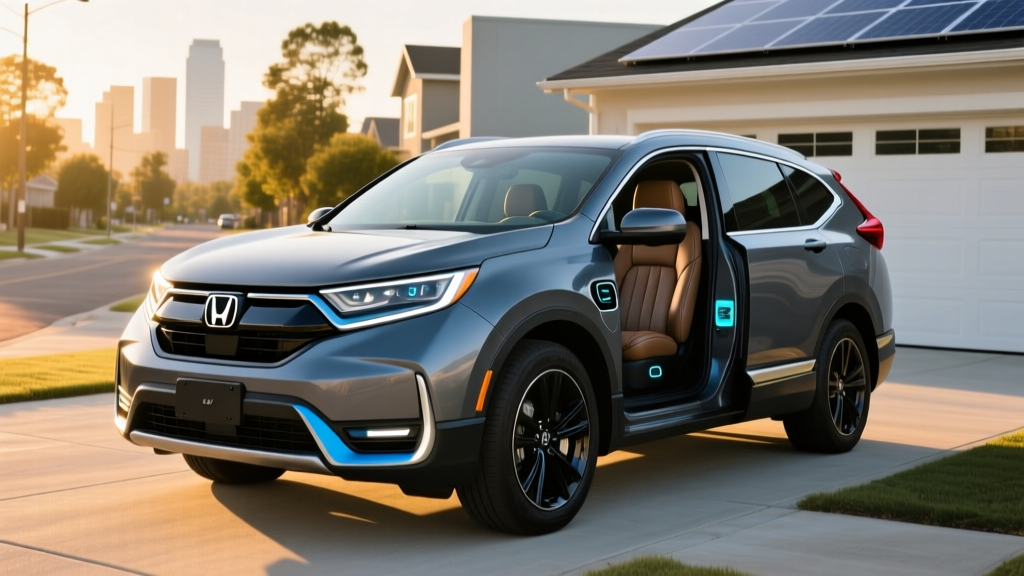
The 2026 Honda CR-V Hybrid Sport Touring sits at the top of Honda's compact hybrid SUV lineup, pairing a 2.0-liter Atkinson-cycle four-cylinder with a two-motor hybrid system for a combined 204 horsepower. EPA-rated at 40 MPG combined (43 city / 36 highway) in front-wheel-drive form, it delivers meaningful fuel savings over the turbocharged gas-only CR-V without requiring a plug, a charging routine, or any change to how you drive.
At an MSRP of approximately $42,350 (including destination), the Sport Touring trim adds premium features like a Bose 12-speaker audio system, wireless Apple CarPlay and Android Auto, heated rear seats, a heated steering wheel, and Honda's full Honda Sensing suite. It competes directly with the Toyota RAV4 Hybrid Limited and the Hyundai Tucson Hybrid Limited — but Honda's two-motor hybrid system has proven exceptionally reliable over multiple generations.
One clarification up front: the CR-V Hybrid is a conventional hybrid (HEV), not a plug-in hybrid. You never plug it in. It generates and recovers all its own electricity through regenerative braking and the gasoline engine. If you're looking for electric-only driving, Honda does not currently offer a CR-V PHEV in the United States.
Fuel Economy: EPA Ratings and Real-World MPG
| Drivetrain | City MPG | Highway MPG | Combined MPG |
|---|---|---|---|
| FWD | 43 | 36 | 40 |
| AWD | 40 | 34 | 37 |
Source: EPA Fuel Economy.
Compared to the gas-only 2026 CR-V (rated at 29 MPG combined with the 1.5L turbo), the hybrid saves roughly 3.5 gallons per 1,000 miles driven. At $3.50/gallon, that's about $12.25 per 1,000 miles — or roughly $184 in annual savings for a driver covering 15,000 miles per year. The hybrid's $2,000–$3,000 price premium over an equivalently equipped gas CR-V typically pays back in 10–16 years at current fuel prices, though the resale-value premium for hybrids can shorten that window.
Powertrain and Performance Specs
| Specification | Value |
|---|---|
| Engine | 2.0L Atkinson-cycle DOHC i-VTEC 4-cylinder |
| Hybrid System | Two-motor (traction + generator), lithium-ion battery |
| Combined System Output | 204 hp / 247 lb-ft torque |
| Transmission | e-CVT (direct-drive with lock-up clutch) |
| Drivetrain | FWD standard; Real Time AWD available |
| 0–60 mph | ~7.6 seconds (FWD, estimated) |
| Towing Capacity | 1,000 lbs |
| Cargo Volume | 36.3 cu ft (rear seats up) / 76.5 cu ft (rear seats folded) |
| Curb Weight | ~3,840 lbs (AWD) |
| Fuel Tank | 14.0 gallons |
| Total Driving Range | ~518 miles (AWD, EPA est.) |
Honda's fourth-generation two-motor hybrid system operates differently from Toyota's planetary-gear Hybrid Synergy Drive. At low speeds, the CR-V Hybrid runs primarily on the electric traction motor, with the gasoline engine acting as a generator to feed the battery. At highway cruising speeds, a lock-up clutch connects the engine directly to the front wheels for efficiency. This means the engine and wheels are mechanically decoupled most of the time — resulting in smooth, electric-like acceleration from a stop and minimal "rubber-banding" from the e-CVT.
The 204 combined horsepower and 247 lb-ft of torque (the electric motor's contribution dominates low-end thrust) give the CR-V Hybrid adequate passing power. The 0–60 mph time of approximately 7.6 seconds is competitive with the RAV4 Hybrid (7.4 sec) and noticeably quicker than some rivals. The AWD system uses a separate rear-mounted electric motor rather than a mechanical driveshaft, which improves packaging and allows up to 50% of torque to reach the rear wheels when needed.
HEV vs PHEV vs EV: Which Powertrain Fits You?
Conventional Hybrid (HEV)
Example: CR-V Hybrid Sport Touring
Plugs in? No
Electric-only range: ~1 mile at low speed
Best for: Drivers without home charging who want better MPG with zero routine change.
Plug-in Hybrid (PHEV)
Example: Toyota RAV4 Prime
Plugs in? Yes (Level 1 or Level 2)
Electric-only range: 25–42 miles typical
Best for: Drivers with home/work charging who want short EV commutes plus gas-engine road-trip range.
Battery Electric (BEV)
Example: Tesla Model Y, Hyundai Ioniq 5
Plugs in? Yes (Level 2 + DC fast charging)
Electric-only range: 250–340 miles
Best for: Drivers with reliable home Level 2 charging who want zero tailpipe emissions and lowest per-mile fuel cost.
The CR-V Hybrid Sport Touring is the right call if you live in an apartment without charging access, regularly drive in extreme cold (where EV range drops 20–30%), or frequently take road trips through areas with sparse DC fast-charging infrastructure. You get roughly 30–40% better fuel economy than a gas CR-V with no behavioral change whatsoever.
Choose a PHEV if you can install a Level 2 charger at home and most daily trips fall under 30 miles — you'd drive electric most days and only burn gas on longer trips. Choose a full EV if you have home charging, want the lowest operating costs, and are comfortable planning road-trip charging stops.
Pricing, Trims, and Tax Credit Eligibility
The 2026 Honda CR-V Hybrid is offered in three trims:
| Trim | MSRP (FWD) | MSRP (AWD) |
|---|---|---|
| Sport | $36,350 | $37,850 |
| Sport-L | $39,350 | $40,850 |
| Sport Touring | $40,850 | $42,350 |
Prices include destination charge. Actual dealer pricing may vary.
The Sport Touring trim justifies its premium with a substantial equipment upgrade over the Sport-L: a 9-inch touchscreen with wireless phone projection, Bose premium audio, a wireless phone charger, heated rear outboard seats, a heated steering wheel, hands-free power tailgate, roof rails, and 19-inch alloy wheels. It also includes Honda Sensing (adaptive cruise control, lane-keeping assist, collision mitigation braking, road departure mitigation, and traffic sign recognition) — standard across all CR-V trims.
Battery Warranty, Reliability, and Replacement Cost
Honda's two-motor hybrid system has an excellent long-term reliability record. The lithium-ion battery pack in the CR-V Hybrid is relatively small (approximately 1.1 kWh usable capacity — far smaller than a PHEV or BEV battery) and operates within a narrow state-of-charge window managed by the vehicle's battery management system. This shallow-cycling strategy dramatically reduces degradation. Many Honda and Toyota hybrids reach 200,000+ miles on the original battery pack.
If the hybrid battery does require replacement outside of warranty, Honda dealer pricing for a new OEM battery pack typically ranges from $2,000 to $4,000 (parts and labor), depending on the model year and region. Third-party refurbished hybrid batteries are available for $1,000–$2,000 installed. This is far less than a BEV battery replacement and is comparable to a timing-belt service or transmission rebuild on a conventional vehicle.
For broader reliability context, the CR-V as a nameplate consistently earns above-average ratings from Consumer Reports and J.D. Power. The IIHS has historically named the CR-V a Top Safety Pick+ when equipped with specific headlights, and NHTSA typically awards it 5 stars overall.
Who Should Buy the CR-V Hybrid Sport Touring?
Reasons to Choose It
- You want 37–40 MPG combined without changing your fueling routine
- You lack access to home or workplace charging (apartment, street parking)
- You drive in extreme cold where EV range loss is a concern
- You want a fully loaded compact SUV under $43,000
- You value Honda's long-term reliability and strong resale value
- You take frequent road trips and don't want to plan charging stops
Reasons to Look Elsewhere
- You have home Level 2 charging and want to drive electric daily (consider a PHEV or BEV)
- You want the lowest possible per-mile fuel cost (BEVs at ~$0.04–0.06/mile vs. hybrid at ~$0.09–0.12/mile)
- You need more than 1,000 lbs of towing capacity
- You want a third row (consider the Honda Pilot Hybrid or Kia Sorento Hybrid)
- You want the federal §30D tax credit (only available on PHEVs/BEVs)
The CR-V Hybrid Sport Touring occupies a specific and practical niche: it's the best-equipped compact hybrid SUV for buyers who want premium features, proven hybrid efficiency, and zero lifestyle compromise. It won't match a BEV on operating cost or a PHEV on electric-only commuting, but it eliminates the two biggest barriers to electrified driving — charging access and range anxiety — while still cutting fuel consumption by roughly a third.
Frequently Asked Questions
How many MPG does the CR-V Hybrid Sport Touring get?
The EPA rates the 2026 CR-V Hybrid at 43 city / 36 highway / 40 combined (FWD) and 40 city / 34 highway / 37 combined (AWD). Real-world city driving often exceeds the EPA estimate, while sustained highway speeds above 70 mph tend to return 2–4 MPG below the sticker.
Does the CR-V Hybrid need to be plugged in?
No. The CR-V Hybrid is a conventional (self-charging) hybrid. It recovers energy through regenerative braking and uses the gasoline engine to charge its small battery pack. You fuel it exactly like a standard gas car.
Is there a CR-V plug-in hybrid (PHEV)?
Honda does not currently sell a CR-V PHEV in the United States. If you want a plug-in hybrid compact SUV, the Toyota RAV4 Prime (42 miles electric-only), Hyundai Tucson PHEV (33 miles), and Mitsubishi Outlander PHEV (38 miles) are the primary alternatives.
How long will the CR-V Hybrid battery last?
Honda's hybrid battery is warranted for 8 years/100,000 miles (10 years/150,000 miles in CARB states). In practice, Honda's shallow-cycle battery management strategy means many hybrid batteries last 200,000+ miles. If replacement is needed, expect $2,000–$4,000 for an OEM pack at a dealer.
Does the CR-V Hybrid qualify for any tax credit?
The federal §30D New Clean Vehicle Credit does not apply to conventional hybrids — only to PHEVs and BEVs. Some state, local, or utility incentives may apply to hybrids; check your state energy office. The IRS maintains current eligibility rules for plug-in vehicles.
Is the CR-V Hybrid faster than the gas CR-V?
Yes, slightly. The hybrid's 204 hp and 247 lb-ft of combined torque (with the electric motor delivering peak torque from 0 RPM) gives it a 0–60 mph time of roughly 7.6 seconds, compared to approximately 8.0 seconds for the 1.5L turbo gas model. The difference is most noticeable in city acceleration from a stop.