Quick Verdict: The Crosstrek Hybrid in 2026
The Subaru Crosstrek Hybrid occupies a narrow but practical lane: it's a plug-in hybrid (PHEV) compact crossover with standard all-wheel drive, genuine ground clearance, and a short electric-only range designed for errand-running and school-drop commutes. If you've been searching for mpg crosstrek hybrid data to decide whether this PHEV saves you money over the gas-only Crosstrek, the answer depends almost entirely on your daily mileage and whether you can charge at home.
For 2026, Subaru continues the Crosstrek Hybrid with its 2.0-liter boxer engine paired with two electric motors and an 8.8 kWh lithium-ion battery. The result is an EPA-estimated 17 miles of electric-only driving and 35 MPG combined once the gasoline engine takes over. That's a meaningful improvement over the gas Crosstrek's 29 MPG combined, but the PHEV premium and limited EV range mean the math only works for specific drivers.
A conventional hybrid (HEV) like the Toyota RAV4 Hybrid never plugs in. It uses a small battery recharged by regenerative braking and the engine to assist acceleration and enable brief low-speed electric driving. You just fill it with gas.
A plug-in hybrid (PHEV) like the Crosstrek Hybrid has a larger battery you charge from a wall outlet or public charger. It can drive on electricity alone for a set distance (17 miles here) before the gas engine starts. Plug in nightly, and short commutes burn zero gasoline. Skip the plug, and it operates like a regular hybrid — just a heavier, less efficient one.
EPA Fuel Economy and Real-World MPG
Fuel economy is the first number buyers search for, and the Crosstrek Hybrid delivers two distinct figures depending on whether the battery has charge.
| Metric | City | Highway | Combined |
|---|---|---|---|
| Charge-depleting (EV mode) | — | — | 90 MPGe |
| Charge-sustaining (hybrid mode) | 35 MPG | 34 MPG | 35 MPG |
| Gas-only Crosstrek (baseline) | 27 MPG | 32 MPG | 29 MPG |
Source: fueleconomy.gov
Subaru's boxers and symmetrical AWD create mechanical drag that slightly hurts highway efficiency. In mixed real-world driving with the battery depleted, expect 32–36 MPG combined. City driving favors the hybrid system — stop-and-go traffic lets regenerative braking recharge the battery frequently, and some owners report 37–39 MPG in urban commuting. Highway cruising at 75+ MPH drops efficiency closer to 30–32 MPG because the flat-four engine lacks a turbo and works harder at sustained speed.
Cold weather (below 30°F) reduces electric-only range by 20–30% and drops hybrid-mode MPG by roughly 3–5 MPG until the cabin and powertrain reach operating temperature.
Electric-Only Range and Total Driving Range
The Crosstrek Hybrid's EPA-rated electric-only range is 17 miles. That figure assumes moderate temperatures, flat terrain, and speeds under 55 MPH. In practice, expect 13–15 miles of usable EV range in warm weather and as little as 10–12 miles in freezing conditions when the battery's chemistry slows and cabin heating draws additional power.
Once the 8.8 kWh battery is depleted, the 2.0-liter engine engages and the car operates as a conventional hybrid. With a 13.2-gallon fuel tank and 35 MPG combined, total range extends to approximately 460–480 miles on a full tank plus full charge — comparable to the gas Crosstrek but with the added benefit of zero-emission short trips when plugged in.
This 17-mile EV range is the Crosstrek Hybrid's most polarizing spec. It covers the average American's daily round-trip commute of roughly 16 miles (per FHWA data), but barely. Competitors like the Toyota RAV4 Prime offer 42 miles of EV range, and the Hyundai Tucson PHEV delivers 33 miles. If your daily driving exceeds 20 miles, the Crosstrek Hybrid will spend most of its time in hybrid mode, reducing the financial case for the PHEV premium.
Powertrain Specs: Engine, Motors, and Combined Output
| Engine | 2.0L DOHC 4-cylinder boxer (152 HP) |
| Electric Motors | Motor 1: 31 HP (starter/generator); Motor 2: 88 HP (drive assist) |
| Combined System Output | 148 HP |
| Battery | 8.8 kWh lithium-ion (usable capacity ~6.0 kWh) |
| Transmission | Lineartronic CVT with AWD |
| Drivetrain | Symmetrical All-Wheel Drive (standard) |
| 0–60 MPH | ~8.5 seconds |
| Ground Clearance | 8.7 inches |
The dual-motor setup is borrowed from Toyota's hybrid synergy drive (Subaru and Toyota share powertrain technology). Motor 1 handles engine starting, regenerative braking capture, and battery charging. Motor 2 provides direct drive assist and EV-only propulsion. Combined output of 148 HP is adequate for merging and passing but won't feel sporty — the gas-only Crosstrek with its 182 HP 2.5L engine actually feels more responsive at highway speed.
Charging: Level 1, Level 2, and the DC Fast-Charge Gap
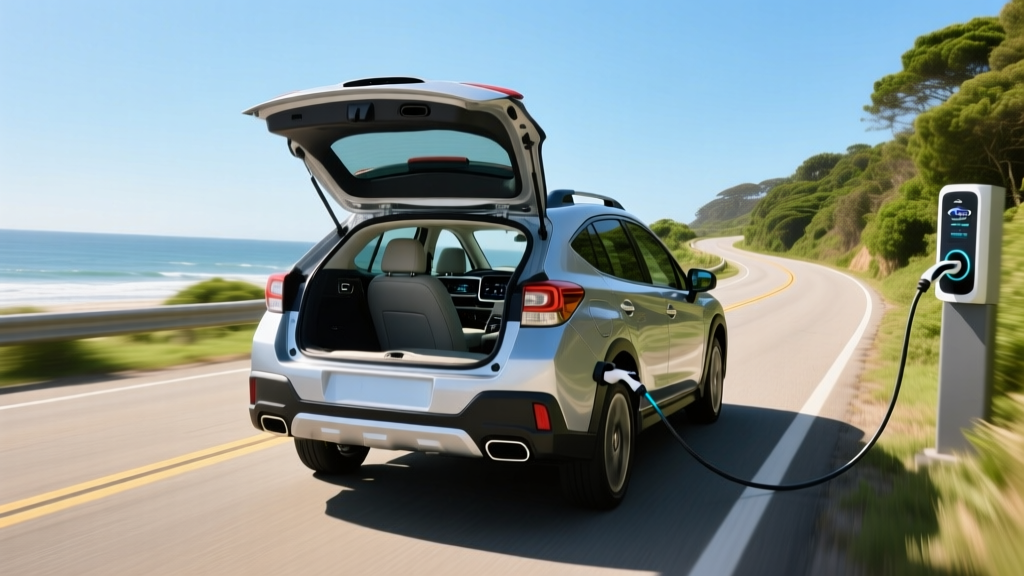
The Crosstrek Hybrid charges via a J1772 connector on Level 1 (120V household) or Level 2 (240V) power. Here's what to expect:
| Charging Level | Power (kW) | 0–100% Time | Practical Notes |
|---|---|---|---|
| Level 1 (120V outlet) | 1.4 kW | ~5.5 hours | Included cord; overnight from a standard outlet |
| Level 2 (240V home/public) | 3.3 kW | ~2.5 hours | Requires home Level 2 charger or public station |
| DC Fast Charging | N/A | N/A | Not supported — no CCS or CHAdeMO port |
The 3.3 kW onboard charger is the bottleneck here. Even at a public Level 2 station capable of 7.2 or 11.5 kW, the Crosstrek Hybrid will only accept 3.3 kW. This is typical for PHEVs with smaller batteries — the Toyota RAV4 Prime charges at 3.3 kW on lower trims and 6.6 kW on higher trims. For an 8.8 kWh battery, the slower rate is less of a problem: a full charge in 2.5 hours means you can top up during a workday or while running errands.
The lack of DC fast charging means the Crosstrek Hybrid is not a road-trip EV. On long highway drives, you'll operate entirely in hybrid mode after the first 17 miles. That's fine — the hybrid system is efficient — but don't plan to "charge up" at Electrify America or Tesla Supercharger stations along the way.
Pricing, Tax Credits, and the PHEV Premium
The 2026 Subaru Crosstrek Hybrid starts at approximately $36,995 MSRP (destination included), available only in a single well-equipped trim. That represents a roughly $5,500–$6,500 premium over the gas-only Crosstrek Premium trim at ~$30,495.
The Crosstrek Hybrid may qualify for a partial federal tax credit under IRS §30D rules, but eligibility depends on critical-mineral sourcing, battery-component manufacturing, your personal income, and whether you've reached the per-manufacturer credit phase-out threshold. Subaru's battery supply chain has historically limited the credit to $3,750 (meeting critical-mineral requirements but not battery-component requirements).
Key §30D requirements for 2026:
- Modified adjusted gross income: ≤ $150,000 (single) / ≤ $300,000 (joint)
- Vehicle MSRP: ≤ $80,000 for SUVs/PHEVs
- Battery capacity: ≥ 7 kWh (Crosstrek Hybrid's 8.8 kWh qualifies)
- Point-of-sale transfer available — dealer applies credit at purchase
Always verify current-year eligibility at irs.gov or with a tax professional before purchasing. Rules and sourcing requirements change annually.
With a $3,750 credit, the effective price drops to roughly $33,245 — still a $2,750 gap over the gas Crosstrek Premium. Fuel savings help close that gap: at 12,000 miles/year with 60% of driving covered on electricity (charged at home at $0.14/kWh), annual fuel cost drops from ~$1,450 (gas Crosstrek) to ~$850 (Crosstrek Hybrid), saving roughly $600/year. Payback takes approximately 4.5–5 years without accounting for state incentives, which vary widely by jurisdiction.
Battery Warranty, Reliability, and Replacement Costs
Subaru covers the Crosstrek Hybrid's high-voltage lithium-ion battery for 8 years or 100,000 miles (whichever comes first) against defects and excessive capacity loss. In California Air Resources Board (CARB) states, that warranty extends to 10 years or 150,000 miles under PZEV/AT-PZEV emissions classifications.
The warranty typically guarantees the battery will retain at least 70% of original capacity during the coverage period. If degradation exceeds that threshold, Subaru will repair or replace the battery at no cost.
Hybrid battery reliability in the Crosstrek Hybrid has been strong. The Toyota-derived hybrid system is one of the most proven powertrains on the road, and the 8.8 kWh pack is conservatively managed — Subaru's battery management system maintains a buffer at the top and bottom of the state-of-charge range to prevent deep cycling, which is the primary cause of lithium-ion degradation.
If you do need an out-of-warranty replacement, expect a dealer-installed hybrid battery to cost between $3,500 and $5,500 including labor. Third-party refurbishers and independent hybrid specialists offer reconditioned packs for $2,000–$3,500. Given the conservative battery management and Toyota-proven chemistry, most Crosstrek Hybrid batteries should last 150,000+ miles before meaningful degradation — well beyond the warranty period.
The conventional 12V auxiliary battery is a separate maintenance item, typically lasting 3–5 years and costing $200–$350 to replace.
Who Should Buy the Crosstrek Hybrid (and Who Shouldn't)
✓ Choose the Crosstrek Hybrid If:
- Your daily round-trip commute is under 17 miles and you can charge at home nightly
- You need AWD and 8.7 inches of ground clearance for snow, dirt roads, or light off-roading
- You want to reduce gasoline use without committing to a full EV's range planning
- You live in a CARB state with additional PHEV rebates or HOV-lane access
- You take occasional long road trips where EV charging infrastructure is sparse
✗ Skip the Crosstrek Hybrid If:
- Your daily commute exceeds 25 miles — you'll burn gas most of the time, negating the PHEV premium
- You can't install a Level 1 or Level 2 charger at home (apartment/condo without charging access)
- You want 30+ miles of electric range — consider the RAV4 Prime (42 mi) or Tucson PHEV (33 mi)
- Performance matters — the 148 HP combined output and CVT drone make it the slowest Crosstrek in the lineup
- Budget is tight — the gas Crosstrek at ~$30,500 delivers 29 MPG without the $6,500 PHEV premium
Hybrid vs. PHEV vs. Full EV: Where Does the Crosstrek Fit?
| Factor | Crosstrek Hybrid (PHEV) | Gas Crosstrek (ICE) | Full EV (e.g., Hyundai Kona Electric) |
|---|---|---|---|
| EV Range | 17 mi | 0 mi | 261 mi |
| Total Range | ~470 mi | ~380 mi | 261 mi |
| Combined MPG/MPGe | 35 MPG / 90 MPGe | 29 MPG | 129 MPGe |
| AWD Available | Standard | Standard | Limited options |
| Base MSRP (approx.) | $36,995 | $27,495 | $34,995 |
| Home Charging Needed | Recommended | No | Essential |
Frequently Asked Questions
How many MPG does the Crosstrek Hybrid get?
The EPA rates the Crosstrek Hybrid at 35 MPG combined (35 city / 34 highway) in hybrid mode after the battery is depleted. In real-world city driving, owners frequently report 37–39 MPG thanks to regenerative braking. Highway cruising drops efficiency to approximately 30–32 MPG.
How far can the Crosstrek Hybrid go on electric only?
The EPA rates it at 17 miles of electric-only range. Real-world expectations are 13–15 miles in warm weather and 10–12 miles in cold weather (below 30°F). Highway speeds above 60 MPH also reduce EV range significantly.
Does the Crosstrek Hybrid need to be plugged in?
No — it operates as a conventional hybrid if you never plug it in, achieving 35 MPG combined. However, to capture the fuel-cost savings and zero-emission short-trip capability that justify the PHEV premium, you should plug in nightly using the included Level 1 cord or an installed Level 2 charger.
Is the Crosstrek Hybrid reliable, and what does battery replacement cost?
Reliability has been strong, with the Toyota-derived hybrid system proving durable across hundreds of thousands of fleet and consumer miles. The hybrid battery is warrantied for 8 years/100,000 miles (10 years/150,000 in CARB states). Out-of-warranty replacement costs $3,500–$5,500 at a dealer, or $2,000–$3,500 from independent hybrid specialists.
Does the Crosstrek Hybrid qualify for a federal tax credit?
It may qualify for up to $3,750 under IRS §30D, depending on battery sourcing requirements and your personal income. Eligibility rules change frequently — verify current-year status at fueleconomy.gov and consult a tax professional. Point-of-sale transfer is available at participating dealers, applying the credit directly to your purchase price.
Can the Crosstrek Hybrid DC fast charge?
No. The Crosstrek Hybrid only accepts Level 1 (120V, 1.4 kW) and Level 2 (240V, 3.3 kW) AC charging via a J1772 connector. There is no CCS, CHAdeMO, or NACS DC fast-charging port. This is standard for most PHEVs with batteries under 15 kWh.
Safety ratings and crash-test data for the Crosstrek Hybrid can be verified at iihs.org and nhtsa.gov.