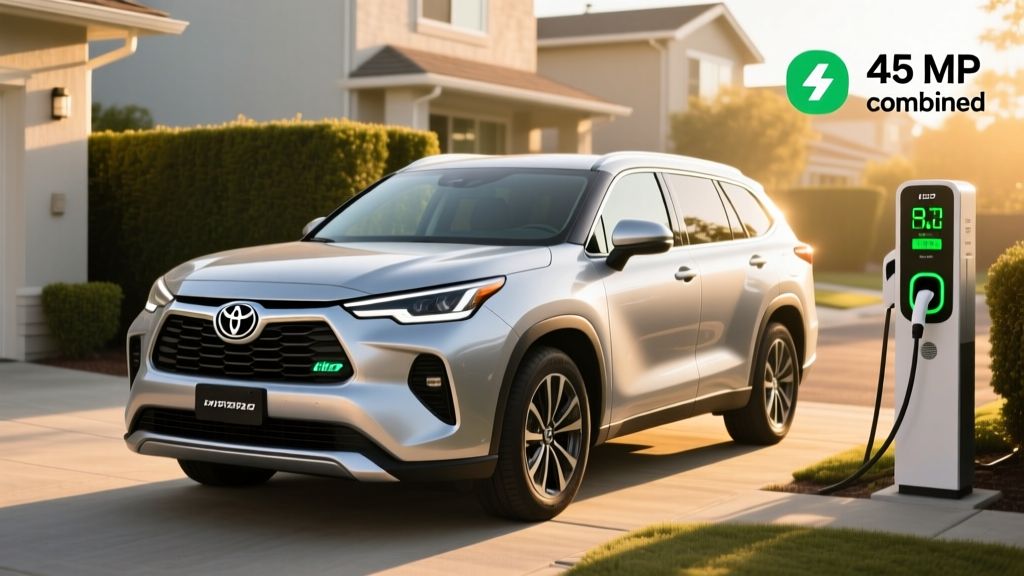
If you are shopping the used three-row SUV market in 2026, the certified pre-owned 2022 Highlander Hybrid occupies a specific and compelling niche. It offers the cargo capacity and seating for seven or eight that growing families demand, paired with a hybrid powertrain that delivers mid-size SUV efficiency without ever requiring a plug. Unlike a plug-in hybrid (PHEV) or a battery-electric vehicle (BEV), the Highlander Hybrid is a conventional self-charging hybrid (HEV). You simply fill it with gas and drive; the system recovers energy through regenerative braking to recharge its small battery pack.
This guide dissects the 2022 model year specifically, analyzing its EPA fuel economy, the value proposition of Toyota's CPO program, long-term battery reliability, and how it stacks up against electrified alternatives in today's market.
2022 Highlander Hybrid Powertrain and Efficiency Specs
The 2022 Toyota Highlander Hybrid utilizes Toyota's fourth-generation hybrid system. It pairs a 2.5-liter four-cylinder engine with two electric motors (one on the front axle, one on the rear for AWD models) to provide smooth, electrically assisted acceleration from a stop and seamless transitions between gas and electric power at cruising speeds.
| Specification | Data Point |
|---|---|
| Powertrain Type | Conventional Hybrid (HEV) — No plug-in required |
| Engine | 2.5L 4-cylinder DOHC 16-valve |
| Combined Net Horsepower | 243 hp |
| Drivetrain | Electronic On-Demand AWD (standard on Hybrid trims) |
| Hybrid Battery Type | Nickel-Metal Hydride (NiMH) / Lithium-ion (depending on trim/build) |
| EPA Fuel Economy (FWD) | 36 City / 35 Hwy / 36 Combined MPG |
| EPA Fuel Economy (AWD) | 35 City / 35 Hwy / 35 Combined MPG |
| Towing Capacity | 3,500 lbs |
Fuel Economy: EPA Sticker vs. Real-World MPG
How many MPG does this hybrid get? The EPA rates the AWD 2022 Highlander Hybrid at 35 MPG combined. However, hybrid vehicles often behave differently in the real world than their gas-only counterparts, particularly in city driving where regenerative braking and low-speed electric motor usage maximize efficiency.
MPG Breakdown and Real-World Expectations
| Driving Scenario | EPA Estimate (AWD) | Real-World Expectation |
|---|---|---|
| City / Stop-and-Go | 35 MPG | 34–38 MPG (Hybrids excel here) |
| Highway (70+ mph) | 35 MPG | 30–33 MPG (Aerodynamic drag hurts all SUVs) |
| Combined Mixed Driving | 35 MPG | 32–36 MPG |
| Cold Weather (Below Freezing) | N/A | 28–31 MPG (Engine runs more to heat cabin) |
According to data aggregated by fueleconomy.gov, real-world driver submissions for the 2022 Highlander Hybrid generally align with or slightly exceed the EPA combined estimate for those with heavy city commutes. Highway-heavy road trippers should expect to see numbers dip into the low 30s.
Understanding the Hybrid (HEV) vs. Plug-In (PHEV) Distinction
It is critical for buyers to understand what they are purchasing. The 2022 Highlander Hybrid is a conventional hybrid (HEV). Toyota did not produce a plug-in hybrid (PHEV) version of the Highlander for the US market in 2022. (The RAV4 Prime is a PHEV; the Highlander is not.)
HEV vs. PHEV vs. EV: Which Fits Your Lifestyle?
| Feature | Highlander Hybrid (HEV) | Plug-In Hybrid (PHEV) e.g., RAV4 Prime | Battery Electric (BEV) e.g., Model X, Ioniq 5 |
|---|---|---|---|
| Plugging In Required? | No. Gas only. | Optional (for max savings) | Yes (Mandatory) |
| Electric-Only Range | ~1 mile at very low speeds | 20–42 miles typical | 250–350+ miles |
| Home Charging Needed? | No | Recommended (Level 2) | Yes (Level 2 critical) |
| Range Anxiety? | None (Gas station network) | None (Gas backup) | Requires planning for road trips |
| Federal Tax Credit (§30D) | Not Eligible | Eligible (up to $7,500, rules apply) | Eligible (up to $7,500, rules apply) |
Who should choose this HEV? The 2022 Highlander Hybrid is the optimal choice for families who lack access to home charging (e.g., apartment dwellers or street parkers), who frequently tow or take long road trips through areas with sparse charging infrastructure, and who want the fuel savings of electrification without altering their refueling habits.
Certified Pre-Owned (CPO) Value and Pricing in 2026
Buying a four-year-old vehicle can be risky, which is where Toyota's CPO program provides a safety net. A certified pre-owned 2022 Highlander Hybrid has passed a 160-point inspection and comes with extended warranty coverage that activates after the original new-car warranty expires.
Estimated CPO Pricing (2026 Market)
- LE / XLE Trims: $33,000 – $38,000
- Limited / Platinum Trims: $39,000 – $46,000
Note: Prices vary heavily by mileage, region, and dealer inventory. These figures represent estimated market averages for CPO models with 30,000–55,000 miles.
The CPO Warranty Advantage
Toyota's CPO warranty extends the powertrain coverage to 7 years / 100,000 miles from the original date of first use (not from when you buy it CPO). For a 2022 model purchased in 2026, this means you have powertrain coverage remaining until 2029 or 100k miles, whichever comes first. This is a significant value-add over a standard used car purchase.
Hybrid Battery Reliability, Warranty, and Replacement Costs
Is this hybrid reliable and what is the battery replacement cost? Toyota's hybrid synergy drive system is widely considered the most proven and reliable on the market, with decades of data from the Prius and Camry Hybrid lines supporting this claim.
Hybrid Battery Coverage
For the 2022 model year, Toyota covers the hybrid battery and related components for 10 years or 150,000 miles, whichever comes first. This warranty is fully transferable to subsequent owners.
Longevity Expectation: Data suggests Toyota hybrid batteries routinely last 150,000 to 200,000+ miles before significant degradation necessitates replacement.
Replacement Cost (Out of Warranty): If the battery fails outside the 10-year/150k window, a refurbished or new replacement typically costs between $3,000 and $5,000 installed at a dealership, though independent hybrid specialists can often perform the service for less using reconditioned modules.
Because the 2022 model is covered through 2032 (or 150k miles), buyers in 2026 are still well within the factory hybrid battery warranty period, making the CPO purchase a low-risk proposition regarding the most expensive electrified component.
Tax Credits and Ownership Economics
Does it qualify for any tax credit? No. Under current IRS §30D Clean Vehicle Credit rules, conventional hybrids (HEVs) that cannot be plugged in do not qualify for the federal EV tax credit (up to $7,500). That credit is reserved for PHEVs and BEVs that meet strict battery sourcing, MSRP, and buyer income caps.
However, the Highlander Hybrid makes up for this in operational savings:
- Fuel Savings: Compared to a gas-only V6 mid-size SUV getting 22 MPG combined, the Highlander Hybrid (35 MPG) saves approximately $600–$900 per year in fuel costs (based on 15,000 miles driven and $3.50/gallon gas).
- Maintenance: Hybrids often see longer brake pad life (due to regenerative braking doing the work) and less engine wear (as the engine shuts off at stops and low speeds).
- No Charging Hardware Costs: Unlike a PHEV or EV, you do not need to spend $500–$2,000 on a home Level 2 charger installation.
Pros and Cons of the CPO 2022 Highlander Hybrid
Pros
- Proven Reliability: Toyota's 4th-gen hybrid system is bulletproof.
- No Plug Needed: Perfect for apartment dwellers or street parking.
- Standard AWD: Electronic on-demand AWD is included on all Hybrid trims.
- Strong Resale Value: Hybrids hold value exceptionally well.
- CPO Warranty: Hybrid battery covered until 2032/150k miles.
Cons
- Sluggish Highway Passing: 243 hp is adequate, not quick, for a heavy SUV.
- No EV-Only Commuting: Cannot do school drop-offs on pure electric.
- No Federal Tax Credit: Misses out on the up-to-$7,500 §30D incentive.
- Engine Drone: The CVT transmission causes the engine to drone under hard acceleration.
Frequently Asked Questions
Can I plug the 2022 Highlander Hybrid in to charge?
No. It is a conventional HEV. It charges its own small battery through regenerative braking and the gas engine. There is no charge port.
Is the CPO warranty worth the extra cost over a private-party used sale?
For a hybrid vehicle, yes. The extension of the powertrain and hybrid system coverage provides peace of mind against expensive inverter or trans-axle repairs that can occur as vehicles age past 60,000 miles.
How does the Highlander Hybrid compare to the Toyota Sienna Hybrid?
The Sienna (minivan) is slightly more efficient (36 MPG combined) and offers vastly more cargo space, but the Highlander offers a more traditional SUV aesthetic, higher ground clearance, and available towing capacity that the Sienna lacks.
What happens if the hybrid battery dies at 160,000 miles?
You will need to replace it. The vehicle will not run without a functional hybrid battery. Expect to pay $3,000–$5,000 for a replacement, which should last another 150,000 miles.