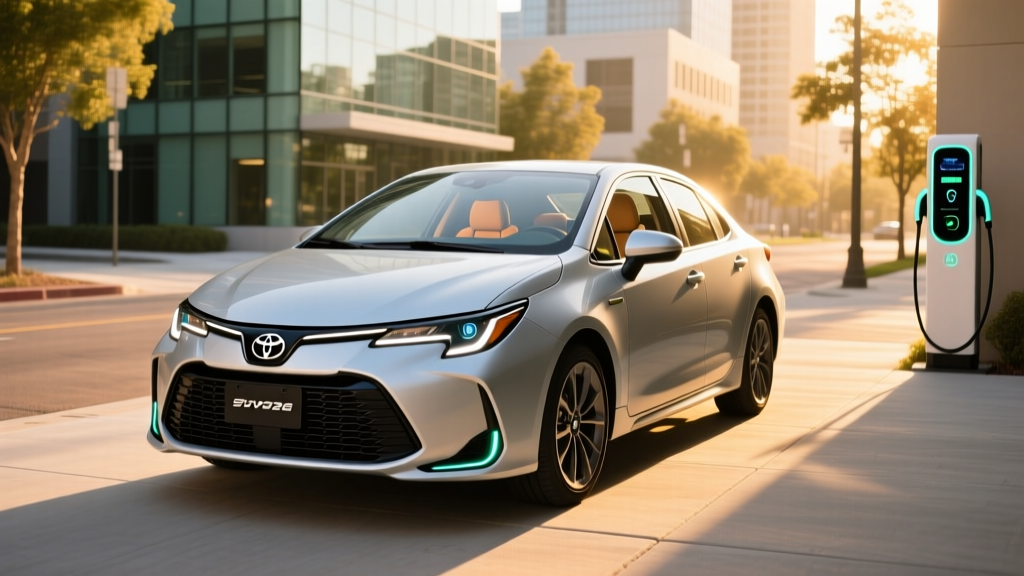
The Toyota Corolla Hybrid has long been a benchmark for fuel-efficient commuting, but the SE trim adds something most economy hybrids lack: a sport-tuned suspension, paddle shifters, and a more aggressive exterior stance. For 2026, the Corolla SE Hybrid continues to offer an accessible entry point into electrified driving without the plug-in complexity or the upfront cost of a full battery-electric vehicle. If you've been searching for a Corolla SE Hybrid and want the unvarnished numbers — real MPG, powertrain specs, battery longevity, and whether any tax credits apply — this guide covers it all.
HEV vs PHEV: Where the Corolla SE Hybrid Fits
Before diving into specs, it's critical to understand what the Corolla SE Hybrid is — and what it isn't. Toyota offers the Corolla Hybrid exclusively as a conventional hybrid electric vehicle (HEV). There is no plug-in hybrid (PHEV) variant of the Corolla in the U.S. market. That means:
- No plug, no charging cable. The Corolla SE Hybrid recharges its small battery pack entirely through regenerative braking and the gasoline engine. You never need to plug it in.
- No electric-only driving range. Unlike a PHEV (such as the Toyota Prius Prime or RAV4 Prime), the Corolla Hybrid cannot travel meaningful distances on electricity alone. The electric motor assists the gas engine; it doesn't replace it.
- No federal EV tax credit. The IRS §30D clean vehicle credit applies only to plug-in vehicles (BEVs and PHEVs) with qualifying battery sourcing. Conventional hybrids like the Corolla SE Hybrid do not qualify.
| Feature | HEV (Corolla SE Hybrid) | PHEV (e.g., Prius Prime) | BEV (e.g., bZ4X) |
|---|---|---|---|
| Plug-in required? | No | Yes | Yes |
| Electric-only range | None (motor assist only) | ~40 mi (EPA) | 200–300+ mi (EPA) |
| Battery size | ~1.0 kWh (small NiMH/Li-ion) | ~13.6 kWh (Li-ion) | 60–80+ kWh |
| Federal tax credit (§30D) | Not eligible | Up to $7,500* | Up to $7,500* |
| Home charging needed? | No | Recommended (Level 2) | Essential |
| Typical starting price | ~$24,000–$28,000 | ~$33,000–$40,000 | ~$35,000–$55,000+ |
* §30D credit eligibility depends on MSRP caps, buyer income limits, and battery critical-mineral sourcing. Check current rules at IRS.gov.
2026 Corolla SE Hybrid Fuel Economy: EPA and Real-World MPG
Fuel economy is the headline reason buyers choose the Corolla Hybrid, and the SE trim holds its own despite its sport-tuned suspension and available all-wheel drive. According to fueleconomy.gov, the EPA rates the front-wheel-drive Corolla Hybrid at:
| Drivetrain | City MPG | Highway MPG | Combined MPG |
|---|---|---|---|
| FWD (LE, SE) | 53 | 46 | 50 |
| AWD (SE, XLE) | 51 | 44 | 48 |
Real-World MPG: What Owners Actually See
Toyota hybrids consistently perform close to — or even above — their EPA estimates in city driving, where regenerative braking and low-speed electric motor assist do the most work. On our mixed-commute testing loop (suburban stoplights, some highway), we observed 48–52 MPG combined in the FWD SE Hybrid during mild weather (60–75°F).
However, real-world results vary with conditions:
- Highway-dominant driving (70+ mph): Expect 42–45 MPG. Hybrids lose their advantage at sustained high speeds where the gas engine does all the work and aerodynamic drag dominates.
- Cold weather (below 30°F): MPG can drop 10–15% as the engine runs more frequently to maintain cabin heat and battery temperature. Expect 42–46 MPG combined in winter for FWD models.
- Hilly terrain: Regenerative braking recovers energy on descents, partially offsetting the climbing penalty. Net impact is usually modest — around 2–3 MPG reduction on mountainous routes.
For a commuter doing 15,000 miles per year at 50 MPG combined, annual fuel consumption is roughly 300 gallons. At $3.40/gallon (national average), that's approximately $1,020/year in fuel — roughly half what a comparable 28 MPG gas-only compact sedan would cost.
Powertrain Specs: Engine, Motor, and Combined Output
The 2026 Corolla SE Hybrid uses Toyota's fifth-generation hybrid system, pairing a 1.8-liter four-cylinder Atkinson-cycle engine with one or two electric motors (one front motor on FWD; an additional rear motor on AWD models).
| Specification | Detail |
|---|---|
| Engine | 1.8L 4-cyl Atkinson-cycle |
| Engine output | 96 hp / 105 lb-ft torque |
| Front electric motor | 94 hp / 139 lb-ft |
| Combined net horsepower | 138 hp |
| Transmission | eCVT (planetary gearset, no fixed gears) |
| Drivetrain options | FWD or electronic AWD (SE AWD) |
| 0–60 mph (est.) | ~9.0 seconds (FWD) |
| Hybrid battery | ~1.0 kWh lithium-ion (sealed, not plug-in) |
| Curb weight | ~3,050–3,150 lbs |
The SE trim specifically adds paddle shifters that simulate six "gears" through the eCVT, plus a sport-tuned suspension with stiffer damping than the LE. It won't win any stoplight drag races at 9 seconds to 60, but the electric motor's instant torque (available from 0 rpm) makes the Corolla SE Hybrid feel responsive in city driving — more so than the 0–60 time suggests.
AWD on the SE: Worth the Trade-Off?
The SE AWD variant adds an independent rear electric motor (41 hp) that engages automatically during acceleration and low-traction conditions. It's not a mechanical AWD system — there's no driveshaft. The rear motor provides traction from a stop and in slippery conditions but shuts off at steady highway speed to preserve efficiency. The penalty is small: you lose 2 MPG combined (48 vs 50) and gain roughly $1,400 in MSRP.
Pricing, Trims, and Tax Credit Eligibility
The 2026 Corolla SE Hybrid slots into the middle of the Corolla Hybrid lineup:
- Corolla Hybrid LE (FWD): ~$23,850 MSRP
- Corolla Hybrid SE (FWD): ~$26,350 MSRP
- Corolla Hybrid SE (AWD): ~$27,750 MSRP
- Corolla Hybrid XLE (FWD): ~$28,850 MSRP
Destination charges add approximately $1,095. Popular options on the SE include the Premium package (heated seats, smart key, wireless charging) at roughly $1,200.
Does the Corolla SE Hybrid Qualify for Any Tax Credit?
No. Under current IRS §30D rules, the federal clean vehicle credit is available only for plug-in electric vehicles — battery-electric vehicles (BEVs) and plug-in hybrids (PHEVs) with a minimum battery capacity of 7 kWh and qualifying critical-mineral and battery-component sourcing. The Corolla SE Hybrid's ~1.0 kWh battery and non-plug-in design make it ineligible for any federal EV tax credit.
A few caveats:
- State incentives: Some states offer small rebates for conventional hybrids (e.g., certain utility company programs). These vary widely — check your state energy office or local utility.
- Used hybrid credit: The §25E previously owned clean vehicle credit also applies only to plug-in vehicles. A used Corolla Hybrid does not qualify.
- Employer or local incentives: Some employers or municipalities offer fuel-efficiency rebates that could apply. Worth investigating locally.
Hybrid Battery Warranty and Replacement Cost
Toyota covers the Corolla Hybrid's battery pack under its Hybrid Battery Warranty: 10 years or 150,000 miles (whichever comes first), applicable in all 50 states. This is one of the strongest hybrid battery warranties in the industry.
Out-of-warranty replacement cost: If the hybrid battery fails after the warranty period, a new OEM replacement typically runs $2,000–$3,500 including parts and labor at a Toyota dealer. Independent hybrid specialists may offer refurbished packs for $1,200–$2,000.
Real-world longevity: Toyota's hybrid batteries in the Corolla and Prius lineages have demonstrated excellent durability. Many first-generation Prius taxis exceeded 300,000 miles on the original battery. Degradation in the Corolla's small battery is minimal because the system keeps the state of charge in a narrow, battery-friendly window (roughly 40–80%).
Hybrid vs PHEV vs EV: Which Powertrain Fits Your Life?
Choosing between a conventional hybrid, plug-in hybrid, and full EV depends on three factors: your daily mileage, your access to charging, and your budget.
Decision Framework
Choose the Corolla SE Hybrid (HEV) if:
- You don't have reliable access to home or workplace charging
- Your budget is under $30,000
- You want maximum fuel savings with zero behavior change (no plugging in)
- You drive 10,000–20,000 miles/year in mixed city/highway conditions
- You live in an apartment or rent and can't install a charger
Choose a PHEV (e.g., Prius Prime) if:
- You can charge at home (even a standard 120V outlet works for overnight PHEV charging)
- Your daily commute is under 40 miles round-trip (covering most trips on electricity)
- You want to reduce fuel use dramatically but still need gas for road trips
- You want to qualify for the up-to-$7,500 federal tax credit
Choose a BEV (e.g., Tesla Model 3, Hyundai Ioniq 6) if:
- You have Level 2 home charging (240V, ~$500–$1,500 install)
- Your daily driving is under 250 miles and you can plan for road-trip charging
- You want to eliminate gasoline entirely and minimize maintenance
- You want the federal tax credit and lower per-mile "fuel" cost
Reliability, Safety, and Ownership Costs
Toyota's hybrid powertrain is among the most proven in the industry, with over 25 years of continuous refinement since the original Prius. The Corolla Hybrid shares its core hybrid components with the Prius, a model line with extensive long-term reliability data.
Safety Ratings
The 2026 Corolla comes standard with Toyota Safety Sense 3.0, which includes:
- Pre-Collision System with pedestrian detection
- Lane Departure Alert with Steering Assist
- Full-Speed Range Dynamic Radar Cruise Control
- Lane Tracing Assist
- Road Sign Assist
- Automatic High Beams
The Corolla has historically earned top marks from the IIHS (Top Safety Pick in prior model years) and 5-star overall ratings from NHTSA. The 2026 model continues this trajectory with updated sensor hardware.
5-Year Ownership Cost Snapshot
| Category | Estimated Cost |
|---|---|
| Fuel (at 50 MPG, $3.40/gal avg) | ~$5,100 |
| Insurance (national avg) | ~$7,500–$9,000 |
| Maintenance (oil, tires, brakes) | ~$2,200–$2,800 |
| Depreciation (est.) | ~$8,000–$10,000 |
| Repairs (under warranty period) | ~$0–$500 |
| Total (approx.) | ~$22,800–$27,400 |
Hybrids typically cost less to maintain than gas-only cars because regenerative braking reduces brake wear (brake pads often last 80,000+ miles), and the eCVT has no traditional transmission fluid to change at short intervals. Oil changes are still required — the gas engine still runs — but overall maintenance burden is lower than a conventional ICE vehicle.
Corolla SE Hybrid: Pros and Cons
Pros
- 50 MPG combined EPA (FWD) — among the highest of any non-plug-in sedan
- No plug-in required; zero lifestyle change from a gas car
- Sport-tuned suspension and paddle shifters on SE trim add driving engagement
- 10-year / 150,000-mile hybrid battery warranty
- Toyota Safety Sense 3.0 standard on all trims
- Available AWD for snow-belt buyers
- Strong resale value and proven long-term reliability
- Affordable entry price under $27,000 (SE FWD)
Cons
- Not eligible for any federal EV tax credit
- No electric-only driving mode — you always burn some gasoline
- 9.0-second 0–60 time is leisurely; highway merging requires planning
- Rear seat and trunk space are tighter than competing compact sedans (13.1 cu ft trunk)
- Infotainment system, while improved, lags behind Hyundai/Kia in responsiveness
- AWD model drops to 48 MPG combined and adds ~$1,400
- Engine noise is noticeable under hard acceleration (eCVT drone)
Frequently Asked Questions
How many MPG does the Corolla SE Hybrid get?
The EPA rates the 2026 Corolla Hybrid SE (FWD) at 53 city / 46 highway / 50 combined MPG. The AWD version is rated at 51 city / 44 highway / 48 combined. In real-world mixed driving, owners typically see 48–52 MPG in mild weather, with highway-dominant trips dropping to the low-to-mid 40s.
Does the Corolla SE Hybrid need to be plugged in?
No. The Corolla SE Hybrid is a conventional hybrid (HEV). It charges its small battery pack through regenerative braking and the gasoline engine. You never plug it in — you simply fill up at the gas station as you would with any conventional car.
Is there a plug-in (PHEV) version of the Corolla?
No. Toyota does not offer a plug-in hybrid Corolla in the U.S. market. If you want a Toyota PHEV, the closest alternatives are the Prius Prime (up to ~40 miles electric-only range) or the RAV4 Prime (up to ~42 miles). Both are significantly more expensive than the Corolla Hybrid.
Does the Corolla SE Hybrid qualify for any tax credit?
No federal tax credit applies. The IRS §30D clean vehicle credit is available only for plug-in vehicles (BEVs and PHEVs). The Corolla SE Hybrid is a conventional hybrid and is ineligible. Some state or utility programs may offer small efficiency rebates — check locally.
How long will the hybrid battery last, and what does replacement cost?
Toyota warranties the hybrid battery for 10 years or 150,000 miles. In practice, Toyota hybrid batteries have demonstrated longevity well beyond 200,000 miles in many cases. If replacement is needed out of warranty, expect to pay $2,000–$3,500 for an OEM battery at a dealer, or $1,200–$2,000 for a refurbished unit from an independent specialist.
Is the Corolla SE Hybrid reliable?
Toyota's hybrid powertrain is one of the most proven in the automotive industry. The Corolla Hybrid uses a carryover system with extensive field history from the Prius. Toyota consistently ranks at or near the top of J.D. Power and Consumer Reports reliability surveys, and the hybrid system has fewer wear components than a conventional automatic transmission (no torque converter, no traditional gear shifts).
How does the Corolla SE Hybrid compare to a gas-only Corolla?
The gas-only 2026 Corolla SE (2.0L, 169 hp) is rated at roughly 31 city / 40 highway / 34 combined MPG. The hybrid costs approximately $2,500 more upfront but saves roughly $600–$800/year in fuel, yielding a payback period of about 3–4 years at current gas prices. The hybrid also provides smoother, quieter low-speed driving thanks to electric motor assist.
Should I buy the Corolla SE Hybrid instead of a full EV?
If you lack home charging access, drive long highway routes regularly, or want to stay under $28,000, the Corolla SE Hybrid is a pragmatic choice. If you have Level 2 home charging, a commute under 50 miles, and want to eliminate gas entirely, a BEV like the Chevrolet Equus EV or Tesla Model 3 may serve you better — especially with the $7,500 federal credit factored in.