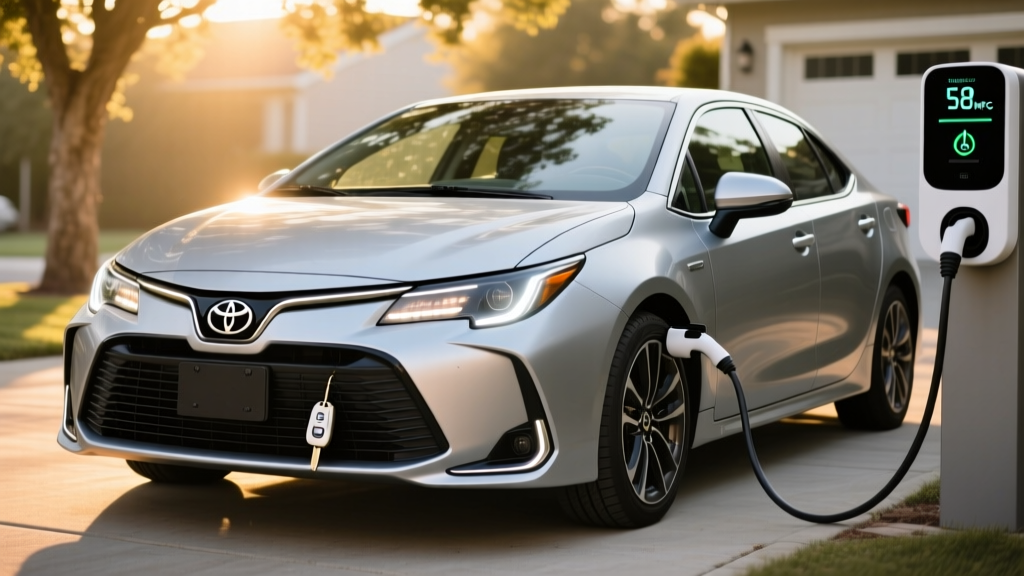
If you've been searching for Corolla Hybrid MPG numbers to decide whether Toyota's electrified compact sedan is worth your money, you're asking the right question. The 2026 Toyota Corolla Hybrid delivers an EPA-estimated 50 MPG combined — a figure that puts it among the most fuel-efficient non-plug-in vehicles sold in the United States. But sticker MPG is only half the story. Real-world driving, trim-level differences, and the AWD option all shift the numbers in ways buyers need to understand before signing a purchase agreement.
This guide breaks down every Corolla Hybrid fuel-economy figure, the powertrain behind them, battery longevity data, total cost of ownership, and how the Corolla Hybrid stacks up against plug-in hybrids and full battery-electric vehicles for different driver profiles.
Corolla Hybrid MPG: EPA Ratings by Trim
The 2026 Corolla Hybrid is offered in LE, SE, and XLE trims, with all-wheel drive (AWD) available on the LE and SE. The front-wheel-drive (FWD) LE delivers the highest fuel economy, while the AWD variants trade a small MPG penalty for added traction. Here is the full EPA breakdown from fueleconomy.gov:
| Trim | Drivetrain | City MPG | Highway MPG | Combined MPG | Annual Fuel Cost* |
|---|---|---|---|---|---|
| LE | FWD | 53 | 46 | 50 | $1,050 |
| SE | FWD | 50 | 43 | 47 | $1,150 |
| XLE | FWD | 50 | 43 | 47 | $1,150 |
| LE AWD | AWD | 51 | 44 | 48 | $1,100 |
| SE AWD | AWD | 49 | 42 | 46 | $1,150 |
*Based on 15,000 miles/year at $3.50/gallon regular unleaded. Your costs will vary with local fuel prices and driving mix.
The FWD LE's 53 MPG city rating is particularly notable. Toyota's Hybrid Synergy Drive system recovers more energy during stop-and-go driving, which is why the city number exceeds the highway number — the opposite of a conventional gas car. This makes the Corolla Hybrid exceptionally well-suited to urban and suburban commuters.
Real-World MPG: What Owners Actually Report
EPA estimates are measured on a dynamometer under controlled conditions. In practice, Corolla Hybrid owners frequently report exceeding the EPA city figure in moderate-temperature urban driving, while highway-heavy road trips tend to return slightly below the EPA highway estimate.
- City/suburban (moderate temps): 50–55 MPG — often exceeds EPA due to frequent regen braking opportunities
- Highway (65–75 mph, flat terrain): 42–46 MPG — aerodynamic drag reduces hybrid advantage at sustained speed
- Cold weather (below 30°F): 40–45 MPG combined — the engine runs more frequently to maintain cabin heat and battery temperature
- Mountainous terrain: 38–44 MPG on sustained climbs; regen recovers energy on descents
The Corolla Hybrid's 11.3-gallon fuel tank paired with the LE trim's 50 MPG combined yields a theoretical range of approximately 565 miles per tank. In mixed real-world driving, expect 480–540 miles between fill-ups — a number that eliminates range anxiety entirely without requiring any charging infrastructure.
Powertrain Specs: How the Corolla Hybrid Achieves 50 MPG
| Specification | Detail |
|---|---|
| Engine | 2.0L 4-cylinder Atkinson-cycle |
| Engine Output | 150 hp / 138 lb-ft torque |
| Electric Motor (FWD) | Permanent-magnet synchronous, integrated in transaxle |
| Electric Motor (AWD, rear) | Additional rear-mounted motor for AWD trims |
| Net Combined Horsepower | 196 hp |
| Transmission | Electronically controlled CVT (eCVT) |
| 0–60 mph | ~7.1 seconds (FWD) |
| Hybrid Battery | ~1.0 kWh lithium-ion (sealed, not plug-in) |
| Fuel Requirement | Regular unleaded (87 octane) |
The Corolla Hybrid pairs a 2.0-liter Atkinson-cycle engine — which prioritizes efficiency over peak power by keeping the intake valve open longer during the compression stroke — with one or two electric motors depending on drivetrain. The eCVT is not a belt-driven continuously variable transmission like those in some competitors; it is a planetary gearset that seamlessly blends engine and motor power with no rubber-band effect.
The 196 combined horsepower figure places the Corolla Hybrid well above the base gas Corolla (169 hp) and gives it confident highway merging ability. This is not a vehicle that feels slow in exchange for its efficiency.
Corolla Hybrid vs. Plug-In Hybrid vs. Full EV: Which Fits You?
The Corolla Hybrid is a conventional hybrid (HEV). It cannot be plugged in. It has no electric-only driving range. Its small battery charges exclusively through regenerative braking and engine-generated power. This is fundamentally different from a plug-in hybrid (PHEV) like the Toyota Prius Prime or a full battery-electric vehicle (BEV) like the Tesla Model 3.
| Factor | Corolla Hybrid (HEV) | Prius Prime (PHEV) | Model 3 (BEV) |
|---|---|---|---|
| Plug-in Required? | No | Yes (for EV range) | Yes |
| Electric-Only Range | None | ~44 miles | ~341 miles (EPA) |
| Total Range | ~565 miles | ~440+ miles combined | ~341 miles |
| Fuel/Energy Cost (per mile) | ~$0.07 | ~$0.04 (EV mode) / ~$0.08 (gas) | ~$0.03–$0.05 |
| Home Charging Needed? | No | Recommended (Level 2) | Essential (Level 2) |
| Federal Tax Credit (§30D) | Not eligible | Up to $7,500* | Up to $7,500* |
| Starting MSRP (2026) | ~$23,500 | ~$33,000 | ~$38,990 |
| Maintenance Complexity | Low (no plug, small battery) | Moderate (larger battery, charging) | Low (fewer moving parts, but tire wear) |
*§30D credit eligibility depends on buyer income, vehicle MSRP caps, battery sourcing, and critical mineral requirements. Verify current-year rules at IRS.gov. The Corolla Hybrid does not qualify because it is not a plug-in vehicle.
- Choose the Corolla Hybrid (HEV) if: You want maximum MPG with zero lifestyle change — no charging, no plug, no range planning. You drive 10,000–18,000 miles/year in mixed city/highway conditions and want the lowest total cost of entry.
- Choose a PHEV (like Prius Prime) if: You have home charging access, your daily commute is under 40 miles round-trip, and you want to drive on electricity most days while keeping a gas engine for road trips.
- Choose a full BEV if: You have reliable home Level 2 charging, your daily driving is predictable, you want the lowest per-mile energy cost, and you're ready to plan around DC fast charging on road trips.
Battery Warranty, Lifespan, and Replacement Cost
Hybrid battery longevity is the single most common concern among first-time hybrid buyers. The Corolla Hybrid's sealed lithium-ion hybrid battery is significantly smaller than a PHEV or BEV battery — roughly 1.0 kWh versus 13+ kWh in a PHEV or 60–80+ kWh in a BEV. This small capacity means each charge cycle is shallow, which dramatically reduces degradation stress.
- Coverage: 10 years / 150,000 miles (whichever comes first)
- What's covered: Hybrid battery pack, hybrid control module, and related hybrid-system components
- Capacity threshold: Toyota warrants the battery against defects and abnormal capacity loss; normal gradual reduction is expected but rarely triggers failure within the warranty period
Toyota's hybrid battery track record is among the best in the industry. Data from fleet operators, taxi services, and long-term owners of the Prius (which shares the same Hybrid Synergy Drive architecture) shows hybrid batteries routinely lasting 150,000–200,000+ miles before requiring replacement. Many first-generation Prius taxis exceeded 300,000 miles on the original battery.
If replacement is needed out of warranty, a new OEM Corolla Hybrid battery typically costs between $2,000 and $3,500 installed at a Toyota dealer. Refurbished or aftermarket options can reduce this to $1,000–$2,000. Compare this to BEV battery replacements, which can exceed $10,000–$18,000 for a full pack. The Corolla Hybrid's small battery is a financial advantage in long-term ownership.
Pricing, Trims, and Tax Credit Eligibility
| Trim | Drivetrain | MSRP (incl. destination) |
|---|---|---|
| LE | FWD | $23,500 |
| SE | FWD | $25,050 |
| XLE | FWD | $27,250 |
| LE AWD | AWD | $24,900 |
| SE AWD | AWD | $26,450 |
Federal tax credit: The Corolla Hybrid does not qualify for the IRS §30D Clean Vehicle Credit. That credit applies only to plug-in electric vehicles (PHEVs and BEVs) with a minimum battery capacity of 7 kWh. The Corolla Hybrid's ~1.0 kWh battery does not meet this threshold. No federal purchase incentive is available for conventional hybrids as of 2026.
State incentives: A small number of states offer modest rebates or HOV-lane access for hybrid vehicles, but these vary by jurisdiction and change frequently. Check your state's energy office or DMV for current programs. Do not assume state-level incentives without verifying directly.
Even without a tax credit, the Corolla Hybrid's low MSRP and fuel savings make its total cost of ownership competitive with vehicles that do qualify for credits but cost $10,000–$15,000 more upfront.
5-Year Ownership Cost Snapshot
| Category | Estimated Cost |
|---|---|
| Fuel (15,000 mi/yr, $3.50/gal, 50 MPG avg) | $5,250 |
| Insurance (national avg, clean record) | $6,500–$8,000 |
| Maintenance (oil changes, tires, brakes) | $2,000–$2,800 |
| Depreciation (estimated 5-yr) | $9,000–$11,000 |
| Total (excl. purchase price) | $22,750–$27,050 |
The Corolla Hybrid's maintenance costs are modestly higher than a BEV (which has no oil changes or spark plugs) but lower than many gas-only competitors because the hybrid system reduces brake wear through regenerative braking — brake pads often last 80,000+ miles. Toyota's reliability reputation and widely available parts keep repair costs predictable.
Pros and Cons at a Glance
- 50 MPG combined (LE FWD) — top-tier in its class
- No plug-in charging required — zero lifestyle change
- 196 hp — confident highway acceleration
- AWD available for snow/rain climates
- 10-year / 150,000-mile hybrid battery warranty
- Low MSRP starting at $23,500
- Toyota Safety Sense 3.0 standard (AEB, lane-keep, adaptive cruise)
- Proven reliability with extensive real-world track record
- No electric-only driving — always burns some fuel
- No federal tax credit eligibility
- Rear seat space is tight for taller passengers
- Cargo volume (13.1 cu ft) is average for the class
- AWD trims drop to 46–48 MPG combined
- Infotainment screen is functional but not class-leading
- Cold-weather MPG drops to low-to-mid 40s
Frequently Asked Questions
How many MPG does the Corolla Hybrid actually get in daily driving?
The EPA rates the 2026 Corolla Hybrid LE at 53 city / 46 highway / 50 combined. In real-world urban commuting, owners commonly report 50–55 MPG. Highway-only trips at 70+ mph tend to return 42–46 MPG. Cold weather (below 30°F) reduces combined economy to approximately 40–45 MPG due to increased engine runtime for cabin heating.
Does the Corolla Hybrid need to be plugged in?
No. The Corolla Hybrid is a conventional hybrid (HEV), not a plug-in hybrid. Its small battery recharges through regenerative braking and the gasoline engine. You fuel it like any other car — there is no charging port, no plug, and no electric-only driving mode.
Is the Corolla Hybrid reliable, and what does battery replacement cost?
Toyota's hybrid system has over two decades of proven reliability across millions of vehicles. The hybrid battery is warrantied for 10 years / 150,000 miles and commonly lasts well beyond that. Out-of-warranty replacement costs $2,000–$3,500 for a new OEM battery — far less than a BEV battery replacement.
Does the Corolla Hybrid qualify for any tax credit?
No. The IRS §30D Clean Vehicle Credit requires a plug-in vehicle with at least 7 kWh of battery capacity. The Corolla Hybrid's ~1.0 kWh battery does not qualify. Some states may offer minor hybrid incentives, but no federal credit is available. Check IRS.gov for current rules.
Should I get the Corolla Hybrid or the Prius?
The Prius offers slightly higher MPG (up to 57 combined) and a more distinctive design, but starts at a higher price (~$28,000). If budget is the priority and you want a conventional sedan shape, the Corolla Hybrid is the better value. If you want maximum efficiency and don't mind paying more, the Prius or Prius Prime (PHEV) may be worth the premium.
How does AWD affect Corolla Hybrid fuel economy?
The AWD system adds a rear electric motor for improved traction in rain and snow but reduces combined MPG by 2–4 miles per gallon depending on trim. The LE AWD returns 48 combined versus the LE FWD's 50. For buyers in northern climates with frequent winter weather, the traction benefit typically outweighs the small efficiency penalty.