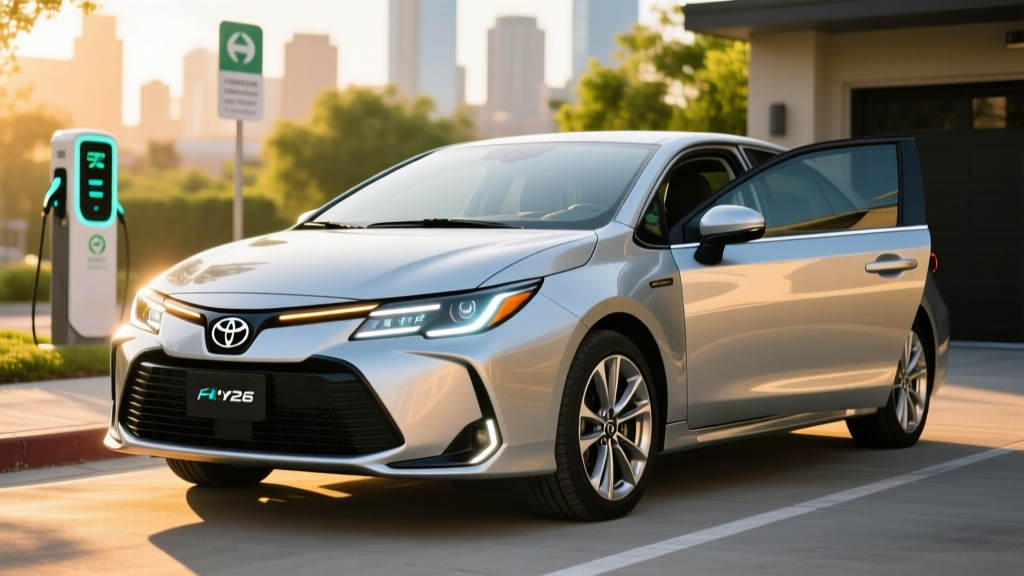
If you've searched for a Corolla Hybrid lease, you're likely weighing one of the most fuel-efficient compact sedans on the market against plug-in hybrids and full EVs. The 2026 Toyota Corolla Hybrid continues to deliver exceptional real-world fuel economy without requiring a plug, a charging routine, or a lifestyle change. But before you sign a lease, you need the exact numbers — MPG breakdowns, powertrain specs, battery warranty details, and whether any tax credits apply.
This guide covers everything a data-driven buyer needs to evaluate a Corolla Hybrid lease in 2026, including how it compares to a PHEV like the Toyota Prius Prime and a full battery-electric vehicle.
Corolla Hybrid Powertrain: What You're Getting
The 2026 Toyota Corolla Hybrid pairs a 1.8-liter four-cylinder Atkinson-cycle engine with Toyota's fifth-generation hybrid system. Two electric motor-generators work through a planetary gearset (eCVT) to deliver seamless power blending — no traditional stepped transmission, no turbo lag.
| Specification | Value |
|---|---|
| Engine | 1.8L 4-cyl Atkinson cycle |
| Combined System Horsepower | 138 hp |
| Drivetrain | FWD (AWD available) |
| Hybrid Battery | ~1.3 kWh lithium-ion (sealed, non-plug) |
| Transmission | eCVT (planetary gearset) |
| 0–60 mph (est.) | ~9.2 seconds |
| EPA Fuel Economy (FWD) | 53 city / 46 highway / 50 combined MPG |
| EPA Fuel Economy (AWD) | 51 city / 44 highway / 48 combined MPG |
| Fuel Tank | 11.4 gallons |
| Total Range (FWD, est.) | ~570 miles |
The AWD variant adds a rear-mounted electric motor for improved traction in rain and light snow, at a modest 2 MPG combined penalty. Neither version requires plugging in — the hybrid battery recharges through regenerative braking and engine-generated electricity.
EPA MPG vs. Real-World Fuel Economy
The EPA's official figures rate the FWD Corolla Hybrid at 53 city / 46 highway / 50 combined MPG. But hybrid fuel economy behaves differently than gas-only cars, and the real-world numbers deserve context.
- City driving: Many owners report 52–56 MPG in stop-and-go traffic. Hybrids thrive here — the electric motor handles low-speed propulsion and regenerative braking recaptures energy at every stop.
- Highway driving: Expect 42–46 MPG at 70–80 mph sustained. Aerodynamic drag dominates, and the engine carries most of the load.
- Cold weather (below 30°F): Plan for a 5–10% reduction (roughly 45–47 combined) as the engine runs more often for cabin heat and the battery operates less efficiently.
- Combined real-world: Most drivers land between 47–52 MPG over mixed use, with city-heavy commuters frequently exceeding the EPA estimate.
This is a key advantage over full EVs, which lose 20–30% of rated range in freezing temperatures. The Corolla Hybrid's fuel economy degrades far less in winter conditions.
Corolla Hybrid vs. Prius Prime PHEV vs. Full EV
The Corolla Hybrid is a conventional hybrid (HEV). It has no plug, no electric-only driving mode of meaningful distance, and no external charging capability. Understanding this distinction is critical before you compare it to a plug-in hybrid or battery-electric vehicle.
| Factor | Corolla Hybrid (HEV) | Prius Prime (PHEV) | Bolt EV / Model 3 (BEV) |
|---|---|---|---|
| Plug-in Required? | No | Yes (optional but beneficial) | Yes (mandatory) |
| Electric-Only Range | None (motor assists at low speed) | ~44 miles (EPA) | 250–340 miles (EPA) |
| Gasoline Use | Always blended | After battery depleted | None |
| Home Charging Needed? | No | Recommended (120V or 240V) | Yes (240V Level 2 ideal) |
| Federal Tax Credit (§30D) | Not eligible | Up to $3,750 (sourcing dependent) | Up to $7,500 (eligibility varies) |
| Best For | No plug access, long commutes | Short commute + occasional road trips | Home charging + daily driving under 250 mi |
If you have no access to a plug at home or work, the Corolla Hybrid is the clear winner. You get 50 MPG without changing a single habit. If you can charge at home and your commute is under 40 miles round-trip, a PHEV like the Prius Prime lets you drive most days on electricity while keeping a gas engine for road trips.
2026 Corolla Hybrid Lease Pricing and Incentives
Lease pricing varies by region, dealer, and credit tier, but here's the current landscape for the 2026 Corolla Hybrid:
- Base MSRP (LE Hybrid FWD): ~$23,500
- AWD upgrade: +$1,400
- Typical 36-month lease: $250–$320/month with $2,500–$3,500 due at signing (varies by money factor, residual, and regional incentives)
- Toyota lease cash: Occasionally offered at $500–$1,000 on hybrid trims — check Toyota's current national offers
One leasing advantage: you avoid long-term battery replacement risk (more on that below), and you can upgrade to a newer hybrid or EV when the lease ends.
Reliability, Battery Warranty, and Replacement Cost
Toyota's hybrid system is among the most proven in the industry, with over 25 years of continuous refinement since the original Prius. The Corolla Hybrid carries strong reliability expectations based on this track record.
- Coverage: 10 years / 150,000 miles (whichever comes first) — Toyota extended this from the previous 8-year/100,000-mile standard
- What's covered: Hybrid battery pack, hybrid control module, inverter, and related hybrid-system components
- Capacity threshold: Toyota warrants the battery against abnormal capacity loss that would prevent normal hybrid operation
The Corolla Hybrid's ~1.3 kWh lithium-ion battery pack is small and lightly stressed compared to a full EV's 60–80 kWh pack. It never deep-cycles to 0% or charges to 100% — Toyota's battery management system keeps the state of charge in a narrow 40–80% window, dramatically reducing degradation.
Battery replacement cost (out of warranty): Approximately $2,000–$3,500 for a refurbished or new hybrid battery pack, plus labor. However, failures within the first 150,000 miles are statistically rare based on Toyota's historical hybrid data. Many Prius batteries from the early 2000s are still in service beyond 200,000 miles.
During a typical 36-month lease (30,000–45,000 miles), you'll remain well within the warranty period, making battery risk essentially zero for lessees.
Who Should Lease the Corolla Hybrid?
Lease the Corolla Hybrid If:
- You lack home or workplace charging access
- Your commute involves heavy stop-and-go city traffic (where hybrids excel)
- You want 50+ MPG without any plug-in routine
- You take regular road trips exceeding 300 miles
- You want low monthly payments on a reliable, low-maintenance sedan
- You live in a region with extreme cold where EV range loss is a concern
Look Elsewhere If:
- You have home charging and want to eliminate gasoline entirely (consider a BEV)
- Your commute is under 40 miles and you want electric-only driving (consider a PHEV)
- You want federal tax credit eligibility (PHEVs and BEVs qualify; HEVs do not)
- You need more cargo space (the Corolla's 13.1 cu ft trunk is modest — consider the RAV4 Hybrid)
- You prioritize acceleration (138 hp and a 9.2-second 0–60 is adequate, not quick)
Corolla Hybrid Lease vs. Buying: The Math
Whether leasing makes financial sense depends on your mileage, how long you plan to keep the car, and your preference for monthly cash flow.
| Factor | 36-Month Lease | Purchase (60-mo loan) |
|---|---|---|
| Monthly Payment (est.) | $275–$320 | $380–$440 |
| Due at Signing | $2,500–$3,500 | $2,000–$4,000 |
| Mileage Limit | 10,000–12,000/yr (penalty ~$0.15–$0.25/mi over) | Unlimited |
| End-of-Term | Return or buy at residual | You own it outright after 60 months |
| Fuel Cost (15k mi/yr at $3.40/gal) | ~$1,020/year | ~$1,020/year |
| Best For | 3-year commitment, low monthly, always under warranty | Long-term ownership, high mileage, building equity |
At 50 MPG combined, the Corolla Hybrid costs roughly $1,020 per year in fuel at 15,000 miles and $3.40/gallon. A comparable gas-only compact sedan at 30 MPG would cost about $1,700 per year — a savings of roughly $680 annually, or $2,040 over a three-year lease.
Frequently Asked Questions
How many MPG does the Corolla Hybrid actually get?
The EPA rates the 2026 Corolla Hybrid FWD at 53 city / 46 highway / 50 combined MPG. In real-world driving, city-heavy commuters often achieve 52–56 MPG, while sustained highway driving drops to 42–46 MPG. Cold weather reduces combined economy by roughly 5–10%.
Does the Corolla Hybrid need to be plugged in?
No. The Corolla Hybrid is a conventional hybrid (HEV), not a plug-in hybrid. Its small battery recharges through regenerative braking and the gasoline engine. You simply fill it with gasoline like any other car.
Does the Corolla Hybrid qualify for any federal tax credit?
No. The IRS §30D Clean Vehicle Credit applies only to plug-in electric vehicles (PHEVs and BEVs). Conventional hybrids are not eligible. Some states may offer separate hybrid incentives — check your state energy office for current programs.
Is the Corolla Hybrid reliable? What about battery replacement?
Toyota's hybrid system is one of the most proven in the industry. The hybrid battery carries a 10-year/150,000-mile warranty. Out-of-warranty replacement costs approximately $2,000–$3,500, but failures within the warranty period are rare. During a typical 36-month lease, you'll remain fully covered.
Corolla Hybrid vs. Prius Prime — which should I lease?
Choose the Corolla Hybrid if you have no plug access, drive long distances, or want the lowest monthly payment. Choose the Prius Prime (PHEV) if you can charge at home, your daily commute is under 44 miles round-trip, and you want to drive mostly on electricity while retaining a gas engine for road trips. The Prius Prime qualifies for a partial federal tax credit (up to $3,750 depending on battery sourcing), while the Corolla Hybrid does not.
What's the difference between the Corolla Hybrid and a full EV?
A full EV (like the Chevrolet Bolt or Tesla Model 3) runs entirely on electricity with 250–340 miles of range, requires home or public charging, and qualifies for up to $7,500 in federal tax credits (eligibility varies by income, MSRP, and battery sourcing). The Corolla Hybrid uses gasoline, needs no plug, delivers 50 MPG, and has no range anxiety — but offers no electric-only driving and no federal credit.
Can I get AWD on the Corolla Hybrid?
Yes. The AWD variant adds a rear electric motor for improved traction. It costs approximately $1,400 more than the FWD model and reduces fuel economy slightly to 51 city / 44 highway / 48 combined MPG.