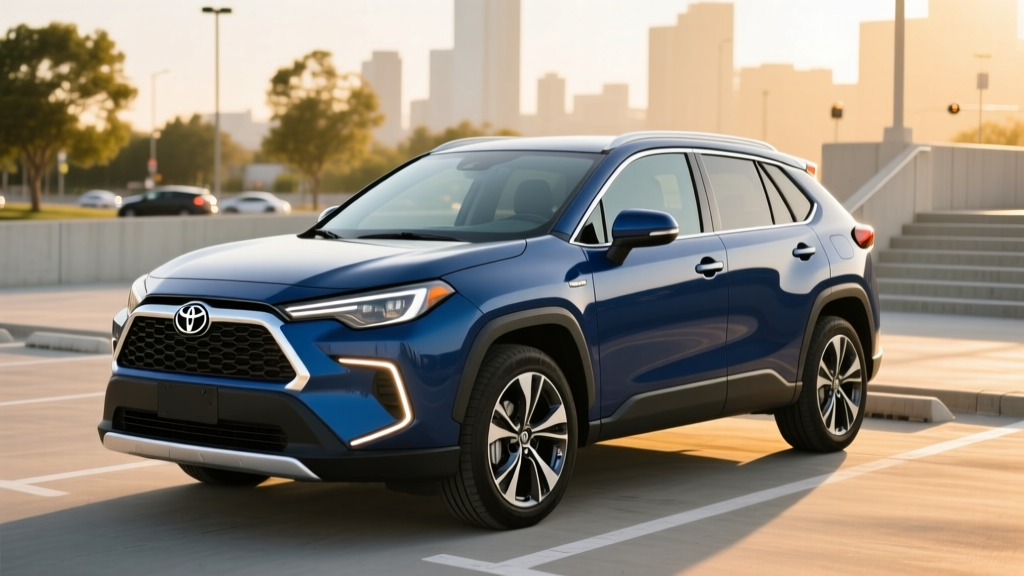
The Toyota Corolla Cross Hybrid occupies a rare sweet spot in the small crossover segment: standard all-wheel drive, a 196-horsepower hybrid powertrain, and an EPA-estimated 42 MPG combined — all in a package priced around $33,000 before options. The top-tier XSE trim adds sport-tuned suspension, a 7-inch digital instrument cluster, and premium interior materials that push it into near-luxury territory for the compact SUV class.
This guide covers the 2026 Corolla Cross XSE Hybrid in depth — powertrain specifications, real-world fuel economy, ownership costs, battery longevity, and how it stacks up against plug-in hybrids and full battery-electric vehicles for different buyer profiles.
Corolla Cross XSE Hybrid Powertrain and Performance Specs
The Corolla Cross Hybrid uses Toyota's fifth-generation hybrid system, pairing a 2.0-liter four-cylinder Atkinson-cycle engine with two electric motor-generators and a compact lithium-ion battery pack. Unlike conventional gas-only crossovers, the hybrid system recaptures energy during braking and coasting, storing it in the battery for electric-assisted acceleration.
| Specification | Value |
|---|---|
| Powertrain | 2.0L 4-cyl hybrid (5th-gen Toyota Hybrid System) |
| Combined Horsepower | 196 hp (net system output) |
| Gas Engine Output | 150 hp @ 6,000 rpm / 139 lb-ft torque |
| Electric Motors | Front + rear motor-generators (e-AWD) |
| Drivetrain | Electronic On-Demand AWD (standard on all Hybrid trims) |
| Transmission | eCVT (planetary gearset, no fixed gears) |
| Hybrid Battery | ~1.0 kWh lithium-ion (self-charging HEV) |
| EPA Fuel Economy | 45 city / 38 highway / 42 combined MPG |
| Fuel Tank Capacity | 10.6 gallons |
| Total Driving Range | ~445 miles (EPA estimate) |
| 0–60 mph | ~7.5 seconds (est.) |
| Towing Capacity | 1,500 lbs |
| Cargo Volume (rear seats up) | 25.5 cu ft |
| Cargo Volume (rear seats folded) | ~65 cu ft |
| XSE Hybrid MSRP | ~$33,500 (before destination) |
The electronic AWD system uses a dedicated rear electric motor (approximately 40 hp) that engages the rear axle automatically when slip is detected or during hard acceleration. There is no mechanical driveshaft connecting the front and rear axles — this reduces weight and packaging complexity while providing confident traction in rain and light snow.
Fuel Economy: EPA Ratings vs. Real-World MPG
The EPA rates the 2026 Corolla Cross Hybrid at 45 MPG city, 38 MPG highway, and 42 MPG combined across all trims including the XSE. These figures are identical regardless of trim because the powertrain and curb weight differences between trims are negligible for EPA testing purposes. Data is published on fueleconomy.gov.
| Driving Cycle | EPA MPG | Real-World Expectation |
|---|---|---|
| City | 45 MPG | 43–48 MPG (hybrids excel in stop-and-go) |
| Highway | 38 MPG | 35–40 MPG (varies with speed and wind) |
| Combined | 42 MPG | 39–44 MPG (depends on driving mix) |
Hybrids consistently outperform their EPA city ratings in real-world stop-and-go driving because regenerative braking recovers energy that a conventional vehicle wastes as heat. Owners who drive primarily in urban and suburban conditions frequently report 44–48 MPG. Highway-only driving at 75+ mph reduces efficiency to the mid-30s, as aerodynamic drag dominates and the electric motor contributes less at sustained high speeds.
Cold weather reduces fuel economy by roughly 5–10% in winter months due to longer engine warm-up cycles (the engine must run to heat the cabin in a hybrid without a standard heat pump) and increased rolling resistance from winter tires. Expect 36–40 MPG combined in freezing conditions.
HEV vs. PHEV vs. EV: Which Powertrain Fits You?
The Corolla Cross Hybrid is a conventional hybrid electric vehicle (HEV). It cannot be plugged in. The small ~1.0 kWh battery charges exclusively through regenerative braking and the gas engine. This is fundamentally different from a plug-in hybrid (PHEV) or a battery-electric vehicle (BEV).
| Feature | HEV (Corolla Cross Hybrid) | PHEV (e.g., RAV4 Prime) | BEV (e.g., Tesla Model Y) |
|---|---|---|---|
| Plug-in Charging? | No — self-charging | Yes — 2.5–6.6 kW AC | Yes — up to 250 kW DC |
| Electric-Only Range | ~1 mile at low speed | 25–42 miles typical | 250–330+ miles |
| Total Range | ~445 miles | 400–500+ miles | 250–330+ miles |
| Fuel/Charging Needed | Gas station only | Gas + optional plug-in | Electricity only |
| Federal Tax Credit | Not eligible (§30D) | Up to $7,500 (if eligible) | Up to $7,500 (if eligible) |
| Home Charging Install | Not required | Optional but recommended | Required for daily use |
| Best For | No charging access, simple ownership | Short commute + home charging | Home charging + mostly electric driving |
If you lack access to home or workplace charging, the Corolla Cross Hybrid is the most practical electrified option. You get meaningful fuel savings (roughly 40% better MPG than a comparable gas-only crossover) without any infrastructure requirements. If you do have a garage outlet and a short commute, a PHEV like the RAV4 Prime lets you drive 42 miles on electricity before the gas engine engages — but at a $10,000+ price premium.
2026 Corolla Cross XSE Hybrid Pricing and Tax Credit Eligibility
The 2026 Corolla Cross XSE Hybrid carries an MSRP of approximately $33,500 before the $1,350 destination charge. Fully loaded with options (premium audio, panoramic roof, advanced park assist), expect a sticker around $36,000–$37,000.
Lower trims are more affordable: the S Hybrid starts around $29,500 and the SE Hybrid around $31,500. All hybrid trims come standard with AWD.
Federal Tax Credit: Not Eligible Under §30D
The Corolla Cross Hybrid does not qualify for the federal §30D Clean Vehicle Credit. Under current IRS rules, the §30D credit applies only to plug-in electric vehicles (PHEVs and BEVs) with a minimum battery capacity of 7 kWh. The Corolla Cross Hybrid's ~1.0 kWh battery is far below this threshold.
Some states offer separate incentives for conventional hybrids, but these are increasingly rare as state programs shift focus to plug-in vehicles. Check your state's energy office or department of environmental quality for current programs.
Cost-per-Mile Comparison
Even without a tax credit, the Corolla Cross Hybrid delivers strong operating economics. At $3.25/gallon and 42 MPG combined, fuel cost is approximately $0.077 per mile. A comparable gas-only small crossover averaging 28 MPG would cost $0.116 per mile — a difference of roughly $390 per year at 10,000 miles annually.
Hybrid Battery Warranty, Longevity, and Replacement Cost
Battery lifespan is consistently the top concern for hybrid buyers. Toyota provides robust coverage:
Toyota Hybrid Battery Warranty
- Hybrid Battery: 10 years / 150,000 miles (whichever comes first) — covers capacity loss and defects
- Hybrid System Components: 8 years / 100,000 miles (inverter, motor-generators, control module)
- Basic Vehicle Warranty: 3 years / 36,000 miles
- Powertrain Warranty: 5 years / 60,000 miles
Toyota's fifth-generation hybrid system uses a smaller, lighter lithium-ion battery pack compared to the nickel-metal hydride packs in older models. Real-world data from millions of Toyota hybrids on the road shows that these packs routinely last 150,000–200,000+ miles before significant degradation. Unlike a BEV's large traction battery, the Corolla Cross Hybrid's small pack operates within a narrow state-of-charge window (roughly 40–80%), which dramatically reduces stress and extends cycle life.
If replacement is needed out of warranty, a new OEM hybrid battery pack typically costs $2,000–$3,500 including labor. Third-party refurbished packs are available for $1,000–$1,800. This is a fraction of BEV battery replacement costs, which can exceed $10,000–$20,000.
Driving Impressions, Safety, and XSE Trim Features
The XSE trim distinguishes itself with a sport-tuned suspension, 18-inch alloy wheels, a leather-trimmed steering wheel, heated front seats, and a 7-inch digital instrument cluster. The ride is firmer than lower trims but remains compliant over rough pavement — Toyota has balanced the sport intent with daily-driver comfort.
The 196 hp system output provides adequate acceleration for highway merging and passing. The eCVT operates smoothly without the gear-hunting feel of some conventional automatics, though it does produce a noticeable drone under hard acceleration — a characteristic of the planetary gearset design, not a defect.
Toyota Safety Sense 3.0 is standard across all trims and includes:
- Pre-Collision System with Pedestrian Detection
- Full-Speed Range Dynamic Radar Cruise Control
- Lane Departure Alert with Steering Assist
- Lane Tracing Assist
- Automatic High Beams
- Road Sign Assist
These are SAE Level 2 driver-assistance features — the driver must remain fully engaged with hands on the wheel and eyes on the road at all times. This is not autonomous or self-driving capability. For detailed safety ratings, refer to NHTSA and IIHS when 2026 model-year crash test results are published.
Who Should Buy the Corolla Cross XSE Hybrid?
Decision Framework
Choose the Corolla Cross XSE Hybrid if:
- You want a compact AWD crossover with the lowest fuel cost in its class
- You lack access to home or workplace charging (apartment, street parking)
- You want Toyota's proven hybrid reliability with a 10-year battery warranty
- You value a premium-feeling interior at a sub-$37,000 price point
- You drive 10,000–15,000 miles/year and want to minimize fuel spend without the upfront cost of a PHEV or BEV
Consider a PHEV or BEV instead if:
- You have home charging and a commute under 40 miles (a PHEV like the RAV4 Prime covers most trips on electricity)
- You want to qualify for the $7,500 federal tax credit (requires a plug-in vehicle meeting §30D sourcing and income rules)
- You want to eliminate gasoline use entirely (BEV)
- You regularly tow more than 1,500 lbs (consider a larger hybrid or PHEV SUV)
Pros
- 42 MPG combined with standard AWD — best in the small crossover class
- No plug-in charging required; works with existing gas-station infrastructure
- 10-year / 150,000-mile hybrid battery warranty
- 196 hp provides confident highway passing
- XSE trim offers premium features at a mainstream price
- Toyota's long-standing hybrid reliability track record
Cons
- Not eligible for federal §30D tax credit
- Small ~1.0 kWh battery means no meaningful electric-only driving
- Cargo space (25.5 cu ft) trails some gas-only competitors
- eCVT drone under hard acceleration
- 1,500-lb towing capacity is limited for the class
- XSE pricing pushes close to larger, more capable hybrid SUVs
Frequently Asked Questions
How many MPG does the Corolla Cross XSE Hybrid get?
The EPA rates the 2026 Corolla Cross Hybrid (all trims including XSE) at 45 MPG city, 38 MPG highway, and 42 MPG combined. Real-world city driving often yields 44–48 MPG thanks to regenerative braking, while sustained highway driving at 75+ mph may drop to the mid-30s.
Can you plug in the Corolla Cross Hybrid to charge?
No. The Corolla Cross Hybrid is a conventional HEV — it has no plug and no charging port. The hybrid battery recharges through regenerative braking and the gas engine. You fuel it exclusively at a gas station, exactly like a conventional car.
How far can the Corolla Cross Hybrid drive on electric only?
Approximately 1 mile at very low speeds (under 25 mph) in EV mode, typically in parking lots or stop-and-go traffic. This is not a plug-in hybrid and is not designed for meaningful electric-only driving. If electric-only commuting is a priority, look at a PHEV like the Toyota RAV4 Prime (42 miles electric) or a BEV.
Is the Corolla Cross Hybrid reliable? What does battery replacement cost?
Toyota's hybrid system has an exceptional reliability record spanning over two decades and millions of vehicles. The hybrid battery is warranted for 10 years / 150,000 miles. Out-of-warranty replacement costs $2,000–$3,500 for an OEM pack, or $1,000–$1,800 for a refurbished unit. Most owners never need a replacement within the vehicle's normal lifespan.
Does the Corolla Cross Hybrid qualify for any tax credit?
No. The federal §30D Clean Vehicle Credit requires a plug-in vehicle with at least 7 kWh of battery capacity. The Corolla Cross Hybrid's ~1.0 kWh battery does not qualify. Some states may offer minor hybrid incentives — check your state energy office for current programs.
How does the XSE trim differ from the SE and S Hybrid trims?
The XSE adds a sport-tuned suspension, 18-inch alloy wheels, SofTex-trimmed heated front seats, a leather-wrapped steering wheel, a 7-inch digital instrument cluster, ambient interior lighting, and a power-adjustable driver's seat. The SE offers many of these features without the sport suspension and digital cluster. The S is the base hybrid with cloth seats and fewer premium amenities.
Is AWD standard on every Corolla Cross Hybrid trim?
Yes. All 2026 Corolla Cross Hybrid trims (S, SE, XSE) come standard with Toyota's electronic on-demand AWD using a dedicated rear electric motor. There is no front-wheel-drive hybrid variant.