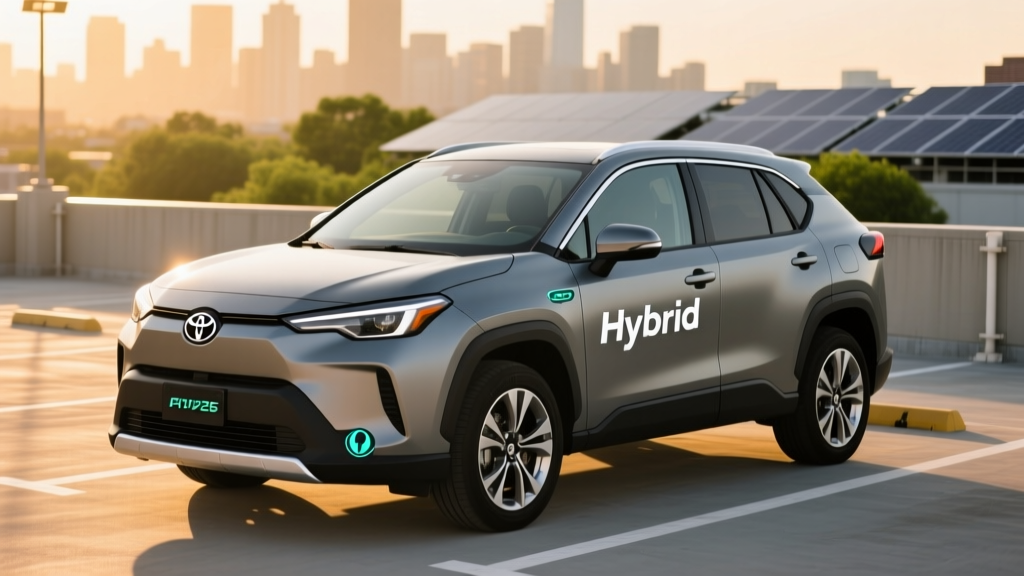
The 2026 Toyota Corolla Cross Hybrid SUV occupies a specific niche: it's one of the few compact crossovers that delivers genuinely low fuel consumption without requiring a plug, a home charger installation, or any change in daily habits. For buyers who want crossover practicality with sedan-like efficiency but aren't ready to commit to a full battery-electric vehicle, the Corolla Cross Hybrid makes a compelling mathematical case.
Unlike a plug-in hybrid (PHEV) or a full EV, this is a conventional hybrid electric vehicle (HEV). It charges its own small battery through regenerative braking and the gasoline engine. You never plug it in. You simply fill it with gas and drive — but you'll visit the gas station far less often than with a non-hybrid competitor.
HEV vs PHEV vs EV: What the Corolla Cross Hybrid Actually Is
Before diving into specs, it's worth clarifying exactly what you're buying, because the terminology matters for your wallet and daily routine.
| Feature | Corolla Cross Hybrid (HEV) | Typical PHEV (e.g., RAV4 Prime) | Full EV (e.g., bZ4X) |
|---|---|---|---|
| Plug-in charging required? | No | Yes (for max benefit) | Yes (mandatory) |
| Electric-only range | ~1 mile (low-speed creep) | 35-42 miles | 220-300+ miles |
| Total range | ~450 miles | ~440 miles (EV + gas) | 220-300 miles |
| Federal tax credit (§30D) | No | Up to $7,500 (if eligible) | Up to $7,500 (if eligible) |
| Home charger needed? | No | Recommended (Level 2) | Essential (Level 2) |
| Battery size | ~1.3 kWh (nickel-metal hydride) | ~18.1 kWh (lithium-ion) | ~71.4 kWh (lithium-ion) |
The Corolla Cross Hybrid is an HEV. Its battery is small and self-charging. If you want electric-only commuting, you need a PHEV or EV. If you want to eliminate plug-in infrastructure concerns entirely, the HEV is the right tool.
Fuel Economy: EPA Ratings and Real-World MPG
The headline number for the 2026 Corolla Cross Hybrid is its EPA-rated fuel economy. With standard electronic all-wheel drive (AWD), the ratings are:
| Driving Cycle | EPA Rating | Real-World Expectation |
|---|---|---|
| City | 45 MPG | 46-50 MPG (hybrids excel in stop-and-go) |
| Highway | 38 MPG | 35-38 MPG (less regen benefit at steady speed) |
| Combined | 42 MPG | 40-44 MPG (varies with driving mix) |
A critical characteristic of all Toyota hybrids: city MPG often exceeds highway MPG. This is the inverse of a conventional gas car, and it's because the hybrid system recovers kinetic energy during braking and low-speed driving that would otherwise be wasted as heat. If your commute involves significant stop-and-go traffic, you'll likely beat the EPA combined rating. If you drive predominantly highway miles at 75-80 mph, expect to fall slightly below it.
With a 10.6-gallon fuel tank, total range works out to approximately 445 miles between fill-ups — comparable to most compact gas crossovers, but with roughly 30-35% fewer fuel stops annually for the average driver covering 12,000 miles per year.
Powertrain Specs: What Powers the Corolla Cross Hybrid
| Specification | Value |
|---|---|
| Engine | 2.0L 4-cylinder Atkinson-cycle |
| Engine output | 150 hp / 139 lb-ft torque |
| Electric motor (front) | 83 kW (111 hp) |
| Electric motor (rear, AWD) | 30 kW (40 hp) |
| Net combined system horsepower | 196 hp |
| Transmission | Electronic CVT (eCVT) |
| Drivetrain | Electronic AWD (standard) |
| 0-60 mph | ~7.5 seconds |
| Hybrid battery | ~1.3 kWh, nickel-metal hydride (NiMH) |
| Towing capacity | Not rated (not recommended) |
The 196 combined horsepower figure represents a meaningful upgrade over the non-hybrid Corolla Cross (169 hp from its 2.0L engine alone). The electric motors provide instant torque fill at low RPMs, which makes the hybrid feel noticeably quicker in city driving and highway merging, even though the 0-60 time isn't sports-car quick. The rear electric motor enables the electronic AWD system — there's no mechanical driveshaft to the rear wheels. Instead, the rear motor engages when slip is detected or under hard acceleration, providing traction without the weight and friction losses of a traditional AWD system.
Pricing, Trims, and Tax Credit Eligibility
For the 2026 model year, the Corolla Cross Hybrid is offered in three trims:
| Trim | MSRP | Key Features |
|---|---|---|
| S | $30,550 | AWD, 8" touchscreen, Toyota Safety Sense 3.0, 17" alloy wheels |
| SE | $32,050 | Sport-tuned suspension, 18" wheels, heated front seats, dual-zone climate |
| XSE | $34,200 | SofTex seats, 10.5" display, wireless CarPlay/Android Auto, JBL audio |
No. The IRS §30D Clean Vehicle Credit applies only to plug-in electric vehicles (PHEVs and BEVs) with sufficient battery capacity. Conventional hybrids like the Corolla Cross Hybrid do not qualify for the federal purchase credit. Some states may offer modest incentives for hybrid purchases — check your state's energy office or department of revenue for current programs.
The pricing gap between the hybrid and the gas-only Corolla Cross (starting around $25,000) is roughly $5,500. At 42 MPG combined vs. 32 MPG for the AWD gas model, and with gas at $3.50/gallon, the hybrid saves approximately $350-$400 per year in fuel for a driver covering 12,000 miles annually. The fuel-cost payback period is roughly 13-15 years at current prices — meaning the hybrid's value proposition isn't purely financial for moderate-mileage drivers. It becomes compelling at higher annual mileage (18,000+ miles/year) or if fuel prices rise significantly.
Hybrid Battery Warranty, Lifespan, and Replacement Cost
Battery longevity is the single most common concern among first-time hybrid buyers. Here are the facts specific to the Corolla Cross Hybrid:
| Item | Detail |
|---|---|
| Hybrid battery warranty | 10 years / 150,000 miles (whichever comes first) |
| Hybrid system warranty | 8 years / 100,000 miles |
| Battery chemistry | Nickel-metal hydride (NiMH) |
| Expected lifespan | 150,000-200,000+ miles based on Toyota hybrid fleet data |
| Replacement cost (out of warranty) | $2,000-$3,500 (battery pack) + $500-$800 labor |
Toyota's hybrid battery track record is well-documented across the Prius fleet, which has accumulated billions of real-world miles since 2000. The NiMH chemistry used in the Corolla Cross Hybrid is less energy-dense than the lithium-ion packs in EVs, but it's extremely durable and tolerant of the shallow charge-discharge cycles that characterize hybrid operation. The battery management system keeps the pack in a narrow state-of-charge window (roughly 40-80%), which dramatically reduces degradation compared to an EV battery that regularly cycles from 10-90%.
In practice, most Toyota hybrid batteries outlast the vehicle itself. When replacement is eventually needed, refurbished and aftermarket NiMH packs have driven costs well below the original-equipment price. A full dealer replacement typically runs $2,500-$4,000 installed; independent hybrid specialists can often perform the swap for $2,000-$2,800.
Real-World Ownership: What It's Actually Like to Live With
The Corolla Cross Hybrid doesn't require any behavioral change. There's no plug to connect, no charging app to manage, no range to monitor. You drive it exactly like a conventional car, and the hybrid system operates transparently in the background.
Where owners notice the difference:
- Fuel stops: Roughly 10-12 fill-ups per year (12,000-mile driver) vs. 14-16 for the gas model
- City driving feel: The electric motor provides smooth, quiet acceleration from stops — no turbo lag, no transmission hunting
- Brake feel: Regenerative braking blends with friction brakes; Toyota's transition is among the smoothest in the industry, though some drivers notice a slightly different pedal feel vs. a non-hybrid
- Cold-weather MPG: Hybrids lose some efficiency in freezing temperatures (the engine runs more often to provide cabin heat), but the penalty is modest — expect 38-40 MPG combined in winter vs. 42-44 in mild weather
- Cargo space: 25.5 cubic feet behind the rear seats, 61.8 cu ft with seats folded — slightly less than the gas model due to hybrid battery packaging under the rear seat
Pros
- 42 MPG combined with standard AWD — no plug required
- 196 hp provides confident merging and passing
- 10-year/150,000-mile hybrid battery warranty
- Toyota Safety Sense 3.0 standard (adaptive cruise, lane centering, auto emergency braking)
- Low maintenance costs (no plug, no complex charging hardware)
- Strong resale value — Toyota hybrids hold value well
Cons
- No federal tax credit (HEV, not PHEV/EV)
- $5,500 premium over gas model; long payback period at moderate mileage
- CVT drone under hard acceleration (common to all Toyota hybrids)
- Rear seat and cargo space slightly compromised vs. gas model
- Not rated for towing
- Infotainment and interior materials are functional, not premium
Corolla Cross Hybrid vs. Alternatives: Which Is Right for You?
Choose the Corolla Cross Hybrid if:
- You lack access to home or workplace charging (apartment, street parking, no garage)
- You want maximum fuel efficiency with zero lifestyle change
- You drive 15,000+ miles per year and want to reduce fuel costs without an EV
- You live in a region with extreme cold where EV range loss is a concern
- You want Toyota's proven hybrid reliability and strong resale value
Choose a PHEV (like the RAV4 Prime or Prius Prime) if:
- You can install a Level 2 home charger and have a short commute (under 40 miles)
- You want to drive most days on electricity but keep gas for road trips
- You qualify for the §30D tax credit (income under $150K single / $300K joint; vehicle meets MSRP and sourcing rules)
Choose a full EV if:
- You have reliable home Level 2 charging
- Your daily driving is under 200 miles and you can plan for road trips
- You want the lowest per-mile energy cost and minimal maintenance
- You qualify for federal and state EV incentives that offset the higher purchase price
Frequently Asked Questions
How many MPG does the 2026 Corolla Cross Hybrid get?
The EPA rates it at 45 city / 38 highway / 42 combined MPG. In real-world driving, city-heavy commuters often achieve 46-50 MPG, while highway-dominant drivers should expect 35-38 MPG. Cold weather reduces efficiency modestly to around 38-40 combined.
Do I need to plug in the Corolla Cross Hybrid?
No. This is a conventional hybrid (HEV), not a plug-in hybrid (PHEV). The battery recharges through regenerative braking and the gasoline engine. You never plug it in — you only refuel with gasoline.
How far can the Corolla Cross Hybrid drive on electric power alone?
Effectively about one mile at very low speeds (under 25 mph) in EV mode. This is not a vehicle designed for electric-only commuting — that's the role of a PHEV or full EV. The hybrid system uses the electric motor to assist the gas engine and recover energy, not to replace it.
Is the Corolla Cross Hybrid reliable, and what will battery replacement cost?
Toyota's hybrid powertrain has an extensive reliability record spanning over two decades and millions of vehicles. The hybrid battery is warranted for 10 years / 150,000 miles. Based on fleet data, most Toyota hybrid batteries last 150,000-200,000+ miles. If replacement is needed out of warranty, expect $2,000-$4,000 installed depending on whether you use a dealer or independent hybrid specialist.
Does the Corolla Cross Hybrid qualify for any tax credit?
No. The federal §30D Clean Vehicle Credit applies only to plug-in vehicles (PHEVs and BEVs). Conventional hybrids do not qualify. Check your state's energy office for any local hybrid incentives, as some states offer modest rebates, though these are increasingly targeted at plug-in vehicles.
How does the Corolla Cross Hybrid compare to the RAV4 Hybrid?
The RAV4 Hybrid is larger (midsize vs. compact), offers more cargo space (37.6 vs. 25.5 cu ft), and gets similar fuel economy (41 MPG combined). It starts roughly $3,000-$4,000 higher. If you need the extra space and don't mind the price bump, the RAV4 Hybrid is the segment benchmark. If compact dimensions and a lower entry price matter more, the Corolla Cross Hybrid fills that gap.
Is the Corolla Cross Hybrid good for road trips?
Yes. With ~445 miles of total range and the ability to refuel at any gas station in under five minutes, it's one of the most road-trip-friendly vehicles in the electrified segment. You'll stop less frequently than in a gas-only crossover, and you won't need to plan around charging infrastructure.
Sources: EPA Fuel Economy, Toyota Corolla Cross Hybrid, IRS §30D Clean Vehicle Credit. Pricing and specifications reflect 2026 model year data available at time of publication; confirm with your local dealer.