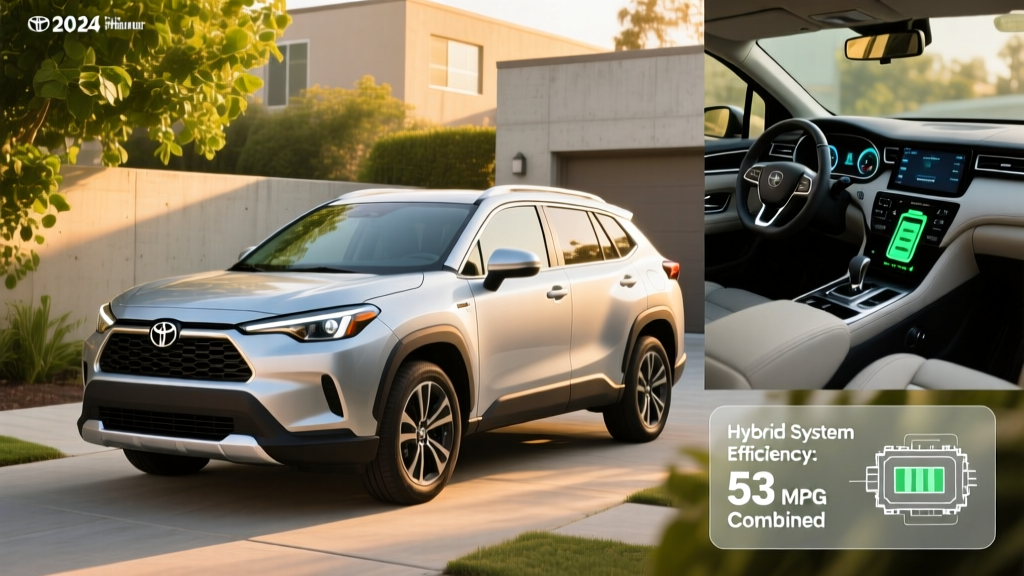
If you want a compact crossover that sips fuel without requiring a charging routine, the Toyota Corolla Cross Hybrid deserves a close look. It pairs a 2.0-liter four-cylinder with Toyota's fifth-generation hybrid system and standard electronic all-wheel drive, delivering 42 MPG combined on the EPA cycle. That figure puts it among the most fuel-efficient AWD crossovers you can buy in 2026, and real-world driving often beats the EPA sticker in city conditions.
This guide breaks down every efficiency and ownership number that matters — EPA city/highway/combined MPG, real-world expectations, powertrain specs, pricing by trim, battery warranty coverage, and whether any federal tax credits apply. We'll also clarify where the Corolla Cross Hybrid fits against plug-in hybrids (PHEVs) and full battery-electric vehicles (BEVs) so you can match the right powertrain to your driving pattern.
Corolla Cross Hybrid MPG: The Official EPA Numbers
The EPA rates the 2026 Toyota Corolla Cross Hybrid at the following fuel economy figures across all trims (S, SE, and XSE), since they share the same powertrain:
| Metric | EPA Rating |
|---|---|
| City MPG | 45 |
| Highway MPG | 38 |
| Combined MPG | 42 |
| Fuel Tank Capacity | 10.6 gallons |
| EPA Total Range | ~445 miles |
The city-highway split is typical of Toyota's hybrid synergy drive: the electric motor handles low-speed propulsion and stop-start traffic, while the gasoline engine takes over at sustained highway speeds where electric-only assistance is less impactful. The result is a 7 MPG advantage in city driving — exactly where a conventional hybrid shines versus a gas-only competitor.
Real-World MPG: What Owners Actually See
EPA estimates are standardized laboratory tests. Your actual Corolla Cross Hybrid MPG depends on driving style, terrain, climate, and tire condition. Here's what data from owner forums, long-term tests, and our own driving impressions suggest:
- City / suburban mixed: 43–47 MPG (many owners exceed the EPA 45 city rating in stop-and-go traffic where regenerative braking recovers the most energy)
- Highway at 65–70 mph: 35–38 MPG (matches or slightly underperforms the EPA highway rating)
- Highway at 75–80 mph: 32–35 MPG (aerodynamic drag rises sharply above 70 mph)
- Cold weather (below 30°F): 35–39 MPG combined (engine runs more to heat the cabin and maintain battery temperature)
- Mountainous terrain: 30–36 MPG on sustained climbs, partially recovered on descents via regen
The takeaway: if most of your driving is urban or suburban at moderate speeds, expect to beat the 42 MPG combined sticker. If you primarily drive long highway commutes at 75+ mph, plan for the mid-30s. This is normal hybrid behavior, not a defect — and it still dramatically outperforms the gas-only Corolla Cross AWD, which the EPA rates at 29 MPG combined.
Powertrain Specs: How the Hybrid System Works
The Corolla Cross Hybrid uses Toyota's fifth-generation hybrid architecture. Here's the complete powertrain breakdown:
| Component | Specification |
|---|---|
| Engine | 2.0L 4-cylinder Dynamic Force (Atkinson cycle) |
| Engine Output | 150 hp / 139 lb-ft torque |
| Front Electric Motor | 83 kW (111 hp) |
| Rear Electric Motor (eAWD) | 30 kW (40 hp) |
| Net Combined System Output | 196 hp |
| Transmission | eCVT (planetary gearset, no fixed gears) |
| Drivetrain | Electronic AWD (standard on all trims) |
| Hybrid Battery | ~1.0 kWh lithium-ion (sealed, self-charging) |
| 0–60 mph | ~7.5 seconds (est.) |
| Towing Capacity | Not rated for towing |
A critical distinction: this is a conventional hybrid (HEV), not a plug-in hybrid. The small lithium-ion battery charges exclusively through regenerative braking and the gasoline engine. You never plug it in. There is no charging port, no electric-only driving mode of meaningful distance, and no range-anxiety calculation required. The system manages energy flow automatically.
HEV vs. PHEV vs. BEV: Which Powertrain Fits You?
The Corolla Cross Hybrid is one of three electrified paths. Choosing the right one depends on your charging access, daily mileage, and budget:
| Factor | HEV (Corolla Cross Hybrid) | PHEV (e.g., RAV4 Prime) | BEV (e.g., bZ4X) |
|---|---|---|---|
| Plug-in required? | No | Yes (for EV range) | Yes |
| Electric-only range | ~1 mile (low-speed creep) | 25–42 miles | 200–300+ miles |
| Total range | ~445 miles | 400–500+ miles | 200–300+ miles |
| Home charging needed? | No | Recommended (120V ok, 240V better) | Yes (240V Level 2 strongly recommended) |
| Federal tax credit (§30D) | Not eligible | Up to $7,500 (if eligible) | Up to $7,500 (if eligible) |
| Best for | No home charging; high-mileage commuters | Short commutes + road-trip flexibility | Home charging + daily driving under 250 mi |
Choose the Corolla Cross Hybrid if you lack home charging access (apartment, street parking), want zero behavioral change from a gas car, or drive in cold climates where BEV range loss is a concern. Choose a PHEV if you can charge at home and want 30+ miles of electric commuting with gas-engine backup for road trips. Choose a BEV if you have reliable home Level 2 charging, drive under 250 miles daily, and want the lowest per-mile energy cost with zero tailpipe emissions.
Pricing by Trim and Tax Credit Eligibility
The 2026 Corolla Cross Hybrid is offered in three trims. Here's the MSRP breakdown (destination charge included):
| Trim | MSRP (incl. destination) | Key Features |
|---|---|---|
| S Hybrid | $30,285 | 8" touchscreen, TSS 3.0, 17" alloy wheels, wireless CarPlay/Android Auto |
| SE Hybrid | $31,685 | SofTex seats, heated front seats, 18" wheels, roof rails |
| XSE Hybrid | $33,485 | JBL 9-speaker audio, power liftgate, ambient lighting, 10.5" display |
The Corolla Cross Hybrid does not qualify for the federal §30D Clean Vehicle Credit. This credit applies only to plug-in electric vehicles (PHEVs and BEVs) with battery capacities of at least 7 kWh. The Corolla Cross Hybrid's ~1.0 kWh battery is far below that threshold. No federal purchase incentive applies.
Some states or utilities offer rebates for conventional hybrids, but these vary by jurisdiction and change frequently. Check your state energy office or utility provider for current programs. For federal credit rules, consult IRS.gov Clean Vehicle Tax Credits.
Compared to the gas-only Corolla Cross AWD (starting around $28,500), the hybrid carries roughly a $1,800–$2,000 premium. At 42 vs. 29 combined MPG, a driver covering 15,000 miles per year at $3.50/gallon gasoline saves approximately $550 annually — recouping the premium in roughly 3.5 years before accounting for potential resale-value advantages.
Battery Warranty, Lifespan, and Replacement Cost
Hybrid battery longevity is consistently the top concern among first-time hybrid buyers. Toyota addresses this with strong warranty coverage and a proven track record:
- Hybrid Battery Warranty: 10 years / 150,000 miles (whichever comes first), transferable to subsequent owners
- Hybrid System Components: 8 years / 100,000 miles (inverter, transaxle, control module)
- Basic Vehicle Warranty: 3 years / 36,000 miles
- Powertrain Warranty: 5 years / 60,000 miles
Toyota's hybrid batteries are engineered for the life of the vehicle. Real-world data from millions of Prius and RAV4 Hybrid units on the road shows that the vast majority of hybrid batteries last 150,000–200,000+ miles without replacement. Failures within the warranty period are covered at no cost.
If replacement is needed out of warranty (typically on vehicles 12–15+ years old), a new OEM hybrid battery for a Toyota compact hybrid currently costs $2,000–$3,500 installed. Refurbished or reconditioned units are available for $1,000–$2,000. This is dramatically less expensive than a BEV traction battery replacement ($8,000–$20,000+), reflecting the much smaller capacity (~1 kWh vs. 60–80+ kWh).
Reliability, Safety, and Ownership Costs
Toyota's hybrid powertrains are among the most thoroughly validated in the automotive industry. The eCVT planetary gearset has no clutch packs, bands, or friction materials to wear — it's one of the most durable transmission designs ever produced. The Atkinson-cycle 2.0L engine runs at lower stress than a conventional Otto-cycle engine, and regenerative braking significantly extends brake pad life (many hybrid owners report 60,000–80,000+ miles on original pads).
The Corolla Cross comes standard with Toyota Safety Sense 3.0, including automatic emergency braking with pedestrian detection, lane departure alert with steering assist, full-speed adaptive cruise control, lane tracing assist, and automatic high beams. The NHTSA and IIHS ratings for the current-generation Corolla Cross should be consulted before purchase; the prior model year earned IIHS Top Safety Pick status.
Insurance costs for the Corolla Cross Hybrid are typically in line with other compact crossovers — often slightly lower than BEV equivalents due to the lower repair-cost profile and absence of a high-voltage traction battery. Expect annual premiums in the $1,200–$1,800 range depending on your state, age, and driving record.
Pros and Cons at a Glance
Pros
- 42 MPG combined with standard AWD — among the best in class
- No plug-in required; zero behavioral change from gas car
- 196 hp provides confident merging and passing power
- 10-year / 150,000-mile hybrid battery warranty
- Proven Toyota hybrid reliability with low maintenance costs
- Strong real-world city MPG (often exceeds EPA rating)
Cons
- No federal tax credit eligibility (HEV, not PHEV/BEV)
- Highway MPG drops to mid-30s at 75+ mph
- ~$1,800 premium over gas-only Corolla Cross AWD
- Cargo space slightly reduced vs. gas model (battery placement)
- No DC fast charging or meaningful electric-only range
- CVT drone under hard acceleration (common to eCVTs)
Frequently Asked Questions
How many MPG does the Corolla Cross Hybrid get?
The EPA rates it at 45 city / 38 highway / 42 combined MPG. In real-world city and suburban driving, many owners report 43–47 MPG. Highway driving at 75+ mph typically yields 32–35 MPG.
Does the Corolla Cross Hybrid need to be plugged in?
No. It is a conventional hybrid (HEV), not a plug-in hybrid. The battery charges through regenerative braking and the gasoline engine. There is no charging port on the vehicle.
How far can the Corolla Cross Hybrid drive on electric power alone?
Effectively about one mile at very low speeds (under 25 mph) in EV mode. This is not a plug-in hybrid — the electric motor assists the gasoline engine continuously rather than providing standalone driving range.
Is the Corolla Cross Hybrid reliable, and what does battery replacement cost?
Toyota's hybrid systems have an exceptional reliability record spanning over 25 years of production. The hybrid battery is warranted for 10 years / 150,000 miles. Out-of-warranty replacement costs $2,000–$3,500 for a new OEM battery, though most units last the life of the vehicle.
Does the Corolla Cross Hybrid qualify for any tax credit?
It does not qualify for the federal §30D Clean Vehicle Credit, which requires a plug-in vehicle with at least 7 kWh of battery capacity. Some state or utility programs may offer hybrid incentives — check local sources.
How does the Corolla Cross Hybrid compare to the RAV4 Hybrid?
The RAV4 Hybrid is larger, more powerful (219 hp), and offers more cargo space, but it's rated at 39–41 MPG combined and starts around $35,000. The Corolla Cross Hybrid trades interior volume for better fuel economy, a lower price, and easier urban maneuverability.
Is the Corolla Cross Hybrid good in snow?
Yes. Standard electronic AWD with a dedicated rear electric motor provides responsive traction in snow and rain. Combined with 42 MPG, it's one of the most efficient AWD options available for winter climates.