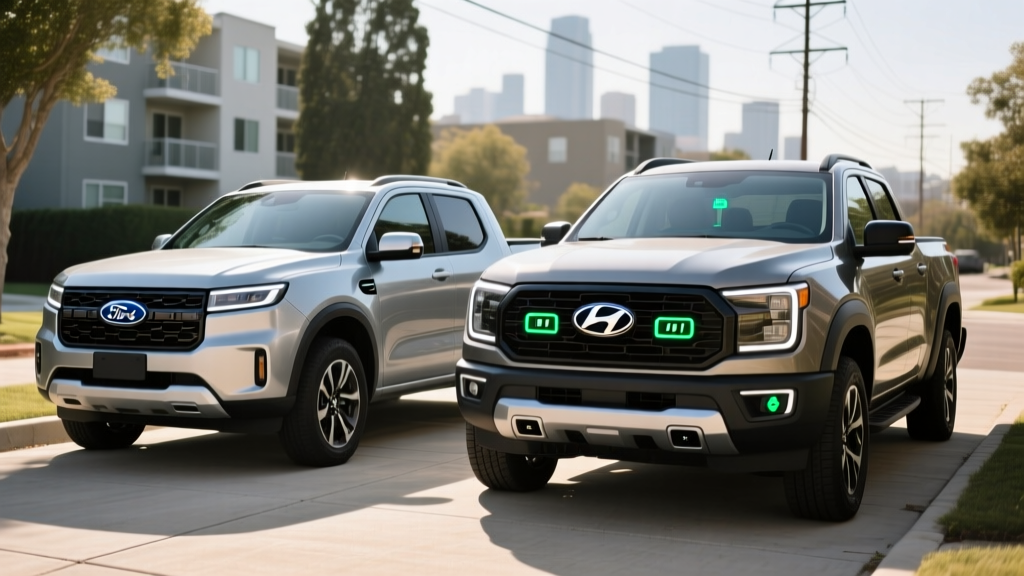
The compact truck segment has exploded over the last few years, and buyers increasingly want the utility of a small bed without the fuel bill of a traditional pickup. That demand has pushed two automakers to offer a compact truck hybrid powertrain: the Ford Maverick Hybrid and the Hyundai Santa Cruz (with its newly available hybrid option for the 2026 model year). If you're cross-shopping these trucks, the differences between a conventional hybrid (HEV) and a plug-in hybrid (PHEV) — and how each performs in real-world driving — matter far more than brochure specs suggest.
This guide breaks down every compact truck hybrid currently on sale, with exact EPA numbers, real-world fuel economy observations, battery warranty details, and a decision framework to help you choose between a hybrid, a PHEV, a full EV, or a gas-only truck.
HEV vs PHEV: What's the Difference in a Compact Truck?
Before comparing models, it's essential to understand the two types of hybridization available in this segment. Confusing them is one of the most common buyer mistakes we see.
Conventional Hybrid (HEV)
A conventional hybrid like the Ford Maverick Hybrid pairs a gasoline engine with a small electric motor and a compact battery (typically 1–2 kWh). The battery recharges through regenerative braking and the engine — you never plug it in. The electric motor assists during acceleration and low-speed driving, reducing fuel consumption by 25–40% compared to a gas-only equivalent. You drive it exactly like a normal truck; the hybrid system works invisibly in the background.
Plug-In Hybrid (PHEV)
A plug-in hybrid has a larger battery (typically 10–20 kWh) that you can charge from a wall outlet or Level 2 charger. This enables electric-only driving for 25–40 miles before the gas engine kicks in. Once the battery is depleted, a PHEV operates like a conventional hybrid. PHEVs are ideal if most of your daily driving is under 35 miles and you have access to home charging — you could go weeks without visiting a gas station.
As of the 2026 model year, the compact truck segment offers the Maverick as a conventional HEV. The Hyundai Santa Cruz introduced a hybrid variant for 2026, also as an HEV configuration. No compact truck currently offers a PHEV powertrain, though industry filings suggest at least one manufacturer is evaluating a PHEV compact truck for the 2027–2028 timeframe.
Ford Maverick Hybrid: Specs, MPG, and Real-World Performance
The Ford Maverick Hybrid remains the segment benchmark for fuel-efficient compact trucks. Built on Ford's C2 unibody platform (shared with the Bronco Sport and Escape), it uses a 2.5-liter Atkinson-cycle four-cylinder engine paired with an electric motor integrated into the eCVT transaxle.
| Specification | 2026 Ford Maverick Hybrid |
|---|---|
| Powertrain | 2.5L I4 Atkinson + electric motor (eCVT) |
| Combined Horsepower | 191 hp |
| Drivetrain | FWD standard (AWD available on hybrid for 2026) |
| Battery Capacity | 1.1 kWh (lithium-ion) |
| EPA MPG (City / Highway / Combined) | 42 / 33 / 37 MPG |
| EPA Range (16.5-gal tank) | ~610 miles |
| 0–60 mph | ~7.8 seconds |
| Towing Capacity | 2,000 lbs (up to 4,000 lbs with 4K Tow Package on gas trims) |
| Bed Length | 54.4 inches (4.5 ft) |
| Starting MSRP | $28,990 (XL FWD Hybrid) |
| Battery Warranty | 8 years / 100,000 miles |
How Many MPG Does the Maverick Hybrid Actually Get?
The EPA rates the FWD Maverick Hybrid at 42 city / 33 highway / 37 combined MPG. The newly available AWD hybrid drops to approximately 38/31/34 MPG due to the added weight and drivetrain losses of the rear motor.
In real-world driving, the Maverick Hybrid is one of those rare vehicles that often exceeds its EPA city estimate. On suburban routes with frequent stops (where regenerative braking recaptures the most energy), owners routinely report 43–46 MPG. Highway driving at 75+ mph, however, tends to yield 30–32 MPG — below the EPA highway sticker — because the aerodynamic profile of a truck bed creates significant drag at speed, and the engine must do most of the work without electric assist at sustained high velocity.
Cold weather (below 35°F) reduces fuel economy by roughly 8–12% as the engine runs more frequently to generate cabin heat and the battery's charge/discharge efficiency drops. Expect 33–35 MPG combined in winter conditions in northern climates.
Who Is the Maverick Hybrid For?
The Maverick Hybrid is ideal for urban and suburban truck buyers who prioritize low fuel costs over towing or off-road capability. Its 2,000-pound tow rating handles a small utility trailer or a pair of dirt bikes but rules out most boat and camper trailers. The 4.5-foot bed with Ford's clever Flexbed system (built-in 12V outlet, threaded inserts for accessories, and a multi-position tailgate) is practical for home-improvement runs and gear hauling, even if it won't swallow a full sheet of plywood flat.
Hyundai Santa Cruz Hybrid: The New Challenger
Hyundai expanded the Santa Cruz lineup for 2026 with a hybrid powertrain option, addressing one of the most common complaints about the gas-only model: its middling fuel economy. The Santa Cruz Hybrid pairs a turbocharged 1.6-liter four-cylinder engine with an electric motor and a 6-speed automatic transmission — a different approach from Ford's eCVT.
| Specification | 2026 Hyundai Santa Cruz Hybrid |
|---|---|
| Powertrain | 1.6L Turbo I4 + electric motor (6-speed auto) |
| Combined Horsepower | 232 hp |
| Drivetrain | AWD standard (HTRAC) |
| Battery Capacity | 1.5 kWh (lithium-ion) |
| EPA MPG (City / Highway / Combined) | 36 / 31 / 33 MPG |
| EPA Range (17.7-gal tank) | ~584 miles |
| 0–60 mph | ~6.9 seconds |
| Towing Capacity | 3,500 lbs |
| Bed Length | 52.1 inches (4.3 ft) with in-floor storage |
| Starting MSRP | $33,490 (SEL Hybrid AWD) |
| Battery Warranty | 10 years / 100,000 miles |
The Santa Cruz Hybrid trades some fuel efficiency for substantially more power and a higher tow rating than the Maverick Hybrid. Its 232 combined horsepower and standard AWD with HTRAC torque vectoring make it more capable in adverse weather and on light off-road trails. The lockable under-bed storage compartment is a standout feature that Maverick doesn't offer.
Real-world MPG for the Santa Cruz Hybrid tends to land between 31–34 combined, closely matching the EPA estimate. Its turbocharged engine doesn't benefit as dramatically from city-stop regenerative braking as the Maverick's Atkinson-cycle setup, so you won't see the same city-MPG upside. Highway driving is more composed thanks to the conventional 6-speed automatic, which avoids the "drone" sensation some drivers notice with eCVTs under hard acceleration.
Side-by-Side: Maverick Hybrid vs Santa Cruz Hybrid
| Category | Ford Maverick Hybrid | Hyundai Santa Cruz Hybrid |
|---|---|---|
| Combined MPG (EPA) | 37 (FWD) | 33 (AWD) |
| Horsepower | 191 hp | 232 hp |
| Drivetrain | FWD / AWD optional | AWD standard |
| Towing | 2,000 lbs | 3,500 lbs |
| Bed Length | 54.4 in | 52.1 in |
| Starting Price | $28,990 | $33,490 |
| Battery Warranty | 8 yr / 100k mi | 10 yr / 100k mi |
| 0–60 mph | ~7.8 sec | ~6.9 sec |
Best Fuel Economy: Maverick Hybrid
With 37 MPG combined (FWD) and real-world city figures that can exceed 43 MPG, the Maverick Hybrid is the clear efficiency champion. If minimizing fuel spend is your top priority, it wins decisively.
Best Capability: Santa Cruz Hybrid
With 232 hp, 3,500-lb towing, and standard AWD, the Santa Cruz Hybrid is the more capable truck for hauling, towing, and all-weather driving. The $4,500 price premium buys meaningful utility.
Battery Longevity, Reliability, and Replacement Cost
Hybrid battery anxiety is the most common concern we hear from first-time hybrid truck buyers. Here's what the data actually shows.
Hybrid Battery Warranty Coverage
Ford Maverick Hybrid: 8 years / 100,000 miles (hybrid battery and components). In California Air Resources Board (CARB) states, coverage extends to 10 years / 150,000 miles for emissions-related hybrid components.
Hyundai Santa Cruz Hybrid: 10 years / 100,000 miles (hybrid battery). Hyundai's warranty is among the longest in the industry and applies nationwide.
Both warranties cover battery capacity loss below a defined threshold (typically 60–70% of original capacity) and all hybrid-system components including the inverter, eCVT/transmission, and electric motor.
How Long Do Compact Truck Hybrid Batteries Actually Last?
Compact truck hybrids use relatively small batteries (1.1–1.5 kWh) that operate within a narrow state-of-charge window — typically between 40% and 80%. This shallow cycling is far less stressful on battery cells than the deep cycles a full EV undergoes, which is why hybrid batteries routinely last well beyond their warranty periods.
Based on data from Ford's earlier hybrid models (Escape Hybrid, Fusion Hybrid) and Toyota's decades of hybrid deployment, hybrid battery packs typically last 150,000–200,000 miles before significant degradation. Many first-generation Toyota Prius batteries exceeded 200,000 miles with less than 20% capacity loss.
If a replacement is needed out of warranty, a compact truck hybrid battery costs between $2,000 and $4,000 installed — substantially less than a full EV battery replacement ($8,000–$20,000+). Individual cell modules can sometimes be replaced for $500–$1,200 at specialized hybrid repair shops, extending battery life at a fraction of a full pack swap.
Overall Reliability
The Maverick Hybrid's powertrain is derived from Ford's fourth-generation hybrid system, which has proven reliable across the Escape Hybrid and other models. The Santa Cruz Hybrid's turbocharged hybrid setup is newer, and while Hyundai's hybrid systems in the Tucson Hybrid and Santa Fe Hybrid have been generally dependable, long-term data for this specific powertrain combination is still accumulating. Hyundai's 10-year powertrain warranty provides meaningful backstop coverage.
Tax Credits and Incentives for Compact Truck Hybrids
This is where buyers often have misconceptions, so let's be precise.
Federal §30D Tax Credit Eligibility — Compact Truck Hybrids
Conventional hybrids (HEV) like the Maverick Hybrid and Santa Cruz Hybrid do NOT qualify for the federal §30D new clean vehicle credit. The §30D credit requires a minimum battery capacity of 7 kWh and plug-in charging capability — criteria that only PHEVs and BEVs meet.
- ✗ Ford Maverick Hybrid — not eligible (HEV, 1.1 kWh battery)
- ✗ Hyundai Santa Cruz Hybrid — not eligible (HEV, 1.5 kWh battery)
- ✓ Eligibility for PHEVs (if one becomes available) would require meeting MSRP cap ($80,000 for trucks), buyer income limits ($150K single / $300K joint), and battery critical-mineral and component sourcing requirements per current IRS rules
- Always verify current-year rules at IRS.gov clean vehicle tax credits
While the federal §30D credit isn't available, some states and local utilities offer rebates or incentives for hybrid vehicle purchases. These vary widely by jurisdiction and change frequently. Check your state energy office or utility provider's website for current programs. Some employers also offer commuter benefit programs that apply to hybrid vehicles.
Compact Truck Hybrid vs Full EV vs Gas Truck: Which Fits You?
Choosing between a hybrid, a full electric vehicle, and a conventional gas truck depends on your driving patterns, charging access, and how you plan to use the truck bed.
Choose a Compact Truck Hybrid (HEV) If:
- You drive 15,000+ miles per year and want to minimize fuel costs without changing your refueling habits
- You don't have reliable access to home or workplace charging
- You need a truck bed for regular hauling but want car-like fuel economy
- Your typical tow load is under 2,000–3,500 lbs
- You want a lower purchase price than a full EV
Choose a Full EV Truck (e.g., Ford F-150 Lightning, Rivian R1T) If:
- You have Level 2 home charging and most trips are under 250 miles
- You want the lowest per-mile "fuel" cost (typically $0.04–$0.08/mile on home electricity vs $0.12–$0.18/mile for a hybrid)
- You value instant torque, near-silent operation, and frunk storage
- You can absorb a higher upfront purchase price ($50,000+)
- You want to eliminate oil changes and most powertrain maintenance
Choose a Gas-Only Compact Truck If:
- You regularly tow near the truck's maximum capacity (gas models often have higher tow ratings)
- Your budget is under $27,000 and you drive fewer than 10,000 miles/year (fuel savings from a hybrid won't offset the price premium quickly)
- You frequently drive in remote areas where hybrid system repair expertise is limited
What About a PHEV Compact Truck?
As of 2026, no compact truck is available as a plug-in hybrid. If a PHEV compact truck arrives in the 2027–2028 timeframe, it would offer 25–40 miles of electric-only range for daily commuting — potentially eliminating gas use for most weekday driving — while retaining a gas engine for longer road trips and towing. A PHEV would also likely qualify for the federal §30D credit (up to $7,500, subject to income, MSRP, and sourcing requirements), which would significantly improve its value proposition. Until then, the HEV options discussed here are the most efficient compact trucks available.
Total Cost of Ownership: 5-Year Comparison
Let's put real numbers behind the purchase decision. This table assumes 15,000 miles/year, $3.40/gallon regular unleaded, and $0.14/kWh home electricity (national averages as of early 2026).
| Cost Factor (5 Years) | Maverick Hybrid (FWD) | Santa Cruz Hybrid (AWD) | Maverick Gas (2.0T EcoBoost AWD) |
|---|---|---|---|
| Purchase Price (base MSRP) | $28,990 | $33,490 | $27,490 |
| Fuel Cost (75,000 mi) | $6,892 | $7,727 | $10,625 |
| Estimated Maintenance | $3,200 | $3,400 | $3,800 |
| Estimated Insurance (avg) | $7,800 | $8,400 | $7,600 |
| Estimated Depreciation | $11,600 | $13,400 | $12,100 |
| 5-Year Total | $58,482 | $66,517 | $61,615 |
| Cost Per Mile | $0.39 | $0.45 | $0.41 |
The Maverick Hybrid's fuel savings — roughly $3,700 over five years compared to the gas Maverick — more than offset its $1,500 higher purchase price. The Santa Cruz Hybrid's higher MSRP and slightly lower MPG result in a higher total cost, but buyers are paying for the additional power, AWD capability, and higher tow rating.
Data sourced from fueleconomy.gov for EPA ratings and Edmunds/Kelley Blue Book for depreciation estimates.
Frequently Asked Questions
How many MPG does a compact truck hybrid get?
The 2026 Ford Maverick Hybrid achieves an EPA-rated 42 city / 33 highway / 37 combined MPG (FWD). The 2026 Hyundai Santa Cruz Hybrid is rated at 36 city / 31 highway / 33 combined MPG (AWD standard). Real-world city MPG for the Maverick often exceeds its EPA estimate by 3–5 MPG in stop-and-go driving.
Do compact truck hybrids need to be plugged in?
No. Both the Maverick Hybrid and Santa Cruz Hybrid are conventional hybrids (HEVs). They recharge their small batteries through regenerative braking and the gasoline engine. You simply fill up at a gas station as you would with any other vehicle. No plug, no charger, no behavior change required.
How far can a compact truck hybrid go on electric only?
Conventional hybrids like these are not designed for extended electric-only driving. The electric motor assists the gas engine at low speeds and during acceleration, but you cannot drive meaningful distances on electricity alone. For 25–40 miles of pure electric range, you'd need a PHEV — and no compact truck PHEV is currently available.
Is the hybrid battery reliable, and what does replacement cost?
Hybrid batteries in compact trucks are highly reliable due to their small size and shallow charge cycling. Most last 150,000–200,000 miles. Ford covers the Maverick Hybrid battery for 8 years/100,000 miles; Hyundai covers the Santa Cruz Hybrid battery for 10 years/100,000 miles. Out-of-warranty replacement costs $2,000–$4,000 installed, with partial module replacement available for $500–$1,200 at specialized shops.
Does a compact truck hybrid qualify for any tax credit?
Conventional hybrids (HEVs) do not qualify for the federal §30D clean vehicle tax credit, which requires plug-in capability and a minimum 7 kWh battery. Check your state and local utility programs for possible hybrid rebates — these vary by jurisdiction and are subject to change. See IRS.gov for current federal credit rules.
Can I tow with a compact truck hybrid?
Yes, but with limits. The Maverick Hybrid is rated for 2,000 lbs (suitable for a small utility trailer, ATV, or pair of dirt bikes). The Santa Cruz Hybrid tows up to 3,500 lbs (enough for a small boat or lightweight travel trailer). If you regularly tow 5,000+ lbs, you'll need a larger truck — no compact truck, hybrid or otherwise, is rated for that load.
Hybrid vs PHEV vs EV — which compact truck should I buy?
If you lack home charging and want maximum simplicity, choose an HEV (Maverick or Santa Cruz Hybrid). If a PHEV compact truck becomes available and you have home charging plus a short commute, it would offer the best of both worlds — electric daily driving with gas backup. If you have Level 2 home charging, mostly drive under 250 miles, and can spend $50,000+, a full EV truck like the F-150 Lightning offers the lowest operating cost. For most compact truck buyers in 2026, the Maverick Hybrid offers the best combination of price, efficiency, and zero lifestyle change.
Ford Maverick Hybrid — Pros & Cons
Pros:
- Best-in-segment fuel economy (37 MPG combined, 42 city)
- Lowest starting price ($28,990)
- Proven hybrid system with strong real-world reliability
- Flexbed system with clever built-in features
- Real-world city MPG often exceeds EPA estimate
Cons:
- Low tow rating (2,000 lbs)
- Modest 191 hp — adequate but not quick
- AWD hybrid option newly available, limited trim availability
- Rear seat space is tight for taller passengers
Hyundai Santa Cruz Hybrid — Pros & Cons
Pros:
- 232 hp — significantly more powerful than Maverick Hybrid
- 3,500-lb tow rating with hybrid powertrain
- Standard AWD with HTRAC torque vectoring
- Lockable under-bed storage compartment
- 10-year/100,000-mile battery warranty
Cons:
- Higher starting price ($33,490)
- Lower fuel economy (33 MPG combined)
- Shorter bed (52.1 in vs 54.4 in)
- New hybrid powertrain — limited long-term reliability data
The compact truck hybrid segment in 2026 offers two distinct value propositions. The Maverick Hybrid is the efficiency-first choice for buyers who want truck utility at sedan-like fuel costs. The Santa Cruz Hybrid is the capability-first choice for those willing to trade a few MPG for more power, higher towing, and standard AWD. Neither requires any change to your driving or refueling habits — just fill up less often and enjoy the savings. For detailed, model-year-specific EPA ratings, always verify at fueleconomy.gov.