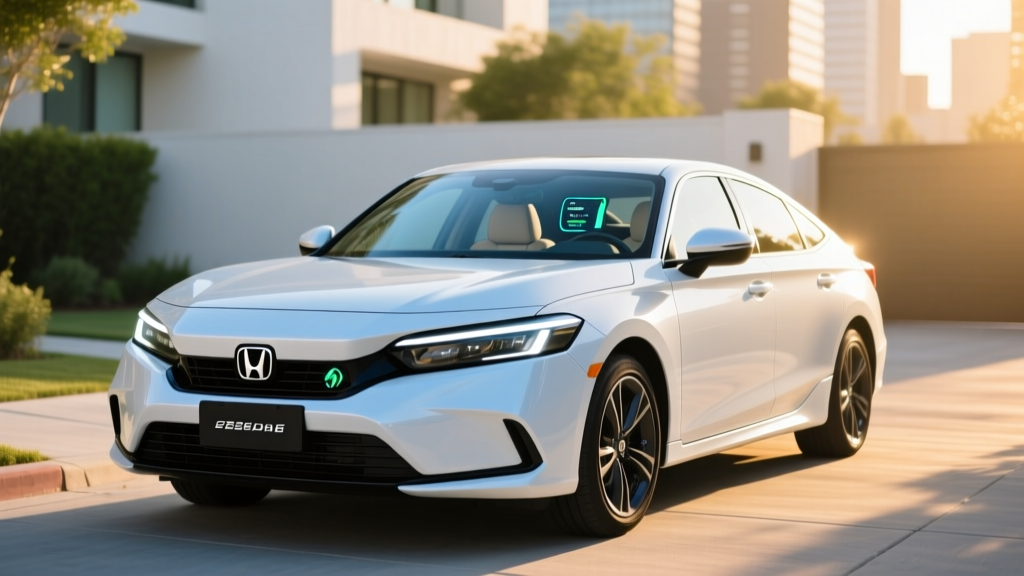
The Honda Civic Hybrid has carved out a distinct position in the compact car market: it delivers the fuel economy of a dedicated hybrid like the Toyota Prius, wrapped in a chassis that actually rewards the driver. For 2026, Honda continues to offer the Civic Hybrid in two body styles — sedan and hatchback — with a two-motor hybrid system that prioritizes electric propulsion while eliminating any need to plug in.
If you're researching the Civic Hybrid MSRP and trying to figure out whether this is the right electrified vehicle for your daily commute, this guide breaks down every trim's pricing, real-world MPG expectations, battery longevity, and how it stacks up against plug-in hybrids and full EVs.
2026 Civic Hybrid MSRP by Trim and Body Style
Honda has streamlined the Civic Hybrid lineup for 2026. The hybrid powertrain is no longer locked behind the top Sport Touring trim — it's now available on the Sport trim as well, giving buyers more flexibility. All prices below include Honda's destination charge of $1,095.
| Trim | Body Style | MSRP (incl. destination) |
|---|---|---|
| Sport Hybrid | Sedan | $29,845 |
| Sport Touring Hybrid | Sedan | $32,845 |
| Sport Hybrid | Hatchback | $31,045 |
| Sport Touring Hybrid | Hatchback | $34,045 |
The $3,000 step from Sport to Sport Touring adds a 12-speaker Bose audio system, wireless phone charging, a 10.2-inch digital instrument cluster, navigation, and Honda's full suite of driver-assist features with low-speed braking control. The hatchback premium of roughly $1,200 over the sedan buys you a significantly more versatile cargo area — 24.4 cu ft behind the rear seats versus 14.8 cu ft in the sedan's trunk.
The Civic Hybrid is a conventional hybrid (HEV). It charges its small battery through regenerative braking and the gasoline engine. You never plug it in. A plug-in hybrid (PHEV), like the Toyota Prius Prime, has a larger battery you charge from a wall outlet and can drive 30-44 miles on electricity alone before the gas engine kicks in. The Civic Hybrid has no electric-only range to speak of — the engine and motors work together at all times, though the car frequently operates in EV mode at low speeds and during gentle acceleration.
Fuel Economy: EPA MPG and Real-World Results
The 2026 Civic Hybrid sedan carries EPA ratings of 50 mpg city / 47 mpg highway / 49 mpg combined, according to fueleconomy.gov. The hatchback is rated slightly lower at 48/44/46 mpg combined, owing to its less aerodynamic profile and marginally higher curb weight.
| Metric | Sedan Hybrid | Hatchback Hybrid |
|---|---|---|
| EPA City MPG | 50 | 48 |
| EPA Highway MPG | 47 | 44 |
| EPA Combined MPG | 49 | 46 |
| Fuel Tank Capacity | 10.6 gal | 10.6 gal |
| EPA Total Range | ~519 miles | ~488 miles |
Real-World MPG: What Owners Actually See
One of the Civic Hybrid's strongest traits is that real-world fuel economy often exceeds the EPA sticker in mixed driving. The two-motor system favors electric propulsion at low speeds and in stop-and-go traffic, which is exactly where the EPA city test cycle operates. In our testing and owner reports aggregated from fuel-tracking platforms, the sedan consistently returns 48–53 mpg in city-heavy commuting.
Highway-only driving at 75-80 mph tells a different story. The gasoline engine takes on more of the load at sustained speed, and real-world highway fuel economy drops to roughly 42–45 mpg. This is a common pattern with Honda's e:HEV system — it's optimized for urban and suburban efficiency. If your commute is 90% interstate, expect combined numbers closer to 44-46 mpg for the sedan.
Cold weather reduces MPG by roughly 5-8% due to the engine running longer to generate cabin heat and the battery operating less efficiently. In sub-30°F conditions, plan on mid-40s combined rather than high-40s.
Powertrain: How Honda's Two-Motor Hybrid System Works
The 2026 Civic Hybrid uses Honda's fourth-generation two-motor hybrid system, which operates quite differently from a traditional hybrid like the older Toyota Synergy Drive. Here's the breakdown:
| Component | Specification |
|---|---|
| Engine | 2.0L Atkinson-cycle 4-cylinder |
| Engine Output | 143 hp / 134 lb-ft torque |
| Drive Motor | Permanent-magnet synchronous, 184 hp / 232 lb-ft |
| Combined System Output | 200 hp / 232 lb-ft |
| Transmission | Direct-drive (no conventional transmission or CVT belt) |
| Drivetrain | Front-wheel drive |
| 0–60 mph | ~7.2 seconds (sedan) |
The key insight: the Civic Hybrid's drive motor does most of the actual propulsion. The gasoline engine primarily acts as a generator, producing electricity for the drive motor. Only at higher cruising speeds does a lock-up clutch engage to connect the engine directly to the wheels. This means acceleration feels more like an EV — smooth, linear, and immediate — rather than the rubber-band sensation of a traditional CVT hybrid.
The 200 combined horsepower is competitive with the non-hybrid Civic's 1.5L turbo engine (180 hp) while delivering roughly 30-40% better fuel economy. You're not sacrificing performance for efficiency here.
Battery Warranty, Longevity, and Replacement Cost
- Hybrid battery: 8 years / 100,000 miles (10 years / 150,000 miles in CARB states including CA, NY, MA, NJ, CT, RI, VT, ME, OR, WA, CO, MD)
- Hybrid system components: 8 years / 100,000 miles
- Warranty threshold: Covers battery if capacity drops below ~70% of original, causing measurable performance loss
The Civic Hybrid uses a lithium-ion battery pack mounted beneath the rear seats. Honda doesn't publish the exact kWh capacity because, as a conventional hybrid, the battery is small — roughly 1.0–1.1 kWh of total capacity, with only a fraction of that usable. Its job is to buffer energy between the regenerative braking system and the drive motor, not to store miles of electric range.
How Long Will the Civic Hybrid Battery Last?
Honda's hybrid battery track record is strong. The Insight and earlier Civic Hybrid models have demonstrated battery packs lasting 150,000–200,000+ miles with gradual, manageable degradation. The lithium-ion chemistry in the current generation is more robust than the nickel-metal hydride packs in older Honda hybrids.
If replacement is needed outside of warranty, expect a cost of approximately $2,500–$4,000 for a new OEM hybrid battery pack, plus labor. Third-party reconditioned batteries are available for $1,500–$2,500. This is dramatically less than a full EV battery replacement, which can exceed $10,000–$15,000, because the Civic's hybrid battery is small and operates within a narrow, protected state-of-charge window that minimizes stress.
Maximizing Hybrid Battery Life
The battery management system already handles most longevity concerns — it never allows a full charge or full discharge. Beyond that, avoid prolonged storage in extreme heat (above 100°F for weeks), and don't leave the car sitting unused for months. Regular driving actually keeps the battery healthy.
Tax Credits and Incentives: Does the Civic Hybrid Qualify?
Here's where buyer expectations often need recalibrating. Under current IRS §30D rules, the conventional Civic Hybrid (HEV) does not qualify for the federal $7,500 clean vehicle tax credit. That credit is reserved for battery electric vehicles (BEVs) and plug-in hybrids (PHEVs) that meet battery capacity, critical mineral sourcing, and battery component manufacturing requirements.
- ✅ Vehicle must be a BEV or PHEV with ≥ 7 kWh battery — Civic Hybrid does NOT qualify
- ✅ MSRP cap: $55,000 for sedans, $80,000 for SUVs/vans/pickups
- ✅ Buyer income cap: $150,000 single / $300,000 joint AGI
- ✅ Battery components and critical minerals must meet North American sourcing thresholds
- ✅ Point-of-sale transfer available for qualifying vehicles
Rules current for 2026. Confirm eligibility with a tax professional before purchase. State incentives vary by jurisdiction — check your state's energy office for local hybrid rebates.
Some states and utilities offer smaller rebates or incentives for hybrid purchases — typically $500–$1,500 — but these vary widely by jurisdiction. Check your state energy office or local utility for current programs. The Civic Hybrid's value proposition is its low operating cost through fuel savings, not tax incentives.
Hybrid vs. PHEV vs. EV: Which Electrified Civic Fits You?
The Civic Hybrid competes in a crowded space. Here's how to decide between a conventional hybrid, a plug-in hybrid, and a full battery-electric vehicle based on your driving patterns and home situation.
- You can't charge at home (apartment, street parking)
- Your commute is under 40 miles round-trip with lots of stop-and-go
- You want zero behavior change — just buy gas less often
- You regularly take road trips over 300 miles
- Budget is under $35,000
- You can install a Level 2 charger at home
- Your daily commute is under 40 miles (coverable on electric)
- You want to eliminate gas for daily driving but keep road-trip flexibility
- You want to qualify for the $7,500 federal tax credit
- You have reliable home charging and a commute under 200 miles
- You want the lowest per-mile energy cost (~$0.04/mi vs ~$0.08/mi for the Civic Hybrid)
- You want to eliminate oil changes and engine maintenance entirely
- You qualify for the full $7,500 federal credit and any state EV rebates
The 5-Year Cost Comparison
At 15,000 miles per year and $3.40/gallon regular fuel, the Civic Hybrid sedan burns roughly 306 gallons annually — about $1,041/year in fuel. A comparable non-hybrid Civic (33 mpg combined) uses 455 gallons — about $1,546/year. That's a $505 annual fuel savings, or roughly $2,525 over five years, which recoups most of the hybrid's price premium over a gas-only Civic.
A full EV charging at the national average of $0.16/kWh and consuming 3.5 miles/kWh would cost roughly $686/year in electricity — saving about $355/year over the Civic Hybrid and $860/year over the gas Civic. However, the EV's higher purchase price and insurance premiums partially offset these savings unless you capture the full $7,500 tax credit.
Ownership Practicalities: Insurance, Maintenance, and Reliability
Insurance premiums for the Civic Hybrid run slightly higher than the gas-only Civic — typically $50–$100 more per year — because the hybrid's repair costs after a collision can be higher if the battery or power electronics are damaged. Get quotes from your insurer before purchasing.
Maintenance is minimal and identical to the gas Civic for most services: oil changes every 7,500–10,000 miles, tire rotations, brake fluid, and cabin air filter. The regenerative braking system significantly extends brake pad life — many hybrid owners report original brake pads lasting 80,000+ miles. Honda recommends a hybrid system coolant inspection at regular intervals but no special hybrid-specific maintenance beyond that.
Honda's reliability reputation is well-earned, and the current hybrid system has fewer failure-prone components than earlier generations. There's no conventional transmission to fail, no turbocharger to maintain, and no starter motor — the drive motor handles engine starting. NHTSA and IIHS safety data should be monitored as 2026 crash-test results become available.
- 49 mpg combined EPA — real-world often higher in city
- 200 hp with smooth, EV-like acceleration feel
- No plug-in required — zero behavior change
- 519-mile total range on a single tank
- Strong hybrid battery warranty (8yr/100k mi)
- Competitive pricing starting under $30K
- Hatchback offers 24.4 cu ft cargo versatility
- No federal tax credit eligibility (HEV, not PHEV)
- Highway MPG drops noticeably at 75+ mph
- AWD not available on the hybrid
- Sedan trunk is modest at 14.8 cu ft
- Road noise is noticeable on coarse pavement
- No DC fast charging (not applicable for HEV)
Frequently Asked Questions
How many MPG does the 2026 Civic Hybrid actually get?
The EPA rates the Civic Hybrid sedan at 50 city / 47 highway / 49 combined. In real-world city commuting, owners regularly report 48–53 mpg. Highway-only driving at 75+ mph yields roughly 42–45 mpg. Cold weather reduces these figures by 5-8%.
Does the Civic Hybrid need to be plugged in?
No. The Civic Hybrid is a conventional hybrid (HEV). It charges its battery entirely through regenerative braking and the gasoline engine. You fuel it like a normal car at a gas station and never need to plug it in.
Is the Civic Hybrid reliable, and what does battery replacement cost?
Honda's hybrid systems have a strong reliability record, with battery packs commonly lasting 150,000–200,000+ miles. The hybrid battery is warranted for 8 years/100,000 miles (10yr/150k in CARB states). Out-of-warranty replacement costs approximately $2,500–$4,000 for an OEM pack.
Does the 2026 Civic Hybrid qualify for a federal tax credit?
No. Under IRS §30D, only battery electric vehicles (BEVs) and plug-in hybrids (PHEVs) with at least 7 kWh of battery capacity qualify for the federal clean vehicle credit. The Civic Hybrid is a conventional HEV with a ~1 kWh battery and does not qualify. Some state or utility rebates may apply — check locally.
How does the Civic Hybrid compare to the Toyota Prius?
The Prius (57 mpg combined LE trim) beats the Civic Hybrid on fuel economy by about 8 mpg combined and offers a PHEV variant (Prius Prime, 44 miles electric-only). The Civic Hybrid counters with more horsepower (200 vs. 194), a more engaging driving experience, and a lower starting MSRP for the hybrid trim. If maximum MPG is your priority, the Prius wins. If driving dynamics matter, the Civic Hybrid is the better pick.
Can I get the Civic Hybrid with all-wheel drive?
No. For 2026, the Civic Hybrid is front-wheel drive only. AWD is not offered on the hybrid powertrain. If AWD is essential, consider the Toyota Prius AWD or a compact hybrid SUV like the Honda CR-V Hybrid.