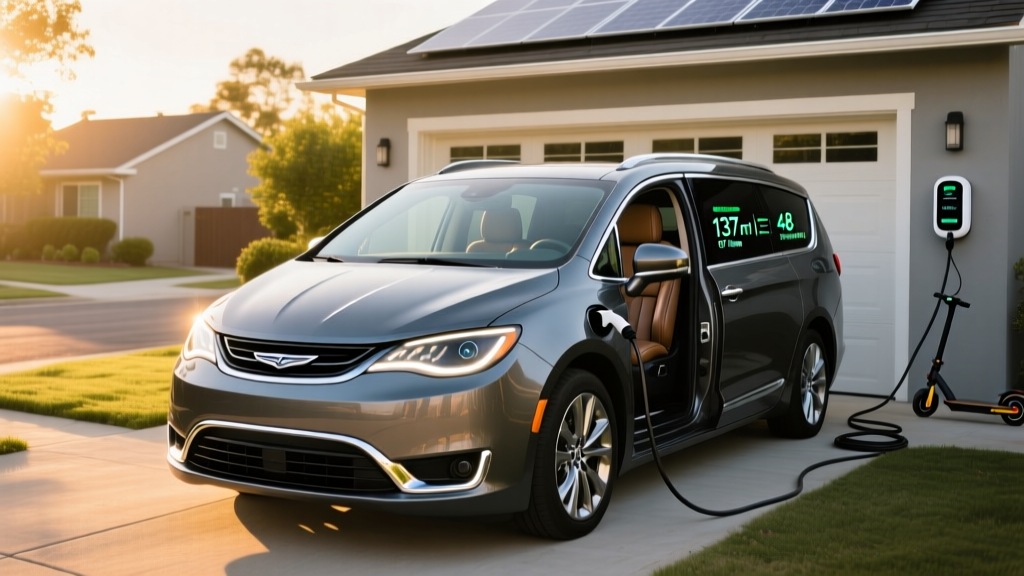
If you need three rows, sliding doors, and the ability to do school-dropoff loops without burning a drop of gas, the Chrysler Pacifica Plug-In Hybrid remains the only minivan in America that lets you plug in. For 2026, Chrysler continues to offer the Pacifica PHEV alongside the conventional gas-only Pacifica — but the plug-in variant occupies a unique lane: genuine electric-only commuting range wrapped in a full-size family hauler.
This guide breaks down exactly what the 2026 Chrysler Pacifica Plug-In Hybrid minivan delivers in range, efficiency, charging practicality, and total ownership cost — with the real-world caveats that spec sheets leave out.
What Is the Pacifica PHEV — and How Does It Differ from the Gas Pacifica?
Before digging into specs, it's critical to understand the distinction between a conventional hybrid (HEV) and a plug-in hybrid (PHEV), because Chrysler sells both versions of the Pacifica and they behave very differently.
| Feature | Conventional Hybrid (HEV) | Plug-In Hybrid (PHEV) |
|---|---|---|
| Battery size | ~1-2 kWh (small) | 16 kWh usable |
| Plugs in? | No — self-charging via regen and engine | Yes — Level 1 or Level 2 |
| Electric-only driving | Brief low-speed assist only | Up to 32 miles at highway speeds |
| Fuel when battery depletes | Runs as standard hybrid | Runs as standard hybrid (30 MPG combined) |
| Tax credit eligible? | No | Previously eligible — see credit section below |
The conventional Pacifica Hybrid (which Chrysler has offered in various years) uses a small battery and electric motor to assist the gas engine — you never plug it in, and it cannot drive on electricity alone for meaningful distances. The Pacifica Plug-In Hybrid carries a much larger 16 kWh battery pack and twin electric motors capable of propelling the van entirely on electricity for up to 32 EPA-rated miles. Once that battery is depleted, the Pacifica PHEV seamlessly transitions into hybrid mode, operating just like a conventional HEV.
Electric-Only Range and Total Driving Range
The headline number for any PHEV buyer is electric-only range. The 2026 Chrysler Pacifica Plug-In Hybrid minivan carries an EPA-rated 32 miles of all-electric range. That figure comes from the vehicle's 16 kWh lithium-ion battery pack (nickel-manganese-cobalt chemistry), of which roughly 13-14 kWh is usable before the system switches to hybrid mode to protect battery longevity.
- City driving (mild weather): 30-34 miles — regen braking extends range in stop-and-go traffic
- Highway driving (70 mph): 24-28 miles — aerodynamic drag on a 5,000-lb minivan consumes energy faster
- Cold weather (below 30°F): 20-25 miles — battery chemistry slows, and cabin heating draws significant power
Once the battery depletes, the Pacifica PHEV operates as a conventional hybrid. The total combined range (electric + gas) is approximately 520 miles, thanks to the 16.5-gallon fuel tank and 30 MPG combined hybrid-mode efficiency. That means road trips require no more planning than a standard gas minivan.
Fuel Economy: EPA MPG and MPGe Breakdown
| Mode | City | Highway | Combined |
|---|---|---|---|
| Electric-only (MPGe) | — | — | 82 MPGe |
| Hybrid mode (MPG, battery depleted) | 29 MPG | 30 MPG | 30 MPG |
| Energy consumption (electric) | 41 kWh/100 miles | ||
Source: EPA Fuel Economy Guide (fueleconomy.gov).
Real-world MPG note: PHEVs are notoriously variable in real-world fuel economy because it depends entirely on how often you plug in. If you charge nightly and drive fewer than 32 miles per day, you may use almost no gasoline for weeks. If you never plug in, the Pacifica PHEV operates at its 30 MPG combined hybrid rating — still a significant improvement over the gas-only Pacifica's 22 MPG combined. Owners who charge regularly report observed averages of 50-80+ MPGe over mixed-use months, according to long-term owner tracking on Fuelly.
Powertrain: What Moves the Pacifica PHEV
| Engine | 3.6L Pentastar V6 (Atkinson-cycle variant) |
| Electric motors | Twin front-axle electric motors (integrated into eFlite CVT) |
| Combined system horsepower | 260 hp |
| Transmission | eFlite electrically variable transmission (single-speed with dual motor/generators) |
| Drivetrain | Front-wheel drive only (no AWD option on PHEV) |
| Battery pack | 16 kWh lithium-ion (NMC chemistry) |
| Battery location | Under second-row floor (eliminates Stow 'n Go for 2nd row) |
| 0-60 mph | ~7.1 seconds (electric launch provides strong initial torque) |
| Curb weight | ~5,050 lbs |
The Pacifica PHEV's powertrain is unique in the minivan segment. The Atkinson-cycle V6 sacrifices some peak power for thermal efficiency, while the twin electric motors deliver instant torque from a stop. The result is surprisingly brisk acceleration in electric mode — the van pulls away from stoplights with the confidence of a much smaller vehicle. However, note a critical trade-off: the PHEV is front-wheel drive only. Chrysler offers all-wheel drive on the gas-only Pacifica, but the PHEV's battery packaging precludes the AWD system. If you need AWD in a minivan, the PHEV is off the table.
Another packaging consequence: the battery lives beneath the second-row floor, which means second-row Stow 'n Go seating is not available on the PHEV. The second-row captain's chairs are removable (not foldable into the floor), while the third row still folds flat. Cargo volume behind the third row is approximately 32.3 cubic feet, expanding to 87.5 cubic feet behind the first row.
Charging: How Long Does the Pacifica PHEV Take to Charge?
| Charging Level | Power (kW) | Time (0-100%) | Miles of EV Range per Hour |
|---|---|---|---|
| Level 1 (120V household outlet) | ~1.4 kW | ~14 hours | ~2-3 miles/hr |
| Level 2 (240V, 32A home charger) | ~7.2 kW | ~2 hours | ~14-16 miles/hr |
| DC Fast Charging | Not supported — the Pacifica PHEV has no DC fast-charge port | ||
The Pacifica PHEV uses a standard J1772 charge port (located on the driver's front fender). On a Level 2 home charger delivering 7.2 kW, a full charge takes approximately 2 hours — fast enough to top off during a workday if you have a workplace charger, or overnight on a standard home Level 2 unit.
On a standard 120V household outlet (Level 1), a full charge takes roughly 14 hours. This is viable for owners who drive fewer than 15 miles per day and can leave the van plugged in overnight, but it won't fully replenish the battery in a single night if you've depleted it completely.
No DC fast charging: This is a notable limitation. The Pacifica PHEV cannot accept DC fast charging, meaning you won't find it useful at Electrify America or Tesla Supercharger stations. For a 16 kWh battery, this is less of a practical concern than it would be on a full EV — the battery is small enough that Level 2 covers most needs. But it does mean that on road trips, you're operating exclusively in hybrid mode once the battery depletes.
Pricing, Trims, and Tax Credit Eligibility
The 2026 Chrysler Pacifica Plug-In Hybrid minivan is offered in three trims. Pricing (MSRP, before destination):
- Pacifica PHEV Select: ~$51,095
- Pacifica PHEV Limited: ~$55,595
- Pacifica PHEV Pinnacle: ~$59,195
(Destination charge adds approximately $1,995.)
The Pacifica PHEV no longer qualifies for the full $7,500 federal tax credit under current IRS §30D rules. Chrysler's parent company Stellantis reached the 200,000-vehicle manufacturer cap on qualifying EV/PHEV sales in 2024, which triggered a phase-out of the credit for all Stellantis plug-in vehicles. As of 2026, the Pacifica PHEV is not eligible for the new clean vehicle credit.
However, buyers should check:
- State/local incentives: Some states (CA, CO, NY, MA, and others) offer their own PHEV rebates or HOV lane access — check your state's energy office or DMV.
- Used PHEV credit (§25E): If purchasing a qualifying pre-owned Pacifica PHEV (model year at least 2 years old, priced under $25,000), you may be eligible for up to $4,000 under the used clean vehicle credit. Income caps apply. See IRS §25E guidelines.
- Utility rebates: Many electric utilities offer $250-$500 rebates for purchasing a PHEV or installing a home Level 2 charger.
Reliability, Battery Warranty, and Replacement Cost
- High-voltage battery warranty: 8 years / 100,000 miles (whichever comes first)
- Capacity retention threshold: Battery is warranted to retain at least 70% of original capacity during the warranty period
- Powertrain warranty: 5 years / 60,000 miles
- Basic vehicle warranty: 3 years / 36,000 miles
Reliability track record: The Pacifica PHEV's powertrain — particularly the 3.6L Pentastar V6 — is one of the most proven engines in the Stellantis portfolio, with millions of units on the road. The eFlite transmission and electric motor system have been in production since the 2017 model year. That said, the Pacifica PHEV has had a mixed reliability record in owner surveys. J.D. Power and Consumer Reports have flagged issues with the infotainment system, power sliding doors, and occasional electrical gremlins in earlier model years (2017-2020). The 2024+ models have shown improvement, but buyers should be aware that minivan complexity (power doors, power liftgate, fold-flat seating mechanisms, and now a high-voltage system) adds more failure points than a simpler sedan.
Battery replacement cost: If the high-voltage battery needs replacement outside of warranty, expect a cost of approximately $8,000-$12,000 for the pack plus labor, based on current parts pricing. This is a significant sum, but it's worth noting that PHEV batteries are smaller and less expensive to replace than full-EV packs. Chrysler's 8-year/100,000-mile battery warranty covers most owners through the period of highest risk, and real-world data from early Pacifica PHEV owners (2017-2019 models now exceeding 100,000 miles) suggests that battery degradation has been modest — typically 10-15% capacity loss over 6-8 years with regular charging.
Who Should Choose the Pacifica PHEV vs. a Full EV or Gas Minivan?
Choose the Chrysler Pacifica PHEV if:
- You need three rows and sliding doors for family duty
- Your daily driving is under 30 miles and you can charge at home
- You want to eliminate gas use for daily trips without range anxiety on road trips
- You don't need AWD
- You value the ability to run climate control on battery power while parked (a big deal for waiting at school pickup)
Choose a full EV (like the Kia EV9 or Tesla Model X) if:
- You want zero gasoline dependency and lower per-mile fuel cost
- You have reliable home charging and access to DC fast charging for road trips
- You want the lowest possible maintenance cost (no oil changes, no engine)
- You can accept higher purchase price and potential charging logistics on long trips
Choose the gas-only Pacifica (or Toyota Sienna HEV) if:
- You cannot install a home charger and don't want to think about plugging in
- You need AWD (gas Pacifica offers it; PHEV does not)
- You want Stow 'n Go second-row seating (not available on PHEV)
- Your budget is under $45,000
- The Toyota Sienna hybrid (36 MPG combined, no plug) meets your needs without PHEV complexity
The Pacifica PHEV occupies a very specific niche: it's the bridge solution for families who want electric commuting but can't compromise on road-trip range, interior space, or the convenience of a minivan. No full EV currently matches its combination of 32 electric miles plus 520 total miles with minivan utility. The trade-off is a higher starting price, FWD-only, and no second-row fold-flat seating.
Pros and Cons at a Glance
Pros
- Only plug-in hybrid minivan available in the US
- 32 miles EV range covers most daily family driving
- 82 MPGe when operating on electricity
- 520+ mile total range eliminates road-trip anxiety
- Smooth, quiet electric driving experience around town
- Strong 260 hp combined output for confident merging
- 8-year/100,000-mile battery warranty
Cons
- No AWD option (FWD only)
- Second-row Stow 'n Go eliminated by battery pack
- No DC fast charging
- Starting price above $51,000 — no longer eligible for federal tax credit
- 14-hour Level 1 charge time is impractical for high-mileage days
- Hybrid-mode MPG (30) trails the Toyota Sienna hybrid (36)
- Mixed reliability history for non-powertrain components
Frequently Asked Questions
How many MPG does the Chrysler Pacifica Plug-In Hybrid get?
In hybrid mode (battery depleted), the Pacifica PHEV gets an EPA-rated 29 city / 30 highway / 30 combined MPG. When operating on electricity, it achieves 82 MPGe combined. Real-world MPG varies enormously based on how often you charge — owners who plug in daily and drive under 32 miles may go weeks without using gasoline, while those who never plug in will see a steady 30 MPG.
How far can the Pacifica PHEV go on electric only?
The EPA rates the Pacifica PHEV at 32 miles of all-electric range. In real-world conditions, expect 24-34 miles depending on temperature, driving style, and terrain. Highway speeds and cold weather reduce range; city driving in mild conditions maximizes it.
Does the Chrysler Pacifica PHEV qualify for a federal tax credit in 2026?
No. Stellantis (Chrysler's parent company) reached the 200,000-vehicle manufacturer sales cap under the previous credit structure, and under current IRS §30D rules, the Pacifica PHEV does not qualify for the new clean vehicle credit. State incentives and the used-vehicle credit (§25E) may still apply — check with your state energy office and a tax professional.
Is the Pacifica PHEV reliable, and what does battery replacement cost?
The powertrain (Pentastar V6 + eFlite transmission) is well-proven, but the Pacifica as a platform has had mixed reliability scores due to electrical and power-accessory issues. The high-voltage battery is warranted for 8 years/100,000 miles at 70%+ capacity retention. Out-of-warranty battery replacement costs approximately $8,000-$12,000. Real-world degradation data from 2017-2019 owners shows modest capacity loss (10-15%) over 6-8 years.
Can the Pacifica PHEV charge at Tesla Superchargers or DC fast-charging stations?
No. The Pacifica PHEV does not support DC fast charging of any kind. It charges exclusively via Level 1 (120V) or Level 2 (240V) using a J1772 connector. This is typical for PHEVs with smaller batteries, but it means you won't benefit from public fast-charging networks.
How does the Pacifica PHEV compare to the Toyota Sienna hybrid?
The Toyota Sienna is a conventional hybrid (HEV) — it doesn't plug in, but it achieves an EPA-rated 36 MPG combined (vs. the Pacifica PHEV's 30 MPG in hybrid mode). The Sienna also offers AWD and is priced lower (starting around $39,000). However, the Sienna cannot drive on electricity alone. If you can charge at home and want zero-gas daily driving, the Pacifica PHEV wins. If you want maximum MPG without ever plugging in, the Sienna hybrid is the better choice.
Does the Pacifica PHEV have a frunk or extra cargo space from the electric powertrain?
No. The Pacifica PHEV retains the same front-engine layout as the gas model, and the battery is mounted under the second-row floor. There is no frunk, and second-row Stow 'n Go is sacrificed. Cargo volume behind the third row is 32.3 cubic feet.
Sources: EPA Fuel Economy (fueleconomy.gov), IRS Clean Vehicle Credits, Chrysler Pacifica official specifications. All figures reflect 2026 model-year data available at time of publication. Tax credit eligibility and incentive programs are subject to change — consult a tax professional for your specific situation.