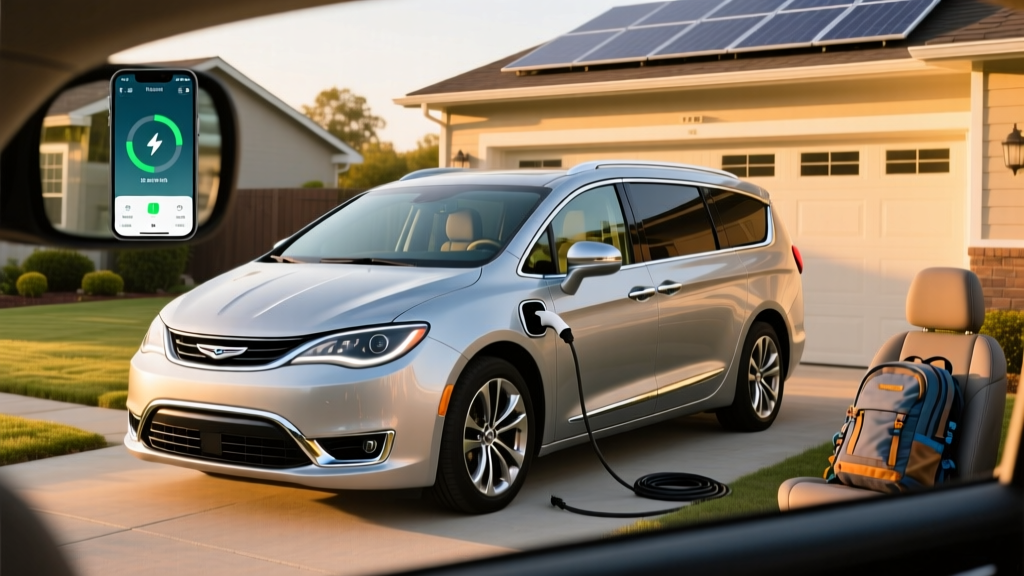
If you need three rows of seating, sliding doors, and a plug-in powertrain, your options narrow to exactly one vehicle: the Chrysler Pacifica Hybrid. As the only plug-in hybrid electric vehicle (PHEV) minivan sold in the United States, the Pacifica Hybrid occupies a unique niche for families who want electric-only school runs but the flexibility of a gas engine for road trips. For 2026, the Pacifica Hybrid carries over its proven powertrain with minor tech and trim updates. Here's every number that matters.
HEV vs. PHEV: What's the Difference in a Minivan?
Conventional Hybrid (HEV)
A standard hybrid like the Toyota Sienna uses a small battery (typically 1–2 kWh) that recharges through regenerative braking and the gas engine. You never plug it in. It delivers strong MPG but zero electric-only driving.
Plug-In Hybrid (PHEV)
The Chrysler Pacifica Hybrid carries a much larger 16 kWh battery you can plug in at home or at a public charger. That battery enables roughly 32 miles of pure electric driving before the gas engine takes over. Once the battery is depleted, it operates like a conventional hybrid.
This distinction matters enormously for minivan buyers. If your daily loop is under 30 miles and you can charge at home, the Pacifica PHEV effectively runs as an EV most days. If you can't plug in, you're carrying 600+ pounds of extra battery weight for nothing — and the non-hybrid Sienna or a gas Pacifica might serve you better.
EPA Fuel Economy and Electric-Only Range
| Metric | Chrysler Pacifica Hybrid (PHEV) | Toyota Sienna (HEV) |
|---|---|---|
| EPA Combined MPG (gas-only) | 30 MPG | 36 MPG |
| EPA City MPG | 29 MPG | 36 MPG |
| EPA Highway MPG | 30 MPG | 36 MPG |
| MPGe (electric + gas combined) | 82 MPGe | N/A |
| Electric-Only Range | 32 miles | 0 miles |
| Total Combined Range | ~430 miles | ~600 miles |
| Fuel Tank Capacity | 16.5 gallons | 14.5 gallons |
Source: fueleconomy.gov
Real-World Range vs. EPA Sticker
EPA electric range: 32 miles. In practice, expect 26–30 miles of electric driving in mild weather with light loads. Highway speeds above 65 mph, full passenger loads, and winter temperatures can cut that to 20–24 miles. The gas engine will kick in under hard acceleration even with battery charge remaining — this is normal PHEV behavior.
EPA gas MPG: 30 combined. Real-world owners report 27–33 MPG in mixed driving. City-heavy routes tend toward the higher end because the hybrid system recovers more energy in stop-and-go traffic. Sustained 75+ mph highway cruising drops efficiency to around 26–28 MPG.
Powertrain, Battery, and Charging Specs
| Specification | Detail |
|---|---|
| Engine | 3.6L Pentastar V6 (Atkinson cycle) |
| Electric Motors | Dual-motor eFlite electrically variable transmission |
| Combined System Output | 260 horsepower |
| Battery Capacity (Usable) | 16 kWh (lithium-ion NMC) |
| Level 1 Charging (120V) | ~14 hours (full charge) |
| Level 2 Charging (240V) | ~2 hours at 7.2 kW |
| DC Fast Charging | Not available |
| Charge Port | J1772 (driver-side front fender) |
| 0–60 mph | ~7.1 seconds |
| Drivetrain | Front-wheel drive only |
The most critical charging detail: the Pacifica Hybrid cannot DC fast charge. There is no CCS or NACS port. Your only charging options are a standard 120V household outlet (Level 1) or a 240V Level 2 home or public charger. Given the small 16 kWh battery, this is less of a limitation than it sounds — a full Level 2 charge in roughly two hours means most owners simply plug in overnight and wake up to a full battery every morning.
On a standard 120V outlet, expect about 5–6 miles of range per hour of charging. That's enough to recover a day's worth of school-drop-off miles if you plug in when you get home, but a Level 2 installation is strongly recommended to unlock the full PHEV experience.
Pricing, Trims, and Tax Credit Eligibility
For 2026, the Chrysler Pacifica Hybrid starts at approximately $51,095 MSRP (including destination) for the base Select trim and climbs to roughly $58,000 for the Pinnacle trim. These prices reflect the premium over the gas-only Pacifica, which starts around $40,000.
Federal §30D Tax Credit: Does the Pacifica PHEV Qualify?
- Vehicle MSRP cap: Must be under $80,000 for vans/SUVs — the Pacifica Hybrid qualifies.
- Buyer income cap: AGI must not exceed $150,000 (single) or $300,000 (joint filers).
- Battery sourcing requirements: Critical minerals and battery components must meet phased-in thresholds that tighten annually. Pacifica Hybrid eligibility has varied by model year as Stellantis adjusts its supply chain.
- Point-of-sale transfer: If eligible, you can transfer the credit to the dealer for an immediate price reduction rather than waiting for tax filing.
- Maximum credit: Up to $7,500, split into $3,750 for critical minerals and $3,750 for battery components. Many PHEVs qualify for only the partial $3,750 due to sourcing rules.
Always verify current eligibility on IRS.gov's qualified vehicle list before purchasing. Rules and eligible models update frequently.
State incentives vary widely. California's CVRP, Colorado's state credit, and various utility rebates can stack on top of federal incentives. Check your state's energy office and local utility for current programs.
Reliability, Battery Warranty, and Replacement Cost
Battery and Hybrid Component Warranty
High-voltage battery: 10 years / 100,000 miles (whichever comes first) in CARB states; 8 years / 100,000 miles in non-CARB states. This warranty covers defects and capacity loss below a defined threshold.
Hybrid components: The electric motors, power inverter, and eFlite transmission carry the same 8–10 year / 100,000-mile coverage depending on state.
Conventional warranty: 3 years / 36,000 miles bumper-to-bumper; 5 years / 60,000 miles powertrain.
The Pacifica Hybrid's battery pack has proven reasonably durable in owner reports. Unlike full EVs with 80+ kWh packs, the Pacifica's 16 kWh battery undergoes shallower charge cycles, which reduces stress. The most commonly reported issues involve the power sliding doors and the infotainment system rather than the hybrid powertrain itself.
If the high-voltage battery does need replacement out of warranty, expect a cost in the range of $7,000 to $10,000 including parts and labor. Third-party remanufactured packs may become available as the earliest Pacifica Hybrids (introduced for the 2017 model year) age out of warranty coverage.
Who Should Buy a PHEV Minivan — and Who Shouldn't?
Choose the Pacifica PHEV If:
- You can install a Level 2 charger at home (garage or driveway with 240V access).
- Your daily driving is mostly under 30 miles — school runs, errands, commuting.
- You take several road trips per year where EV charging infrastructure is sparse.
- You need a minivan specifically — three rows, sliding doors, flat-folding stow-and-go seats.
- You want to reduce fuel consumption without committing to a full EV.
Choose the Toyota Sienna HEV Instead If:
- You cannot charge at home (apartment, no garage, no 240V access).
- You want the highest possible MPG without plugging in (36 vs. 30 combined).
- You need all-wheel drive (Sienna offers AWD; Pacifica Hybrid is FWD only).
- Lower purchase price matters — the Sienna Hybrid starts around $38,000.
Choose a Full EV (e.g., Kia EV9) If:
- You want zero gas-engine maintenance and have reliable home charging.
- Your road trips are planned around DC fast-charging corridors.
- You want access to the full $7,500 federal tax credit (EV9 eligibility varies by sourcing).
- Three rows and ~270+ miles of range meet your needs.
Pacifica Hybrid Pros
- Only PHEV minivan available — no direct competitor
- 32 miles electric covers most daily family driving
- Stow 'n Go second- and third-row seating (unique to Pacifica)
- Smooth, quiet electric-only operation around town
- Strong 260 HP for confident highway merging
Pacifica Hybrid Cons
- No DC fast charging capability
- FWD only — no AWD option unlike Sienna or EV9
- Higher starting price than gas-only and HEV minivans
- Stow 'n Go second row not available on Hybrid (battery occupies under-floor space; captain's chairs only)
- Partial or no federal tax credit depending on current sourcing rules
Frequently Asked Questions
How many MPG does the Pacifica Hybrid get?
The EPA rates the 2026 Chrysler Pacifica Hybrid at 30 MPG combined (29 city / 30 highway) when operating as a hybrid after the battery is depleted. When factoring in electric-only driving, it achieves 82 MPGe. Real-world results range from 27–33 MPG depending on driving style and conditions.
How far can the Pacifica PHEV go on electric only?
The EPA-rated electric-only range is 32 miles. In real-world driving, expect 26–30 miles in mild weather and 20–24 miles in cold conditions or at sustained highway speeds. The gas engine may engage under hard throttle even with battery charge remaining.
Can I charge the Pacifica Hybrid at a DC fast charger?
No. The Pacifica Hybrid only supports Level 1 (120V) and Level 2 (240V) AC charging via a J1772 connector. A full Level 2 charge takes about 2 hours. DC fast charging is not available on any current PHEV minivan.
Does the Pacifica Hybrid qualify for the federal tax credit?
Eligibility under IRS §30D depends on current battery-sourcing and critical-mineral requirements, which change periodically. The Pacifica Hybrid's MSRP falls under the $80,000 van cap, and income limits apply ($300,000 joint / $150,000 single). Check the IRS qualified vehicles list for the most current status before purchasing.
Is the Pacifica Hybrid reliable?
The hybrid powertrain itself has proven durable, with the high-voltage battery covered by an 8–10 year / 100,000-mile warranty depending on your state. Owner-reported issues tend to center on non-powertrain items like power doors and infotainment. The 3.6L Pentastar V6 is one of Stellantis's most widely deployed engines with a long track record.
What does a replacement hybrid battery cost?
Out-of-warranty high-voltage battery replacement runs approximately $7,000–$10,000 at a dealership. As the Pacifica Hybrid platform ages (first introduced in 2017), aftermarket and remanufactured battery options may reduce this cost over time.
Hybrid vs. PHEV vs. EV — which minivan is right for me?
If you can charge at home and drive under 30 miles daily, the PHEV gives you EV-like daily driving with gas-engine backup. If you can't charge at home, the Toyota Sienna HEV delivers better MPG (36 combined) with no plug required. If you want zero emissions and have charging access, a three-row EV like the Kia EV9 offers 270+ miles of range — but at a significantly higher price.